
Implementation of the FCP role from a National

- Slides: 22
Implementation of the FCP role from a National Perspective Sarah Withers Head of FCP Implementation @CSP_FCP #First. Contact. Physio
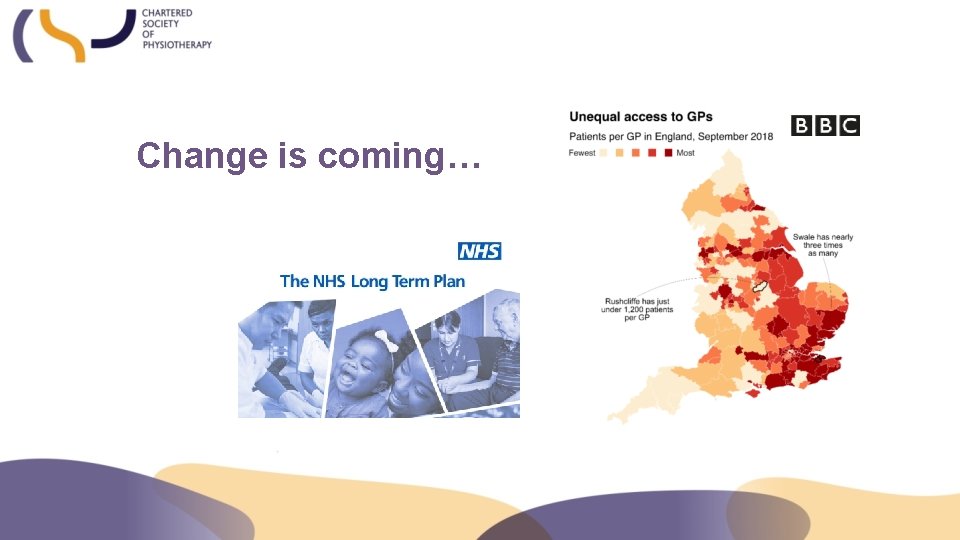
Change is coming…
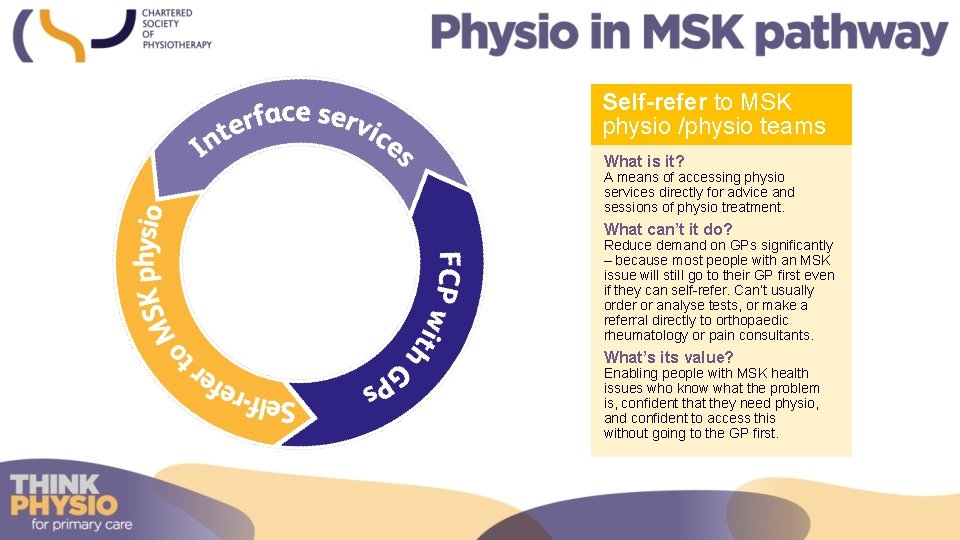
Self-refer to MSK physio /physio teams What is it? A means of accessing physio services directly for advice and sessions of physio treatment. What can’t it do? Reduce demand on GPs significantly – because most people with an MSK issue will still go to their GP first even if they can self-refer. Can’t usually order or analyse tests, or make a referral directly to orthopaedic rheumatology or pain consultants. What’s its value? Enabling people with MSK health issues who know what the problem is, confident that they need physio, and confident to access this without going to the GP first.
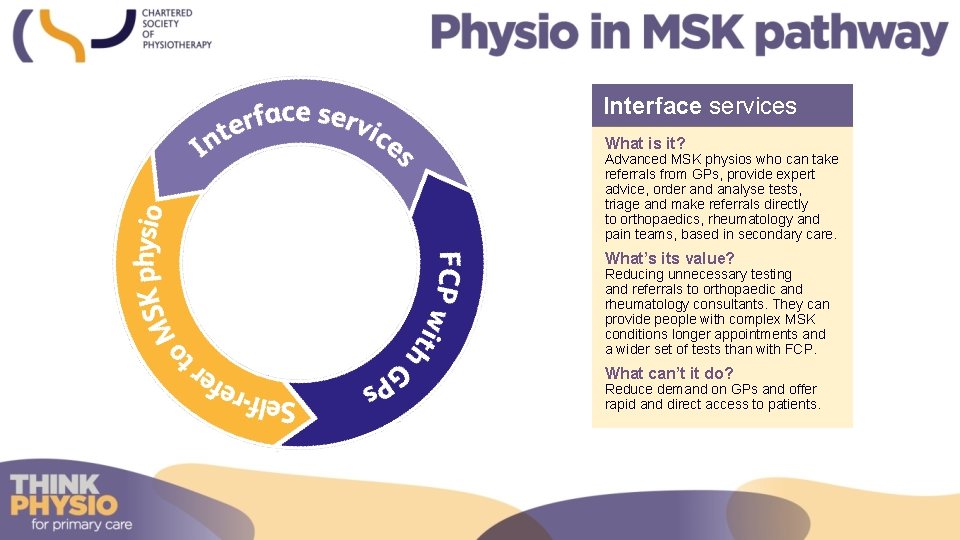
Interface services What is it? Advanced MSK physios who can take referrals from GPs, provide expert advice, order and analyse tests, triage and make referrals directly to orthopaedics, rheumatology and pain teams, based in secondary care. What’s its value? Reducing unnecessary testing and referrals to orthopaedic and rheumatology consultants. They can provide people with complex MSK conditions longer appointments and a wider set of tests than with FCP. What can’t it do? Reduce demand on GPs and offer rapid and direct access to patients.
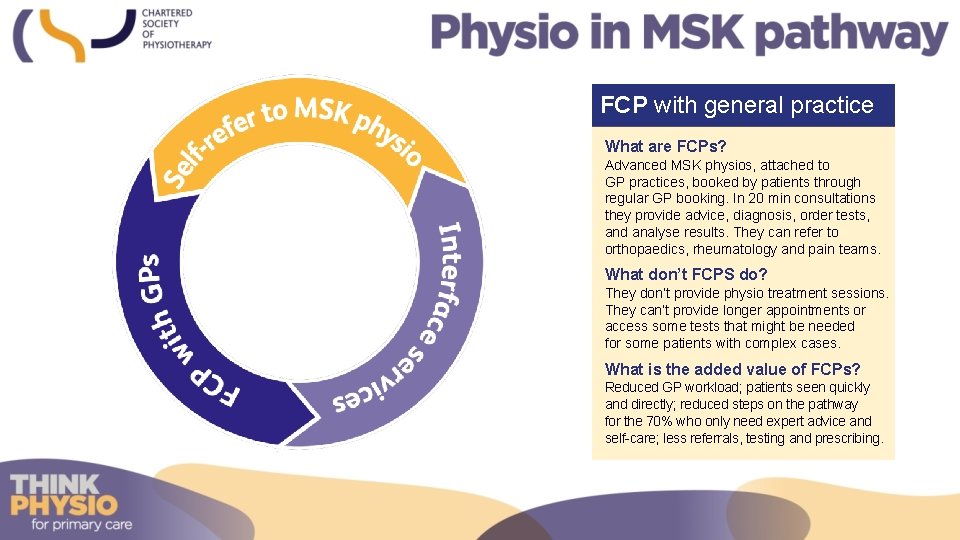
FCP with general practice What are FCPs? Advanced MSK physios, attached to GP practices, booked by patients through regular GP booking. In 20 min consultations they provide advice, diagnosis, order tests, and analyse results. They can refer to orthopaedics, rheumatology and pain teams. What don’t FCPS do? They don’t provide physio treatment sessions. They can’t provide longer appointments or access some tests that might be needed for some patients with complex cases. What is the added value of FCPs? Reduced GP workload; patients seen quickly and directly; reduced steps on the pathway for the 70% who only need expert advice and self-care; less referrals, testing and prescribing.
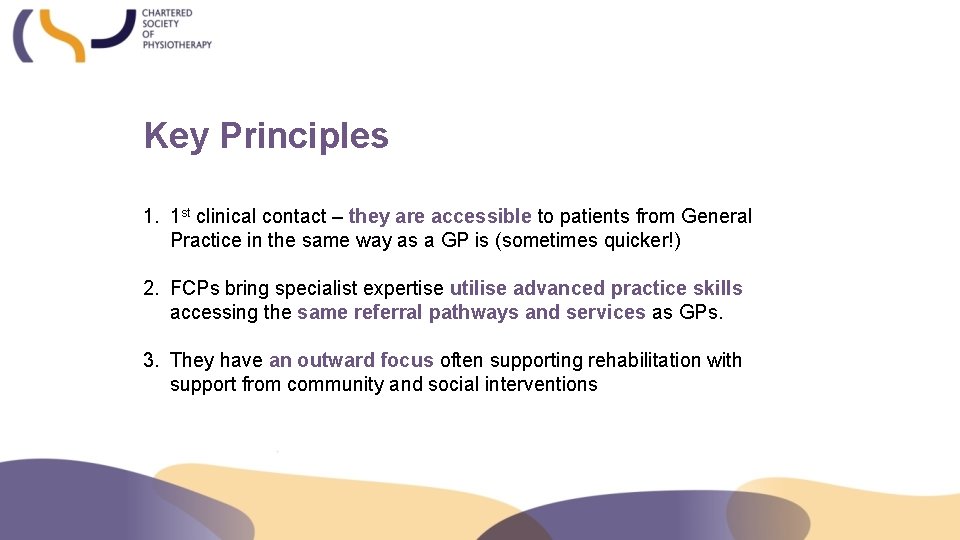
Key Principles 1. 1 st clinical contact – they are accessible to patients from General Practice in the same way as a GP is (sometimes quicker!) 2. FCPs bring specialist expertise utilise advanced practice skills accessing the same referral pathways and services as GPs. 3. They have an outward focus often supporting rehabilitation with support from community and social interventions
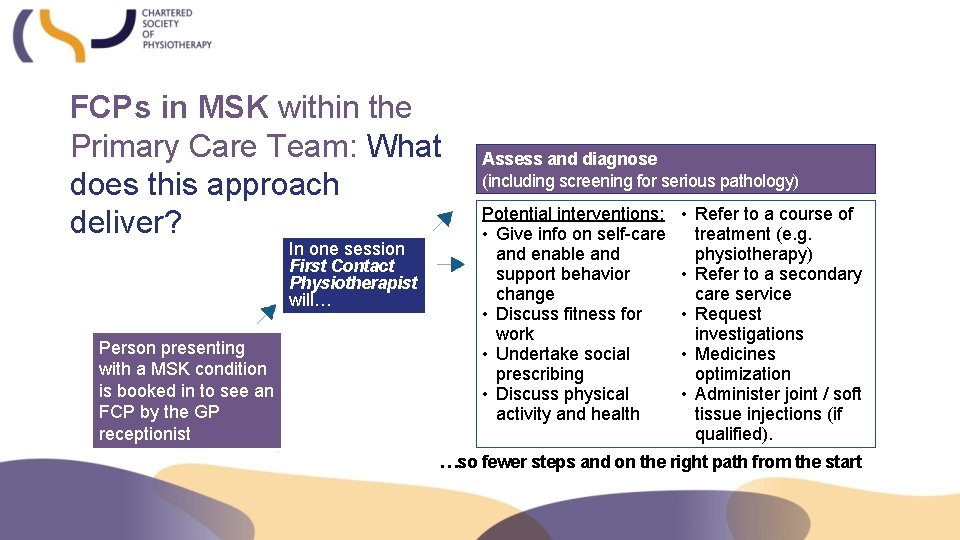
FCPs in MSK within the Primary Care Team: What does this approach deliver? In one session First Contact Physiotherapist will… Person presenting with a MSK condition is booked in to see an FCP by the GP receptionist Assess and diagnose (including screening for serious pathology) Potential interventions: • Give info on self-care and enable and support behavior change • Discuss fitness for work • Undertake social prescribing • Discuss physical activity and health • Refer to a course of treatment (e. g. physiotherapy) • Refer to a secondary care service • Request investigations • Medicines optimization • Administer joint / soft tissue injections (if qualified). …so fewer steps and on the right path from the start
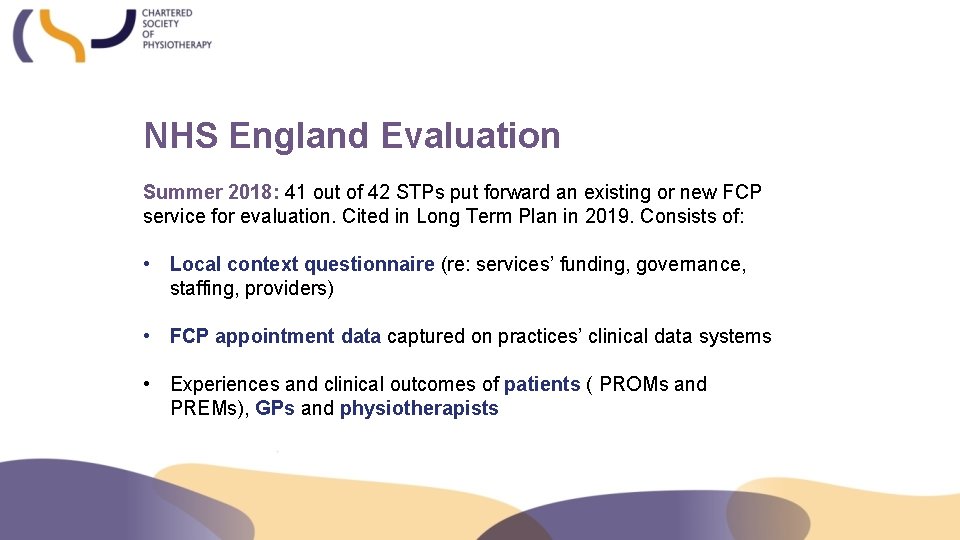
NHS England Evaluation Summer 2018: 41 out of 42 STPs put forward an existing or new FCP service for evaluation. Cited in Long Term Plan in 2019. Consists of: • Local context questionnaire (re: services’ funding, governance, staffing, providers) • FCP appointment data captured on practices’ clinical data systems • Experiences and clinical outcomes of patients ( PROMs and PREMs), GPs and physiotherapists
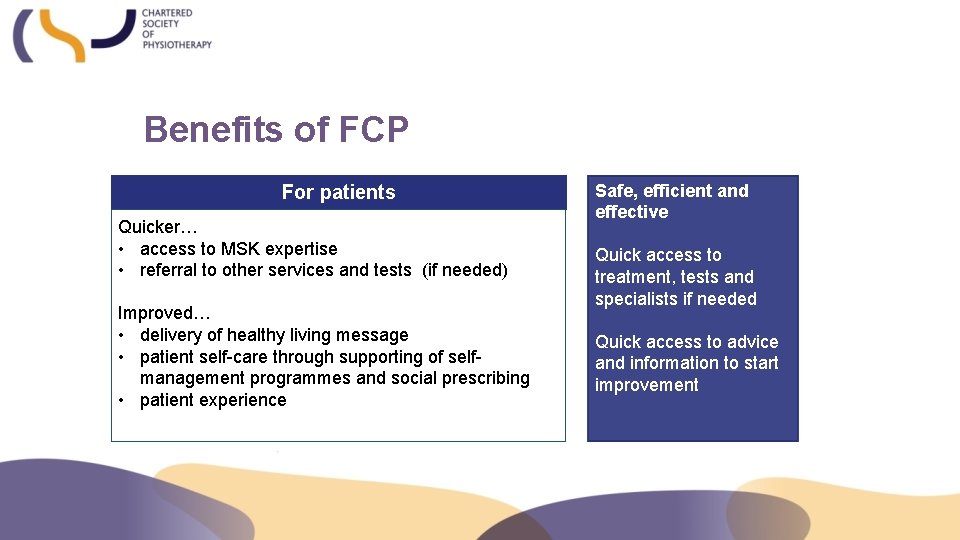
Benefits of FCP For patients Quicker… • access to MSK expertise • referral to other services and tests (if needed) Improved… • delivery of healthy living message • patient self-care through supporting of selfmanagement programmes and social prescribing • patient experience Safe, efficient and effective Quick access to treatment, tests and specialists if needed Quick access to advice and information to start improvement
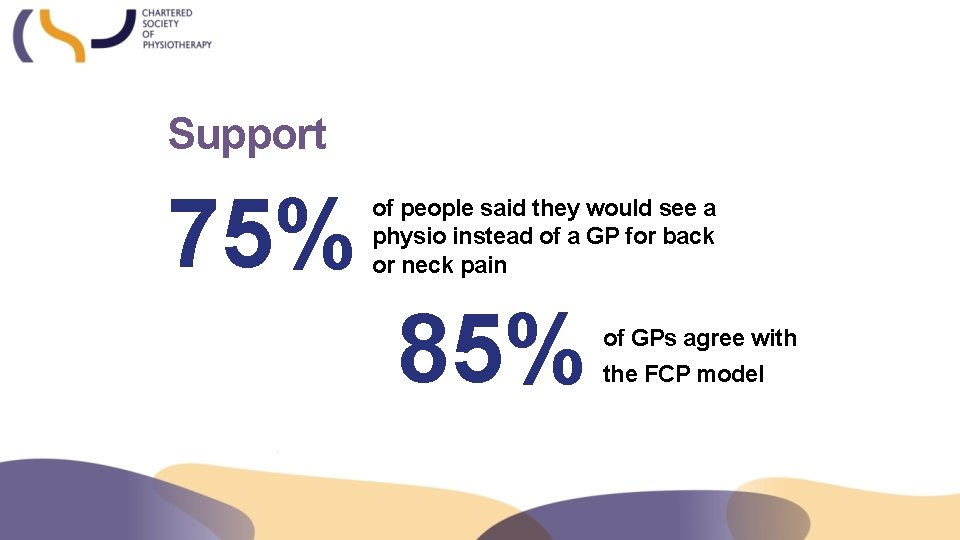
Support 75% of people said they would see a physio instead of a GP for back or neck pain 85% of GPs agree with the FCP model
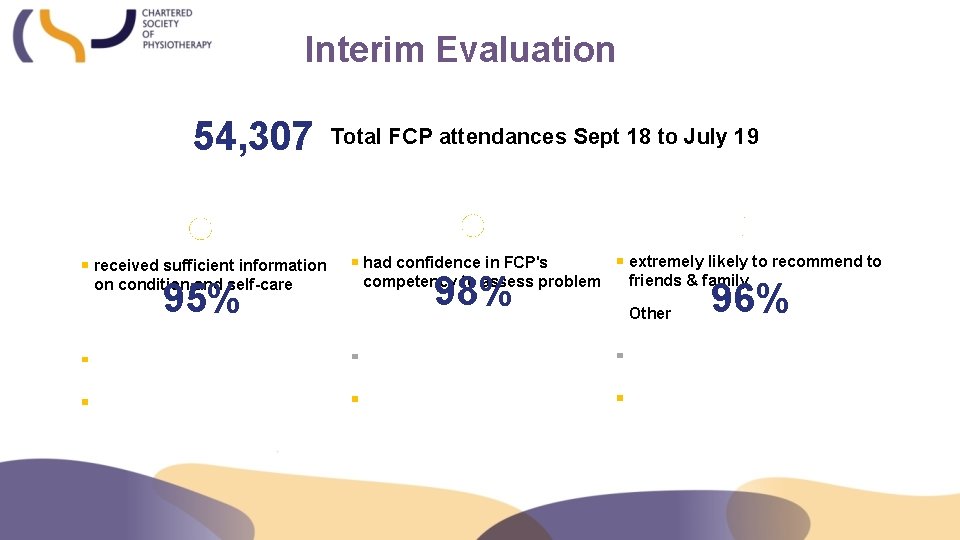
Interim Evaluation 54, 307 received sufficient information on condition and self-care 95% Total FCP attendances Sept 18 to July 19 had confidence in FCP's competency to assess problem 98% extremely likely to recommend to friends & family Other 96%
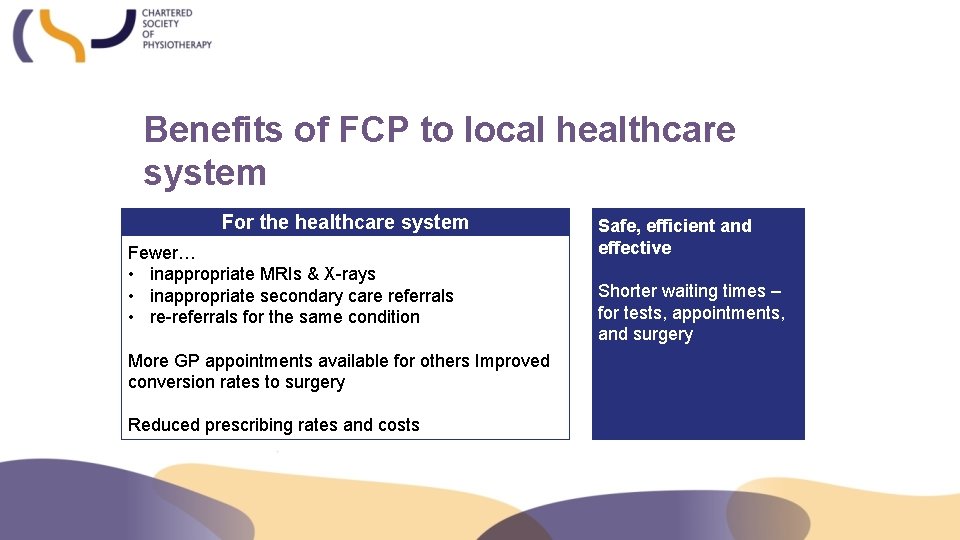
Benefits of FCP to local healthcare system For the healthcare system Fewer… • inappropriate MRIs & X-rays • inappropriate secondary care referrals • re-referrals for the same condition More GP appointments available for others Improved conversion rates to surgery Reduced prescribing rates and costs Safe, efficient and effective Shorter waiting times – for tests, appointments, and surgery
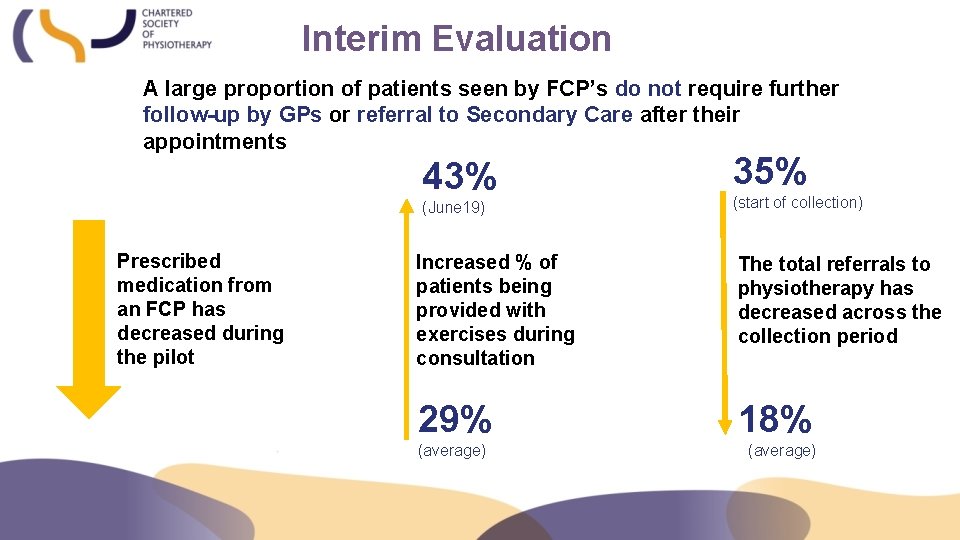
Interim Evaluation A large proportion of patients seen by FCP’s do not require further follow-up by GPs or referral to Secondary Care after their appointments 43% (June 19) Prescribed medication from an FCP has decreased during the pilot 35% (start of collection) Increased % of patients being provided with exercises during consultation The total referrals to physiotherapy has decreased across the collection period 29% 18% (average)
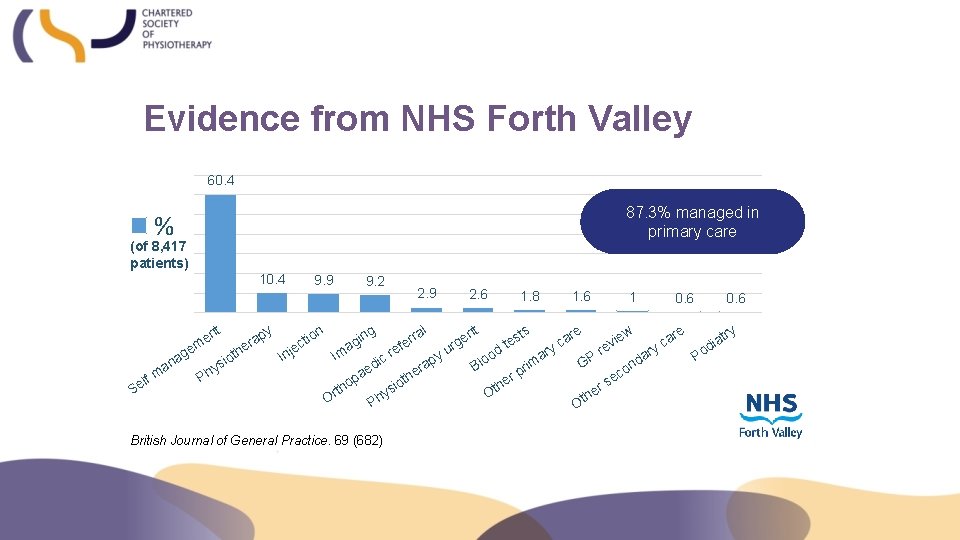
Evidence from NHS Forth Valley 60. 4 87. 3% managed in primary care % (of 8, 417 patients) 10. 4 n me e g na a m f l e S p ra he t sio y Ph y t 9. 9 9. 2 2. 9 2. 6 1. 8 1. 6 1 0. 6 l e e nt try ng on ra sts i i e r ar ar iew t a e i g c c g v e c t f r a e od ry ry re re od Im a a y u P Inj P c o i d p l G im d B ra on pr e c ae r h e p t r s the sio tho e r y O h O Ph Ot British Journal of General Practice. 69 (682)
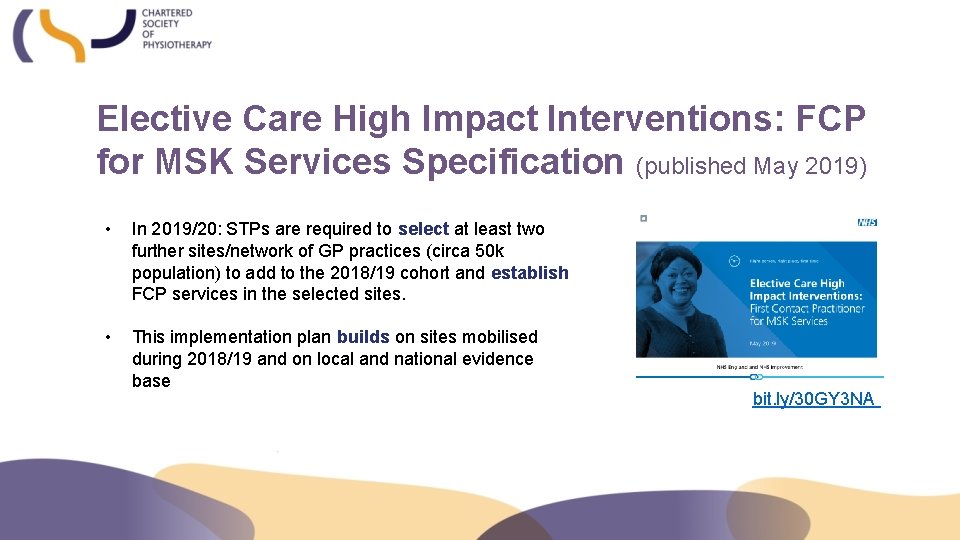
Elective Care High Impact Interventions: FCP for MSK Services Specification (published May 2019) • In 2019/20: STPs are required to select at least two further sites/network of GP practices (circa 50 k population) to add to the 2018/19 cohort and establish FCP services in the selected sites. • This implementation plan builds on sites mobilised during 2018/19 and on local and national evidence base bit. ly/30 GY 3 NA
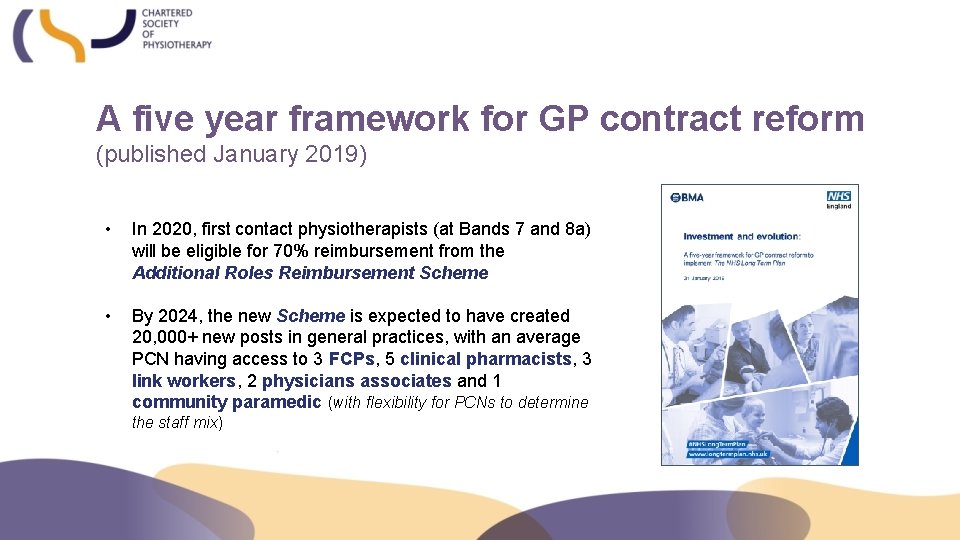
A five year framework for GP contract reform (published January 2019) • In 2020, first contact physiotherapists (at Bands 7 and 8 a) will be eligible for 70% reimbursement from the Additional Roles Reimbursement Scheme • By 2024, the new Scheme is expected to have created 20, 000+ new posts in general practices, with an average PCN having access to 3 FCPs, 5 clinical pharmacists, 3 link workers, 2 physicians associates and 1 community paramedic (with flexibility for PCNs to determine the staff mix)
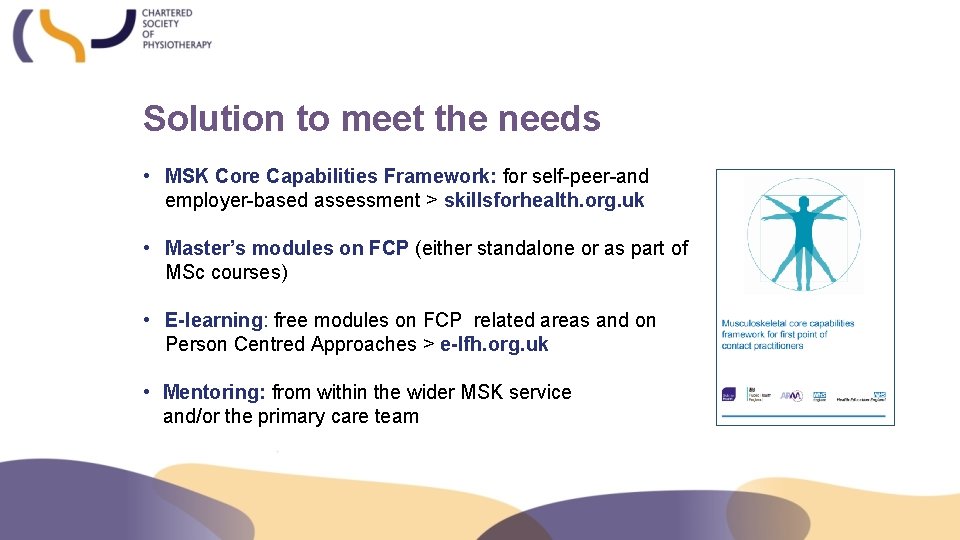
Solution to meet the needs • MSK Core Capabilities Framework: for self-peer-and employer-based assessment > skillsforhealth. org. uk • Master’s modules on FCP (either standalone or as part of MSc courses) • E-learning: free modules on FCP related areas and on Person Centred Approaches > e-lfh. org. uk • Mentoring: from within the wider MSK service and/or the primary care team
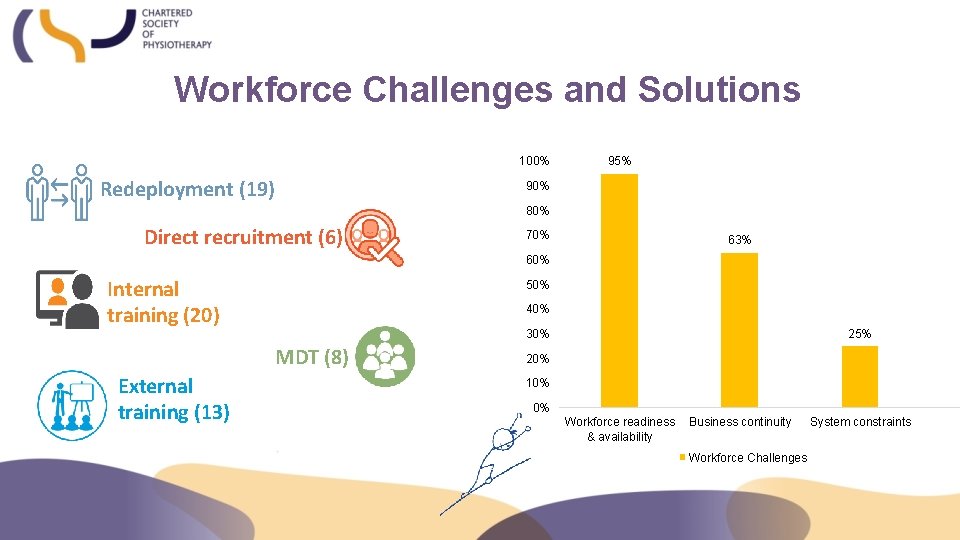
Workforce Challenges and Solutions 100% Redeployment (19) 95% 90% 80% Direct recruitment (6) 70% 63% 60% Internal training (20) 50% 40% MDT (8) External training (13) 25% 30% 20% 10% 0% Workforce readiness Business continuity & availability Workforce Challenges System constraints
Patient and Public Engagement • Meeting with patient participation groups and returning! • Questionnaires to patient groups • Using information in developing a preferred model across the county • Involving patient ambassadors or patient governors
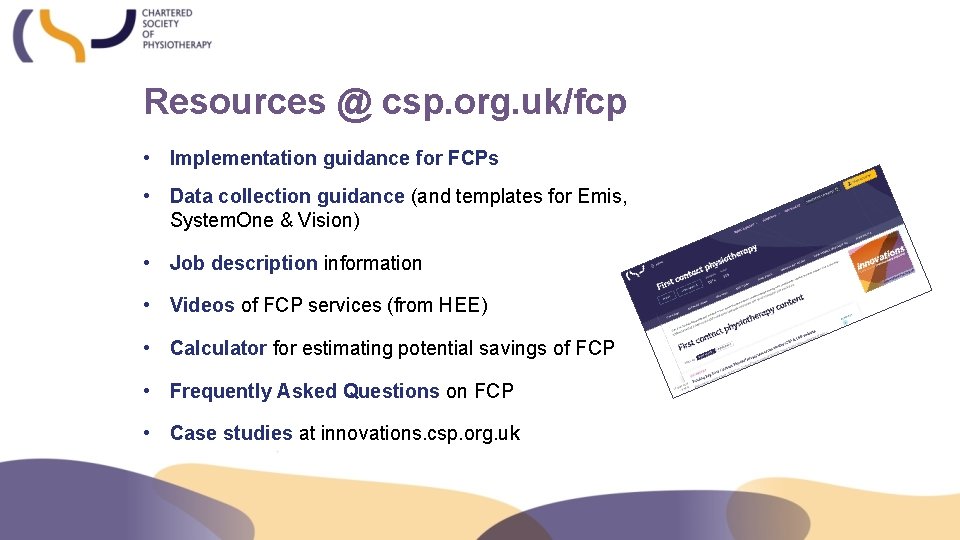
Resources @ csp. org. uk/fcp • Implementation guidance for FCPs • Data collection guidance (and templates for Emis, System. One & Vision) • Job description information • Videos of FCP services (from HEE) • Calculator for estimating potential savings of FCP • Frequently Asked Questions on FCP • Case studies at innovations. csp. org. uk
The CSP’s Priorities on FCP • Supporting FCP implementation • Developing workforce • Leading on evaluation (at national and local levels) • Working with Higher Education Institutes on workforce development • Providing resources • Enabling peer support • Informing and influencing public policy
@CSP_FCP #First. Contact. Physio