
Implementation of Pipeline Integrity Management System PIMS for

- Slides: 10
Implementation of Pipeline Integrity Management System (PIMS) for PETRONAS’ Upstream & Downstream Pipelines December 29, 2021
CONTENTS 1 OBJECTIVE 2 BACKGROUND 3 PETRONAS’ PIMS 4 CONCLUSIONS FUELING THE FUTURE 2
OBJECTIVE To present to IGU’s Tra. Com and TSG_3 members on Pipeline Integrity Management System (PIMS) implementation within PETRONAS Group for its upstream and downstream pipelines. FUELING THE FUTURE 3
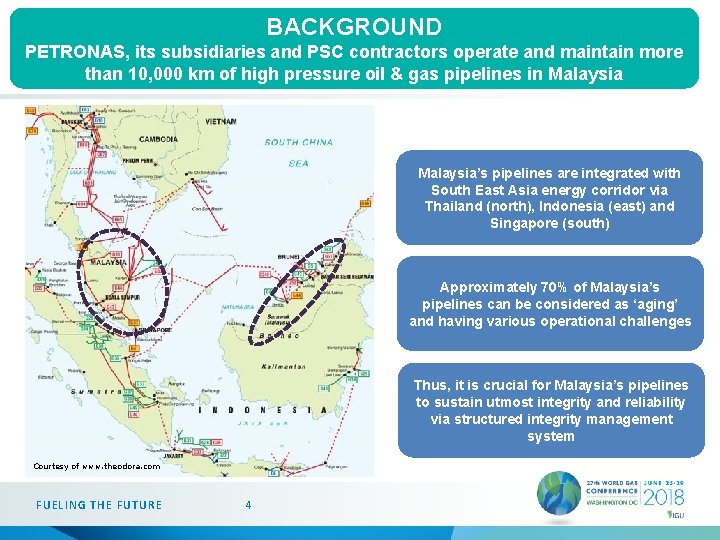
BACKGROUND PETRONAS, its subsidiaries and PSC contractors operate and maintain more than 10, 000 km of high pressure oil & gas pipelines in Malaysia’s pipelines are integrated with South East Asia energy corridor via Thailand (north), Indonesia (east) and Singapore (south) Approximately 70% of Malaysia’s pipelines can be considered as ‘aging’ and having various operational challenges Thus, it is crucial for Malaysia’s pipelines to sustain utmost integrity and reliability via structured integrity management system Courtesy of www. theodora. com FUELING THE FUTURE 4
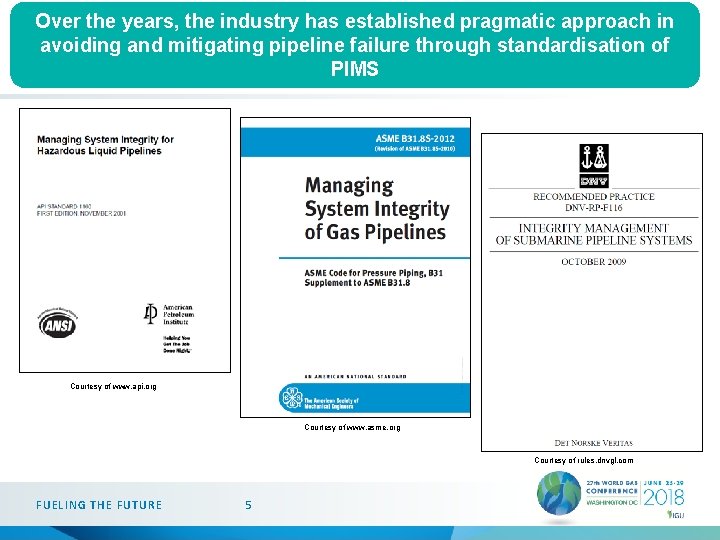
Over the years, the industry has established pragmatic approach in avoiding and mitigating pipeline failure through standardisation of PIMS Courtesy of www. api. org Courtesy of www. asme. org Courtesy of rules. dnvgl. com FUELING THE FUTURE 5
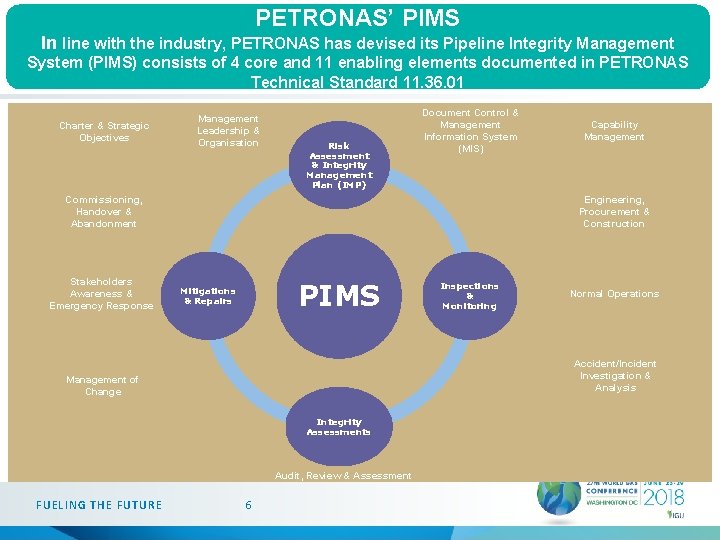
PETRONAS’ PIMS In line with the industry, PETRONAS has devised its Pipeline Integrity Management System (PIMS) consists of 4 core and 11 enabling elements documented in PETRONAS Technical Standard 11. 36. 01 Charter & Strategic Objectives Management Leadership & Organisation Risk Assessment & Integrity Management Plan (IMP) Document Control & Management Information System (MIS) Commissioning, Handover & Abandonment Stakeholders Awareness & Emergency Response Engineering, Procurement & Construction PIMS Mitigations & Repairs Inspections & Monitoring Normal Operations Accident/Incident Investigation & Analysis Management of Change Integrity Assessments Audit, Review & Assessment FUELING THE FUTURE Capability Management 6
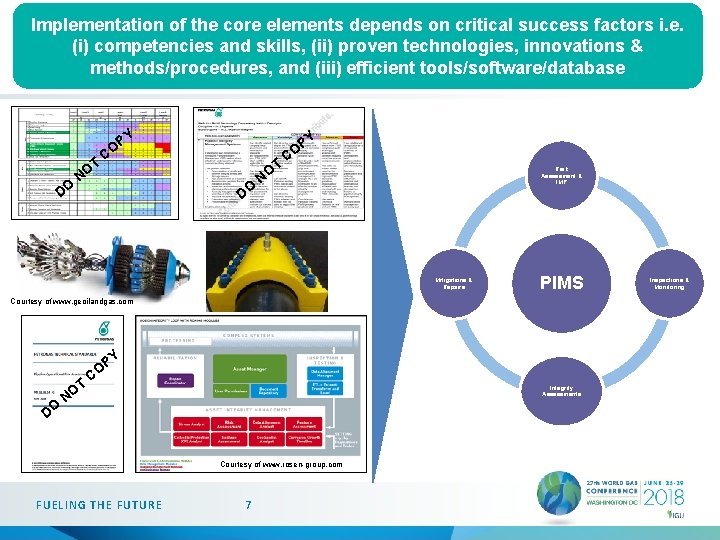
Implementation of the core elements depends on critical success factors i. e. (i) competencies and skills, (ii) proven technologies, innovations & methods/procedures, and (iii) efficient tools/software/database Y DO T NO Y P O C T DO NO P CO Risk Assessment & IMP Mitigations & Repairs PIMS Courtesy of www. geoilandgas. com Y T DO NO P CO Integrity Assessments Courtesy of www. rosen-group. com Audit, Review & Assessment FUELING THE FUTURE 7 Inspections & Monitoring
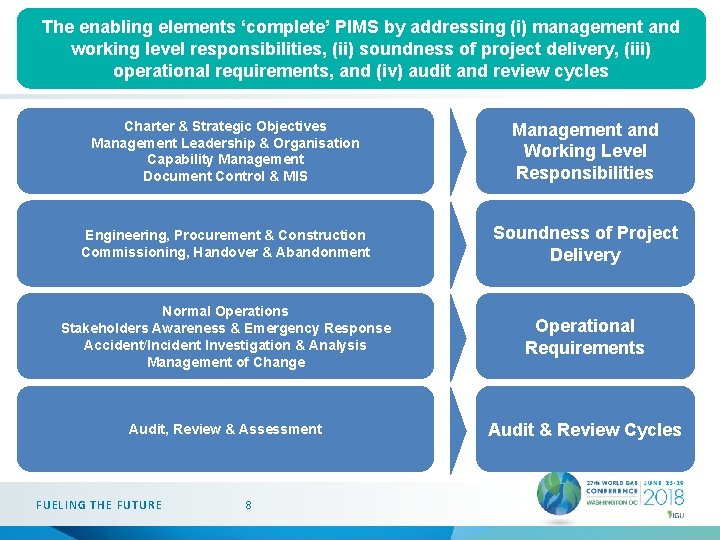
The enabling elements ‘complete’ PIMS by addressing (i) management and working level responsibilities, (ii) soundness of project delivery, (iii) operational requirements, and (iv) audit and review cycles Charter & Strategic Objectives Management Leadership & Organisation Capability Management Document Control & MIS Management and Working Level Responsibilities Engineering, Procurement & Construction Commissioning, Handover & Abandonment Soundness of Project Delivery Normal Operations Stakeholders Awareness & Emergency Response Accident/Incident Investigation & Analysis Management of Change Operational Requirements Audit, Review & Assessment Audit & Review Cycles FUELING THE FUTURE 8
CONCLUSIONS • The O&G industry has matured in managing integrity of pipeline system through inception of various codes and standards i. e. ASME, API and DNV. • In tandem with the industry, PETRONAS establishes its own PIMS benchmarked against industry’s codes and standards; and best practices. • PETRONAS’ PIMS addresses pipeline integrity management core elements; and adopts typical requirements of a ‘management system’ through the enabling elements. • With PIMS in place, the integrity of PETRONAS’ pipelines are further strengthened; and the implementation effectiveness lies upon the ‘operational discipline’ of all stakeholders. FUELING THE FUTURE 9
Thank you FUELING THE FUTURE 10