
Implementation of OO Languages Efficient use of instructions
- Slides: 9
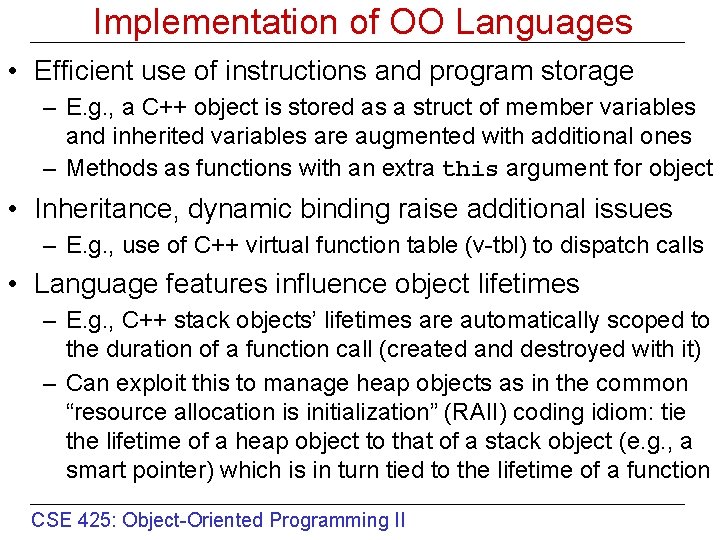
Implementation of OO Languages • Efficient use of instructions and program storage – E. g. , a C++ object is stored as a struct of member variables and inherited variables are augmented with additional ones – Methods as functions with an extra this argument for object • Inheritance, dynamic binding raise additional issues – E. g. , use of C++ virtual function table (v-tbl) to dispatch calls • Language features influence object lifetimes – E. g. , C++ stack objects’ lifetimes are automatically scoped to the duration of a function call (created and destroyed with it) – Can exploit this to manage heap objects as in the common “resource allocation is initialization” (RAII) coding idiom: tie the lifetime of a heap object to that of a stack object (e. g. , a smart pointer) which is in turn tied to the lifetime of a function CSE 425: Object-Oriented Programming II
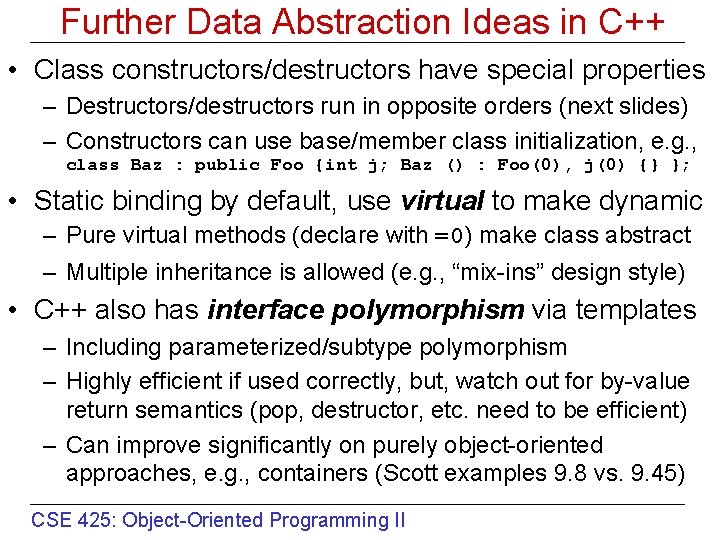
Further Data Abstraction Ideas in C++ • Class constructors/destructors have special properties – Destructors/destructors run in opposite orders (next slides) – Constructors can use base/member class initialization, e. g. , class Baz : public Foo {int j; Baz () : Foo(0), j(0) {} }; • Static binding by default, use virtual to make dynamic – Pure virtual methods (declare with =0) make class abstract – Multiple inheritance is allowed (e. g. , “mix-ins” design style) • C++ also has interface polymorphism via templates – Including parameterized/subtype polymorphism – Highly efficient if used correctly, but, watch out for by-value return semantics (pop, destructor, etc. need to be efficient) – Can improve significantly on purely object-oriented approaches, e. g. , containers (Scott examples 9. 8 vs. 9. 45) CSE 425: Object-Oriented Programming II
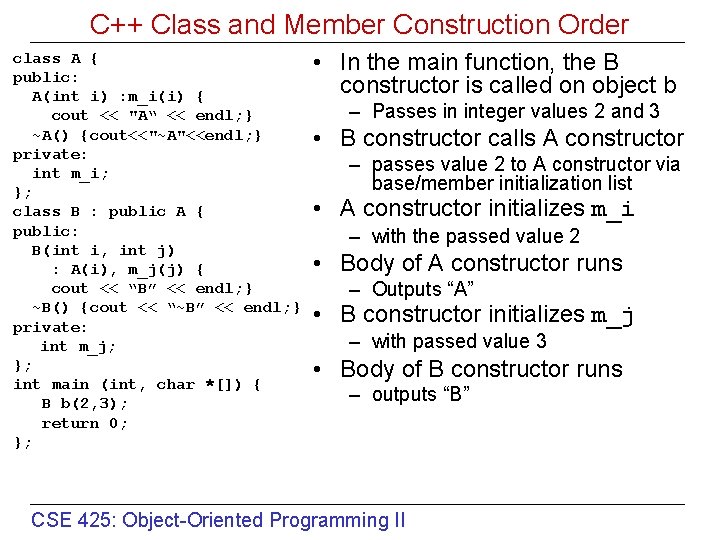
C++ Class and Member Construction Order class A { public: A(int i) : m_i(i) { cout << "A“ << endl; } ~A() {cout<<"~A"<<endl; } private: int m_i; }; class B : public A { public: B(int i, int j) : A(i), m_j(j) { cout << “B” << endl; } ~B() {cout << “~B” << endl; } private: int m_j; }; int main (int, char *[]) { B b(2, 3); return 0; }; • In the main function, the B constructor is called on object b – Passes in integer values 2 and 3 • B constructor calls A constructor – passes value 2 to A constructor via base/member initialization list • A constructor initializes m_i – with the passed value 2 • Body of A constructor runs – Outputs “A” • B constructor initializes m_j – with passed value 3 • Body of B constructor runs – outputs “B” CSE 425: Object-Oriented Programming II
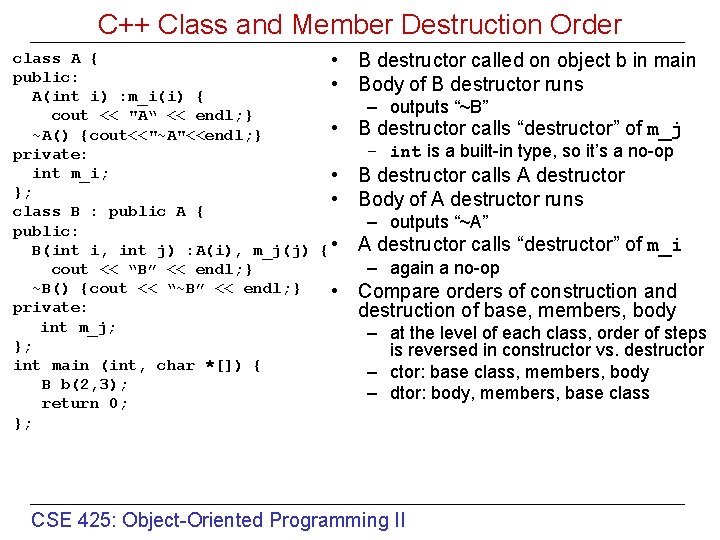
C++ Class and Member Destruction Order class A { • public: • A(int i) : m_i(i) { cout << "A“ << endl; } • ~A() {cout<<"~A"<<endl; } private: int m_i; • }; • class B : public A { public: B(int i, int j) : A(i), m_j(j) { • cout << “B” << endl; } ~B() {cout << “~B” << endl; } • private: int m_j; }; int main (int, char *[]) { B b(2, 3); return 0; }; B destructor called on object b in main Body of B destructor runs – outputs “~B” B destructor calls “destructor” of m_j – int is a built-in type, so it’s a no-op B destructor calls A destructor Body of A destructor runs – outputs “~A” A destructor calls “destructor” of m_i – again a no-op Compare orders of construction and destruction of base, members, body – at the level of each class, order of steps is reversed in constructor vs. destructor – ctor: base class, members, body – dtor: body, members, base class CSE 425: Object-Oriented Programming II
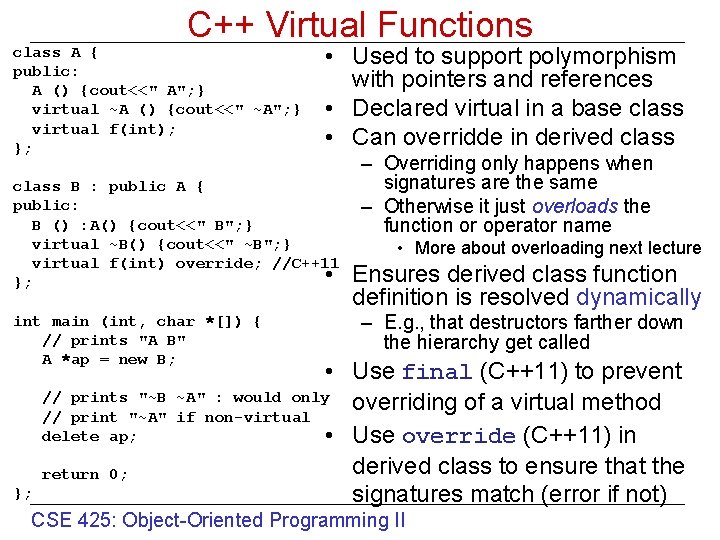
C++ Virtual Functions class A { public: A () {cout<<" A"; } virtual ~A () {cout<<" ~A"; } virtual f(int); }; • Used to support polymorphism with pointers and references • Declared virtual in a base class • Can overridde in derived class B : public A { public: B () : A() {cout<<" B"; } virtual ~B() {cout<<" ~B"; } virtual f(int) override; //C++11 • }; int main (int, char *[]) { // prints "A B" A *ap = new B; // prints "~B // print "~A" delete ap; return 0; }; – Overriding only happens when signatures are the same – Otherwise it just overloads the function or operator name • More about overloading next lecture Ensures derived class function definition is resolved dynamically – E. g. , that destructors farther down the hierarchy get called • Use final (C++11) to prevent ~A" : would only overriding of a virtual method if non-virtual • Use override (C++11) in derived class to ensure that the signatures match (error if not) CSE 425: Object-Oriented Programming II
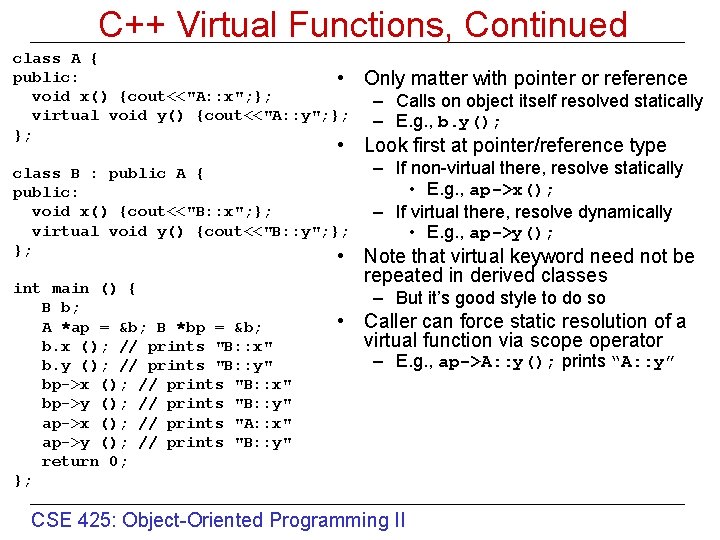
C++ Virtual Functions, Continued class A { public: • void x() {cout<<"A: : x"; }; virtual void y() {cout<<"A: : y"; }; }; Only matter with pointer or reference – Calls on object itself resolved statically – E. g. , b. y(); • Look first at pointer/reference type class B : public A { public: void x() {cout<<"B: : x"; }; virtual void y() {cout<<"B: : y"; }; }; • int main () { B b; A *ap = &b; B *bp = &b; b. x (); // prints "B: : x" b. y (); // prints "B: : y" bp->x (); // prints "B: : x" bp->y (); // prints "B: : y" ap->x (); // prints "A: : x" ap->y (); // prints "B: : y" return 0; }; – If non-virtual there, resolve statically • E. g. , ap->x(); – If virtual there, resolve dynamically • E. g. , ap->y(); Note that virtual keyword need not be repeated in derived classes – But it’s good style to do so • Caller can force static resolution of a virtual function via scope operator – E. g. , ap->A: : y(); prints “A: : y” CSE 425: Object-Oriented Programming II
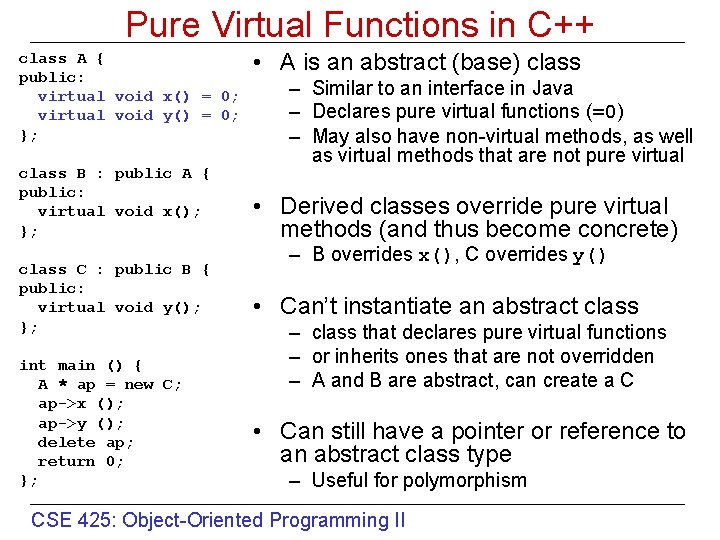
Pure Virtual Functions in C++ class A { public: virtual void x() = 0; virtual void y() = 0; }; class B : public A { public: virtual void x(); }; class C : public B { public: virtual void y(); }; int main () { A * ap = new C; ap->x (); ap->y (); delete ap; return 0; }; • A is an abstract (base) class – Similar to an interface in Java – Declares pure virtual functions (=0) – May also have non-virtual methods, as well as virtual methods that are not pure virtual • Derived classes override pure virtual methods (and thus become concrete) – B overrides x(), C overrides y() • Can’t instantiate an abstract class – class that declares pure virtual functions – or inherits ones that are not overridden – A and B are abstract, can create a C • Can still have a pointer or reference to an abstract class type – Useful for polymorphism CSE 425: Object-Oriented Programming II
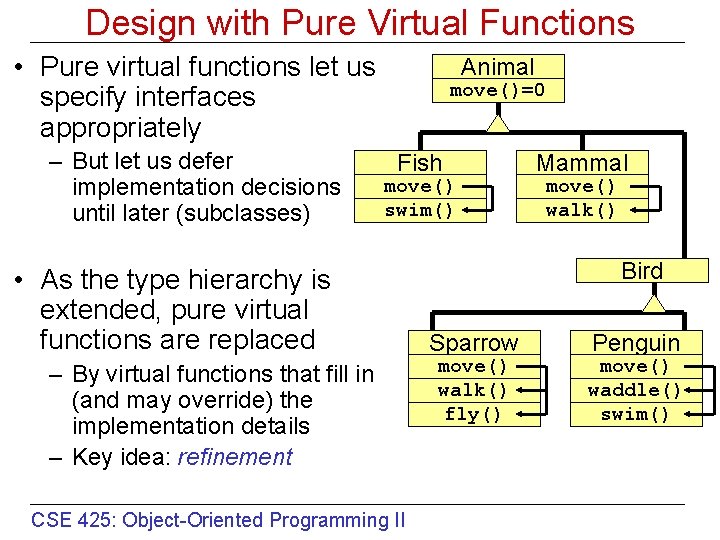
Design with Pure Virtual Functions • Pure virtual functions let us specify interfaces appropriately – But let us defer implementation decisions until later (subclasses) Animal move()=0 Fish move() swim() • As the type hierarchy is extended, pure virtual functions are replaced – By virtual functions that fill in (and may override) the implementation details – Key idea: refinement CSE 425: Object-Oriented Programming II Mammal move() walk() Bird Sparrow move() walk() fly() Penguin move() waddle() swim()
Today’s Studio Exercises • We’ll keep working with classes (for logic programming applications) – Developing clauses, checking for type compatibility • Today’s exercises are again all in C++ – Please re-use your code from the previous studio session – As always, please ask us for help as needed • When done, send e-mail with “Object-Oriented Programming Studio II” in the subject line, to cse 425@seas. wustl. edu CSE 425: Object-Oriented Programming II