
Implementation of Incremental Sampling Methodology ISM Hugh Rieck



- Slides: 28
Implementation of Incremental Sampling Methodology (ISM) Hugh Rieck US Army Corps of Engineers Environmental & Munitions Center of Expertise hugh. j. rieck@usace. army. mil 402 -697 -2660 ITRC ISM Team Meeting March 22, 2019 1
Presentation Overview • General background and history • Stumbling blocks to correct implementation • Important Concepts and Characteristics of Incremental Sampling 2
Incremental Sampling • Pierre Gy’s Sampling Theory – "Incremental Sampling" or "Sampling by Increments" is the term used by Pierre Gy to describe his method for obtaining representative samples from heterogeneous media composed of discrete particles. – Gy, P. , 1954, Erreur Commise dans le Prelevement d’un Echantillon sur un Lot de Minerai’ (Error made when sampling a mineral lot), Congres des laveries des mines metalliques français, Paris, 1953, Rev. Ind. Minerale, St-Etienne, 36, 311 -45 (1954) • Refined / finalized theory in 1988 – Gy, P. , 1988, Heterogeneity, Echantillonage, Homogeneisation. Ensemble Coherent de Theories (Heterogeneity, Sampling, Homogenisation. Their Logical Integration), Masson, Paris (1988). 3
Incremental Sampling • More Accessible references: Gy, P. , 1992, Sampling of Heterogeneous and Dynamic Material Systems. Theories of Heterogeneity, Sampling, and Homogenising, Elsevier, Amsterdam. Gy, Pierre, 1998, Sampling for Analytical Purposes, John Wiley & Sons, West Sussex, England, 153 p. ISBN 0 471 97956 2, [L’Echantillonage des lots de matiere en vue de leur analyse, Masson, Paris, 1996]. Pitard, Francis F. , 1993, Pierre Gy’s sampling theory and sampling practice: Heterogeneity, sampling correctness, and statistical process control, 2 nd Edition, Baton Rouge, LA: CRC Press, ISBN 0 -8493 -8917 -8. USACE CRREL studies (Tom Jenkins, Alan Hewitt and others) EDQW Guidance: Guide for Implementing EPA SW-846 Method 8330 B, 07 -Jul -2008 4
Gy’s Examination • All soils are heterogeneous – Short-range heterogeneity (compositional) – Long-range heterogeneity (distributional) • Sampling error is at least 10 times analytical error • How can we obtain a representative sample? 5
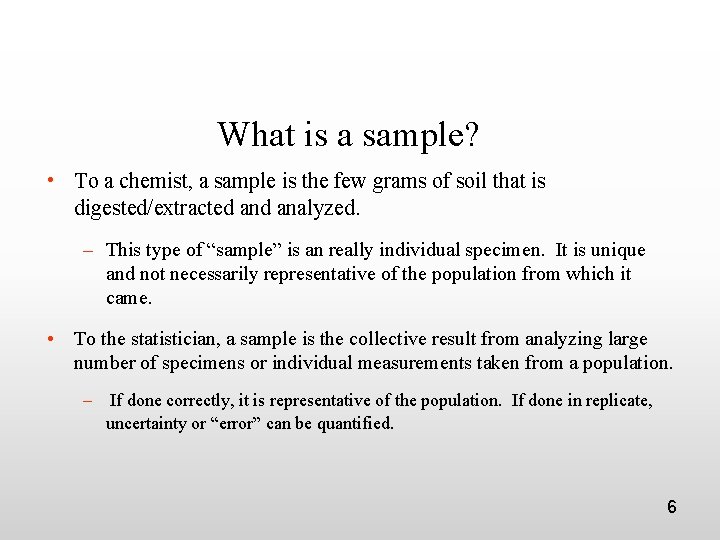
What is a sample? • To a chemist, a sample is the few grams of soil that is digested/extracted analyzed. – This type of “sample” is an really individual specimen. It is unique and not necessarily representative of the population from which it came. • To the statistician, a sample is the collective result from analyzing large number of specimens or individual measurements taken from a population. – If done correctly, it is representative of the population. If done in replicate, uncertainty or “error” can be quantified. 6
Purpose of Sampling • Obtain a sample (or samples) representative of the population – Take the entire population (typically not practical) – Probabilistic sampling (Statistical sampling) (can estimate sampling error) • Discrete sampling • Incremental sampling – Non-Probabilistic sampling (cannot estimate sampling error) • Judgmental sampling • Biased sampling 7
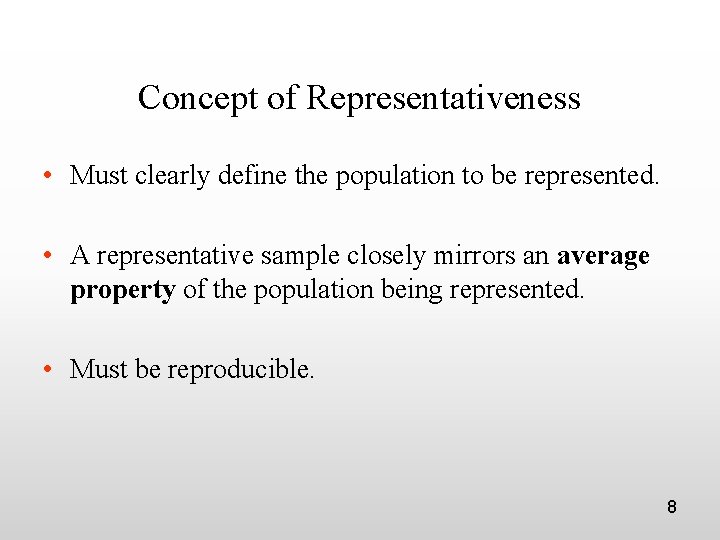
Concept of Representativeness • Must clearly define the population to be represented. • A representative sample closely mirrors an average property of the population being represented. • Must be reproducible. 8
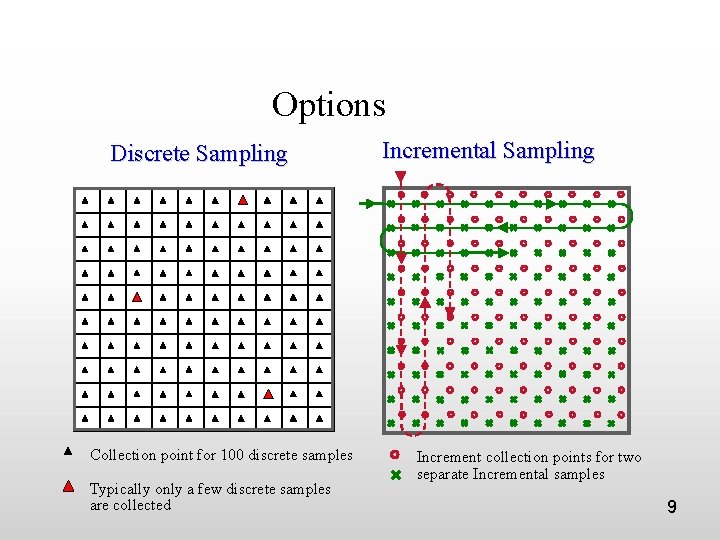
Options Discrete Sampling Collection point for 100 discrete samples Typically only a few discrete samples are collected Incremental Sampling Increment collection points for two separate Incremental samples 9
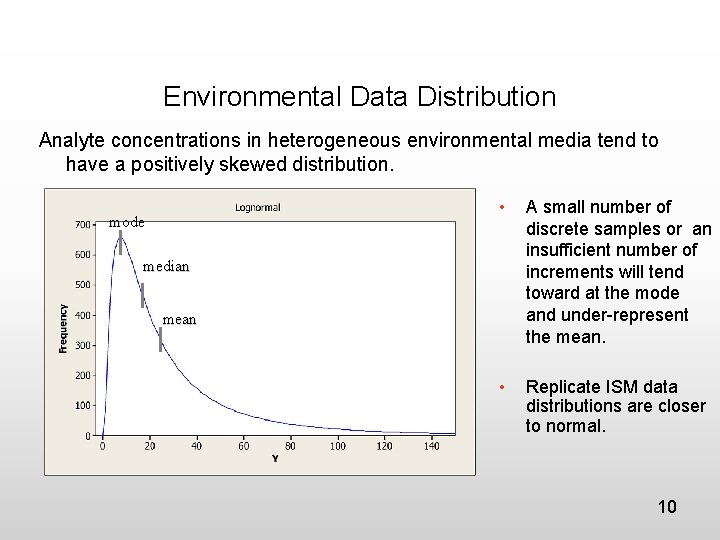
Environmental Data Distribution Analyte concentrations in heterogeneous environmental media tend to have a positively skewed distribution. mode • A small number of discrete samples or an insufficient number of increments will tend toward at the mode and under-represent the mean. • Replicate ISM data distributions are closer to normal. median mean 10
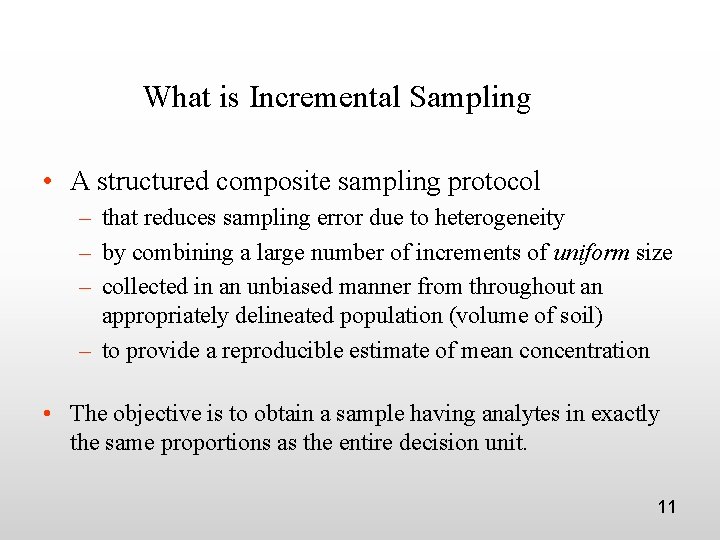
What is Incremental Sampling • A structured composite sampling protocol – that reduces sampling error due to heterogeneity – by combining a large number of increments of uniform size – collected in an unbiased manner from throughout an appropriately delineated population (volume of soil) – to provide a reproducible estimate of mean concentration • The objective is to obtain a sample having analytes in exactly the same proportions as the entire decision unit. 11
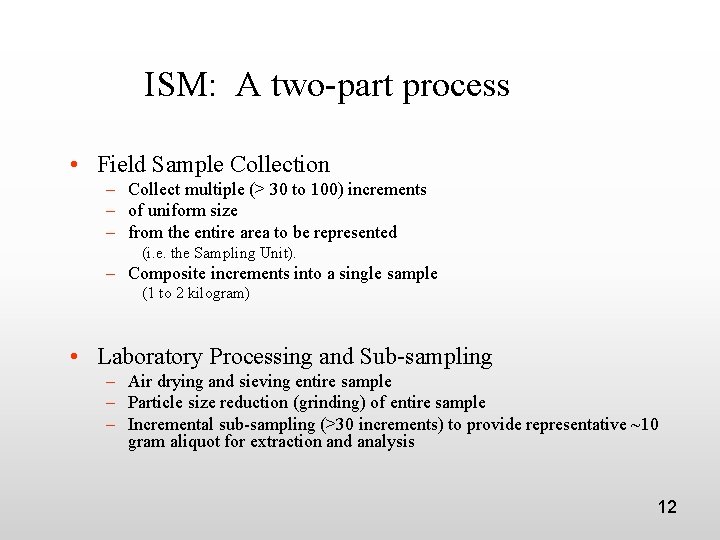
ISM: A two-part process • Field Sample Collection – Collect multiple (> 30 to 100) increments – of uniform size – from the entire area to be represented (i. e. the Sampling Unit). – Composite increments into a single sample (1 to 2 kilogram) • Laboratory Processing and Sub-sampling – Air drying and sieving entire sample – Particle size reduction (grinding) of entire sample – Incremental sub-sampling (>30 increments) to provide representative ~10 gram aliquot for extraction and analysis 12
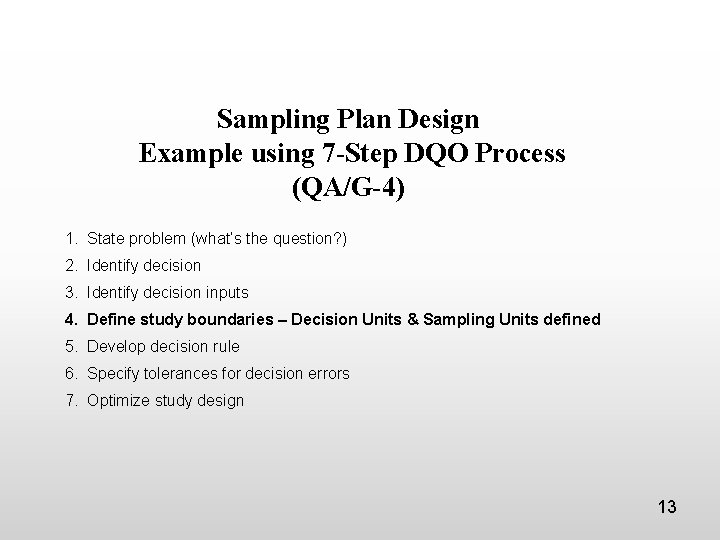
Sampling Plan Design Example using 7 -Step DQO Process (QA/G-4) 1. State problem (what’s the question? ) 2. Identify decision 3. Identify decision inputs 4. Define study boundaries – Decision Units & Sampling Units defined 5. Develop decision rule 6. Specify tolerances for decision errors 7. Optimize study design 13
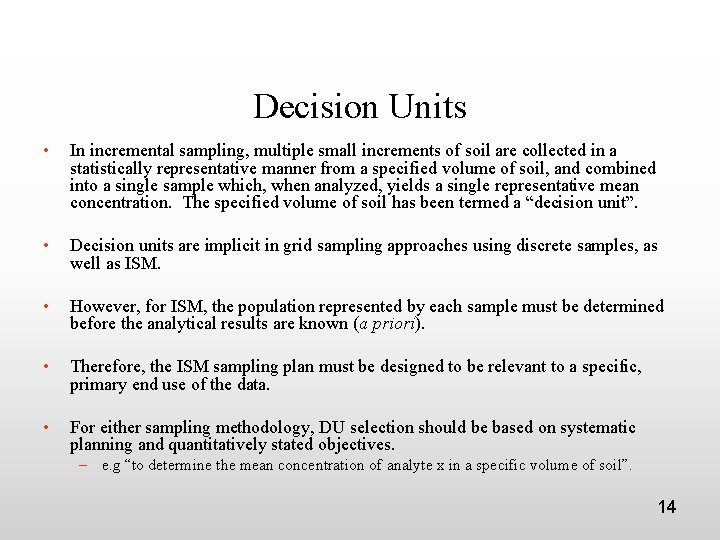
Decision Units • In incremental sampling, multiple small increments of soil are collected in a statistically representative manner from a specified volume of soil, and combined into a single sample which, when analyzed, yields a single representative mean concentration. The specified volume of soil has been termed a “decision unit”. • Decision units are implicit in grid sampling approaches using discrete samples, as well as ISM. • However, for ISM, the population represented by each sample must be determined before the analytical results are known (a priori). • Therefore, the ISM sampling plan must be designed to be relevant to a specific, primary end use of the data. • For either sampling methodology, DU selection should be based on systematic planning and quantitatively stated objectives. – e. g “to determine the mean concentration of analyte x in a specific volume of soil”. 14
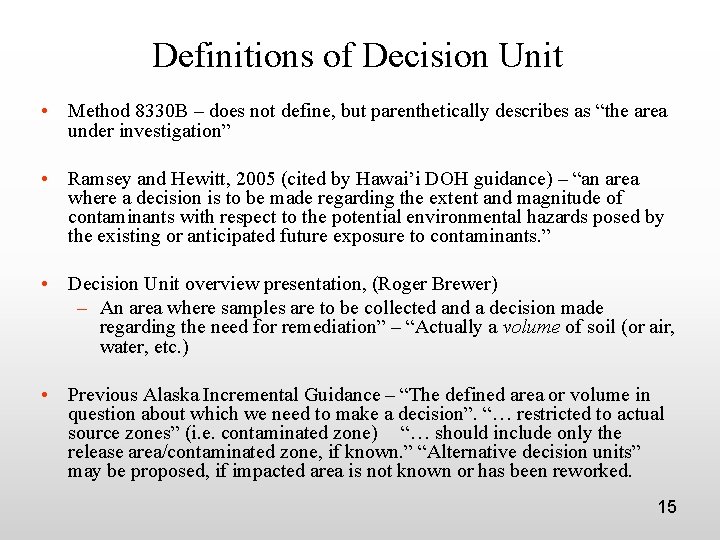
Definitions of Decision Unit • Method 8330 B – does not define, but parenthetically describes as “the area under investigation” • Ramsey and Hewitt, 2005 (cited by Hawai’i DOH guidance) – “an area where a decision is to be made regarding the extent and magnitude of contaminants with respect to the potential environmental hazards posed by the existing or anticipated future exposure to contaminants. ” • Decision Unit overview presentation, (Roger Brewer) – An area where samples are to be collected and a decision made regarding the need for remediation” – “Actually a volume of soil (or air, water, etc. ) • Previous Alaska Incremental Guidance – “The defined area or volume in question about which we need to make a decision”. “… restricted to actual source zones” (i. e. contaminated zone) “… should include only the release area/contaminated zone, if known. ” “Alternative decision units” may be proposed, if impacted area is not known or has been reworked. 15
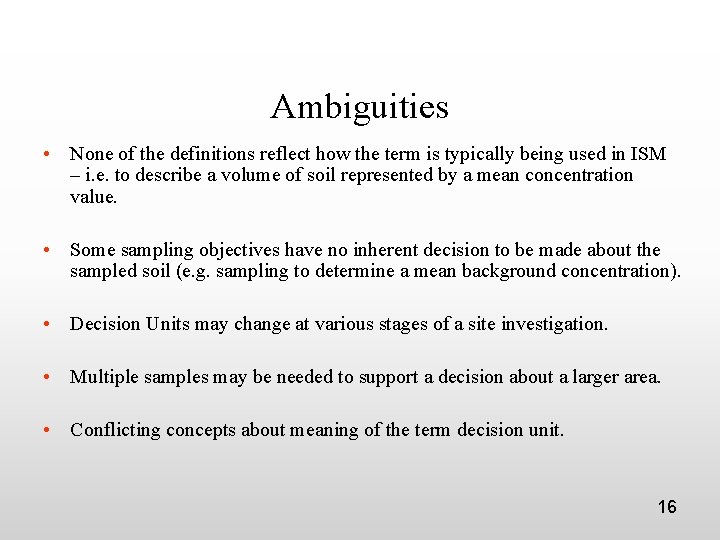
Ambiguities • None of the definitions reflect how the term is typically being used in ISM – i. e. to describe a volume of soil represented by a mean concentration value. • Some sampling objectives have no inherent decision to be made about the sampled soil (e. g. sampling to determine a mean background concentration). • Decision Units may change at various stages of a site investigation. • Multiple samples may be needed to support a decision about a larger area. • Conflicting concepts about meaning of the term decision unit. 16
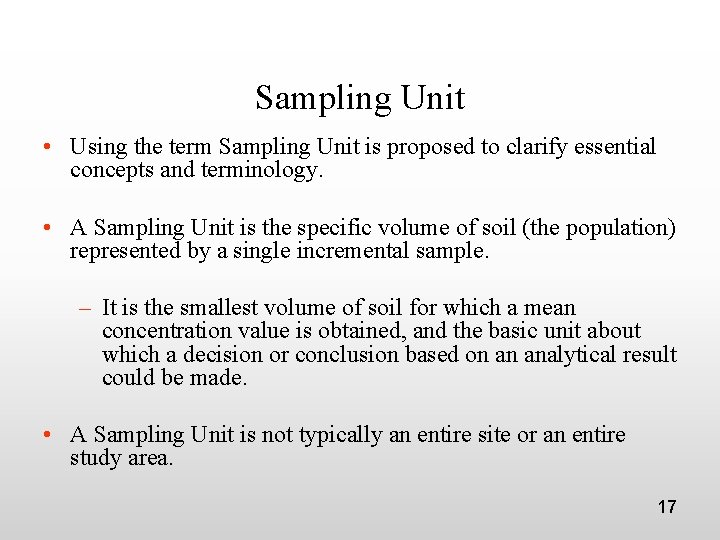
Sampling Unit • Using the term Sampling Unit is proposed to clarify essential concepts and terminology. • A Sampling Unit is the specific volume of soil (the population) represented by a single incremental sample. – It is the smallest volume of soil for which a mean concentration value is obtained, and the basic unit about which a decision or conclusion based on an analytical result could be made. • A Sampling Unit is not typically an entire site or an entire study area. 17
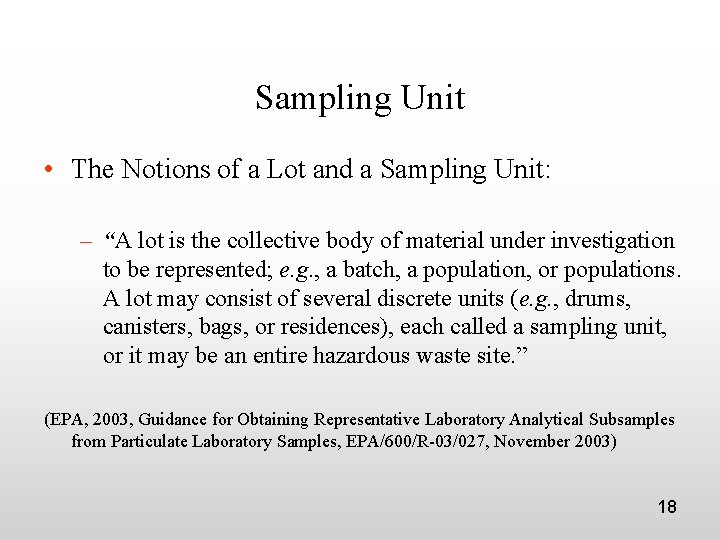
Sampling Unit • The Notions of a Lot and a Sampling Unit: – “A lot is the collective body of material under investigation to be represented; e. g. , a batch, a population, or populations. A lot may consist of several discrete units (e. g. , drums, canisters, bags, or residences), each called a sampling unit, or it may be an entire hazardous waste site. ” (EPA, 2003, Guidance for Obtaining Representative Laboratory Analytical Subsamples from Particulate Laboratory Samples, EPA/600/R-03/027, November 2003) 18
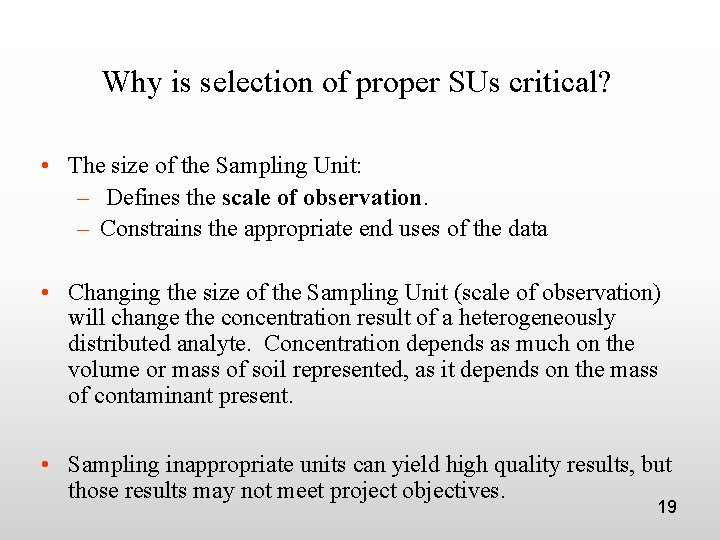
Why is selection of proper SUs critical? • The size of the Sampling Unit: – Defines the scale of observation. – Constrains the appropriate end uses of the data • Changing the size of the Sampling Unit (scale of observation) will change the concentration result of a heterogeneously distributed analyte. Concentration depends as much on the volume or mass of soil represented, as it depends on the mass of contaminant present. • Sampling inappropriate units can yield high quality results, but those results may not meet project objectives. 19
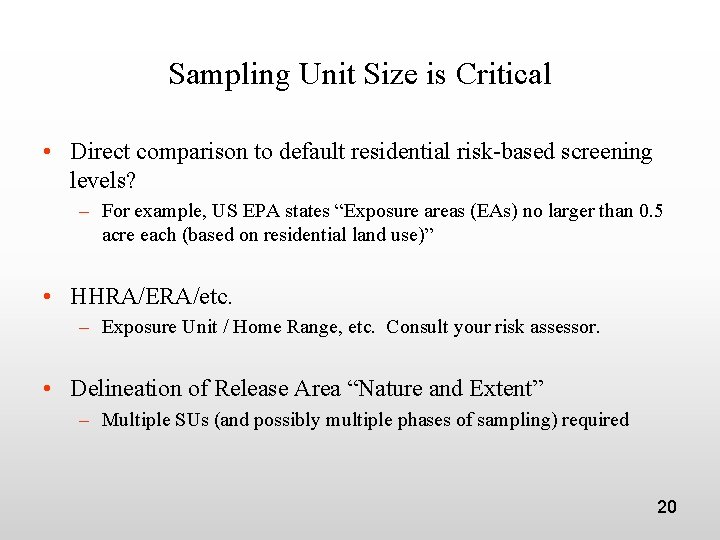
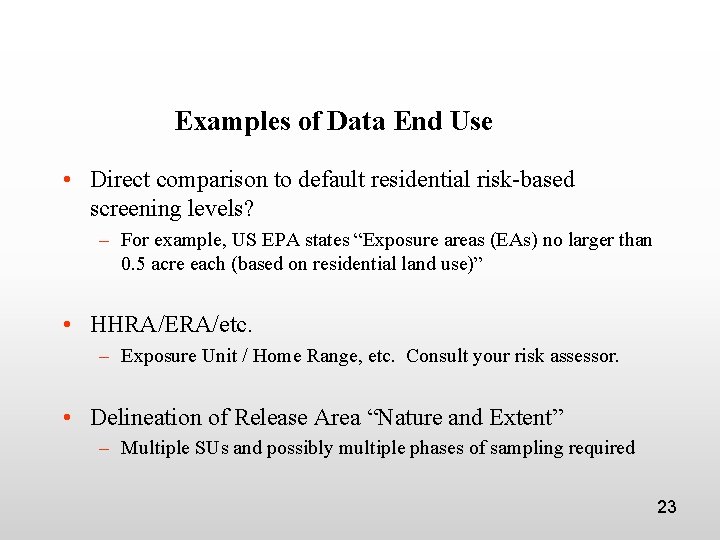
Sampling Unit Size is Critical • Direct comparison to default residential risk-based screening levels? – For example, US EPA states “Exposure areas (EAs) no larger than 0. 5 acre each (based on residential land use)” • HHRA/ERA/etc. – Exposure Unit / Home Range, etc. Consult your risk assessor. • Delineation of Release Area “Nature and Extent” – Multiple SUs (and possibly multiple phases of sampling) required 20
Sampling Units - The Hard Part (but it shouldn’t be) • Systematic planning and clear articulation of project objectives are the essential foundation for designing any sampling plan. • Determining the primary end use of the data (what the results will be compared to) requires thorough systematic planning. • Deficiencies in systematic planning and sampling design become starkly apparent when inappropriate ISM decision units are defined. 21
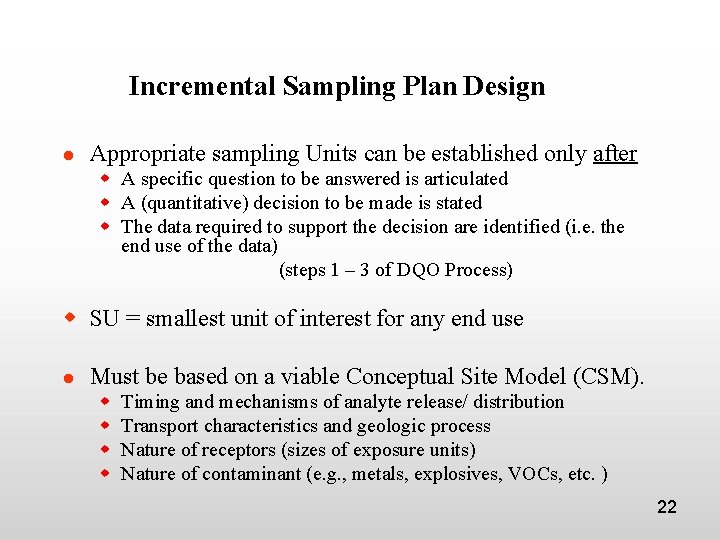
Incremental Sampling Plan Design l Appropriate sampling Units can be established only after w A specific question to be answered is articulated w A (quantitative) decision to be made is stated w The data required to support the decision are identified (i. e. the end use of the data) (steps 1 – 3 of DQO Process) w SU = smallest unit of interest for any end use l Must be based on a viable Conceptual Site Model (CSM). w w Timing and mechanisms of analyte release/ distribution Transport characteristics and geologic process Nature of receptors (sizes of exposure units) Nature of contaminant (e. g. , metals, explosives, VOCs, etc. ) 22
Examples of Data End Use • Direct comparison to default residential risk-based screening levels? – For example, US EPA states “Exposure areas (EAs) no larger than 0. 5 acre each (based on residential land use)” • HHRA/ERA/etc. – Exposure Unit / Home Range, etc. Consult your risk assessor. • Delineation of Release Area “Nature and Extent” – Multiple SUs and possibly multiple phases of sampling required 23
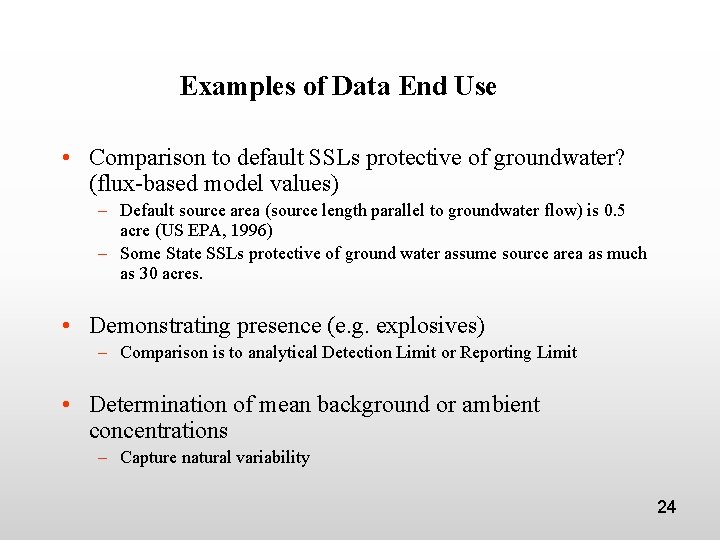
Examples of Data End Use • Comparison to default SSLs protective of groundwater? (flux-based model values) – Default source area (source length parallel to groundwater flow) is 0. 5 acre (US EPA, 1996) – Some State SSLs protective of ground water assume source area as much as 30 acres. • Demonstrating presence (e. g. explosives) – Comparison is to analytical Detection Limit or Reporting Limit • Determination of mean background or ambient concentrations – Capture natural variability 24
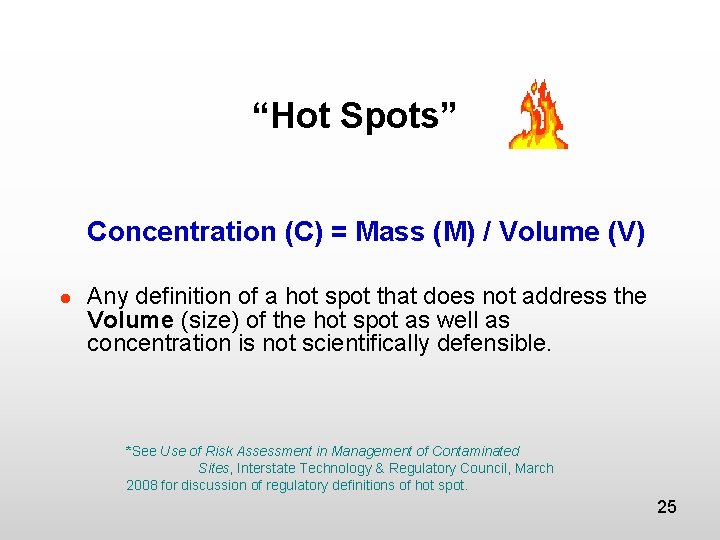
“Hot Spots” Concentration (C) = Mass (M) / Volume (V) l Any definition of a hot spot that does not address the Volume (size) of the hot spot as well as concentration is not scientifically defensible. *See Use of Risk Assessment in Management of Contaminated Sites, Interstate Technology & Regulatory Council, March 2008 for discussion of regulatory definitions of hot spot. 25
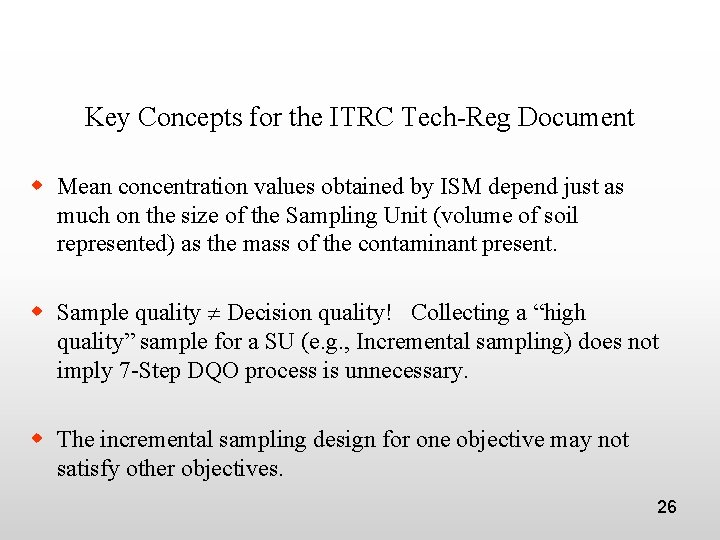
Key Concepts for the ITRC Tech-Reg Document w Mean concentration values obtained by ISM depend just as much on the size of the Sampling Unit (volume of soil represented) as the mass of the contaminant present. w Sample quality Decision quality! Collecting a “high quality” sample for a SU (e. g. , Incremental sampling) does not imply 7 -Step DQO process is unnecessary. w The incremental sampling design for one objective may not satisfy other objectives. 26
Misconceptions • “Incremental sampling dilutes out hot spots. ” – However, designers need to guard against inappropriately large decision units that may, indeed, dilute out significant contamination. • "Incremental sampling loses the spatial resolution achieved with discrete sampling. ” – The appearance of “spatial resolution” from only a few discrete or 7 point wheel samples may be illusory, due simply to the large range of variability between individual samples. 27
Questions? Discussion? 28