
Implementation of identification and validation of nonformal and
- Slides: 24
Implementation of identification and validation of non-formal and informal learning A critical issue in a strongly structured VET-system EPANIL second meeting 23. /24. June 2005 in Arras, France Gerald Heidegger, Irina Michel, Wiebke Petersen biat/University of Flensburg
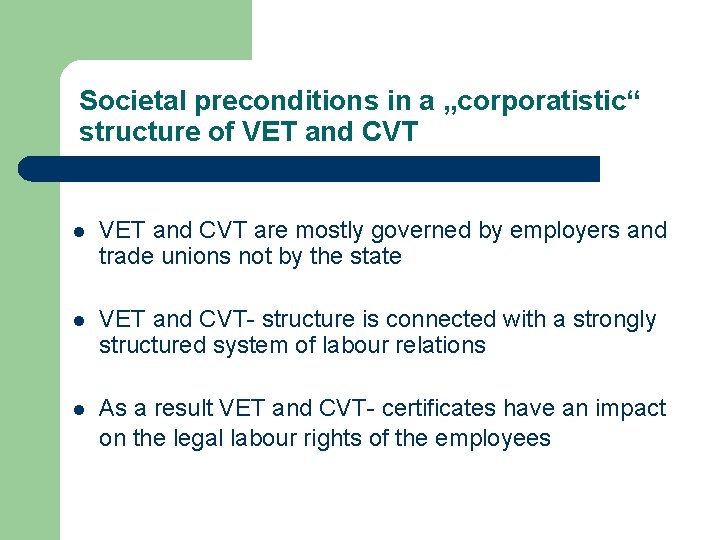
Societal preconditions in a „corporatistic“ structure of VET and CVT l VET and CVT are mostly governed by employers and trade unions not by the state l VET and CVT- structure is connected with a strongly structured system of labour relations l As a result VET and CVT- certificates have an impact on the legal labour rights of the employees
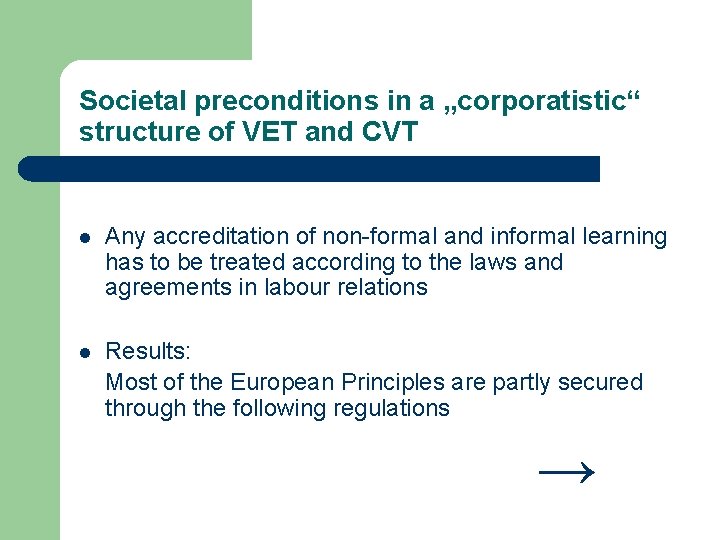
Societal preconditions in a „corporatistic“ structure of VET and CVT l Any accreditation of non-formal and informal learning has to be treated according to the laws and agreements in labour relations Results: Most of the European Principles are partly secured through the following regulations l →
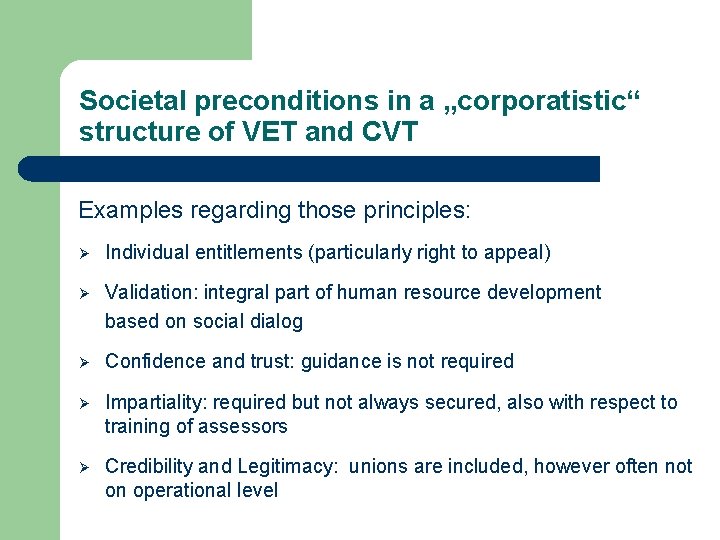
Societal preconditions in a „corporatistic“ structure of VET and CVT Examples regarding those principles: Ø Individual entitlements (particularly right to appeal) Ø Validation: integral part of human resource development based on social dialog Ø Confidence and trust: guidance is not required Ø Impartiality: required but not always secured, also with respect to training of assessors Ø Credibility and Legitimacy: unions are included, however often not on operational level
Relevance of non-formal and informal learning in a „corporatistic“ structure – Germany as an example l Rising awareness of the individual’s responsibility and selforganization capabilities in continuing education l Non-formal and informal learning as part of lifelong learning are gaining more attention in this context l Strong legal framework for lifelong learning in formal contexts l BUT: initiatives for validation of non-formal and informal learning within continuing education are without formalized legal framework l Legal framework becomes important when certificates are used in connection with an actual employment
Relevance of non-formal learning in the (dual) apprenticeship system The dual system consists of two learning environments: Ø Ø Worked based learning in the company offering → formal learning options, e. g. cooking according to the instructions of the „Meister“ → non-formal learning options, e. g. observing and participating in the daily work process School-based learning → mainly formal learning options
Relevance of non-formal learning in the (dual) apprenticeship system Final exam: only testing of some specific abilities, skills and knowledge, activity is „equated“ with competence Expectation: background and competence of the trainee is much broader than shown in the final examination → Input oriented idea of VET!!! → Therefore non-formal and informal learning is no alternative to an apprenticeship in the dual system!!! Consequence: separate accreditation of non-formal and informal learning relevant only in CVT
Relevance of non-formal and informal learning for CVT and lifelong learning l Most CVT courses are similar to the IVET-principles: non-formal learning is included in the formal learning („Meister“ in the crafts and industry) l Accreditation is only complementary to the formally accredited occupational certificates l Most important case of identification of non-formal and informal learning: „profiling“ schemes
Relevance of non-formal and informal learning for CVT and lifelong learning – Germany as an example l „Profiling“ schemes on behalf of the labour office Assessment of competences and skills for the re-integration into the labour market focusing on: Ø Ø Ø Ø Former occupational experience Content related knowledge Curriculum vitae Mother Tongue Foreign language(s) IT-skills Personal and key-competences → no formal system of accreditation → the fact that the profiling-sheet is owned by the labour office is contradictory to European Principles
Recognition of non-formal and informal learning in a strongly structured VET and CVT -system? ● „Weiterbildungspass“/ “Profil. PASS“- initiative → Model of a national pass certifying informal learning → Model project of the „Federal and States Commitee on Planning Education and Promoting Research“ („Bund-Länder Kommission für Bildungsplanung und Forschungsförderung“) → Financed and commissioned by the „German Federal and States Ministries of Education“ („Bundesministerium für Bildung und Forschung- BMBF“)
Strongly structured system: model of a portfolio for lifelong learning – methods and instruments First recording system measuring informal learning: Ø Open recording system → operates with a concrete context in which the performed activity is described referring to suggested competences including e. g. ability to work independently or in a team → person can complete the list of suggested competencies on his/her own → the duration is registered → Outcomes are certified by a third person or organization
Strongly structured system: model of a portfolio for lifelong learning – methods and instruments Second recording system measuring informal learning: Ø Closed recording system → gives a complete list of competencies → person can not additional recordings → performed activity is described and registered within a concrete context and by a third person or organization
Model of a portfolio for lifelong learning conclusions for a strongly structured system l Assessment stage: Ø Describing learning efficiencies and competencies Ø Mostly consisting of self-evaluation of the portfolio/ “pass“owner along a given list of competencies Ø Not involving external institutions that scientifically measure recorded competences → Little checkable procedures: missing assessment of how far the experience has been a learning experience
Strongly structured system: model of a portfolio for lifelong learning – contents l First and main step: → documentation of formal, non-formal and informal learning l Contents: → School leaving certificates (formal) → Formally accredited occupational certificates → Formally accredited certificates of further Education → Formally accredited certificates of continuing education (particularly including non-formal learning) → Work certificates issued by the employers (comprehending mostly non-formally acquired competencies)
Strongly structured system: model of a portfolio for lifelong learning - examples l Reports of one‘s own documentation about the processes of nonformal and informal learning l Reports about voluntary work (related to citizenship): portfolio „Nachweismappe Ehrenamt“ l Portfolio about processes of non-formal and informal learning („Kompetenzbilanz“)
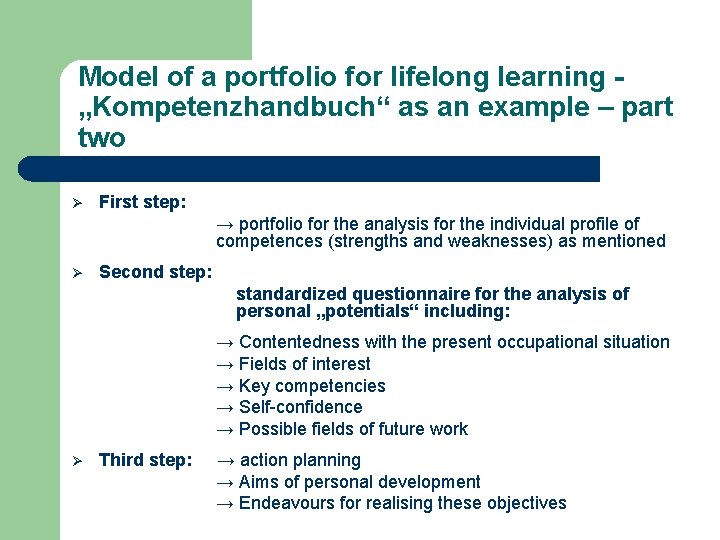
Model of a portfolio for lifelong learning „Kompetenzhandbuch“ as an example – part one l Originally devised by the metal workers union (IG Metall) for the IT occupations ( for these a close interrelation between formal education and informal learning is widely spread: „nerds“) l Aim: „to collect, identify, discover and make visible personal and occupational competences l Three steps: → → → portfolio standardized questionnaire action planning
Model of a portfolio for lifelong learning „Kompetenzhandbuch“ as an example – part two Ø First step: → portfolio for the analysis for the individual profile of competences (strengths and weaknesses) as mentioned Ø Second step: standardized questionnaire for the analysis of personal „potentials“ including: → Contentedness with the present occupational situation → Fields of interest → Key competencies → Self-confidence → Possible fields of future work Ø Third step: → action planning → Aims of personal development → Endeavours for realising these objectives
Model project for identification and evaluation of informal learning: „Kompetenzbilanz“ l Not to be mixed up with „bilan de compétence“ – only related to informal learning l The following show the characteristics describing the operational steps →
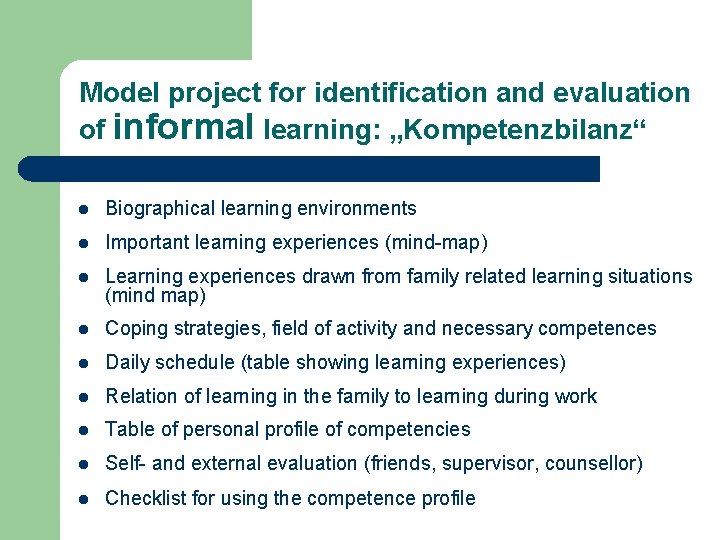
Model project for identification and evaluation of informal learning: „Kompetenzbilanz“ l Biographical learning environments l Important learning experiences (mind-map) l Learning experiences drawn from family related learning situations (mind map) l Coping strategies, field of activity and necessary competences l Daily schedule (table showing learning experiences) l Relation of learning in the family to learning during work l Table of personal profile of competencies l Self- and external evaluation (friends, supervisor, counsellor) l Checklist for using the competence profile
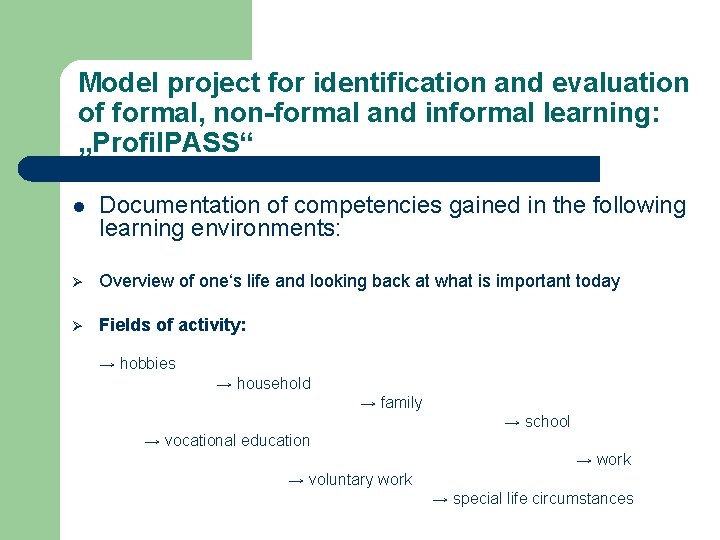
Model project for identification and evaluation of formal, non-formal and informal learning: „Profil. PASS“ l Documentation of competencies gained in the following learning environments: Ø Overview of one‘s life and looking back at what is important today Ø Fields of activity: → hobbies → household → family → school → vocational education → work → voluntary work → special life circumstances
Model project for identification and evaluation of formal, non-formal and informal learning: „Profil. PASS“ l Documentation of competencies gained in the following learning environments: Ø Balance: get an overview of abilities and competences Ø Goals and next steps: wishes and personal goals, preferred leisure time and work activities, interests to be liked to pursued Ø Collecting of reports: follows recommendations for the „Europass“
Societal conditions for implementing a Portfolio of lifelong learning in a strongly structured system Feasibility study regarding such a portfolio („Weiterbildungspass“) concludes: Ø Goals of the pass initiatives move between individual, societal and corporate demands and are often motivated merely economically Ø Passes operate incompletely and with little systematic procedures: additional recordings can not be included or external institutions that measure the competencies are not involved (compared to CEP) → first results of evaluation
Societal conditions for implementing a Portfolio of lifelong learning in a strongly structured system l Particularly demand of the unions: not only outcomes should be documented but also processes of learning which show the ability and openness for learning l Counselling is substantial – some work agreements already contain this requirement laws guiding labour relations and have to be recognised when the portfolios are used by the employers l Employees fear to be occupied– employers want as much transparency as possible l Employers want the documentation and the evaluation to be as comprehensive as possible but are not prepared to provide the necessary resources
CONCLUSIONS General fundamental contradiction: All groups wish the recognition of the portfolio but the legal conditions only allow this to a certain degree! l Various initiatives show the relevance of the topic in the national arena and willingness on national scale to implement non-formal and informal learning into the legal framework of continuing education l Too early to compare the efficiency and effectiveness of many initiatives l Non-formal and informal learning moves between individual, corporate and societal demands l Mostly input oriented identification of non-formal and informal learning in Germany