
Implementation of European Union Law into National law












- Slides: 30
Implementation of European Union Law into National law Sandra Vīgante Head of Division of Public International Law Ministry of Justice of the Republic of Latvia 2018
Agenda 1. 2. 3. 4. Types of EU Law and the hierarchy of norms Legislative and non-legislative acts Implementation of secondary EU Law - regulations, directives, decisions into national law (methodology, legal technique and other aspects) Legal impact assessment of draft law (including when EU Law is implemented into national law Used abbreviation: EU – European Union TEU – Treaty on European Union TFEU – Treaty on Functioning of the European Union EP – European Parliament ECJ – European Union Court of Justice © Sandra Vīgante 24. 02. 2021. 2
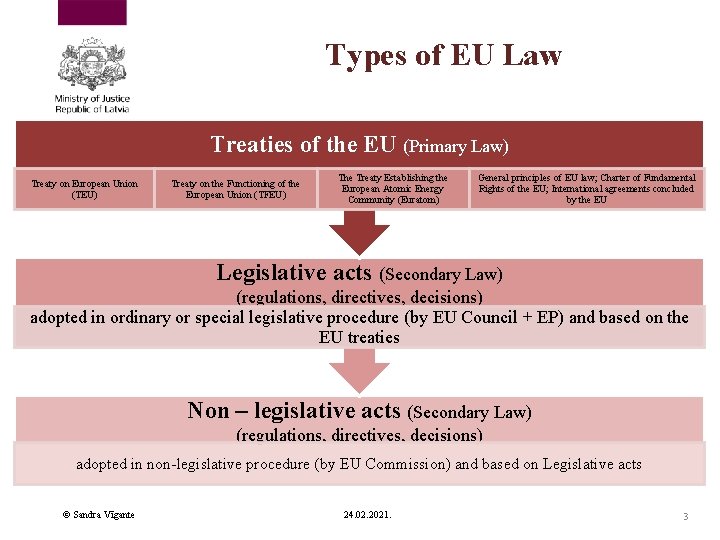
Types of EU Law Treaties of the EU (Primary Law) Treaty on European Union (TEU) Treaty on the Functioning of the European Union (TFEU) The Treaty Establishing the European Atomic Energy Community (Euratom) General principles of EU law; Charter of Fundamental Rights of the EU; International agreements concluded by the EU Legislative acts (Secondary Law) (regulations, directives, decisions) adopted in ordinary or special legislative procedure (by EU Council + EP) and based on the EU treaties Non – legislative acts (Secondary Law) (regulations, directives, decisions) adopted in non-legislative procedure (by EU Commission) and based on Legislative acts © Sandra Vīgante 24. 02. 2021. 3
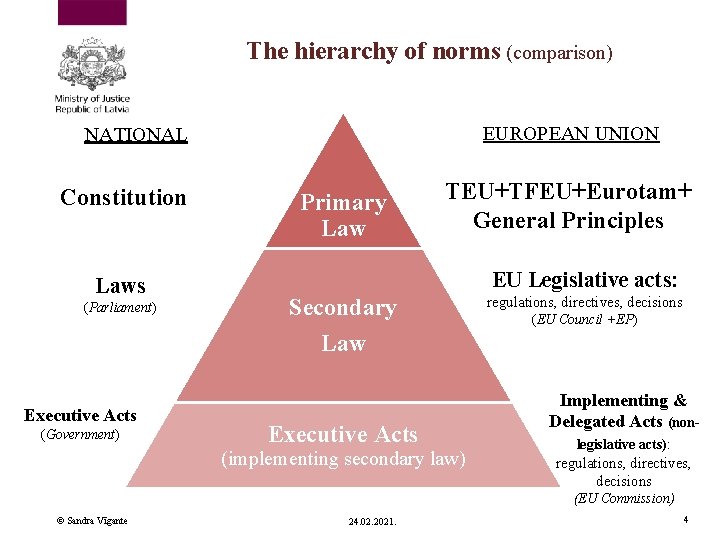
The hierarchy of norms (comparison) EUROPEAN UNION NATIONAL Constitution Laws (Parliament) Primary Law TEU+TFEU+Eurotam+ General Principles EU Legislative acts: Secondary regulations, directives, decisions (EU Council +EP) Law Executive Acts (Government) Executive Acts (implementing secondary law) Implementing & Delegated Acts (nonlegislative acts): regulations, directives, decisions (EU Commission) © Sandra Vīgante 24. 02. 2021. 4
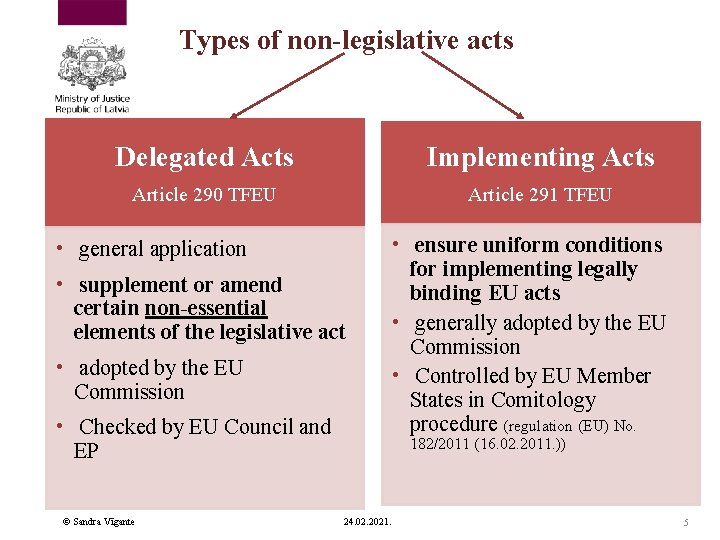
Types of non-legislative acts Delegated Acts Implementing Acts Article 290 TFEU Article 291 TFEU • general application • supplement or amend certain non-essential elements of the legislative act • adopted by the EU Commission • Checked by EU Council and EP © Sandra Vīgante • ensure uniform conditions for implementing legally binding EU acts • generally adopted by the EU Commission • Controlled by EU Member States in Comitology procedure (regulation (EU) No. 182/2011 (16. 02. 2011. )) 24. 02. 2021. 5
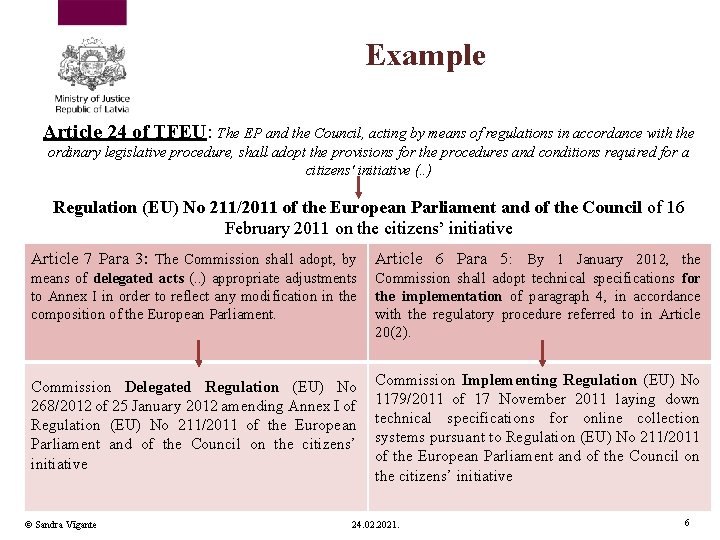
Example Article 24 of TFEU: The EP and the Council, acting by means of regulations in accordance with the ordinary legislative procedure, shall adopt the provisions for the procedures and conditions required for a citizens' initiative (. . ) Regulation (EU) No 211/2011 of the European Parliament and of the Council of 16 February 2011 on the citizens’ initiative Article 7 Para 3: The Commission shall adopt, by Article 6 Para 5: By 1 January 2012, the means of delegated acts (. . ) appropriate adjustments to Annex I in order to reflect any modification in the composition of the European Parliament. Commission shall adopt technical specifications for the implementation of paragraph 4, in accordance with the regulatory procedure referred to in Article 20(2). Commission Delegated Regulation (EU) No 268/2012 of 25 January 2012 amending Annex I of Regulation (EU) No 211/2011 of the European Parliament and of the Council on the citizens’ initiative Commission Implementing Regulation (EU) No 1179/2011 of 17 November 2011 laying down technical specifications for online collection systems pursuant to Regulation (EU) No 211/2011 of the European Parliament and of the Council on the citizens’ initiative © Sandra Vīgante 24. 02. 2021. 6
Implementation of EU legal acts into national law 1. Comparing EU law and National law → rules and regulations, case law of the courts and administrative practice 2. Does the existing national law and administrative practice comply/does not comply with the EU law 3. If does not comply, it is necessary to: → → adopt new legislation amend legislation already in force invalidate concrete legislation change the existing judicial and /or administrative practice © Sandra Vīgante 24. 02. 2021. 7
Meaning of the «State» in EU Law The EU Court of Justice explains scope of the «state» widely and includes: 1) any national regulatory authority 2) municipal authority (ECJ case C-103/88) 3) independent institution which is protecting public order and safety (ECJ Case C-222/84) 4) entrepreneur whose business is connected with security of the state (ECJ Case C– 188/89) «State» - any state’s institution or any individual, who fulfils tasks delegated by the state © Sandra Vīgante 24. 02. 2021. 8
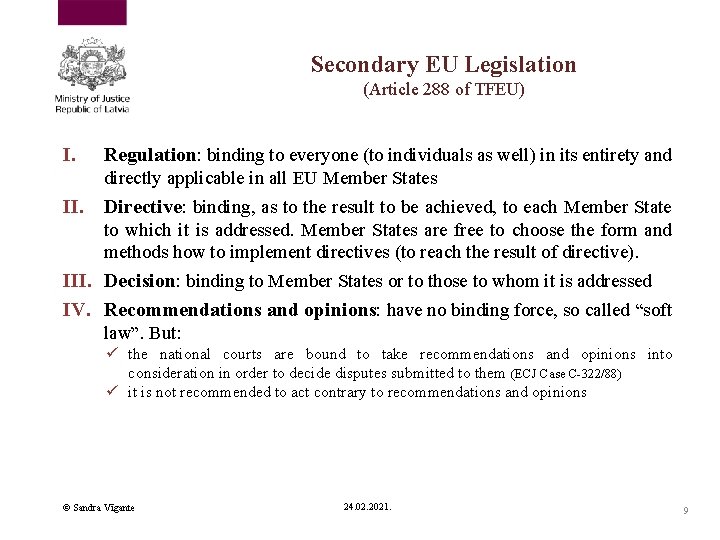
Secondary EU Legislation (Article 288 of TFEU) I. Regulation: binding to everyone (to individuals as well) in its entirety and directly applicable in all EU Member States II. Directive: binding, as to the result to be achieved, to each Member State to which it is addressed. Member States are free to choose the form and methods how to implement directives (to reach the result of directive). III. Decision: binding to Member States or to those to whom it is addressed IV. Recommendations and opinions: have no binding force, so called “soft law”. But: ü the national courts are bound to take recommendations and opinions into consideration in order to decide disputes submitted to them (ECJ Case C-322/88) ü it is not recommended to act contrary to recommendations and opinions © Sandra Vīgante 24. 02. 2021. 9
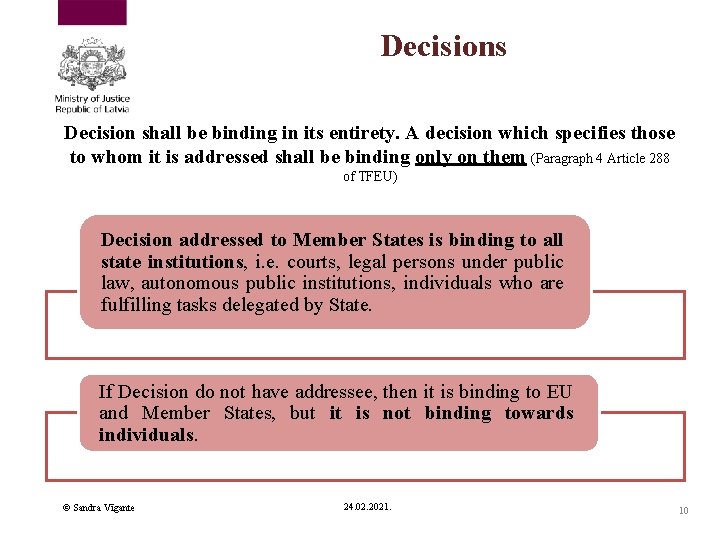
Decisions Decision shall be binding in its entirety. A decision which specifies those to whom it is addressed shall be binding only on them (Paragraph 4 Article 288 of TFEU) Decision addressed to Member States is binding to all state institutions, i. e. courts, legal persons under public law, autonomous public institutions, individuals who are fulfilling tasks delegated by State. If Decision do not have addressee, then it is binding to EU and Member States, but it is not binding towards individuals. © Sandra Vīgante 24. 02. 2021. 10
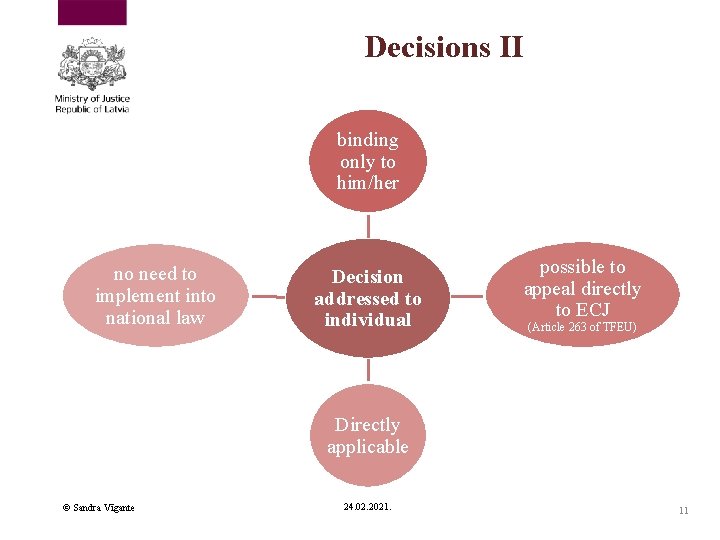
Decisions II binding only to him/her no need to implement into national law Decision addressed to individual possible to appeal directly to ECJ (Article 263 of TFEU) Directly applicable © Sandra Vīgante 24. 02. 2021. 11
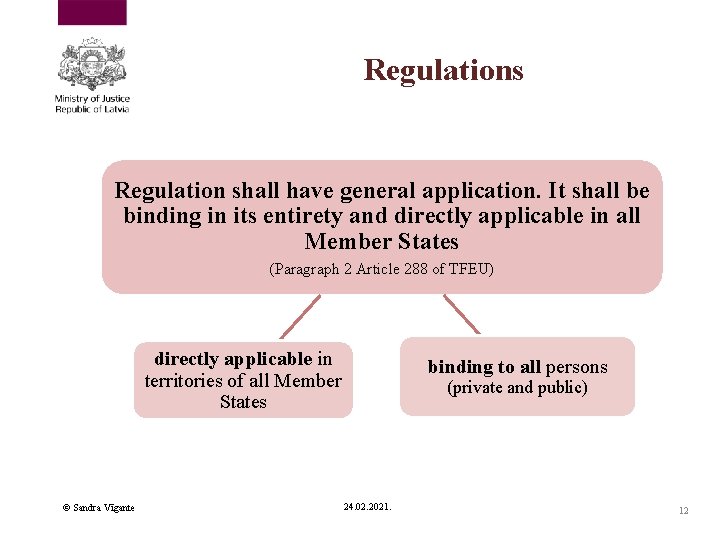
Regulations Regulation shall have general application. It shall be binding in its entirety and directly applicable in all Member States (Paragraph 2 Article 288 of TFEU) directly applicable in territories of all Member States © Sandra Vīgante binding to all persons (private and public) 24. 02. 2021. 12
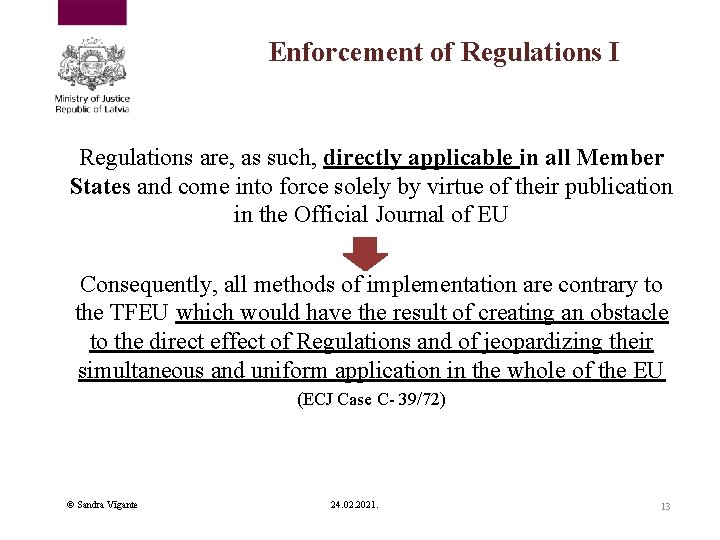
Enforcement of Regulations I Regulations are, as such, directly applicable in all Member States and come into force solely by virtue of their publication in the Official Journal of EU Consequently, all methods of implementation are contrary to the TFEU which would have the result of creating an obstacle to the direct effect of Regulations and of jeopardizing their simultaneous and uniform application in the whole of the EU (ECJ Case C- 39/72) © Sandra Vīgante 24. 02. 2021. 13
Enforcement of Regulations II • BUT implementing measures which assure direct applicability are necessary Ø Member States are obligated to adopt national laws and ensure administrative practice if direct applicability of Regulations is possible just by said measures Ø If legal provisions of the Regulation are complicated, the national administration may adopt explanatory guideline for the application of a Regulation to clarify any doubts raised (ECJ Case C 94/77) Ø In exceptional cases it is aloud to incorporate (to copy) Regulation into national law, if it is in the interests of individuals and there is no other way how to achieve direct applicability of the Regulation (ECJ Case C- 272/83) © Sandra Vīgante 24. 02. 2021. 14
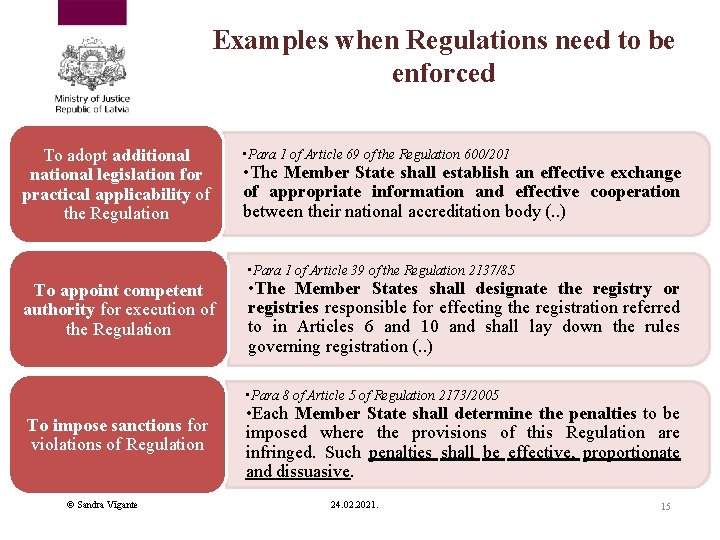
Examples when Regulations need to be enforced To adopt additional national legislation for practical applicability of the Regulation • Para 1 of Article 69 of the Regulation 600/201 • The Member State shall establish an effective exchange of appropriate information and effective cooperation between their national accreditation body (. . ) • Para 1 of Article 39 of the Regulation 2137/85 To appoint competent authority for execution of the Regulation • The Member States shall designate the registry or registries responsible for effecting the registration referred to in Articles 6 and 10 and shall lay down the rules governing registration (. . ) • Para 8 of Article 5 of Regulation 2173/2005 To impose sanctions for violations of Regulation © Sandra Vīgante • Each Member State shall determine the penalties to be imposed where the provisions of this Regulation are infringed. Such penalties shall be effective, proportionate and dissuasive. 24. 02. 2021. 15
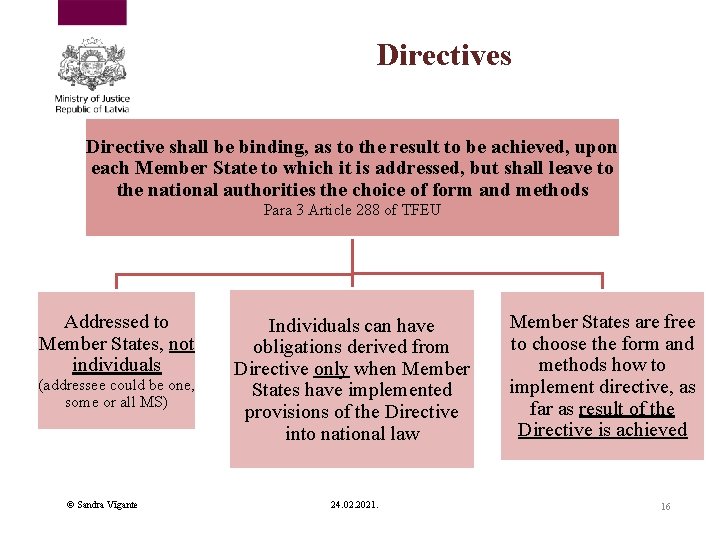
Directives Directive shall be binding, as to the result to be achieved, upon each Member State to which it is addressed, but shall leave to the national authorities the choice of form and methods Para 3 Article 288 of TFEU Addressed to Member States, not individuals (addressee could be one, some or all MS) © Sandra Vīgante Individuals can have obligations derived from Directive only when Member States have implemented provisions of the Directive into national law 24. 02. 2021. Member States are free to choose the form and methods how to implement directive, as far as result of the Directive is achieved 16
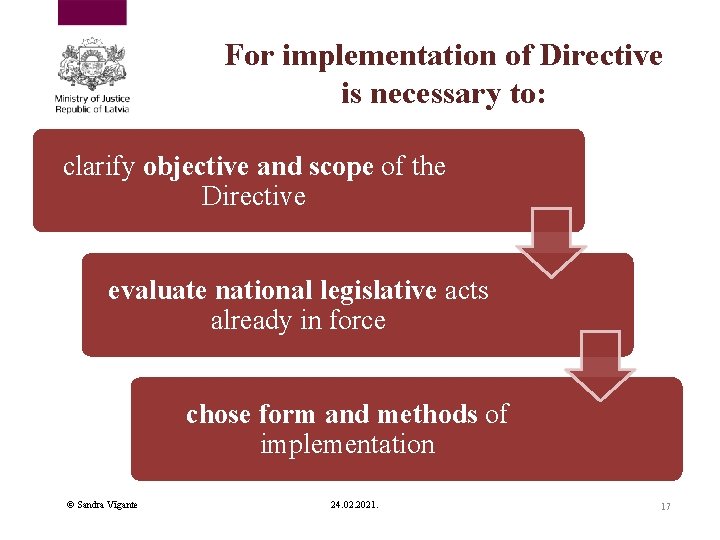
For implementation of Directive is necessary to: clarify objective and scope of the Directive evaluate national legislative acts already in force chose form and methods of implementation © Sandra Vīgante 24. 02. 2021. 17
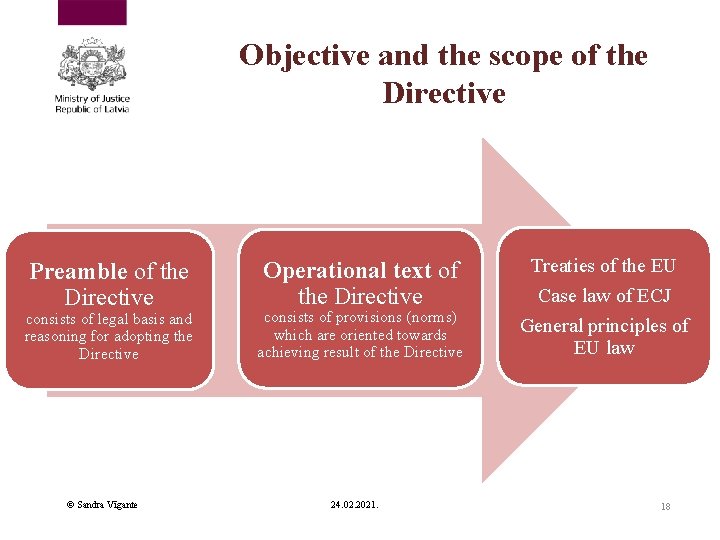
Objective and the scope of the Directive Preamble of the Directive consists of legal basis and reasoning for adopting the Directive © Sandra Vīgante Operational text of the Directive consists of provisions (norms) which are oriented towards achieving result of the Directive 24. 02. 2021. Treaties of the EU Case law of ECJ General principles of EU law 18
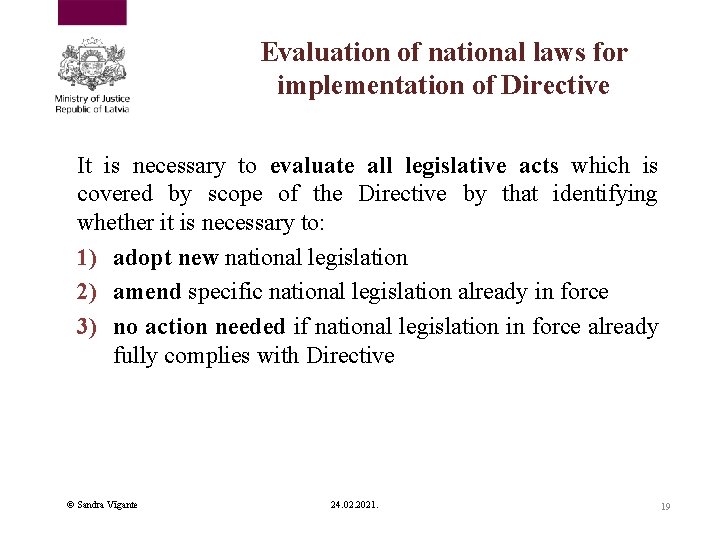
Evaluation of national laws for implementation of Directive It is necessary to evaluate all legislative acts which is covered by scope of the Directive by that identifying whether it is necessary to: 1) adopt new national legislation 2) amend specific national legislation already in force 3) no action needed if national legislation in force already fully complies with Directive © Sandra Vīgante 24. 02. 2021. 19
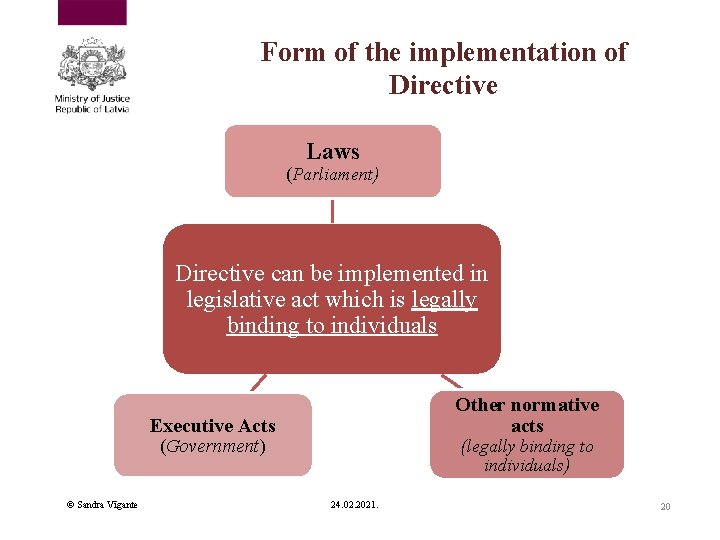
Form of the implementation of Directive Laws (Parliament) Directive can be implemented in legislative act which is legally binding to individuals Other normative acts Executive Acts (Government) © Sandra Vīgante (legally binding to individuals) 24. 02. 2021. 20
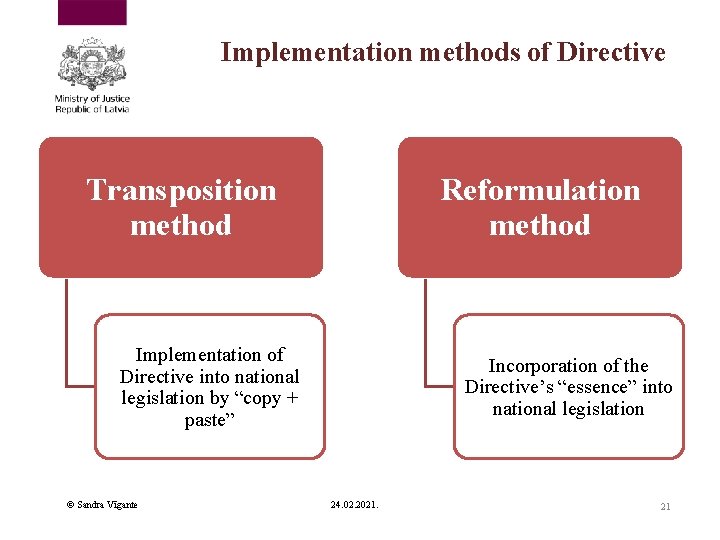
Implementation methods of Directive Transposition method Reformulation method Implementation of Directive into national legislation by “copy + paste” © Sandra Vīgante Incorporation of the Directive’s “essence” into national legislation 24. 02. 2021. 21
Choice of method for implementation To select the most appropriate method of implementation it is important to take into account not only the rules of the directive, but also the language (phrasing) and legal technique of the national legislation in which the implementation of directive is planned. Considering that text of the Directive is compromise between 28 Member States (the text is complicated) reformulation method is most appropriate method of implementation © Sandra Vīgante 24. 02. 2021. 22
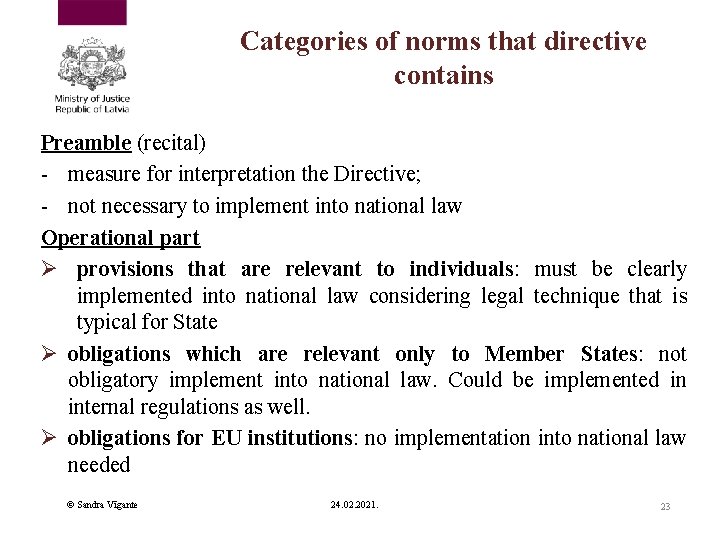
Categories of norms that directive contains Preamble (recital) - measure for interpretation the Directive; - not necessary to implement into national law Operational part Ø provisions that are relevant to individuals: must be clearly implemented into national law considering legal technique that is typical for State Ø obligations which are relevant only to Member States: not obligatory implement into national law. Could be implemented in internal regulations as well. Ø obligations for EU institutions: no implementation into national law needed © Sandra Vīgante 24. 02. 2021. 23
Exception The only reason (excuse) when transposition of directive is not mandatory is the reasons of geography when EU law rules, for example, certain mountains or waters which are not part of the territory of the Member State concerned, or otherwise because of the geographical situation of the Member States cannot apply to it (ECJ Case C 372/00) © Sandra Vīgante 24. 02. 2021. 24
Ex-ante impact assessment of draft laws The aim of impact assessment (explanatory note) is to ensure that the social, economical impact and fiscal impact on state and/or municipal budget of draft law are estimated. Impact assessment helps to exclude possibility to adopt mutually conflicting legal acts. Impact assessment is the technical tool for planning further short and medium term actions, ensuring that sudden negative financial or legal consequences will no appear. © Sandra Vīgante 24. 02. 2021. 25
Content of impact assessment (in Latvia) I. III. IV. V. VII. • Necessity of draft legal act (present situation; concept of the draft legal act) • The impact on the development of the society and national economy (macroeconomic; simplification of administrative procedure; social consequences) • The impact of the draft legal act on the state budget and the municipal budgets (incomes and expenditures; financial impact; compensatory measures) • Possible impact on the system of legal norms in force (what legal acts should be additionally issued) • Conformity of draft legal act to the international obligations of the Republic of Latvia (EU/international law; concordance table) • Involvement of society and activities of communication (NGOs; public; international consultants) • Impact of draft legal act on the functions and human resources of governmental institutions (necessity for new institutions) © Sandra Vīgante 24. 02. 2021. 26
Check list for a good legal act 1. Think before write 2. Focus on the reader 3. Get document into shape 4. Keep it short and simple 5. Make sense 6. Cut out excess nouns 7. Be concrete, not abstract 8. Prefer active verbs to passive 9. Beware of jargons and abbreviations 10. Revise and check. “ How to write clearly” – European Commission © Sandra Vīgante 24. 02. 2021. 27
Ensure consistency The terminology used in a legal act shall be consistent both internally and with acts already in force, especially in the same field Formal consistency: ü Words must be used in their ordinary sense. If a word has one meaning in everyday or technical language, but a different meaning in legal language, the phrase must be formulated in such a way as to avoid any ambiguity ü In the interests of precision and to avoid problems of interpretation, it may be necessary to define a term. Substantive consistency: ü Consistency of terminology must also be checked with regard to the content of the legal act itself. There must be no contradictions inherent in the legal act. ü Definitions must be respected throughout the legal act. Defined terms must be used in a uniform manner and their content must not diverge from the definitions given. © Sandra Vīgante 24. 02. 2021. 28
Sources Access to EU law http: //eurlex. europa. eu/ Case Law of ECT https: //curia. eur opa. eu/ © Sandra Vīgante 24. 02. 2021. 29
Thank you for your attention! Sandra Vīgante Head of International Public Law Division Ministry of Justice of the Republic of Latvia e-mail address: sandra. vigante@tm. gov. lv