
Implementation of Density Functional Theory based Electronic Structure
Implementation of Density Functional Theory based Electronic Structure Codes on Advanced Computing Architectures W. A. Shelton, E. Aprá, G. I. Fann and R. J. Harrison

Cray-X 1 E • 1024 Multi-streaming vector processor (MSP) – Each MSP has 2 MB of cache and a peak computation rate of 12. 8 GF – 4 single-streaming processors (SSPs) form a node with 16 Gbytes of shared memory – Memory is physically distributed on individual modules – all memory is directly addressable to and accessible by any MSP in the system through the use of load and store instructions

Cray XT 3 2. 17 GB/sec Sustained • • 5294 nodes 4 -processors per node connected through hypertransport 2. 4 -GHz AMD Opteron processor and 2 GB of memory SDRAM memory controller and function of Northbridge is pulled onto the Opteron die. Memory latency reduced to <60 ns Interface off the chip is an open standard (Hyper. Transport) 6. 5 GB/sec Sustained Six Network Links Each >3 GB/s x 2 (7. 6 GB/sec Peak for each link)
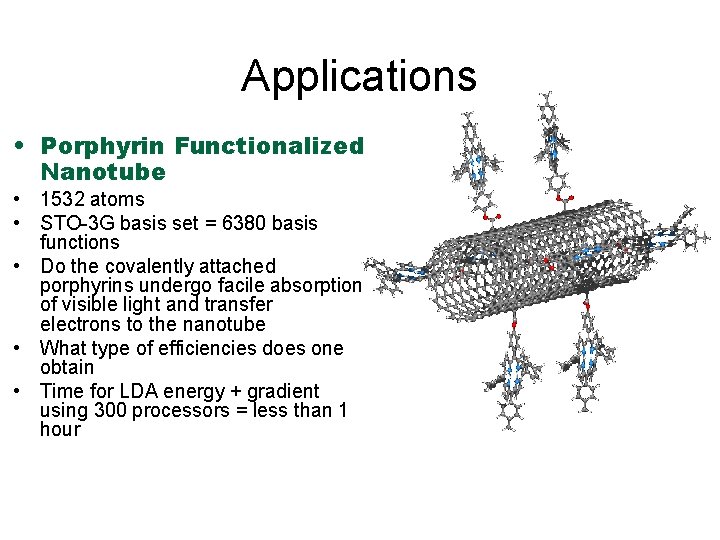
Applications • Porphyrin Functionalized Nanotube • 1532 atoms • STO-3 G basis set = 6380 basis functions • Do the covalently attached porphyrins undergo facile absorption of visible light and transfer electrons to the nanotube • What type of efficiencies does one obtain • Time for LDA energy + gradient using 300 processors = less than 1 hour
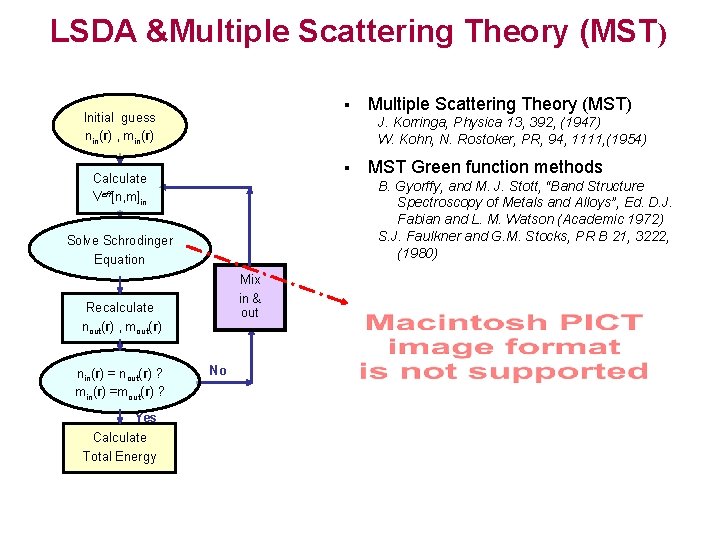
LSDA &Multiple Scattering Theory (MST) § Initial guess nin(r) , min(r) J. Korringa, Physica 13, 392, (1947) W. Kohn, N. Rostoker, PR, 94, 1111, (1954) § Calculate Veff[n, m]in Mix in & out Recalculate nout(r) , mout(r) Yes Calculate Total Energy MST Green function methods B. Gyorffy, and M. J. Stott, “Band Structure Spectroscopy of Metals and Alloys”, Ed. D. J. Fabian and L. M. Watson (Academic 1972) S. J. Faulkner and G. M. Stocks, PR B 21, 3222, (1980) Solve Schrodinger Equation nin(r) = nout(r) ? min(r) =mout(r) ? Multiple Scattering Theory (MST) No
Algorithm Design for future generation architectures • More accurate • Spectral or pseudo-spectral accuracy • Wider range of applicability • Sparse representation • Memory requirements grow linearly • Each processor can treat thousands of atoms • Make use of large number of processors • Message-Passing • Each atom/node local message-passing is independent of the size of the system • Time consuming step of model • Sparse linear solver • Direct or preconditioned iterative approach
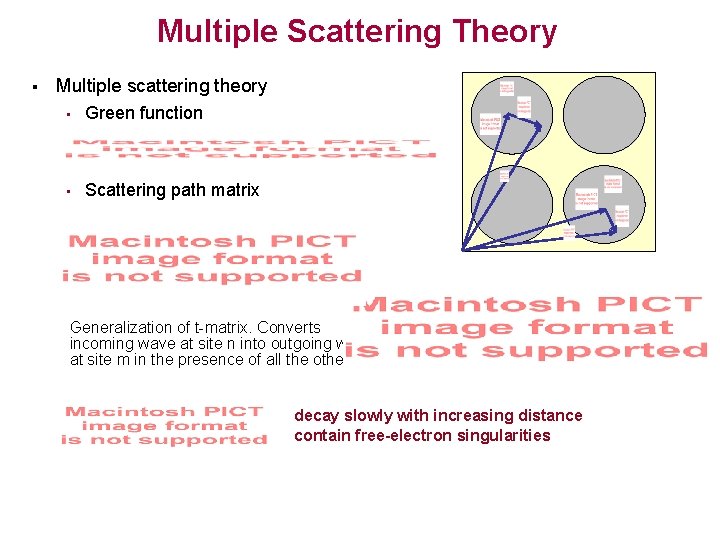
Multiple Scattering Theory § Multiple scattering theory • Green function • Scattering path matrix Generalization of t-matrix. Converts incoming wave at site n into outgoing wave at site m in the presence of all the other sites decay slowly with increasing distance contain free-electron singularities
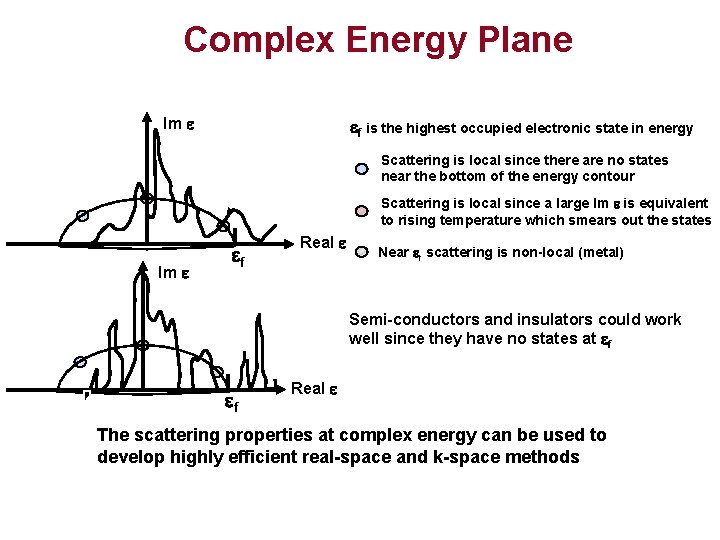
Complex Energy Plane Im e ef is the highest occupied electronic state in energy Scattering is local since there are no states near the bottom of the energy contour Scattering is local since a large Im e is equivalent to rising temperature which smears out the states Im e ef Real e Near ef scattering is non-local (metal) Semi-conductors and insulators could work well since they have no states at ef ef Real e The scattering properties at complex energy can be used to develop highly efficient real-space and k-space methods
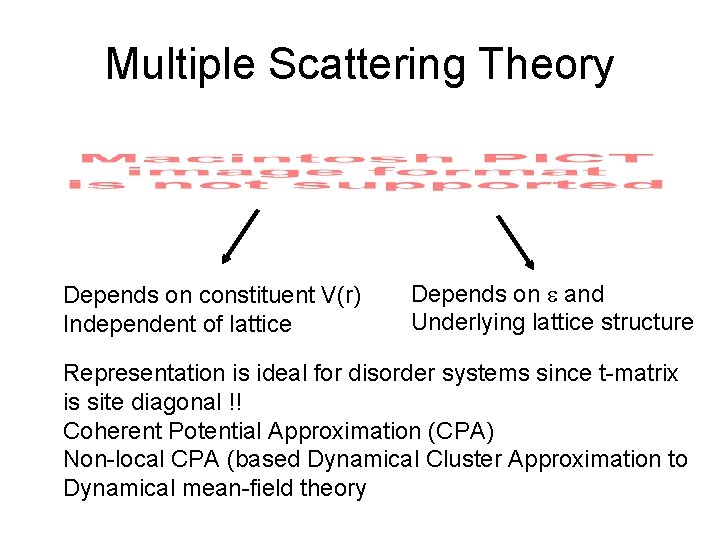
Multiple Scattering Theory Depends on constituent V(r) Independent of lattice Depends on and Underlying lattice structure Representation is ideal for disorder systems since t-matrix is site diagonal !! Coherent Potential Approximation (CPA) Non-local CPA (based Dynamical Cluster Approximation to Dynamical mean-field theory
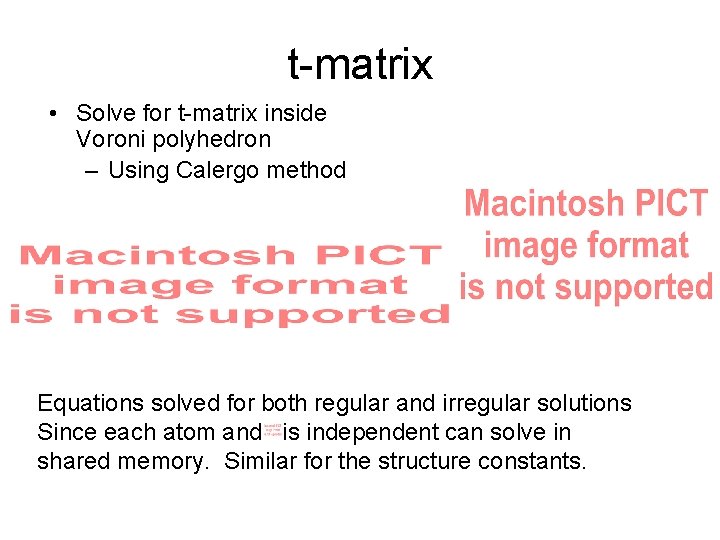
t-matrix • Solve for t-matrix inside Voroni polyhedron – Using Calergo method Equations solved for both regular and irregular solutions Since each atom and is independent can solve in shared memory. Similar for the structure constants.
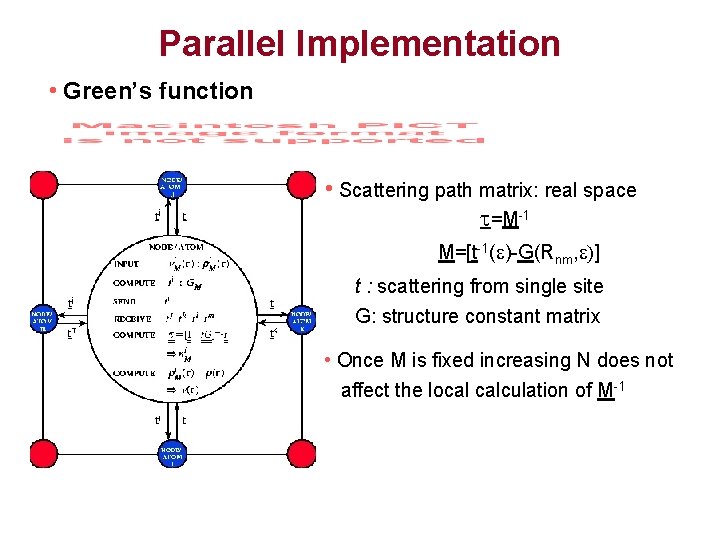
Parallel Implementation • Green’s function • Scattering path matrix: real space t=M-1 M=[t-1( )-G(Rnm, )] t : scattering from single site G: structure constant matrix • Once M is fixed increasing N does not affect the local calculation of M-1

Tight-Binding MST Representation Tight Binding Multiple Scattering Theory Embed a constant repulsive potential Shifts the energy zero allowing for calculations at negative energy Rapidly decaying interactions Free electron singularities are not a problem Sparse representation } 2 Ryd. Vr Constant inside a sphere {0

Screened Structure Constants • Linear solve using m atom cluster that is less than the n atom system • Easy to perform Fourier transform – K-space method • Screened Structure Constants Gs on the left unscreened on the right – Screened structure constants rapidly go to zero, whereas the free space structure constants have hardly changed
Screened MST Methods • Formulation produces a sparse matrix representation – 2 -D case has tridiagonal structure with a few distant elements due to periodicity – 3 -D case has scattered elements • Mainly due to mapping 3 -D structure to a matrix (2 -D) • A few elements due to periodic boundary conditions • Require block diagonals of the inverse of t(e) matrix – Block diagonals represent the site t(e) matrix and are needed to calculate the Green’s function for each atomic site • Sparse direct and preconditioned iterative methods are used to calculate tii(e) – Super. LU – Transpose free Quasi-Minimal Residual Method (TFQMR)
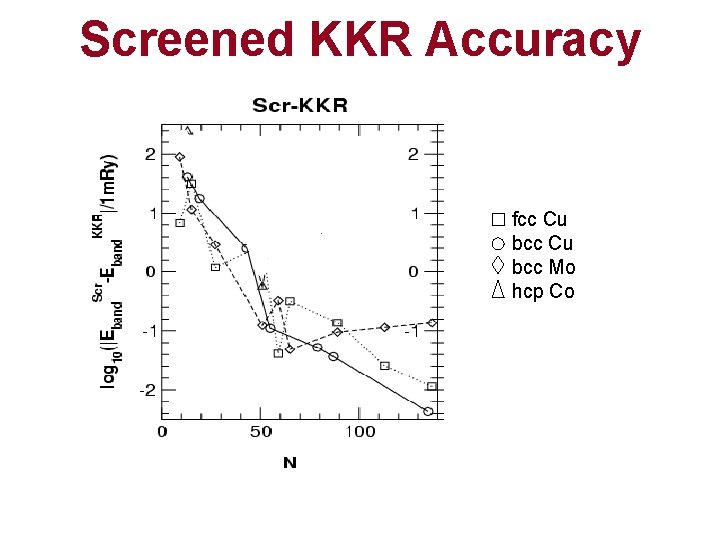
Screened KKR Accuracy fcc Cu bcc Mo hcp Co
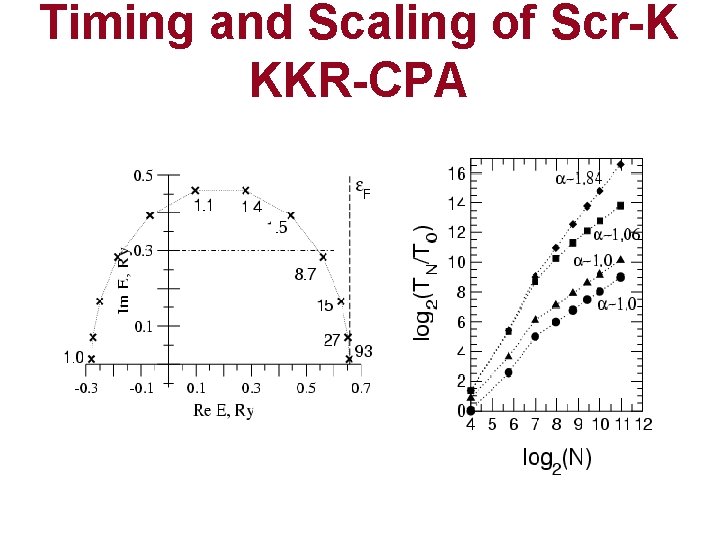
Timing and Scaling of Scr-K KKR-CPA
Conclusion • Initial benchmarking of the Screened KKR method – Super. LU N 1. 8 for finding the inverse of the upper left block of t – TFQMR with block Jacobi preconditioner N 1. 06 for finding the inverse of the upper left block of t • Extremely high sparsity (97%-99% zeros increases with increasing system size) • Large number of atoms on a single processor • Real-space/Scr-KKR hybrid may provide the most efficient parallel approach for new generation architectres • Single code contains – LSMS, KKR-CPA, Scr-LSMS and Scr-KKR-CPA
Local Poisson Equation Discontinuous Galerkin approach
- Slides: 18