
IMPLEMENTATION OF CIRCULAR 1 OF 2016 SAOU GAUTENG

- Slides: 42
IMPLEMENTATION OF CIRCULAR 1 OF 2016 SAOU (GAUTENG) EMPOWERMENT: NEWLY APPOINTED PRINCIPALS 25 FEBRUARY 2020
INTRODUCTION • • Maintaining and exercising discipline is the one the key responsibilities of Principals must deal with the progressive discipline of employees within their authority. Dispute Management at Districts and Head Office should render only a support service in respect of progressive discipline. Serious acts of misconduct and cases of corporal punishment (assault) must be referred to the District Office’s Dispute Management unit for a formal disciplinary inquiry.
PURPOSE OF CIRCULAR • • To indicate the specific responsibilities and authority of Principals. To clarify the procedures to be followed. To provide practical guidelines on administering the relevant disciplinary processes. To provide standardised formats of forms and letters to be used.
LEGAL FRAMEWORK AND AUTHORITY • • • Educators: – Employment of Educators Act, 1998. – Schedule 2 of the Employment of Educators Act, 1998. – South African Schools Act, 1996 (s. 16(3), s. 16 A(2)(e)). Public Servants: – Public Service Act, (Act No. 103 of 1994) as amended. – PSCBC Resolution No. 1 of 2003. – South African Schools Act, 1996 (16 A(2)(e)). Other provisions: – South African Schools Act, 1996 (s. 16 A(3)). – Labour Relations Act (Act No. 66 of 1995) as amended. – Schedule 8 of the Labour Relations Act (Act No. 66 of 1995). – Employment contract of SGB employees.
DEFINITIONS Misconduct • • Sections 17 and 18, as well as Schedule 2 of the Employment of Educators Act, 1998. Other legislation - Section 18(1)(a) - failure to comply with or contravening any other statute, regulation or legal obligation relating to education and the employment relationship, e. g. PFMA, SASA, Child Care Act, Sexual Offences Act, etc. Annexure A of PSCBC Resolution No. 1 of 2003 - Public Service Code of Conduct. LRA’s Schedule 8 - Code of Good Practice: Dismissals – not necessary to communicate well established rules.
WHAT IS DISCIPLINARY ACTION? Disciplinary action – • any corrective action • instituted against an employee • in response to unacceptable behaviour, or • unsatisfactory work performance, • other than incompetence or incapacity.
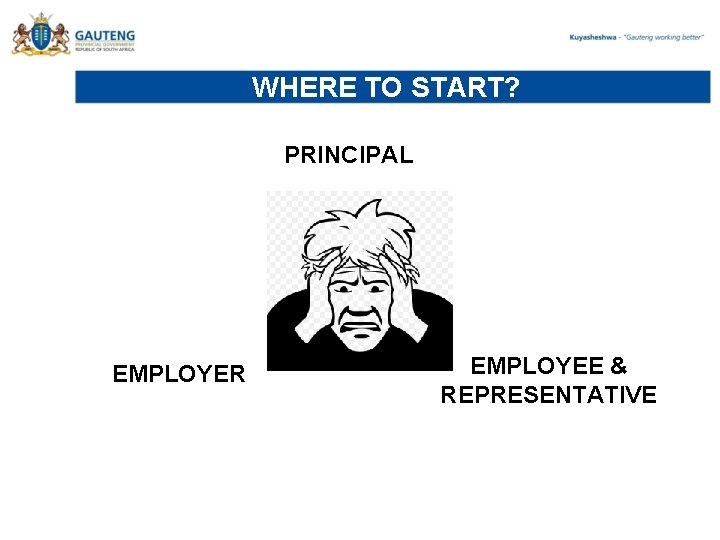
WHERE TO START? PRINCIPAL EMPLOYER EMPLOYEE & REPRESENTATIVE
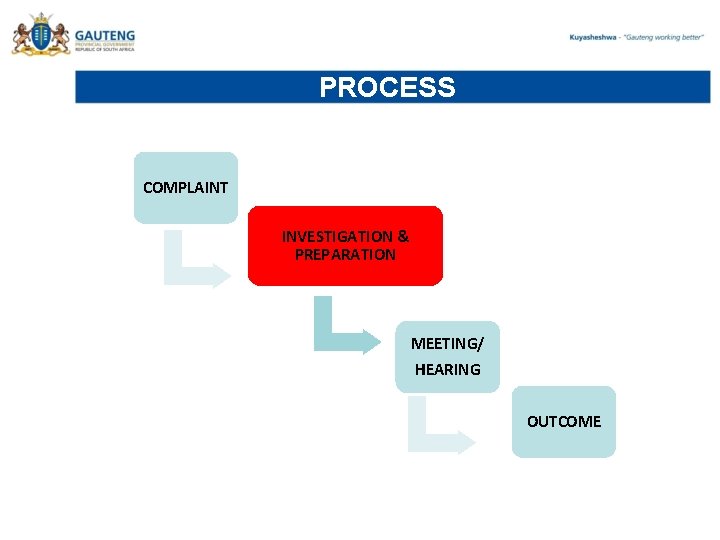
PROCESS COMPLAINT INVESTIGATION & PREPARATION MEETING/ HEARING OUTCOME
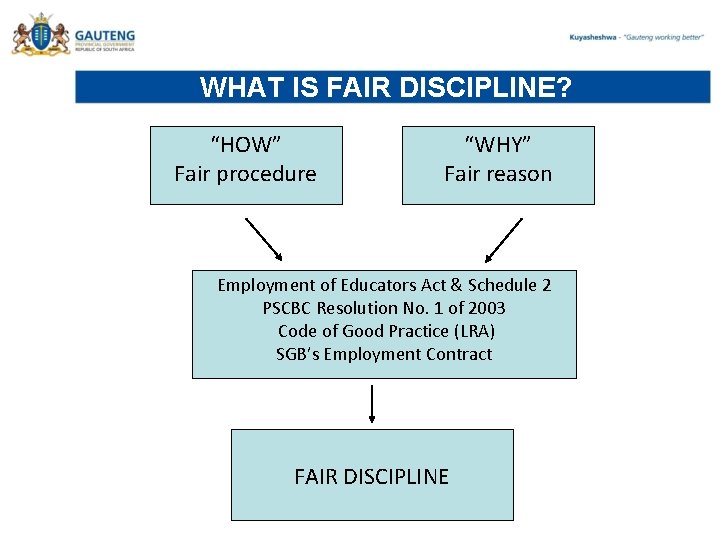
WHAT IS FAIR DISCIPLINE? “HOW” Fair procedure “WHY” Fair reason Employment of Educators Act & Schedule 2 PSCBC Resolution No. 1 of 2003 Code of Good Practice (LRA) SGB’s Employment Contract FAIR DISCIPLINE
WHAT GUIDES A FAIR PROCEDURE? • Section 23 of Bill of Rights - right to fair labour practices. • Labour Relations Act (Schedule 8) - a dismissal is unfair if it is not effected for a fair reason and in accordance with a fair procedure. • Schedule 2 (Disciplinary Code and Procedures for Educators) - discipline must be applied in a prompt fair, consistent and just manner. • Procedural steps to be taken before an employee can be charged and found guilty of misconduct. • Must follow the steps stipulated in the prescribed disciplinary code and procedures, legislation, etc. • Failure to follow procedural requirements can result in negative outcomes – procedural unfairness.
ELEMENTS OF A FAIR PROCEDURE • Offence - inform employee of nature of offence/details of complaint. • Timely - within a reasonable period, avoid perception that offence was condoned. • Notice of meeting - give sufficient notice of the date to allow employees to prepare their defence. Prepare witnesses, etc. • Representation - employees may be represented by trade union representative or another employee based at the school. • Defence - employees have a right to state their case or defend themselves on their own or via a representative. • Right to call a witness - employees may call any witness. • Right to the finding - an employee must be informed whether guilty or not. If guilty, he/she has the right to be fully informed of the facts and reasons for the guilty finding. • Appeal/Objection • Educators cannot appeal but only object to a finding or sanction following the informal disciplinary procedure (Item 4(6)(d)). • Employees employed ito the Public Service Act may appeal any decision ito item 2. 4(d) of PSCBC Resolution 1 of 2003.
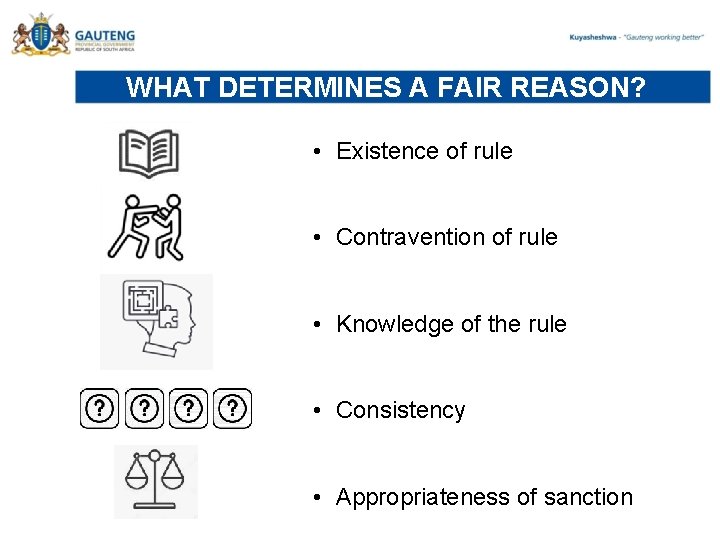
WHAT DETERMINES A FAIR REASON? • Existence of rule • Contravention of rule • Knowledge of the rule • Consistency • Appropriateness of sanction
WHAT DETERMINES A FAIR REASON? • Substantive fairness - reasons for disciplinary action. • Valid reasons and substantial, supporting evidence for misconduct. • Determined by the following enquiries: • Did the employee break an existing, reasonable and valid workplace rule? • Was the employee aware or could he/she reasonably have been expected to be aware of the rule? • Did you act against the employee for a valid reason? • Are action being taken consistently? • Was the action taken appropriate given the proven reason? • Factors to consider ito reasonable action: • • • Seriousness of the transgression. Nature of the post and of the workplace. Employee's circumstances. Employer's circumstances. Other.
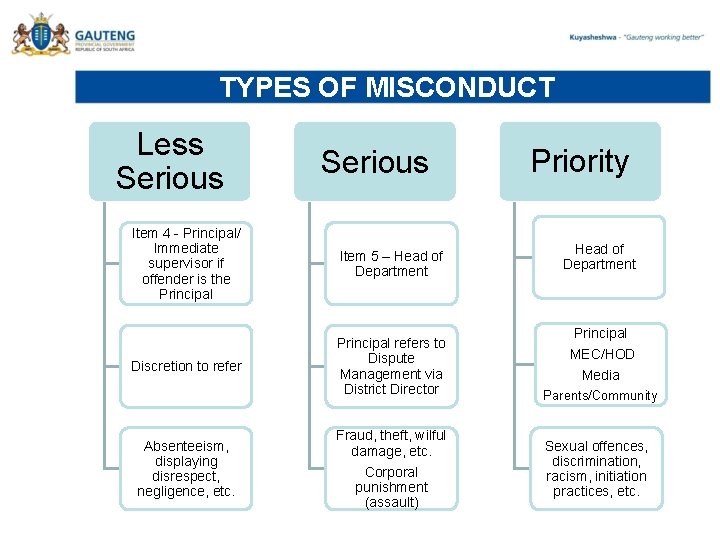
TYPES OF MISCONDUCT Less Serious Item 4 - Principal/ Immediate supervisor if offender is the Principal Item 5 – Head of Department Discretion to refer Principal refers to Dispute Management via District Director Absenteeism, displaying disrespect, negligence, etc. Fraud, theft, wilful damage, etc. Corporal punishment (assault) Priority Head of Department Principal MEC/HOD Media Parents/Community Sexual offences, discrimination, racism, initiation practices, etc.
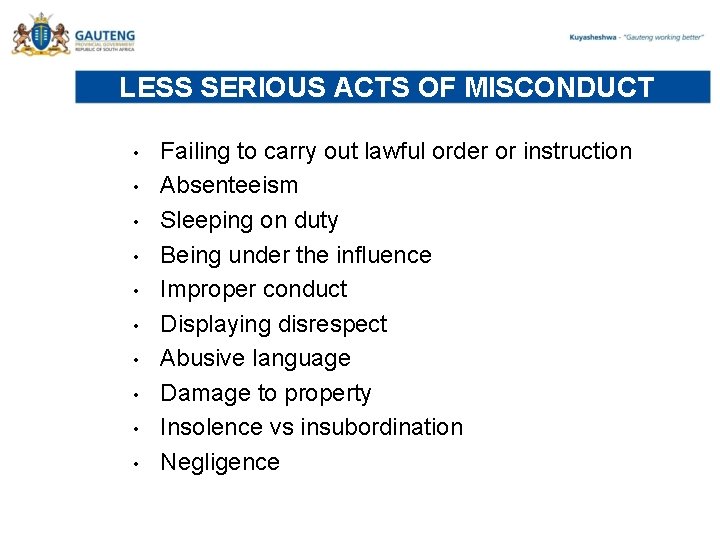
LESS SERIOUS ACTS OF MISCONDUCT • • • Failing to carry out lawful order or instruction Absenteeism Sleeping on duty Being under the influence Improper conduct Displaying disrespect Abusive language Damage to property Insolence vs insubordination Negligence
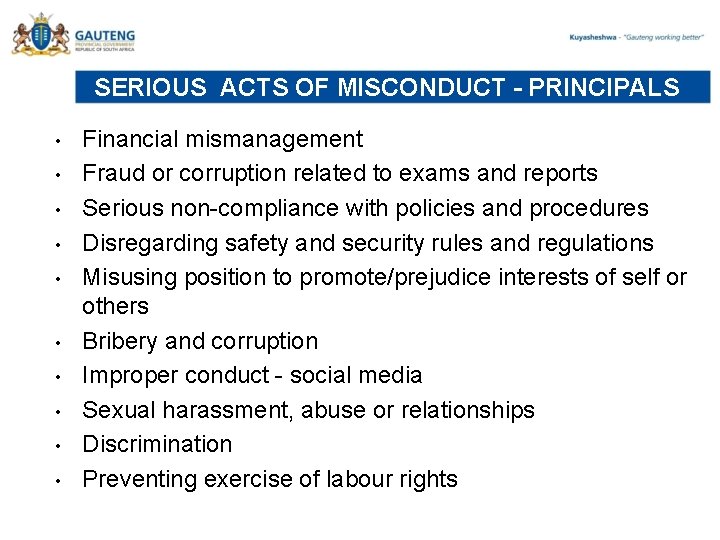
SERIOUS ACTS OF MISCONDUCT - PRINCIPALS • • • Financial mismanagement Fraud or corruption related to exams and reports Serious non-compliance with policies and procedures Disregarding safety and security rules and regulations Misusing position to promote/prejudice interests of self or others Bribery and corruption Improper conduct - social media Sexual harassment, abuse or relationships Discrimination Preventing exercise of labour rights
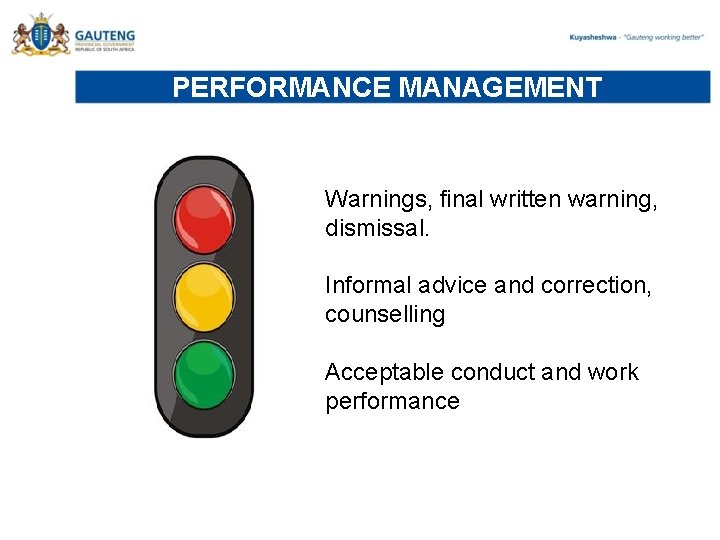
PERFORMANCE MANAGEMENT Warnings, final written warning, dismissal. Informal advice and correction, counselling Acceptable conduct and work performance
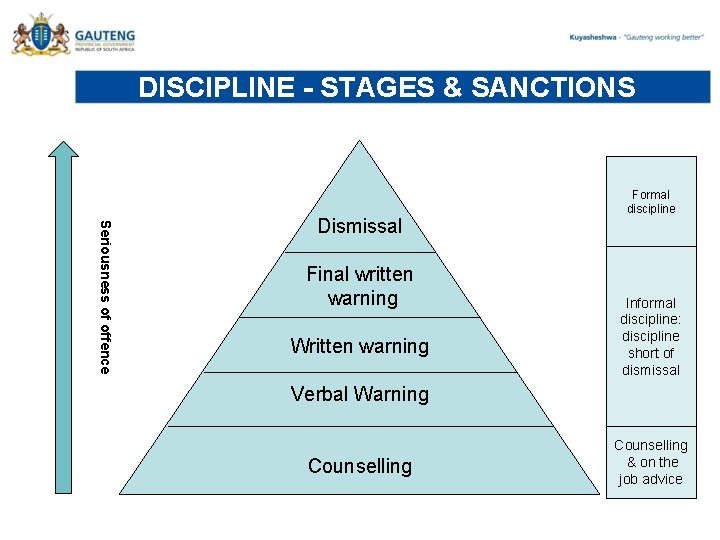
DISCIPLINE - STAGES & SANCTIONS Seriousness of offence Dismissal Final written warning Written warning Formal discipline Informal discipline: discipline short of dismissal Verbal Warning Counselling & on the job advice
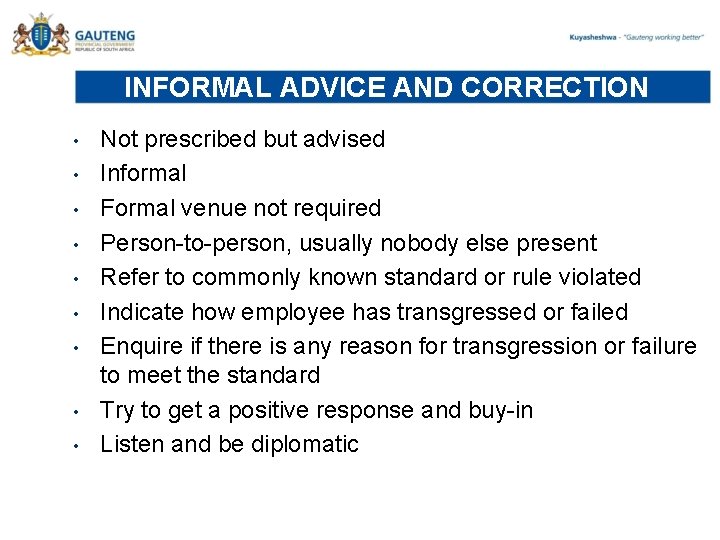
INFORMAL ADVICE AND CORRECTION • • • Not prescribed but advised Informal Formal venue not required Person-to-person, usually nobody else present Refer to commonly known standard or rule violated Indicate how employee has transgressed or failed Enquire if there is any reason for transgression or failure to meet the standard Try to get a positive response and buy-in Listen and be diplomatic
COUNSELLING
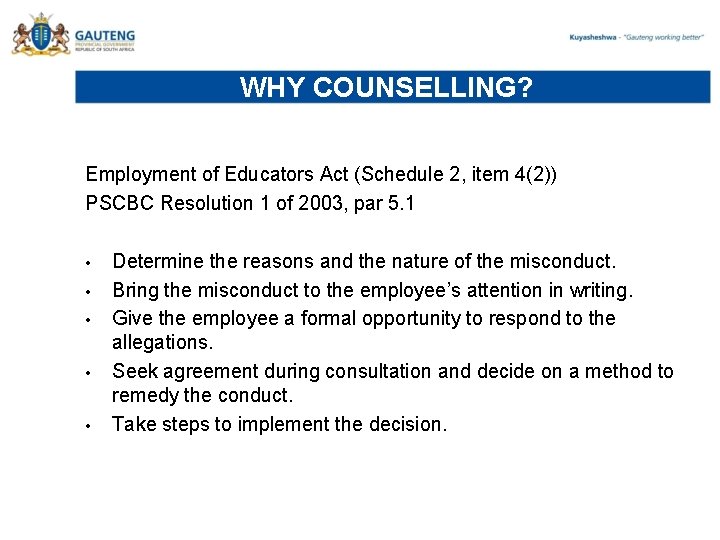
WHY COUNSELLING? Employment of Educators Act (Schedule 2, item 4(2)) PSCBC Resolution 1 of 2003, par 5. 1 • • • Determine the reasons and the nature of the misconduct. Bring the misconduct to the employee’s attention in writing. Give the employee a formal opportunity to respond to the allegations. Seek agreement during consultation and decide on a method to remedy the conduct. Take steps to implement the decision.
COUNSELLING - GENERAL • • First step of disciplinary procedure Adopt a problem solving approach, not confrontational Semi-formal, appropriate venue, e. g. Principal's office, boardroom Formal appointment, i. e. scheduled meeting Advise of right to have representative present Inform about the rule broken or standard not attained Ito standard not obtained – – • • inform employee how he/she is failing identify obstacles preventing attainment of standard consider assistance and/or training required encourage and motivate Multiple sessions may be required Warn employee of escalation if behaviour is not corrected Keep record, e. g. recording and/or minutes co-signed by employee Schedule a follow-up session
VERBAL WARNING Employment of Educators Act (Schedule 2, item 4(3)) PSCBC Resolution 1 of 2003, par 5. 1 • • • In cases where the seriousness of the misconduct warrants it, the employer of the educator may give the educator a verbal warning. Inform the educator that further misconduct may result in more serious disciplinary action. Record the warning in writing, to be signed by both parties for record purposes.
WRITTEN AND FINAL WRITTEN WARNING Employment of Educators Act (Schedule 2, item 4, 5 and 6): PSCBC Resolution 1 of 2003, par 5. 3 and 5. 4 • • • If the seriousness of the misconduct warrants it, a written warning or a final written warning may be issued. Use Form A (written warning) and Form B (final written warning). Employees must acknowledge receipt on the copy. If he/she refuses, hand it to him/her in the presence of another educator, to sign and confirm that the warning was conveyed. Warnings must be filed in the employee’s personal file. Warnings remain valid for six months. In case of further disciplinary action during this period, warnings and any written objection (CS) or appeal (PS) or additional information may be taken into account in deciding on a sanction.
OBJECTIONS, APPEALS & DISPUTES Employment of educators act (schedule 2, item 4(4) PSCBC resolution 1 of 2003, par 2. 4(d) • • An educator may provide additional information or written objection against the finding or sanction, if he/she disagrees with it. The additional information and the objection must be filed on his/her personal file with the warning. Public Service employees may appeal to the MEC against decisions taken during informal disciplinary action in terms of item 2. 4(d) and par 8 of PSCBC Resolution 1 of 2003. NB. All employees have the right to refer an unfair labour practice dispute to the bargaining council or CCMA following disciplinary action – s. 186(2)(b).
WHAT ARE THE DUTIES OF A PRINCIPAL? • • • Notify employees of the expected behaviour, performance requirements and possible consequences for failure to comply. Ensure that staff members know the rules, expected conduct and/or procedures. Make efforts to establish whether any rule or instruction of management was violated. Conduct a fair and objective investigation prior to disciplinary action. Provide substantial evidence and documentation to prove misconduct. Take informal disciplinary action appropriate to the seriousness and nature of the offence by considering these factors: – – Circumstances surrounding violation. Seriousness of the offence. Past record of the offender. Disciplinary actions taken in similar situations i. e. to apply rules consistently
INVESTIGATION INTERVIEW - STEPS • Interview the accuser/complainant. • Interview witnesses. • Interview others whom I have knowledge of the incident. • Interview the accused. • Reviewing relevant documents and/or evidence. • Re-interview people as needed, i. e. conduct detailed and complete interviews.
INVESTIGATION INTERVIEW: PROCESS • • • Ask open ended questions. Elicit facts and not opinions. Interview face-to-face whenever possible. Put the witness at ease. Explain the process. Start with broad open-ended in the questions. Get the chronology of events - repeat the dates. Ask one question at a time. Ask fact based questions – who, what, where, when, and how. Record the employees actual words - harassment, racism, etc. Focus on gathering information and not drawing conclusions. Ask if there any other questions you should have asked in the interview.
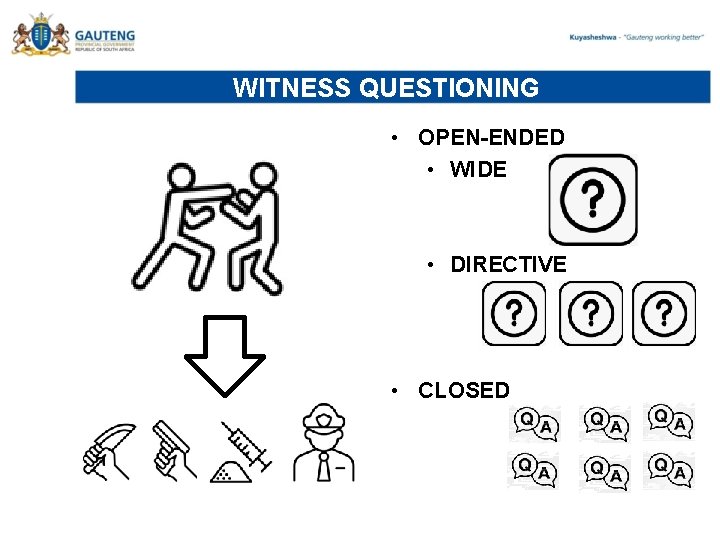
WITNESS QUESTIONING • OPEN-ENDED • WIDE • DIRECTIVE • CLOSED
CREDIBILITY ASSESSMENT When there are conflicting versions of events, you must weigh the credibility of the witnesses. Factors to consider: • Inherent plausibility - does it makes sense? • Demeanour - nervousness, eye contact, etc. • Is the employee/witness forthcoming with information or was it “dragged out”? • Motive to lie • Corroborative evidence – something to back up the witness. • Past record. NB! None of these factors create conclusive presumptions of guilt or are determinative as to credibility.
DECIDING ON A SANCTION • Informal disciplinary sanctions must be appropriate. • Annexure E (PS&CS) of Circular 1 of 2016 serves as a guide in determining sanctions at informal disciplinary meetings. • Each case must be considered on its own merits. • Act consistently and follow a fair procedure otherwise it may be an unfair labour practice. • Take the circumstances in which an offence occurs into account. • Focussing on the substance rather than the form of the offence is important.
SANCTION - FACTORS TO CONSIDER Factors to consider when deciding on the sanction may include: • • The time-frame over which the offence occurred. Whether the offence is a single action or series of acts. The potential for repetition of the offence. The intention of the employee – premeditation makes the offence more serious. Provocation may only result in a more lenient sanction, not a not guilty finding. The initial response of the employee. The scale of the offence. The impact of the offence on the employment relationship.
SANCTION - MITIGATING AND AGGRAVATING • Aggravating factors: wilfulness, lack of remorse, previous valid warnings and if the employer previously brought the seriousness of the relevant infringement to the attention of the employee. • Mitigating factors: long service, previous exemplary service, an unblemished disciplinary record, remorse, coercion, acting out of fear for his/her own safety, and the employee’s personal circumstances. • NB - The nature of the job and the circumstances of the infringement are more significant than the employee’s personal circumstances.
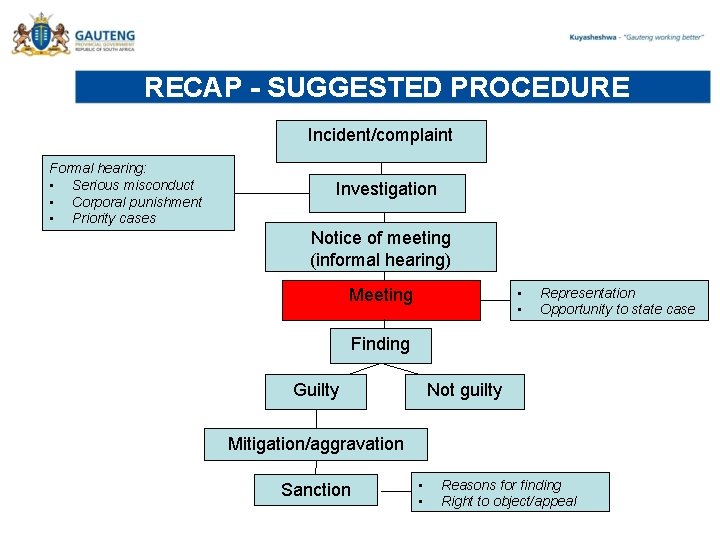
RECAP - SUGGESTED PROCEDURE Incident/complaint Formal hearing: • Serious misconduct • Corporal punishment • Priority cases Investigation Notice of meeting (informal hearing) • • Meeting Representation Opportunity to state case Finding Guilty Not guilty Mitigation/aggravation Sanction • • Reasons for finding Right to object/appeal
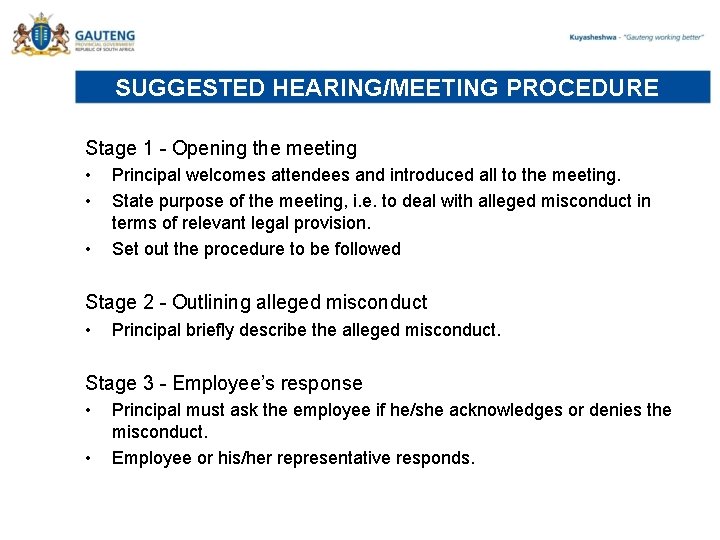
SUGGESTED HEARING/MEETING PROCEDURE Stage 1 - Opening the meeting • • • Principal welcomes attendees and introduced all to the meeting. State purpose of the meeting, i. e. to deal with alleged misconduct in terms of relevant legal provision. Set out the procedure to be followed Stage 2 - Outlining alleged misconduct • Principal briefly describe the alleged misconduct. Stage 3 - Employee’s response • • Principal must ask the employee if he/she acknowledges or denies the misconduct. Employee or his/her representative responds.
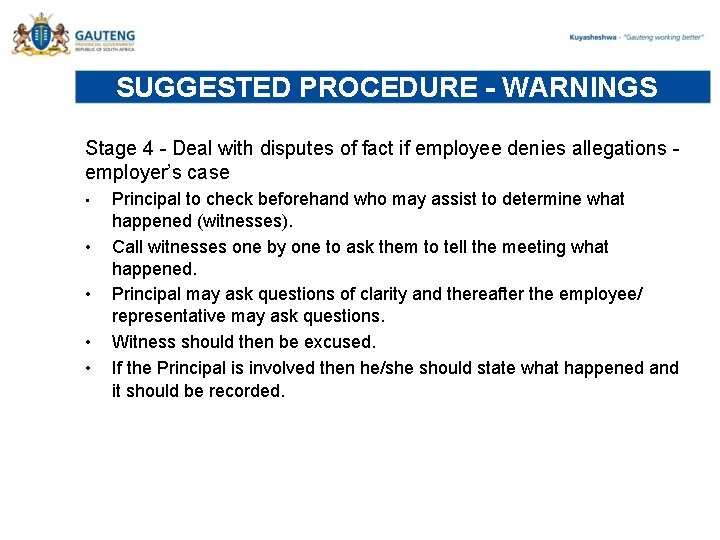
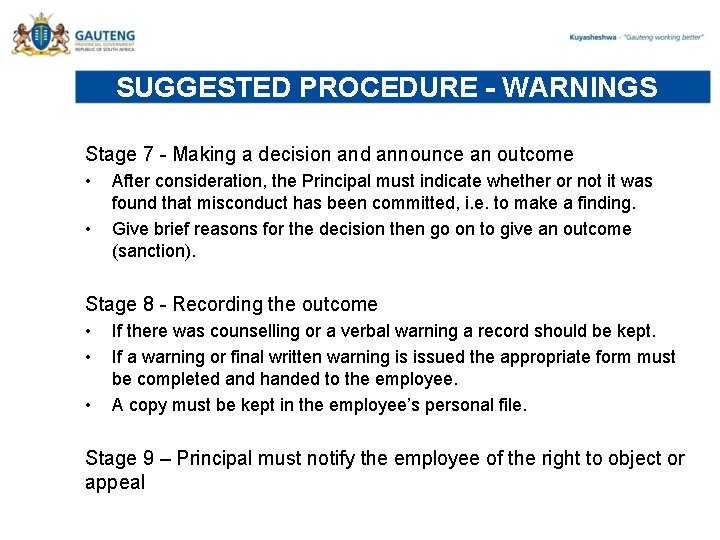
SUGGESTED PROCEDURE - WARNINGS Stage 4 - Deal with disputes of fact if employee denies allegations employer’s case • • • Principal to check beforehand who may assist to determine what happened (witnesses). Call witnesses one by one to ask them to tell the meeting what happened. Principal may ask questions of clarity and thereafter the employee/ representative may ask questions. Witness should then be excused. If the Principal is involved then he/she should state what happened and it should be recorded.
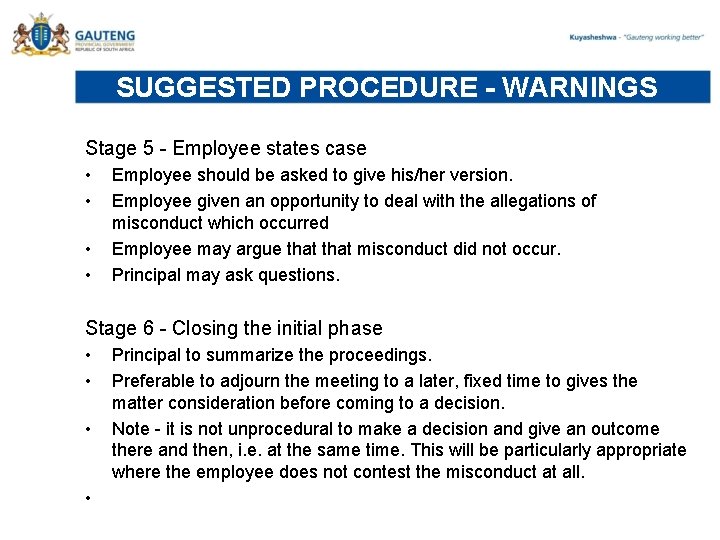
SUGGESTED PROCEDURE - WARNINGS Stage 5 - Employee states case • • Employee should be asked to give his/her version. Employee given an opportunity to deal with the allegations of misconduct which occurred Employee may argue that misconduct did not occur. Principal may ask questions. Stage 6 - Closing the initial phase • • Principal to summarize the proceedings. Preferable to adjourn the meeting to a later, fixed time to gives the matter consideration before coming to a decision. Note - it is not unprocedural to make a decision and give an outcome there and then, i. e. at the same time. This will be particularly appropriate where the employee does not contest the misconduct at all.
SUGGESTED PROCEDURE - WARNINGS Stage 7 - Making a decision and announce an outcome • • After consideration, the Principal must indicate whether or not it was found that misconduct has been committed, i. e. to make a finding. Give brief reasons for the decision then go on to give an outcome (sanction). Stage 8 - Recording the outcome • • • If there was counselling or a verbal warning a record should be kept. If a warning or final written warning is issued the appropriate form must be completed and handed to the employee. A copy must be kept in the employee’s personal file. Stage 9 – Principal must notify the employee of the right to object or appeal
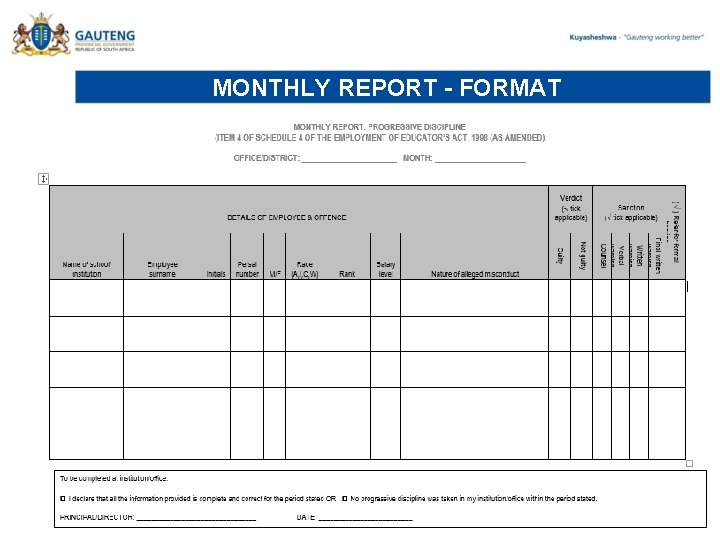
MONTHLY REPORT ON PROGRESSIVE DISCIPLINE • Principals must submit a monthly report on progressive discipline to the relevant Dispute Management unit at the District Office on the prescribed reporting template.
MONTHLY REPORT - FORMAT
CONCLUSION • Managing misconduct requires the manager to have a clear understanding of all requirements entailed for each case. • We need to encourage the practice of progressive discipline within the Gauteng Department of Education. • Employees charged with misconduct must be treated fairly. • Actions taken must benefit those punished and the employer – corrective discipline. • Prescribed procedures must be utilised in a consistent and fair manner to improve the working conditions of both the employer and the employee.
CONTACT DETAILS 011 355 -0426 060 991 8452 Deidre. Viljoen@gauteng. gov. za