
Implementation of Arc GIS Geoprocessing Models to Understand


- Slides: 19
Implementation of Arc. GIS Geoprocessing Models to Understand Delineate Areas Damaged by the Tornadoes of Spring 2011 © Abi Dhakal GIS Specialist Alabama Forestry Commission
Alabama Forestry Commission (AFC) • AFC Implemented Methods to Acquire Tornado Damage Data • Techniques Used to Create Geospatial Data of the Tornado. Damaged Paths • AFC’s Coordination with the State’s GIS Task Force for Tornado Data • Arc. GIS Geoprocessing Models • Conclusion
AFC Implemented Methods to Acquire Tornado Damage Data • AFC pilots were tasked to send in GPS Exchange Format (GPX) files of the tornado-impacted areas to the AFC State Headquarters. • The GPX files came in as waypoints and tracks. • Waypoints were sent for impacted areas where significant linear damage was minimal. • Tracks were sent for areas of significant linear damage. • The GPX files were converted to feature classes using DNR Garmin. • Data was also obtained from NOAA’s National Weather Service. • Some of the tornado-damaged paths were obtained from the State FTP site, facilitated by Information Services Division (ISD).
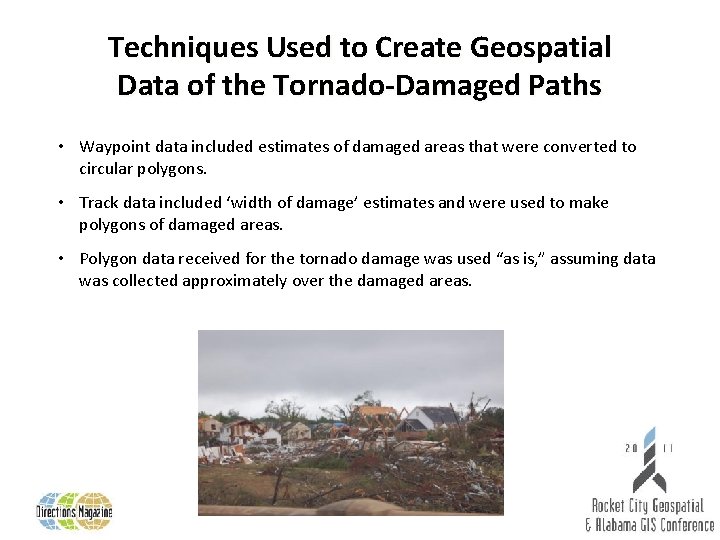
Techniques Used to Create Geospatial Data of the Tornado-Damaged Paths • Waypoint data included estimates of damaged areas that were converted to circular polygons. • Track data included ‘width of damage’ estimates and were used to make polygons of damaged areas. • Polygon data received for the tornado damage was used “as is, ” assuming data was collected approximately over the damaged areas.
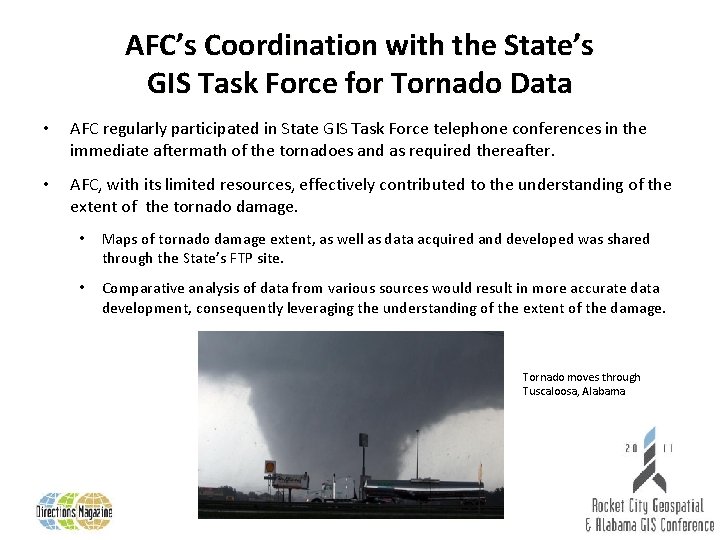
AFC’s Coordination with the State’s GIS Task Force for Tornado Data • AFC regularly participated in State GIS Task Force telephone conferences in the immediate aftermath of the tornadoes and as required thereafter. • AFC, with its limited resources, effectively contributed to the understanding of the extent of the tornado damage. • Maps of tornado damage extent, as well as data acquired and developed was shared through the State’s FTP site. • Comparative analysis of data from various sources would result in more accurate data development, consequently leveraging the understanding of the extent of the damage. Tuscaloosa News Tornado moves through Tuscaloosa, Alabama
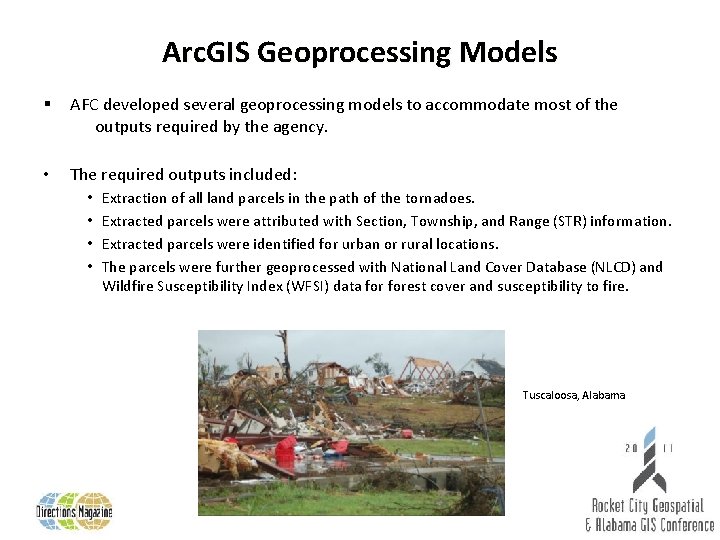
Arc. GIS Geoprocessing Models § AFC developed several geoprocessing models to accommodate most of the outputs required by the agency. • The required outputs included: • • Extraction of all land parcels in the path of the tornadoes. Extracted parcels were attributed with Section, Township, and Range (STR) information. Extracted parcels were identified for urban or rural locations. The parcels were further geoprocessed with National Land Cover Database (NLCD) and Wildfire Susceptibility Index (WFSI) data forest cover and susceptibility to fire. Tuscaloosa, Alabama
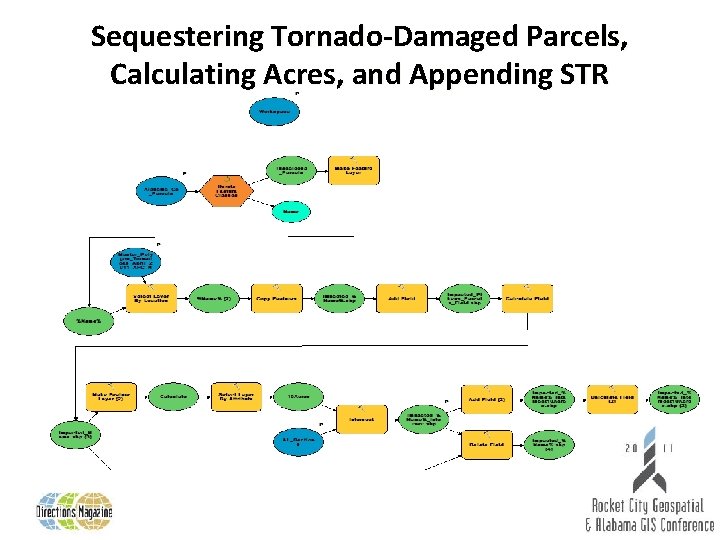
Sequestering Tornado-Damaged Parcels, Calculating Acres, and Appending STR
Appending NLCD and WFSI Values to the Parcel Records
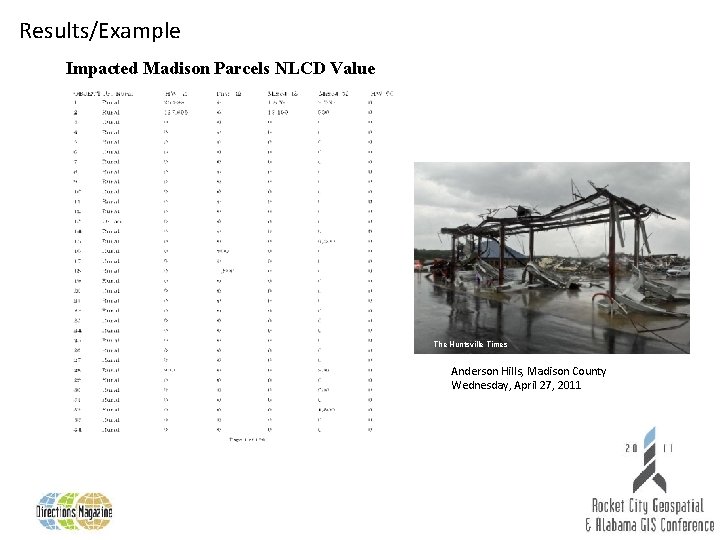
Results/Example Impacted Madison Parcels NLCD Value The Huntsville Times Anderson Hills, Madison County Wednesday, April 27, 2011
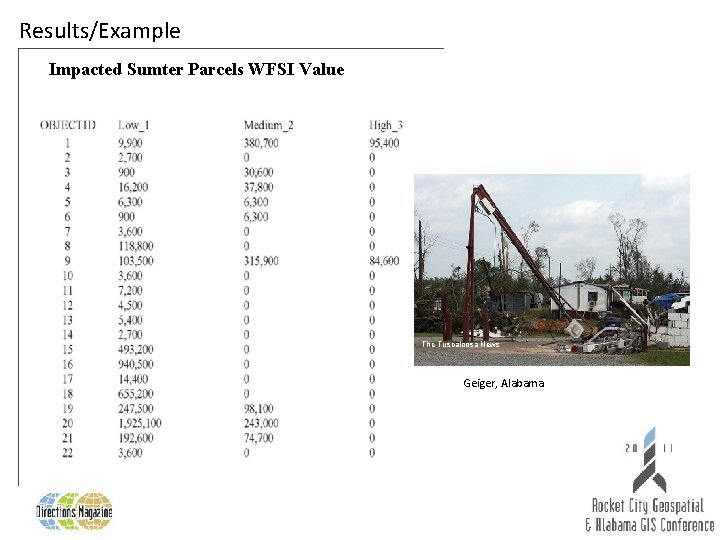
Results/Example Impacted Sumter Parcels WFSI Value The Tuscaloosa News Geiger, Alabama
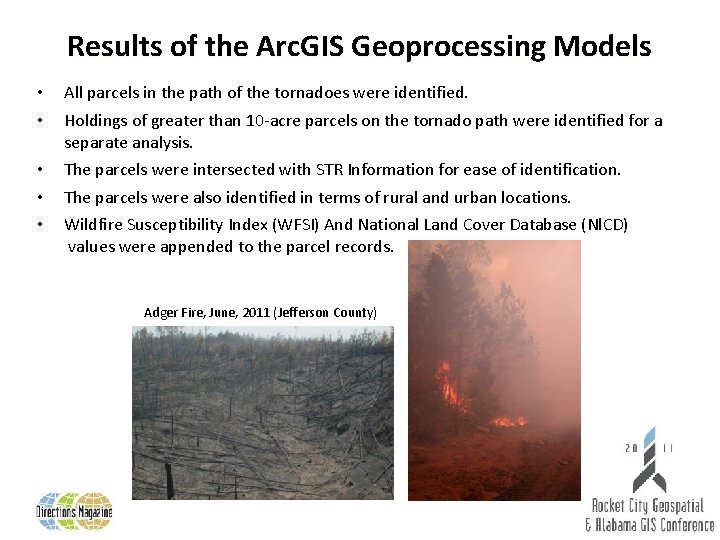
Results of the Arc. GIS Geoprocessing Models • • All parcels in the path of the tornadoes were identified. • • • The parcels were intersected with STR Information for ease of identification. Holdings of greater than 10 -acre parcels on the tornado path were identified for a separate analysis. The parcels were also identified in terms of rural and urban locations. Wildfire Susceptibility Index (WFSI) And National Land Cover Database (Nl. CD) values were appended to the parcel records. Adger Fire, June, 2011 (Jefferson County)
AFC Generated Mapbook by County
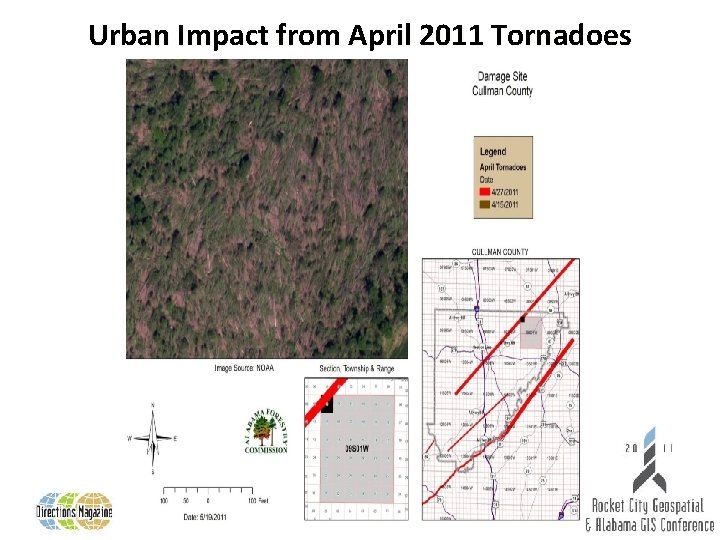
Urban Impact from April 2011 Tornadoes
Conclusion • AFC resources and preliminary National Weather Service data were used to determine the path of damage. • The Arc. GIS geoprocessing models were developed within days of the tornado impact. • The models helped AFC understand the extent of damage by the April tornadoes. • This greatly reduced the time for analysis. • Geoprocessing models, used with accurate tornado-path data, produce results of high confidence. • Alabama’s Information Service Division (ISD) sent the model to Joplin, Missouri.
Contact Information: ABI DHAKAL ALABAMA FORESTRY COMMISSION 513 MADISON AVENUE MONTGOMERY, ALABAMA 36104 PHONE : 334 -240 -9365 EMAIL: abi. dhakal@forestry. alabama. gov PATRICK GLASS ALABAMA FORESTRY COMMISSION ASSISTANT STATE FORESTER PHONE : 334 -240 -9367 EMAIL : Patrick. Glass@forestry. alabama. gov http: //www. youtube. com/watch? v=nk. UJUq. STOA 0
Questions? Abi Dhakal GIS Specialist Alabama Forestry Commission
Arc. GIS Geoprocessing Model
ABSTRACT The spring 2011 tornadoes were recorded in more than half of Alabama’s counties. The Arc. GIS geoprocessing models implemented by the Alabama Forestry Commission (AFC) were very effective in classifying areas of tornado damage. The models were used to classify forested versus non-forested parcels, parcels with varying Wildfire Susceptibility Indices, and segregating parcels into urban and rural classes. The Arc. GIS geoprocessing models provided quick analyses of the damaged areas. The AFC effectively coordinated with the State’s GIS Task Force to share knowledge of the tornado damage and eliminate redundancy in analysis processes. The AFC collected GPS Exchange Format (GPX) files on the tornado paths that were converted to feature classes for GIS analysis to meet agency objectives. The results of the analysis were used by Alabama’s Congressional Delegation to document a supplemental funding request for the USDA Farm Services Agency’s Emergency Forest Restoration Program. Results are also being used by the AFC, Alabama Forestry Recovery Task Force, Alabama Cooperative Extension Service, and other agencies to manage recovery of the forest resources.