
Implementation of Antibiotic Time Outs at UNC Medical
Implementation of Antibiotic Time Outs at UNC Medical Center September 19, 2019 Project Lead: Zach Willis Project Manager: May-Britt Sten Project Team Members: Ronald Davis, Donna Krzastek, Lindsay Daniels, Jon Juliano, Clare Mock, Will Stanley, Michael Swartwood Project Sponsor: David Weber Faculty Coach: Jennifer Elston-Lafata
Antibiotic Time Out A structured review of a patient’s antibiotic regimen after 48 hours Goal: progress from empiric to targeted antibiotics ◦ Empiric: broad-spectrum, toxic, expensive ◦ Targeted: narrow(er)-spectrum, safer, cheaper Completely independent of the central stewardship team Recommended by CDC as core element of antibiotic stewardship ◦ Joint Commission standards refer to CDC core activities
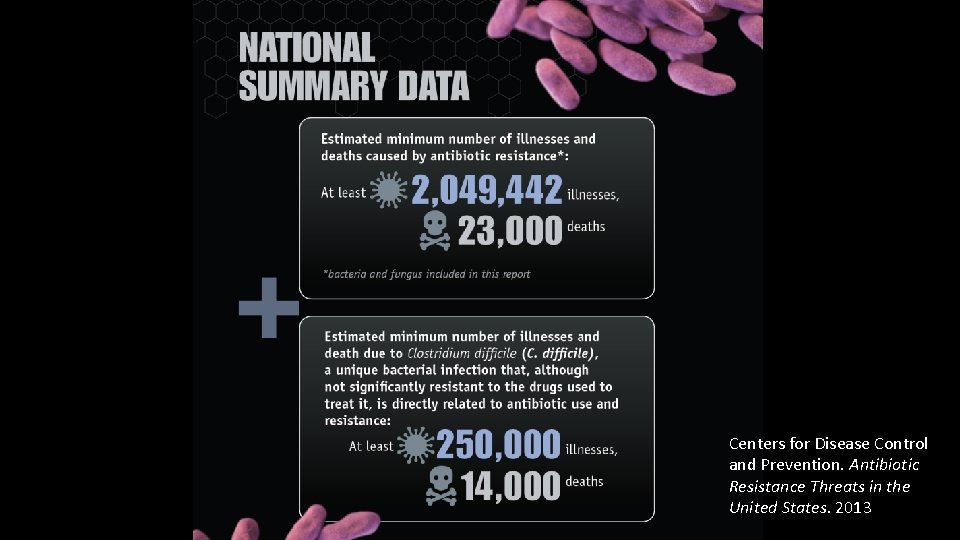
Centers for Disease Control and Prevention. Antibiotic Resistance Threats in the United States. 2013
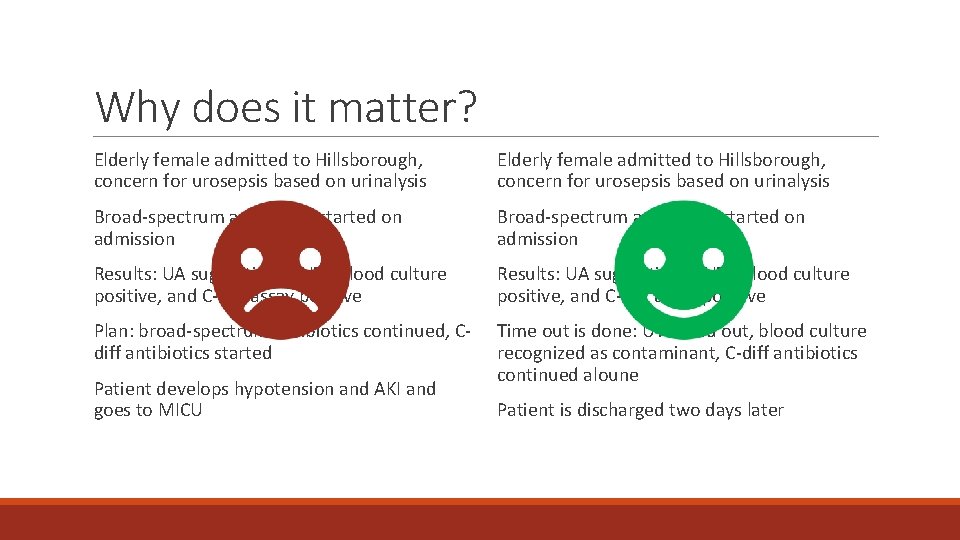
Why does it matter? Elderly female admitted to Hillsborough, concern for urosepsis based on urinalysis Broad-spectrum antibiotics started on admission Results: UA suggestive of UTI, blood culture positive, and C-diff assay positive Plan: broad-spectrum antibiotics continued, Cdiff antibiotics started Time out is done: UTI ruled out, blood culture recognized as contaminant, C-diff antibiotics continued aloune Patient develops hypotension and AKI and goes to MICU Patient is discharged two days later

Aim Implement routine, documented, meaningful antibiotic time outs for medical patients at UNC Hospitals Hillsborough Campus.
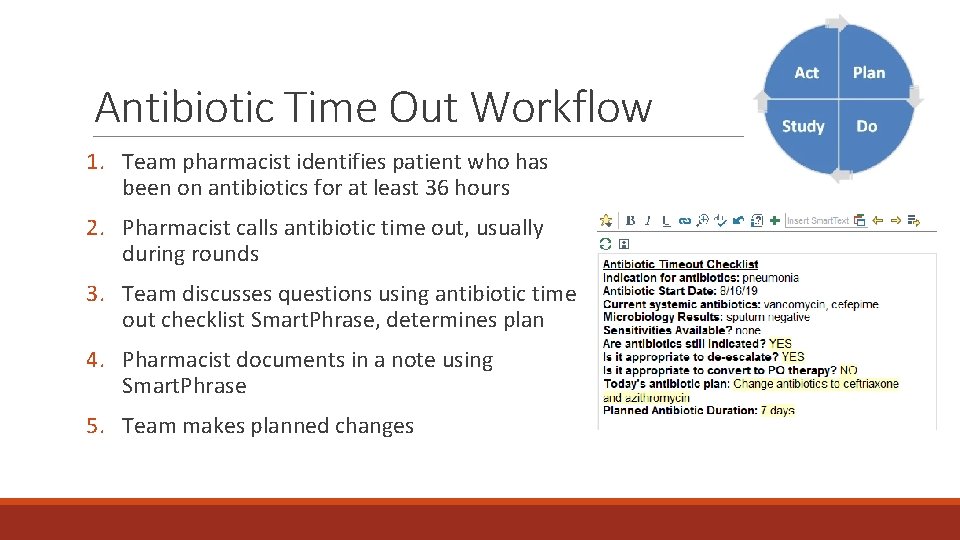
Antibiotic Time Out Workflow 1. Team pharmacist identifies patient who has been on antibiotics for at least 36 hours 2. Pharmacist calls antibiotic time out, usually during rounds 3. Team discusses questions using antibiotic time out checklist Smart. Phrase, determines plan 4. Pharmacist documents in a note using Smart. Phrase 5. Team makes planned changes

Challenge: Identifying Eligible Patients Method Comments Status i. Vent initiated by pharmacist approving initial order i. Vent can communicate with other pharmacists and be timed; requires participation by all pharmacists at all hours Not being used Crystal report of all patients on antibiotics, sorted by order age Effective, but added step in pharmacist’s workflow Not being used Pharmacy Sign Out Replacing i. Vents. Still only visible to pharmacists and relies on initial input. Some pharmacists are using this. Add reminder to physician sign- Checkbox reminder in the patient’s signout; out Smart. Phrase team fills in the date of eligibility Modest success in pilot testing

Pharmacy Sign Out

Results: Time Out Uptake Pilot testing Official MDA and BEST participation HBB and HBC added Weekends added Family Medicine (Blue and Green) added
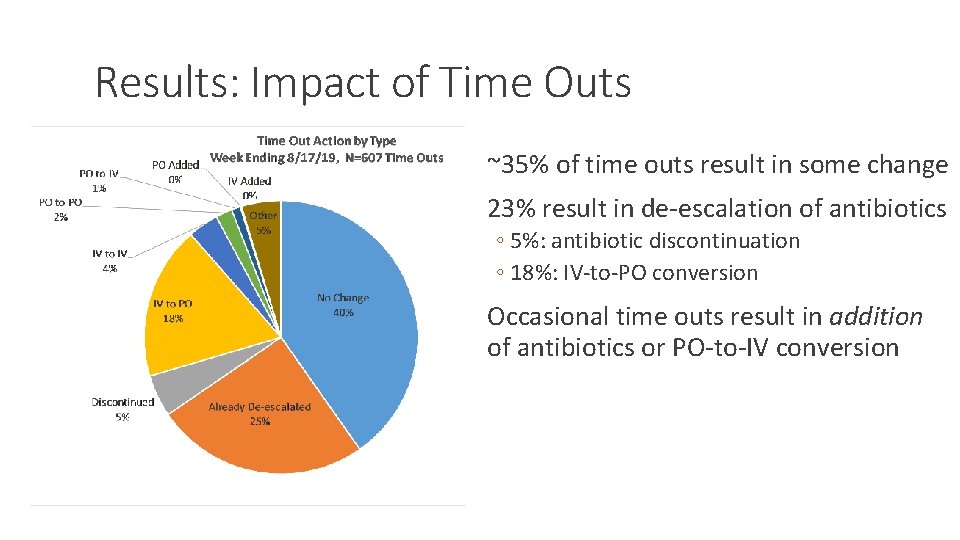
Results: Impact of Time Outs ~35% of time outs result in some change 23% result in de-escalation of antibiotics ◦ 5%: antibiotic discontinuation ◦ 18%: IV-to-PO conversion Occasional time outs result in addition of antibiotics or PO-to-IV conversion
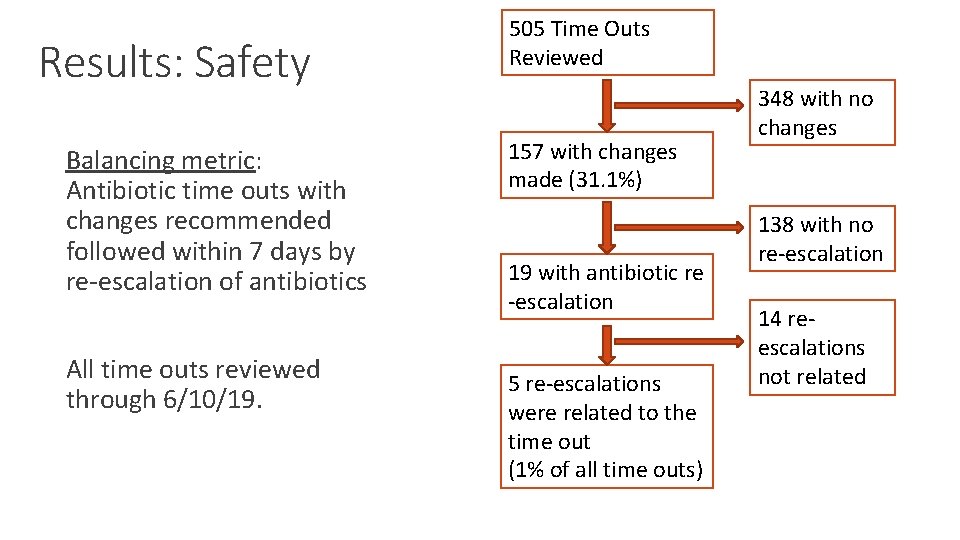
Results: Safety Balancing metric: Antibiotic time outs with changes recommended followed within 7 days by re-escalation of antibiotics All time outs reviewed through 6/10/19. 505 Time Outs Reviewed 157 with changes made (31. 1%) 19 with antibiotic re -escalation 5 re-escalations were related to the time out (1% of all time outs) 348 with no changes 138 with no re-escalation 14 reescalations not related
Potential Cost Savings Time out takes <1 minute Common de-escalation for pneumonia: ◦ Vanc and pip-tazo ceftriaxone and azithromycin ◦ $80/day $18/day IV-to-PO conversion saves $60 per patient (Sallach-Ruma et al. , 2014) ◦ Occurred in 88 patients on MDA/BEST (84 team-weeks) $5, 280 saved ◦ Comparable teams at Chapel Hill: 7 Internal Medicine, 2 Family Medicine, 2 Pediatrics ◦ 13 services with 1 additional IV-PO conversion per week 676 per year $40, 560 De-escalation of antibiotics may facilitate: ◦ ◦ Earlier discharge Avoidance of central lines Less drug monitoring and toxicity Reduced risk of C-diff
Sustainment and Spread Sustainment: ◦ Antimicrobial Stewardship Program will continue data monitoring, feedback, and engagement Spread: ◦ Continued expansion to additional teams, including surgical services, ICUs ◦ Challenges: ◦ Efficient data collection and management ◦ Engagement with partner services ◦ Reliable systems to identify eligible patients
Questions? Washington Post, 2/18/16
- Slides: 14