
Implementation of a New Calibration Method to Resolve
Implementation of a New Calibration Method to Resolve Back-Pressure Effects on the Calibration of Gas Flow Meters By : M. Dlamini D. Jonker E. P. Tarnow TQM-5134 -1
Overview • Introduction • Intermediate Checks Between Two Flow Cells of a Piston Prover Reference Standard • Calibration Method – Split Method • Verification and Commissioning of the 100 l/min Flow Cell Validation of the Split Method • Conclusion TQM-5134 -1
Introduction • The NMISA Gas Flow laboratory performed intermediate checks on their piston prover gas flow reference standard (ML-800) using a series method. • When the flow rate was above 25 l/min, an “over-pressure” message was displayed by the flow cell connected upstream. • This indicated that the pressure to the reference standard was higher than its limits, that is, it exceeded 1, 244 k. Pa above atmosphere. • The ML-800 gas flow reference standard is designed to be used at atmospheric pressures only. • A new calibration method, Split Method, was implemented and validated to have both reference standards venting to atmosphere. TQM-5134 -1
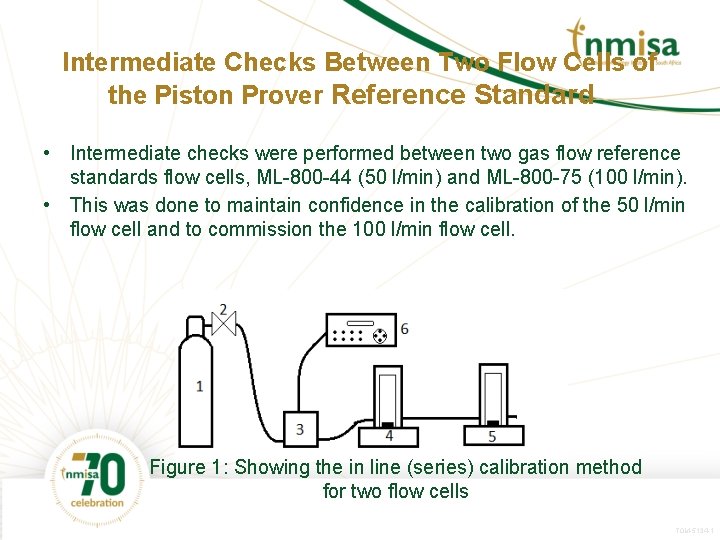
Intermediate Checks Between Two Flow Cells of the Piston Prover Reference Standard • Intermediate checks were performed between two gas flow reference standards flow cells, ML-800 -44 (50 l/min) and ML-800 -75 (100 l/min). • This was done to maintain confidence in the calibration of the 50 l/min flow cell and to commission the 100 l/min flow cell. Figure 1: Showing the in line (series) calibration method for two flow cells TQM-5134 -1
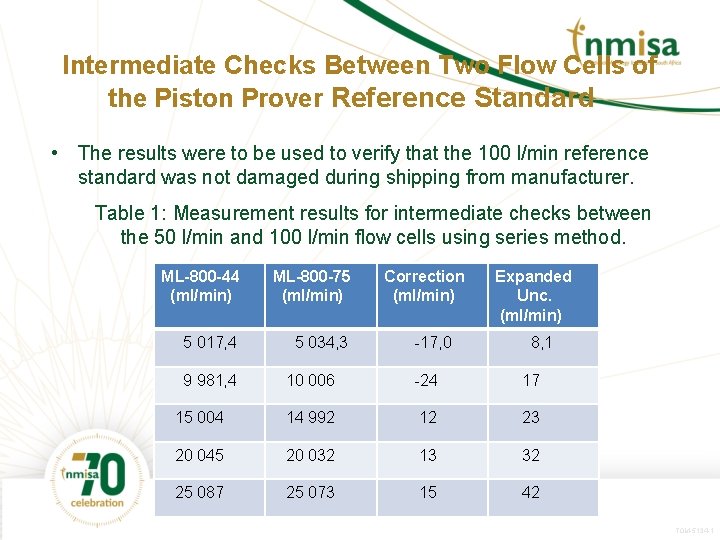
Intermediate Checks Between Two Flow Cells of the Piston Prover Reference Standard • The results were to be used to verify that the 100 l/min reference standard was not damaged during shipping from manufacturer. Table 1: Measurement results for intermediate checks between the 50 l/min and 100 l/min flow cells using series method. ML-800 -44 (ml/min) ML-800 -75 (ml/min) 5 017, 4 5 034, 3 9 981, 4 Correction (ml/min) -17, 0 Expanded Unc. (ml/min) 8, 1 10 006 -24 17 15 004 14 992 12 23 20 045 20 032 13 32 25 087 25 073 15 42 TQM-5134 -1
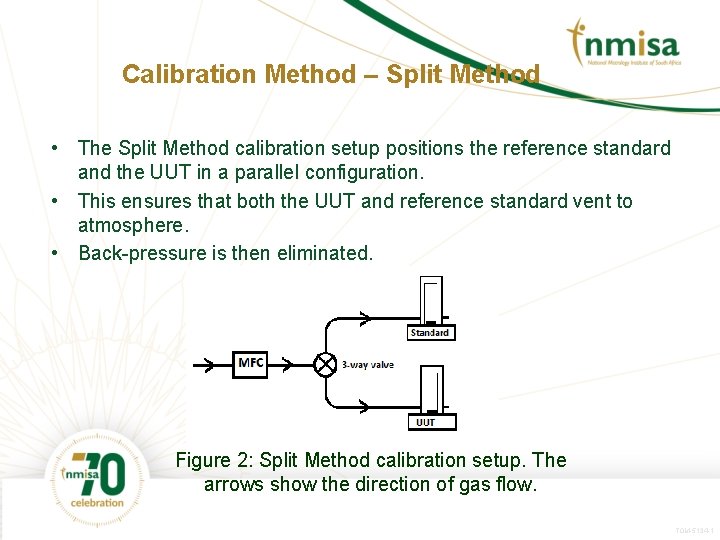
Calibration Method – Split Method • The Split Method calibration setup positions the reference standard and the UUT in a parallel configuration. • This ensures that both the UUT and reference standard vent to atmosphere. • Back-pressure is then eliminated. Figure 2: Split Method calibration setup. The arrows show the direction of gas flow. TQM-5134 -1
Calibration Method – Split Method • Any flow perturbation due to the up/down movement of the reference standard’s piston is avoided. • The Split Method was validated using measurement results for the verification and commissioning of the 100 l/min flow cell. • The Split Method was validated against a series calibration method using a laminar flow system as the reference standard. • The 100 l/min flow cell was calibrated against the 50 l/min flow cell using the Split Method. • It was then calibrated against the laminar flow system using a validated Series method. • The results are discussed in the next section. TQM-5134 -1
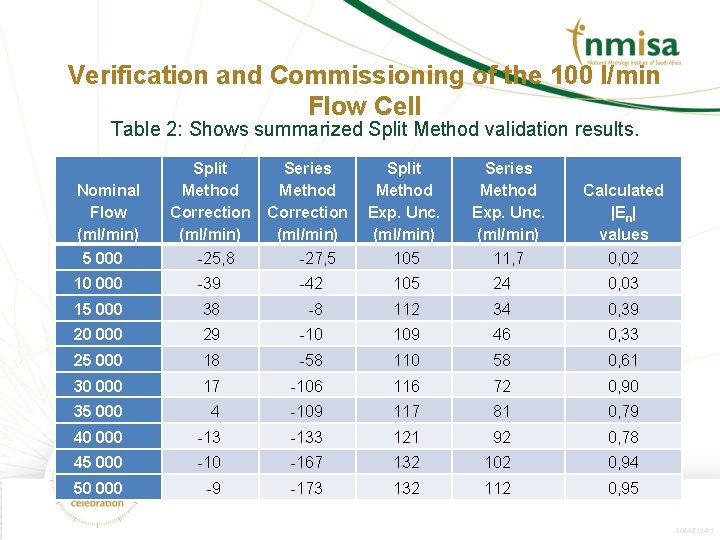
Verification and Commissioning of the 100 l/min Flow Cell Table 2: Shows summarized Split Method validation results. Split Method Correction (ml/min) -25, 8 Series Method Correction (ml/min) -27, 5 Split Method Exp. Unc. (ml/min) 105 10 000 -39 -42 105 24 0, 03 15 000 38 -8 112 34 0, 39 20 000 29 -10 109 46 0, 33 25 000 18 -58 110 58 0, 61 30 000 17 -106 116 72 0, 90 35 000 4 -109 117 81 0, 79 40 000 -133 121 92 0, 78 45 000 -167 132 102 0, 94 50 000 -9 -173 132 112 0, 95 Nominal Flow (ml/min) 5 000 Series Method Exp. Unc. (ml/min) 11, 7 Calculated |En| values 0, 02 TQM-5134 -1
Verification and Commissioning of the 100 l/min Flow Cell • The normalized error values (En) between the Split Method and the Series method were all less than or equal to 1. • The results are also shown graphically in figure 3. • The graphs shows overlapping uncertainties. • This indicates satisfactory performance of the Split Method. • Raw validation data is presented in the full paper. TQM-5134 -1
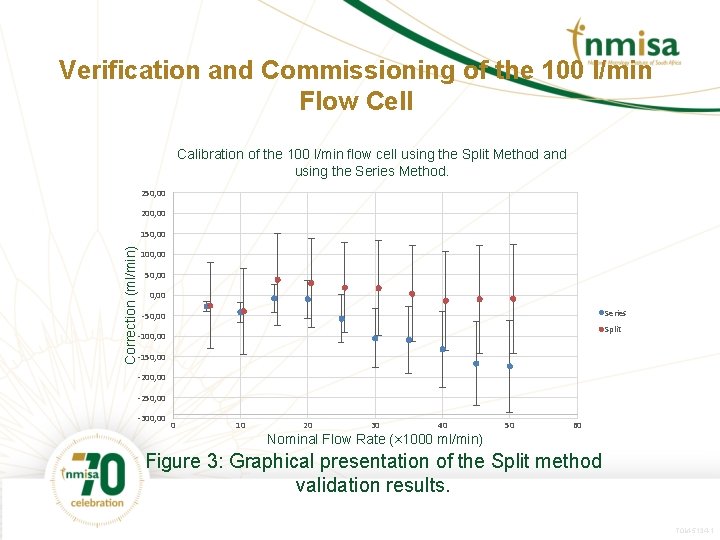
Verification and Commissioning of the 100 l/min Flow Cell Calibration of the 100 l/min flow cell using the Split Method and using the Series Method. 250, 00 200, 00 Correction (ml/min) 150, 00 100, 00 50, 00 Series -50, 00 Split -100, 00 -150, 00 -200, 00 -250, 00 -300, 00 0 10 20 30 40 50 60 Nominal Flow Rate (× 1000 ml/min) Figure 3: Graphical presentation of the Split method validation results. TQM-5134 -1
Verification and Commissioning of the 100 l/min Flow Cell • The measurements indicate good agreement between the 50 l/min and 100 l/min flow cells. • Using the Split Method, gas flow measurements up to 50 l/min can be performed without any over-pressure error. • This was because the reference standard and UUT were both venting to atmosphere eliminating any flow restriction which would cause back pressure. TQM-5134 -1
Conclusion • The ½”-¼” reducer created flow restriction which resulted in backpressure in the flow cell upstream. • The Split Method has the two flow cells venting to atmosphere, hence the back-pressure was eliminated. • Thus, flow measurements up to 50 l/min could be performed. • The Split Method will also be validated to calibrate other types of instruments such as mass flow meters. TQM-5134 -1
The End Thank You! TQM-5134 -1
- Slides: 13