
Implementation Notes PALISADE Library Homomorphic Cryptography For Programmers
Implementation Notes PALISADE Library Homomorphic Cryptography For Programmers, By Programmers NJIT Cybersecurity Research Center Jerry Ryan gwryan@njit. edu
Principles • Do not require deep expertise in homomorphic cryptography to use the library • Provide a framework for experimenting with all levels of implementation • Be straightforward for programmers to use
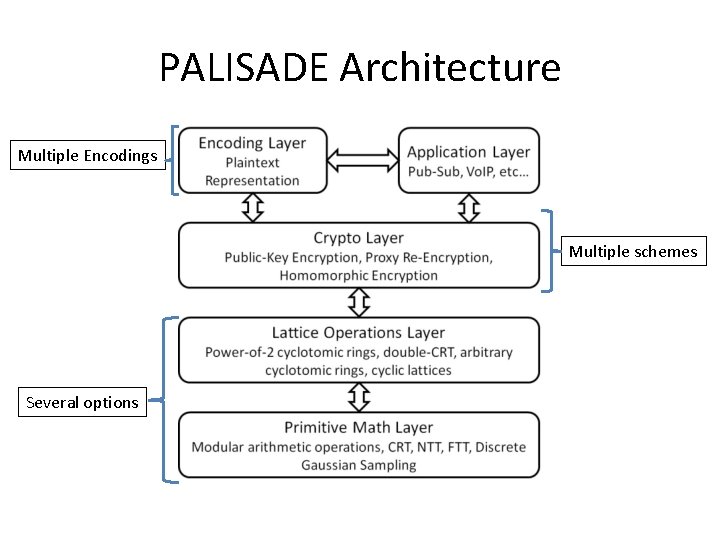
PALISADE Architecture Multiple Encodings Multiple schemes Several options
Each Layer Provides… • A mechanism to choose a particular implementation for a given layer, and a guideline for providers of new implementations – Example: Victor Shoup’s NTL library was integrated into PALISADE with a thin wrapper layer – Able to – and interested in – integrating hardware accelerators • Interface specification (class definitions) • Prototypes for operations to be implemented • C++ operator overloads – Example: Eval Mult is implemented as an overload of operator* for pairs of Ciphertexts, or for a Ciphertext and a Plaintext
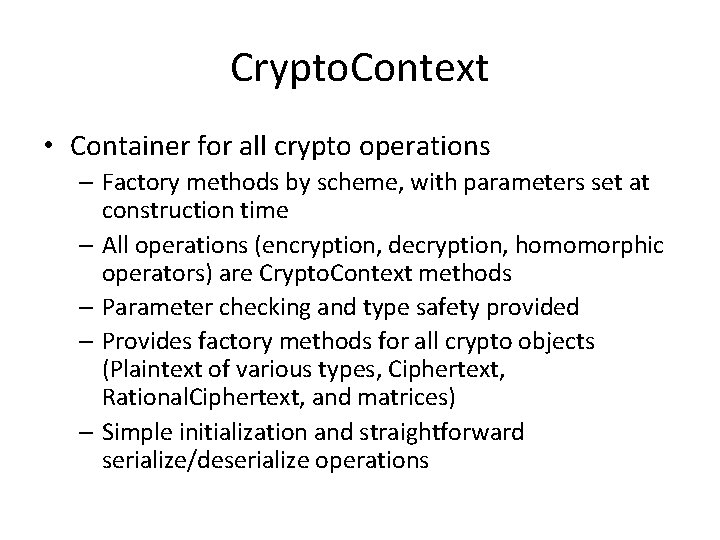
Crypto. Context • Container for all crypto operations – Factory methods by scheme, with parameters set at construction time – All operations (encryption, decryption, homomorphic operators) are Crypto. Context methods – Parameter checking and type safety provided – Provides factory methods for all crypto objects (Plaintext of various types, Ciphertext, Rational. Ciphertext, and matrices) – Simple initialization and straightforward serialize/deserialize operations
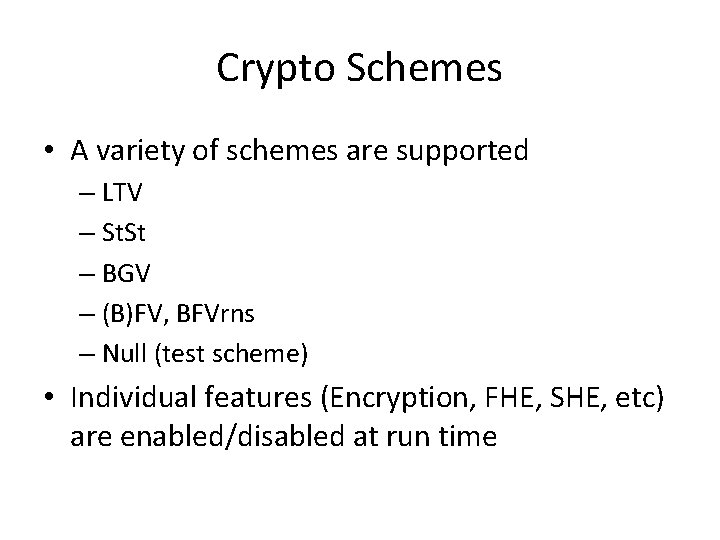
Crypto Schemes • A variety of schemes are supported – LTV – St. St – BGV – (B)FV, BFVrns – Null (test scheme) • Individual features (Encryption, FHE, SHE, etc) are enabled/disabled at run time
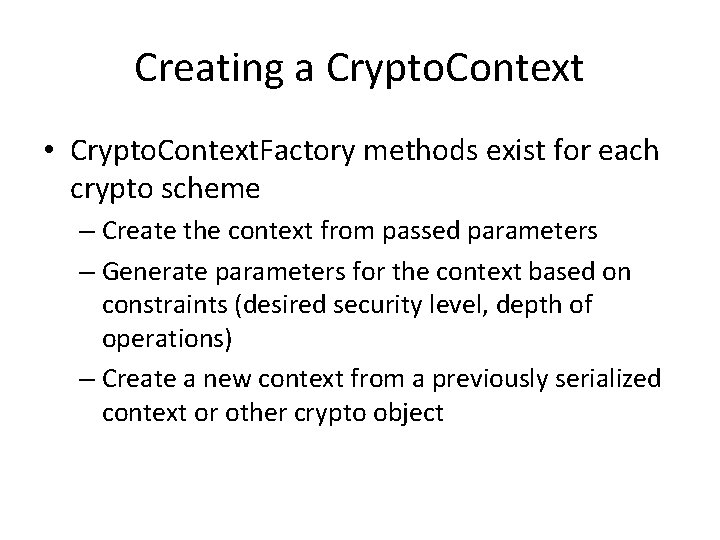
Creating a Crypto. Context • Crypto. Context. Factory methods exist for each crypto scheme – Create the context from passed parameters – Generate parameters for the context based on constraints (desired security level, depth of operations) – Create a new context from a previously serialized context or other crypto object
Creating a New Scheme? • Create new subclass definitions for your scheme • Build implementations for supported methods • Provide new Crypto. Context. Factory method(s)
What’s a Null Scheme? • Useful testing platform – All keys are elements full of zeroes – Encrypt/Re-Encrypt/Decrypt are simply copies – Eval. Add is mod p element-wise add – Eval. Mult is mod p convolution
Element • Library classes are currently templated based on type of the underlying data elements – Poly – Native. Poly – DCRTPoly
Basic Operations • • Key Generation Re-Encryption Key Generation Encrypt Decrypt Re. Encrypt Eval. Add Eval. Mult …
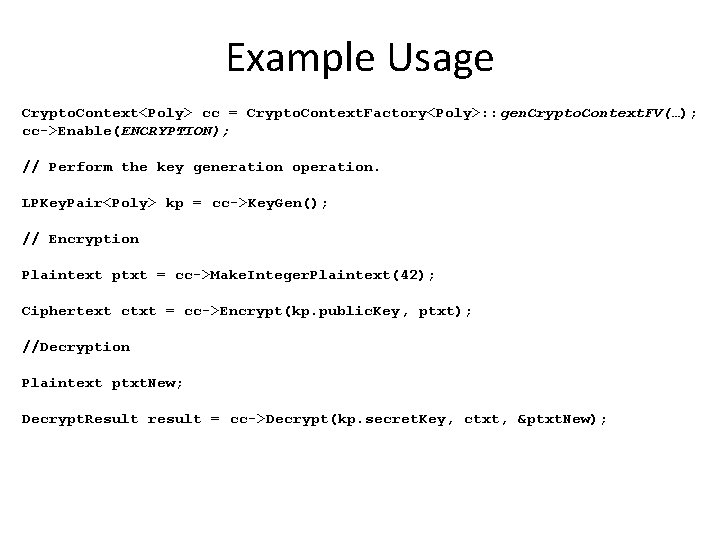
Example Usage Crypto. Context<Poly> cc = Crypto. Context. Factory<Poly>: : gen. Crypto. Context. FV(…); cc->Enable(ENCRYPTION); // Perform the key generation operation. LPKey. Pair<Poly> kp = cc->Key. Gen(); // Encryption Plaintext ptxt = cc->Make. Integer. Plaintext(42); Ciphertext ctxt = cc->Encrypt(kp. public. Key, ptxt); //Decryption Plaintext ptxt. New; Decrypt. Result result = cc->Decrypt(kp. secret. Key, ctxt, &ptxt. New);
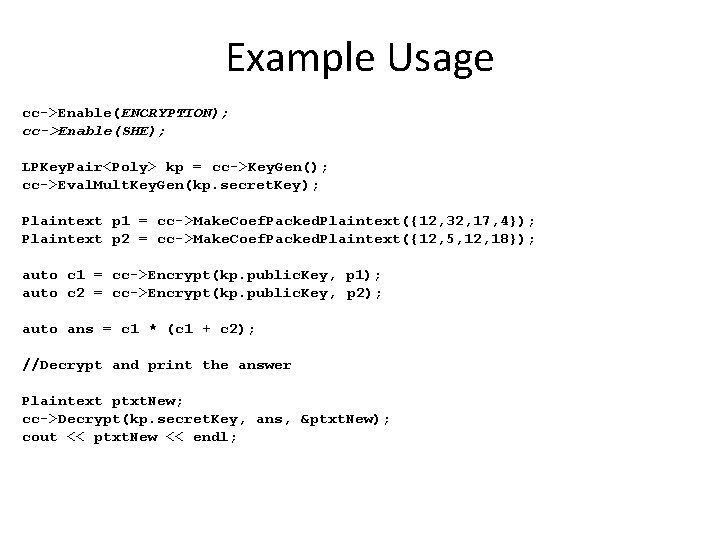
Example Usage cc->Enable(ENCRYPTION); cc->Enable(SHE); LPKey. Pair<Poly> kp = cc->Key. Gen(); cc->Eval. Mult. Key. Gen(kp. secret. Key); Plaintext p 1 = cc->Make. Coef. Packed. Plaintext({12, 32, 17, 4}); Plaintext p 2 = cc->Make. Coef. Packed. Plaintext({12, 5, 12, 18}); auto c 1 = cc->Encrypt(kp. public. Key, p 1); auto c 2 = cc->Encrypt(kp. public. Key, p 2); auto ans = c 1 * (c 1 + c 2); //Decrypt and print the answer Plaintext ptxt. New; cc->Decrypt(kp. secret. Key, ans, &ptxt. New); cout << ptxt. New << endl;
- Slides: 13