
Implementation Intentions and Remote Alcohol Monitoring A behavioral
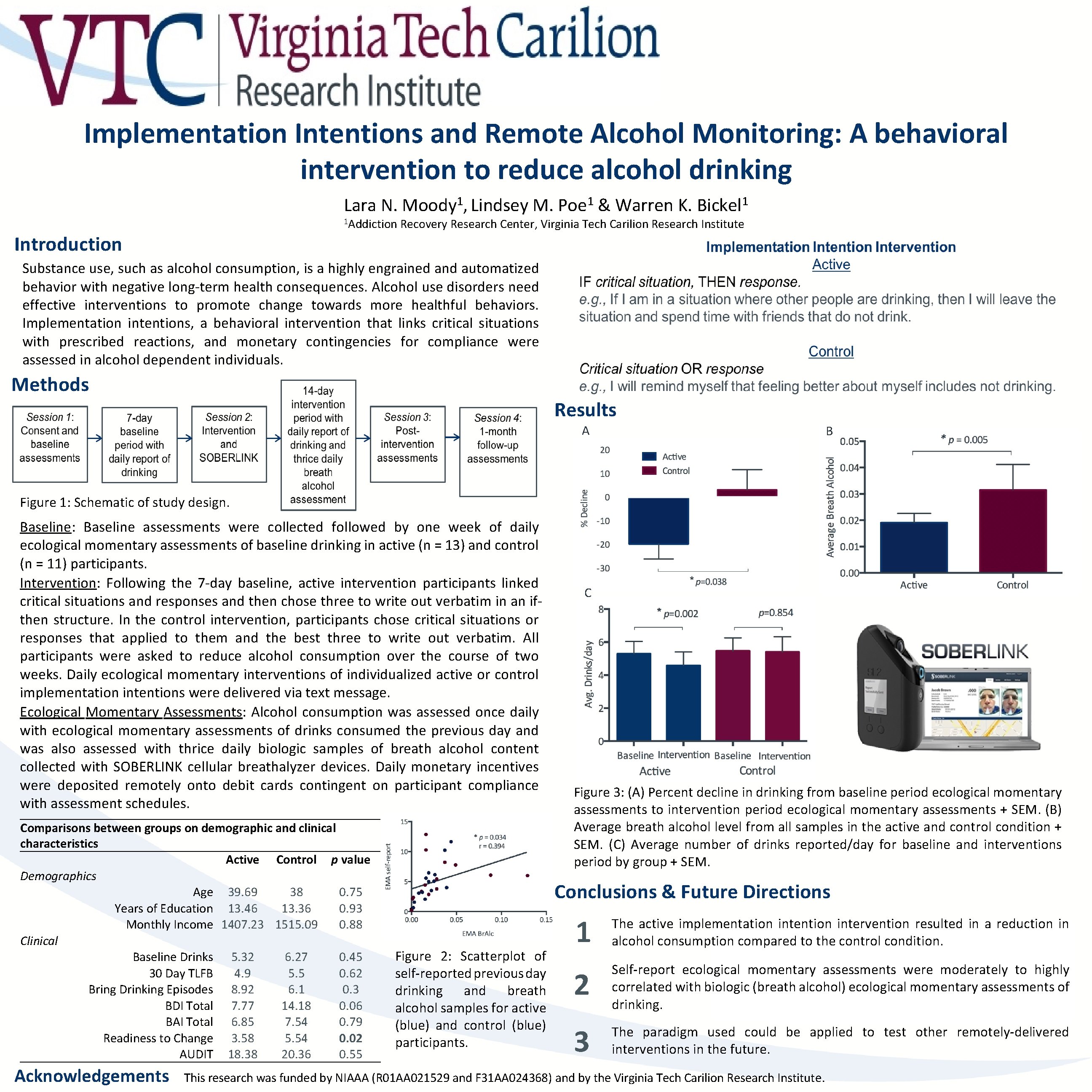
Implementation Intentions and Remote Alcohol Monitoring: A behavioral intervention to reduce alcohol drinking Lara N. 1 Addiction Introduction 1 Moody , Lindsey M. 1 Poe & Warren K. 1 Bickel Recovery Research Center, Virginia Tech Carilion Research Institute Substance use, such as alcohol consumption, is a highly engrained and automatized behavior with negative long-term health consequences. Alcohol use disorders need effective interventions to promote change towards more healthful behaviors. Implementation intentions, a behavioral intervention that links critical situations with prescribed reactions, and monetary contingencies for compliance were assessed in alcohol dependent individuals. Methods Results A B Figure 1: Schematic of study design. Baseline: Baseline assessments were collected followed by one week of daily ecological momentary assessments of baseline drinking in active (n = 13) and control (n = 11) participants. Intervention: Following the 7 -day baseline, active intervention participants linked critical situations and responses and then chose three to write out verbatim in an ifthen structure. In the control intervention, participants chose critical situations or responses that applied to them and the best three to write out verbatim. All participants were asked to reduce alcohol consumption over the course of two weeks. Daily ecological momentary interventions of individualized active or control implementation intentions were delivered via text message. Ecological Momentary Assessments: Alcohol consumption was assessed once daily with ecological momentary assessments of drinks consumed the previous day and was also assessed with thrice daily biologic samples of breath alcohol content collected with SOBERLINK cellular breathalyzer devices. Daily monetary incentives were deposited remotely onto debit cards contingent on participant compliance with assessment schedules. Comparisons between groups on demographic and clinical characteristics Active Control p value Demographics Age 39. 69 38 0. 75 Years of Education 13. 46 13. 36 0. 93 Monthly Income 1407. 23 1515. 09 0. 88 Clinical Baseline Drinks 5. 32 6. 27 0. 45 30 Day TLFB 4. 9 5. 5 0. 62 Bring Drinking Episodes 8. 92 6. 1 0. 3 BDI Total 7. 77 14. 18 0. 06 BAI Total 6. 85 7. 54 0. 79 Readiness to Change 3. 58 5. 54 0. 02 AUDIT 18. 38 20. 36 0. 55 Acknowledgements C Figure 3: (A) Percent decline in drinking from baseline period ecological momentary assessments to intervention period ecological momentary assessments + SEM. (B) Average breath alcohol level from all samples in the active and control condition + SEM. (C) Average number of drinks reported/day for baseline and interventions period by group + SEM. Conclusions & Future Directions Figure 2: Scatterplot of self-reported previous day drinking and breath alcohol samples for active (blue) and control (blue) participants. 1 The active implementation intention intervention resulted in a reduction in alcohol consumption compared to the control condition. 2 Self-report ecological momentary assessments were moderately to highly correlated with biologic (breath alcohol) ecological momentary assessments of drinking. 3 The paradigm used could be applied to test other remotely-delivered interventions in the future. This research was funded by NIAAA (R 01 AA 021529 and F 31 AA 024368) and by the Virginia Tech Carilion Research Institute.
- Slides: 1