
Implementation and Statistical capacity building J de Beer
Implementation and Statistical capacity building J de Beer UNCEEA meeting 20 June 2017
Structure of session Overview of work-stream Joe de beer Inputs of regional activities Representatives General discussion All
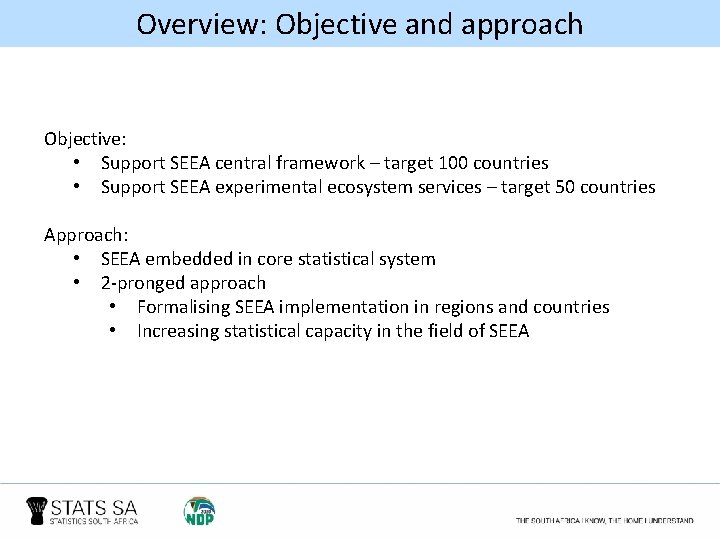
Overview: Objective and approach Objective: • Support SEEA central framework – target 100 countries • Support SEEA experimental ecosystem services – target 50 countries Approach: • SEEA embedded in core statistical system • 2 -pronged approach • Formalising SEEA implementation in regions and countries • Increasing statistical capacity in the field of SEEA
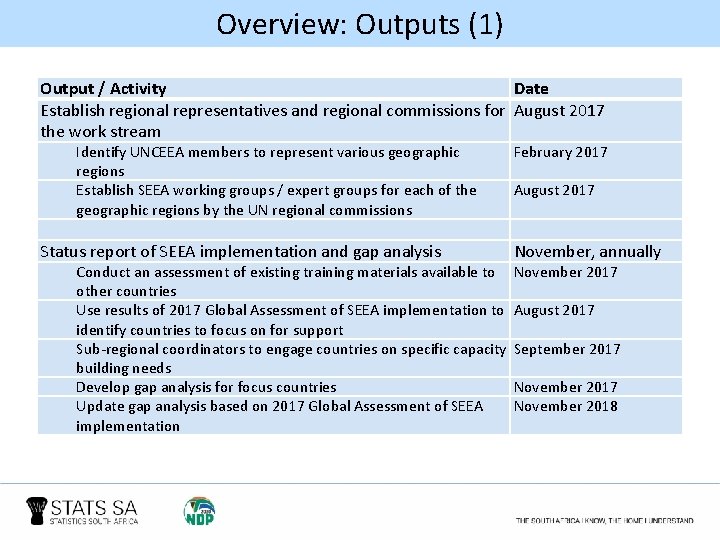
Overview: Outputs (1) Output / Activity Date Establish regional representatives and regional commissions for August 2017 the work stream Identify UNCEEA members to represent various geographic regions Establish SEEA working groups / expert groups for each of the geographic regions by the UN regional commissions Status report of SEEA implementation and gap analysis Conduct an assessment of existing training materials available to other countries Use results of 2017 Global Assessment of SEEA implementation to identify countries to focus on for support Sub-regional coordinators to engage countries on specific capacity building needs Develop gap analysis for focus countries Update gap analysis based on 2017 Global Assessment of SEEA implementation February 2017 August 2017 November, annually November 2017 August 2017 September 2017 November 2018
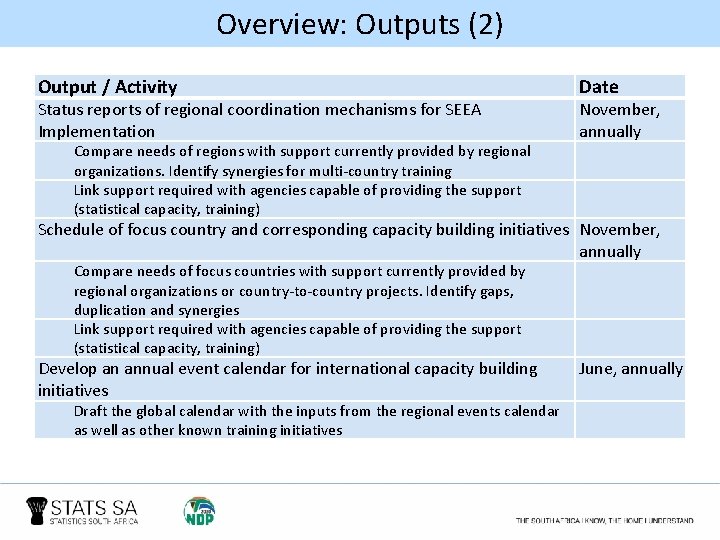
Overview: Outputs (2) Output / Activity Status reports of regional coordination mechanisms for SEEA Implementation Compare needs of regions with support currently provided by regional organizations. Identify synergies for multi-country training Link support required with agencies capable of providing the support (statistical capacity, training) Date November, annually Schedule of focus country and corresponding capacity building initiatives November, annually Compare needs of focus countries with support currently provided by regional organizations or country-to-country projects. Identify gaps, duplication and synergies Link support required with agencies capable of providing the support (statistical capacity, training) Develop an annual event calendar for international capacity building initiatives Draft the global calendar with the inputs from the regional events calendar as well as other known training initiatives June, annually
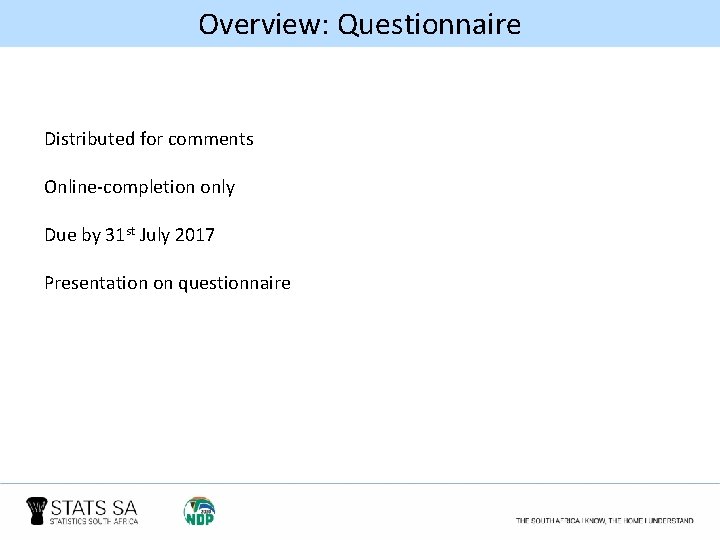
Overview: Questionnaire Distributed for comments Online-completion only Due by 31 st July 2017 Presentation on questionnaire
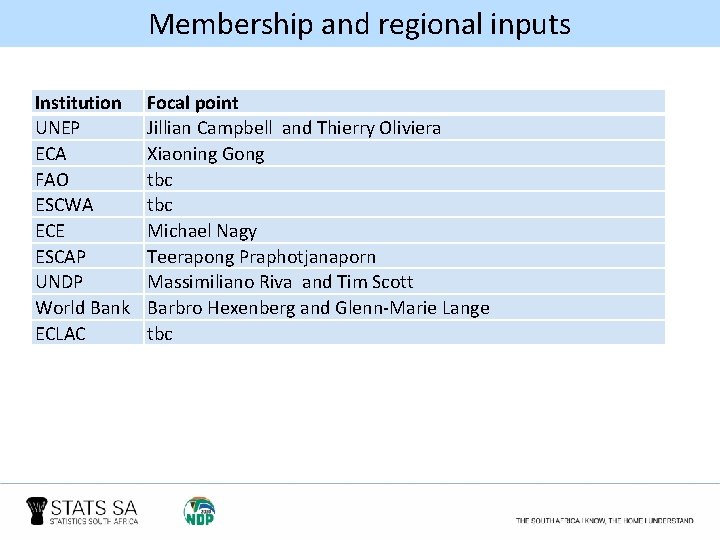
Membership and regional inputs Institution UNEP ECA FAO ESCWA ECE ESCAP UNDP World Bank ECLAC Focal point Jillian Campbell and Thierry Oliviera Xiaoning Gong tbc Michael Nagy Teerapong Praphotjanaporn Massimiliano Riva and Tim Scott Barbro Hexenberg and Glenn-Marie Lange tbc
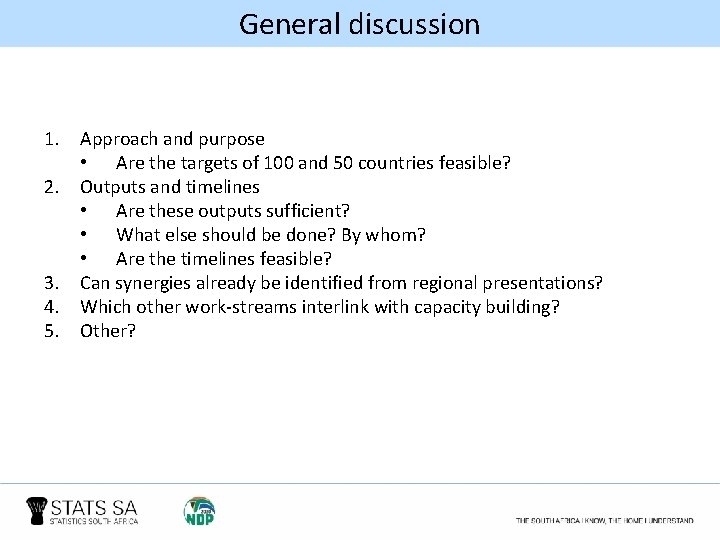
General discussion 1. Approach and purpose • Are the targets of 100 and 50 countries feasible? 2. Outputs and timelines • Are these outputs sufficient? • What else should be done? By whom? • Are the timelines feasible? 3. Can synergies already be identified from regional presentations? 4. Which other work-streams interlink with capacity building? 5. Other?
- Slides: 8