
Implement High Availability for Mission Critical Databases Where
Implement High Availability for Mission Critical Databases Where “good enough” availability just isn’t good enough, ensure business requirements will be met before investing in people, processes, and technology for true high availability. Info-Tech Research Group, Inc. is a global leader in providing IT research and advice. Info-Tech’s products and services combine actionable insight and relevant advice with Info-Tech's products and services combine actionable insight and advice ready-to-use tools and templates that cover the fullrelevant spectrum of IT with concerns. and templates that cover the full spectrum©of 1997 -2016 IT concerns. © 1997 -Research 2016 Info-Tech Group. Research Inc. Info-Tech Research Group 1
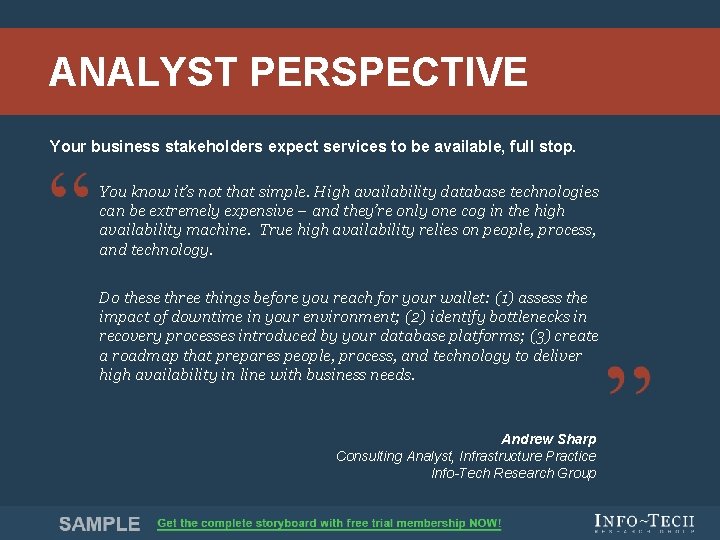
ANALYST PERSPECTIVE Your business stakeholders expect services to be available, full stop. You know it’s not that simple. High availability database technologies can be extremely expensive – and they’re only one cog in the high availability machine. True high availability relies on people, process, and technology. Do these three things before you reach for your wallet: (1) assess the impact of downtime in your environment; (2) identify bottlenecks in recovery processes introduced by your database platforms; (3) create a roadmap that prepares people, process, and technology to deliver high availability in line with business needs. Andrew Sharp Consulting Analyst, Infrastructure Practice Info-Tech Research Group 2
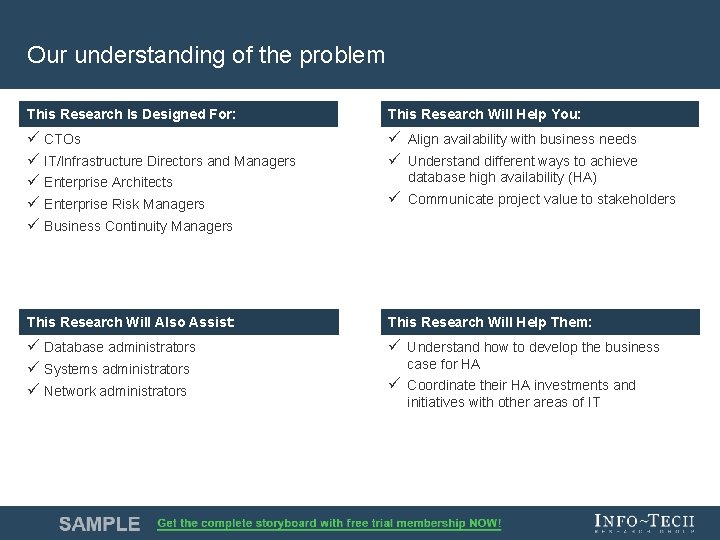
Our understanding of the problem This Research is Is Designed For: This Research Will Help You: ü CTOs ü IT/Infrastructure Directors and Managers ü Enterprise Architects ü Enterprise Risk Managers ü Business Continuity Managers ü Align availability with business needs ü Understand different ways to achieve This Research Will Also Assist: This Research Will Help You: Them: ü Database administrators ü Systems administrators ü Network administrators ü Understand how to develop the business database high availability (HA) ü Communicate project value to stakeholders case for HA ü Coordinate their HA investments and initiatives with other areas of IT Info-Tech Research Group 3
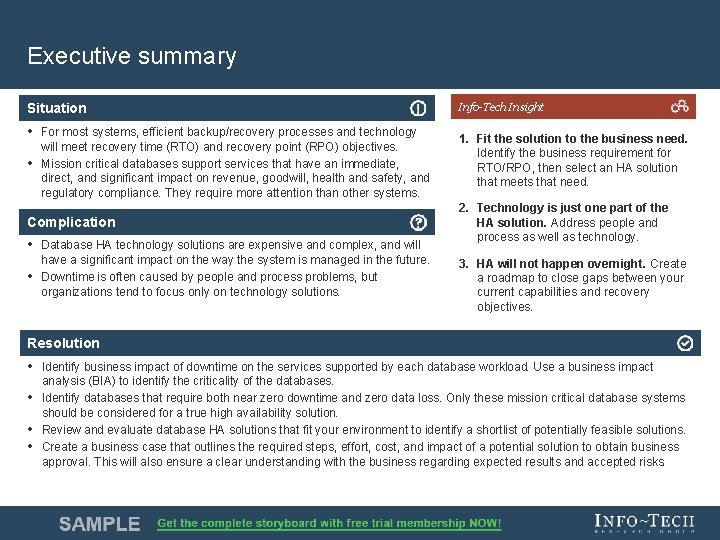
Executive summary Situation • For most systems, efficient backup/recovery processes and technology • will meet recovery time (RTO) and recovery point (RPO) objectives. Mission critical databases support services that have an immediate, direct, and significant impact on revenue, goodwill, health and safety, and regulatory compliance. They require more attention than other systems. Complication • Database HA technology solutions are expensive and complex, and will • have a significant impact on the way the system is managed in the future. Downtime is often caused by people and process problems, but organizations tend to focus only on technology solutions. Info-Tech Insight 1. Fit the solution to the business need. Identify the business requirement for RTO/RPO, then select an HA solution that meets that need. 2. Technology is just one part of the HA solution. Address people and process as well as technology. 3. HA will not happen overnight. Create a roadmap to close gaps between your current capabilities and recovery objectives. Resolution • Identify business impact of downtime on the services supported by each database workload. Use a business impact • • • analysis (BIA) to identify the criticality of the databases. Identify databases that require both near zero downtime and zero data loss. Only these mission critical database systems should be considered for a true high availability solution. Review and evaluate database HA solutions that fit your environment to identify a shortlist of potentially feasible solutions. Create a business case that outlines the required steps, effort, cost, and impact of a potential solution to obtain business approval. This will also ensure a clear understanding with the business regarding expected results and accepted risks. Info-Tech Research Group 4
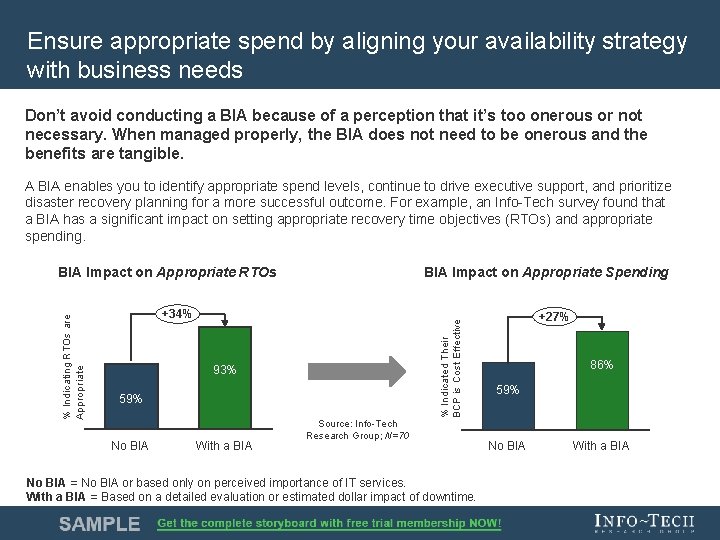
Ensure appropriate spend by aligning your availability strategy with business needs Don’t avoid conducting a BIA because of a perception that it’s too onerous or not necessary. When managed properly, the BIA does not need to be onerous and the benefits are tangible. A BIA enables you to identify appropriate spend levels, continue to drive executive support, and prioritize disaster recovery planning for a more successful outcome. For example, an Info-Tech survey found that a BIA has a significant impact on setting appropriate recovery time objectives (RTOs) and appropriate spending. % Indicating RTOs are Appropriate +34% 93% 59% No BIA With a BIA Source: Info-Tech Research Group; N=70 % Indicated Their BCP is Cost Effective BIA Impact on Appropriate Spending BIA Impact on Appropriate RTOs +27% 86% 59% No BIA With a BIA No BIA = No BIA or based only on perceived importance of IT services. With a BIA = Based on a detailed evaluation or estimated dollar impact of downtime. Info-Tech Research Group 5
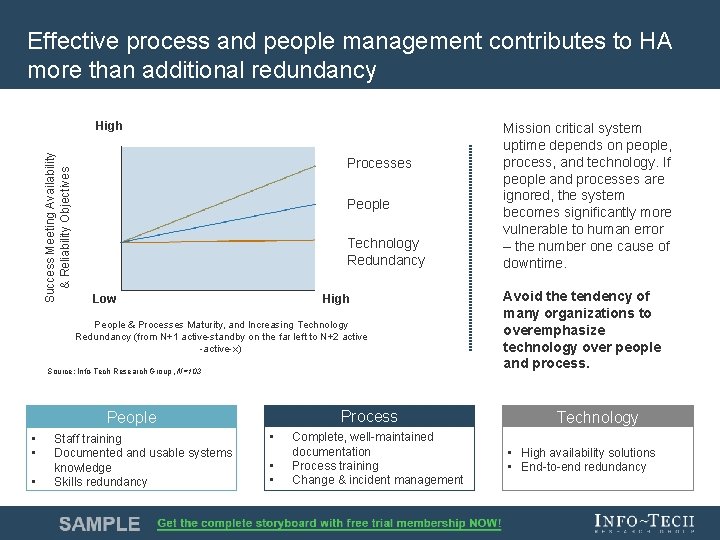
Effective process and people management contributes to HA more than additional redundancy Success Meeting Availability & Reliability Objectives High Processes People Technology Redundancy Low High People & Processes Maturity, and Increasing Technology Redundancy (from N+1 active-standby on the far left to N+2 active -active-x) Source: Info-Tech Research Group , N=103 Process People • • • Staff training Documented and usable systems knowledge Skills redundancy • • • Complete, well-maintained documentation Process training Change & incident management Mission critical system uptime depends on people, process, and technology. If people and processes are ignored, the system becomes significantly more vulnerable to human error – the number one cause of downtime. Avoid the tendency of many organizations to overemphasize technology over people and process. Technology • High availability solutions • End-to-end redundancy Info-Tech Research Group 6
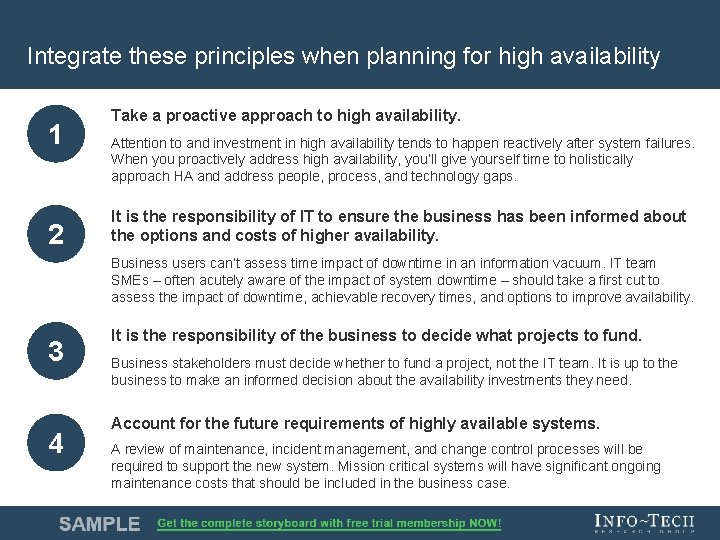
Integrate these principles when planning for high availability 1 2 Take a proactive approach to high availability. Attention to and investment in high availability tends to happen reactively after system failures. When you proactively address high availability, you’ll give yourself time to holistically approach HA and address people, process, and technology gaps. It is the responsibility of IT to ensure the business has been informed about the options and costs of higher availability. Business users can’t assess time impact of downtime in an information vacuum. IT team SMEs – often acutely aware of the impact of system downtime – should take a first cut to assess the impact of downtime, achievable recovery times, and options to improve availability. 3 4 It is the responsibility of the business to decide what projects to fund. Business stakeholders must decide whether to fund a project, not the IT team. It is up to the business to make an informed decision about the availability investments they need. Account for the future requirements of highly available systems. A review of maintenance, incident management, and change control processes will be required to support the new system. Mission critical systems will have significant ongoing maintenance costs that should be included in the business case. Info-Tech Research Group 7
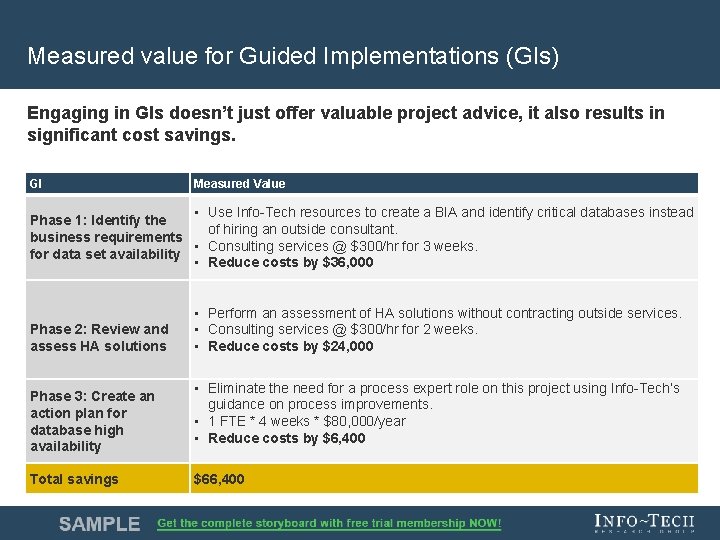
Measured value for Guided Implementations (GIs) Engaging in GIs doesn’t just offer valuable project advice, it also results in significant cost savings. GI Measured Value • Phase 1: Identify the business requirements • for data set availability • Phase 2: Review and assess HA solutions Phase 3: Create an action plan for database high availability Total savings Use Info-Tech resources to create a BIA and identify critical databases instead of hiring an outside consultant. Consulting services @ $300/hr for 3 weeks. Reduce costs by $36, 000 • Perform an assessment of HA solutions without contracting outside services. • Consulting services @ $300/hr for 2 weeks. • Reduce costs by $24, 000 • Eliminate the need for a process expert role on this project using Info-Tech’s guidance on process improvements. • 1 FTE * 4 weeks * $80, 000/year • Reduce costs by $6, 400 $66, 400 Info-Tech Research Group 8
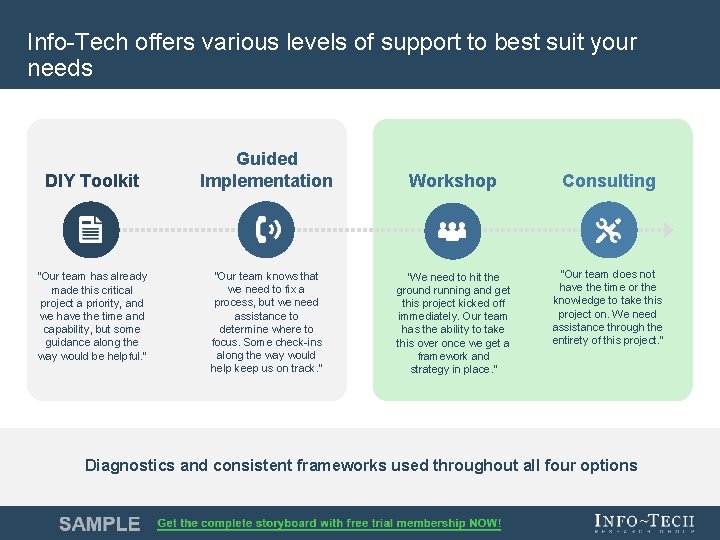
Info-Tech offers various levels of support to best suit your needs DIY Toolkit “Our team has already made this critical project a priority, and we have the time and capability, but some guidance along the way would be helpful. ” Guided Implementation Workshop Consulting “Our team knows that we need to fix a process, but we need assistance to determine where to focus. Some check-ins along the way would help keep us on track. ” “We need to hit the ground running and get this project kicked off immediately. Our team has the ability to take this over once we get a framework and strategy in place. ” “Our team does not have the time or the knowledge to take this project on. We need assistance through the entirety of this project. ” Diagnostics and consistent frameworks used throughout all four options Info-Tech Research Group 9
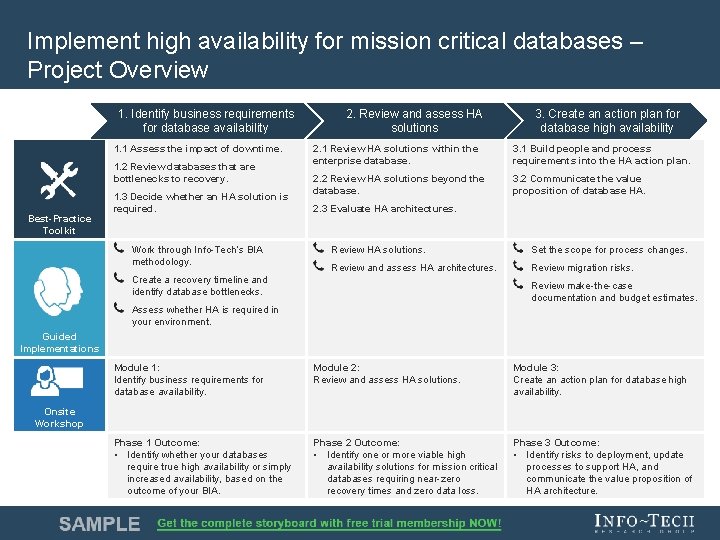
Implement high availability for mission critical databases – Project Overview 1. Identify business requirements for database availability 1. 1 Assess the impact of downtime. 1. 2 Review databases that are bottlenecks to recovery. Best-Practice Toolkit 1. 3 Decide whether an HA solution is required. Work through Info-Tech’s BIA methodology. 2. Review and assess HA solutions 3. Create an action plan for database high availability 2. 1 Review HA solutions within the enterprise database. 3. 1 Build people and process requirements into the HA action plan. 2. 2 Review HA solutions beyond the database. 3. 2 Communicate the value proposition of database HA. 2. 3 Evaluate HA architectures. Review HA solutions. Set the scope for process changes. Review and assess HA architectures. Review migration risks. Create a recovery timeline and identify database bottlenecks. Review make-the-case documentation and budget estimates. Assess whether HA is required in your environment. Guided Implementations Module 1: Identify business requirements for database availability. Module 2: Review and assess HA solutions. Module 3: Create an action plan for database high availability. Phase 1 Outcome: • Identify whether your databases require true high availability or simply increased availability, based on the outcome of your BIA. Phase 2 Outcome: • Identify one or more viable high availability solutions for mission critical databases requiring near-zero recovery times and zero data loss. Phase 3 Outcome: • Identify risks to deployment, update processes to support HA, and communicate the value proposition of HA architecture. Onsite Workshop Info-Tech Research Group 10
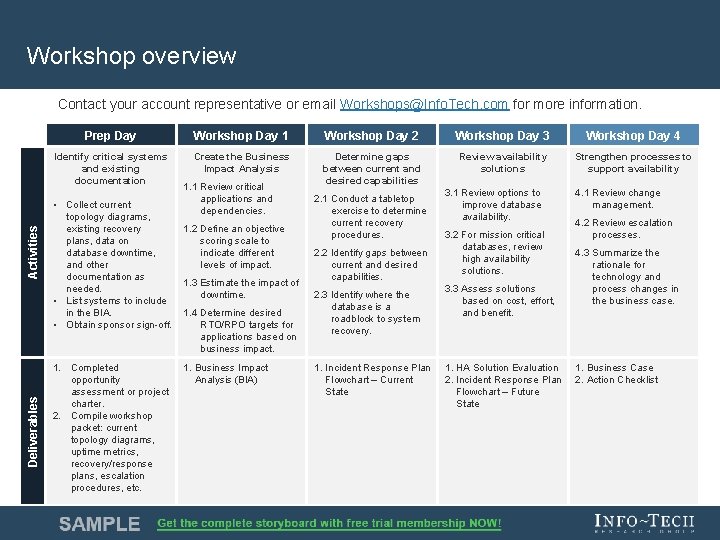
Workshop overview Deliverables Activities Contact your account representative or email Workshops@Info. Tech. com for more information. Prep Day Workshop Day 1 Workshop Day 2 Workshop Day 3 Workshop Day 4 Identify critical systems and existing documentation Create the Business Impact Analysis Determine gaps between current and desired capabilities Review availability solutions Strengthen processes to support availability • Collect current topology diagrams, existing recovery plans, data on database downtime, and other documentation as needed. • List systems to include in the BIA. • Obtain sponsor sign-off. 1. Completed opportunity assessment or project charter. 2. Compile workshop packet: current topology diagrams, uptime metrics, recovery/response plans, escalation procedures, etc. 1. 1 Review critical applications and dependencies. 1. 2 Define an objective scoring scale to indicate different levels of impact. 1. 3 Estimate the impact of downtime. 1. 4 Determine desired RTO/RPO targets for applications based on business impact. 1. Business Impact Analysis (BIA) 2. 1 Conduct a tabletop exercise to determine current recovery procedures. 2. 2 Identify gaps between current and desired capabilities. 2. 3 Identify where the database is a roadblock to system recovery. 1. Incident Response Plan Flowchart – Current State 3. 1 Review options to improve database availability. 3. 2 For mission critical databases, review high availability solutions. 3. 3 Assess solutions based on cost, effort, and benefit. 1. HA Solution Evaluation 2. Incident Response Plan Flowchart – Future State 4. 1 Review change management. 4. 2 Review escalation processes. 4. 3 Summarize the rationale for technology and process changes in the business case. 1. Business Case 2. Action Checklist Info-Tech Research Group 11
Info-Tech Research Group Helps IT Professionals To: ü ü ü Quickly get up to speed with new technologies ü Manage business expectations ü Justify IT spending and prove the value of IT ü Train IT staff and effectively manage an IT department Make the right technology purchasing decisions – fast Deliver critical IT projects, on time and within budget Sign up for free trial membership to get practical solutions for your IT challenges • “Info-Tech helps me to be proactive instead of reactive – a cardinal rule in a stable and leading edge IT environment. - ARCS Commercial Mortgage Co. , LP Toll Free: 1 -888 -670 -8889 www. infotech. com Info-Tech Research Group 12
- Slides: 12