
Implanted Venous Access Devices Care and Maintenance of

- Slides: 10
Implanted Venous Access Devices Care and Maintenance of Ports Bethlehem Campus
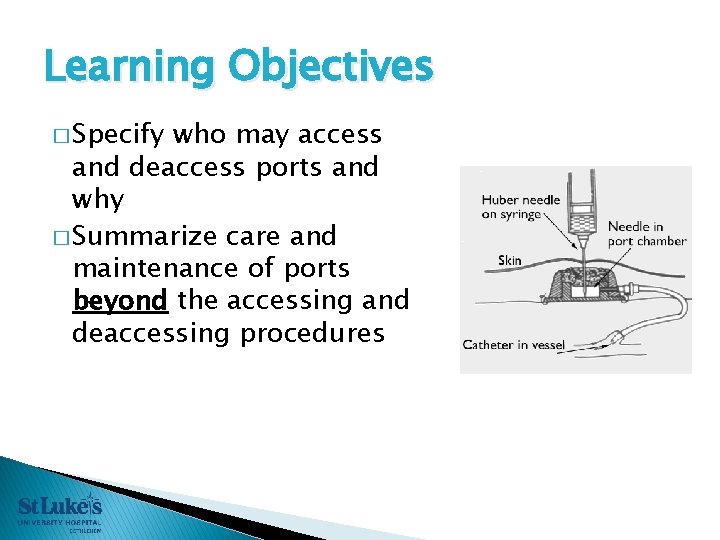
Learning Objectives � Specify who may access and deaccess ports and why � Summarize care and maintenance of ports beyond the accessing and deaccessing procedures
Who can access and deaccess? � Because it is a low frequency and high risk procedure, only nurses on specific units will be permitted to access/deaccess ports (effective Monday, January 19, 2015) � These nurses have recently passed our new competency for accessing/deaccessing ports � The next slide shows the Port Access Call Schedule to follow if you need to contact a nurse to access or deaccess a port
Who do I call? Note: Inpatient units are to call in order listed � � Day 1. 2. 3. Shift (M-F) PICC Team PPHP 6 Emergency Department Evening/Night Shift (M-F) 1. Critical Care Coordinators (3 pm-3 am) 2. PPHP 6 3. Emergency Department Weekends 1. PICC Team (Saturday Day Shift) 2. Critical Care Coordinators (D/E/N) 3. PPHP 6 4. Emergency Department Note: certain outpatient/diagnostic/treatment areas (not listed above) will continue to be permitted to access ports
How can I “access” this schedule? � You can “access” this schedule on the Nursing Practice Resource Site 24/7 � It is listed alphabetically under “Equipment” under “P”- “Port Access Call Schedule” � Did you get the “access” pun? How about this one?
Alert to all RNs � An order is needed to access and deaccess a port � If skin is compromised over a permanent venous access device, it should not be used and the physician/AP notified
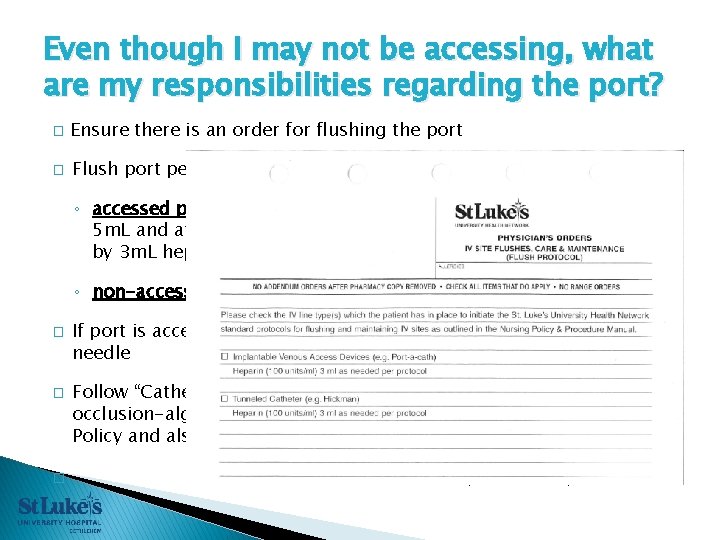
Even though I may not be accessing, what are my responsibilities regarding the port? � Ensure there is an order for flushing the port � Flush port per SLUHN flush protocol: ◦ accessed port - flush before each use with normal saline solution 5 m. L and after each use with normal saline solution 5 m. L followed by 3 m. L heparin (100 units/m. L) ◦ non-accessed port - obtain physician order for flush frequency � � � If port is accessed, ensure port is reaccessed every 7 days with a new needle Follow “Catheter Occlusion Algorithm” if indication of catheter occlusion-algorithm is found attached to the Central Venous Access Policy and also on the Nursing Practice Resource Site (continued)
Responsibilities (continued) � Assess site upon first contact with patient on your shift and thereafter at frequent intervals normally not greater than 2 hours � Report any breaks in the skin, redness, swelling, warmth, drainage, etc. to the physician/AP immediately � No ointments are to be used on the port site � Provide patient education during hospitalization and upon discharge; reinforce last two bullets above
Emerging Standards for Port Care � As the concern for central line associated blood stream infections (CLABSIs) has grown, the purpose for accessing an implanted port needs to be carefully considered � Ports are less typically used as the first line for blood draws and routine IV infusions
Please proceed to the program posttest. Thank you!