
IMPLANON NXT 68 mg etonogestrel implant Clinical Training
- Slides: 24
IMPLANON NXT® (68 mg etonogestrel implant) Clinical Training Program Update on Insertion and Removal Procedure 1
Prescribing Information – Overview of changes • Specification of the implant insertion site: the implant should be inserted subdermally just under the skin in the upper, inner arm, 8 -10 cm from the medial epicondyle and 3 -5 cm posterior to (below) the sulcus (groove between the biceps and triceps muscles), overlying the triceps muscle • New positioning of the woman’s arm during insertion and removal of the implant, which should be flexed at the elbow with her hand underneath (or as close as possible to) her head • Revised wording and figures for implant insertion and removal • Revised instructions for the removal of non-palpable implants • Clarification that replacement of an implant may be performed through the same incision from which the previous implant was removed as long as the previous insertion site is in the correct updated location 2
Insertion 3
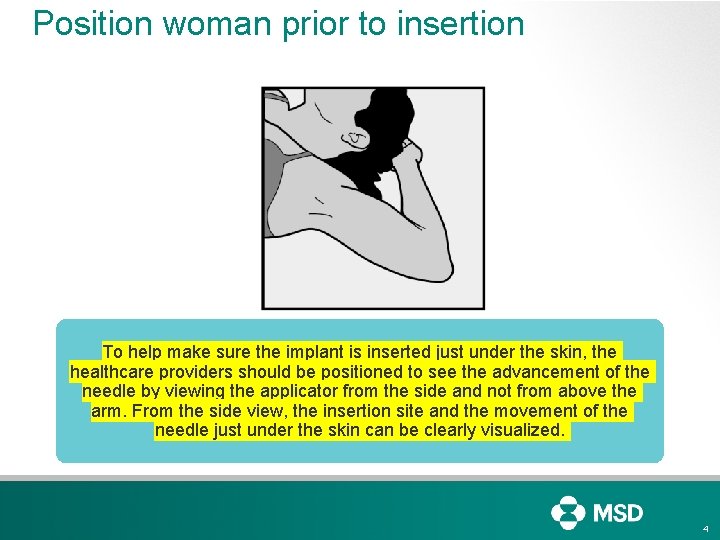
Position woman prior to insertion To help make sure the implant is inserted just under the skin, the healthcare providers should be positioned to see the advancement of the needle by viewing the applicator from the side and not from above the arm. From the side view, the insertion site and the movement of the needle just under the skin can be clearly visualized. 4
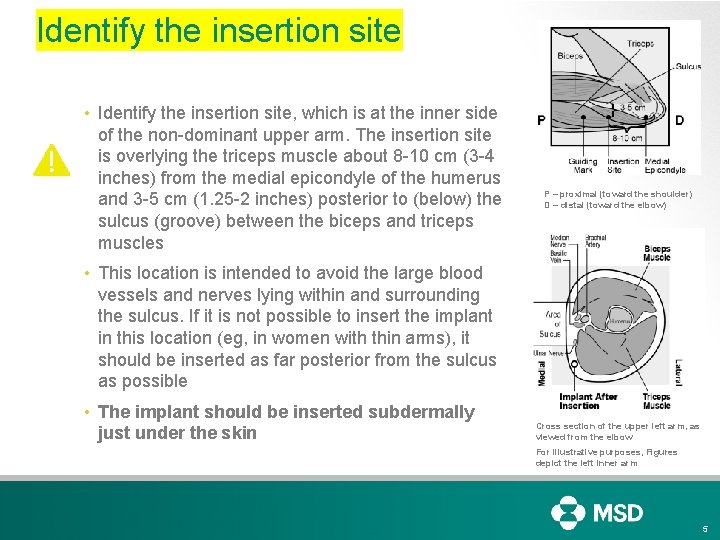
Identify the insertion site • Identify the insertion site, which is at the inner side of the non-dominant upper arm. The insertion site is overlying the triceps muscle about 8 -10 cm (3 -4 inches) from the medial epicondyle of the humerus and 3 -5 cm (1. 25 -2 inches) posterior to (below) the sulcus (groove) between the biceps and triceps muscles P – proximal (toward the shoulder) D – distal (toward the elbow) • This location is intended to avoid the large blood vessels and nerves lying within and surrounding the sulcus. If it is not possible to insert the implant in this location (eg, in women with thin arms), it should be inserted as far posterior from the sulcus as possible • The implant should be inserted subdermally just under the skin Cross section of the upper left arm, as viewed from the elbow For illustrative purposes, Figures depict the left inner arm 5
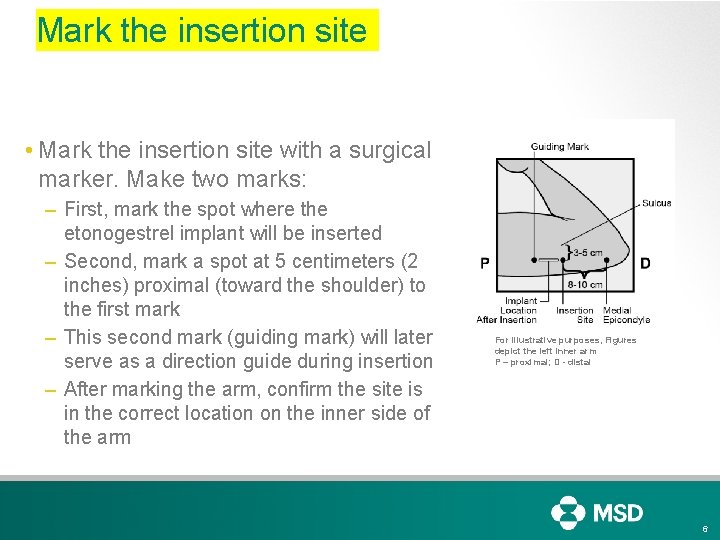
Mark the insertion site • Mark the insertion site with a surgical marker. Make two marks: – First, mark the spot where the etonogestrel implant will be inserted – Second, mark a spot at 5 centimeters (2 inches) proximal (toward the shoulder) to the first mark – This second mark (guiding mark) will later serve as a direction guide during insertion – After marking the arm, confirm the site is in the correct location on the inner side of the arm For illustrative purposes, Figures depict the left inner arm P – proximal; D - distal 6
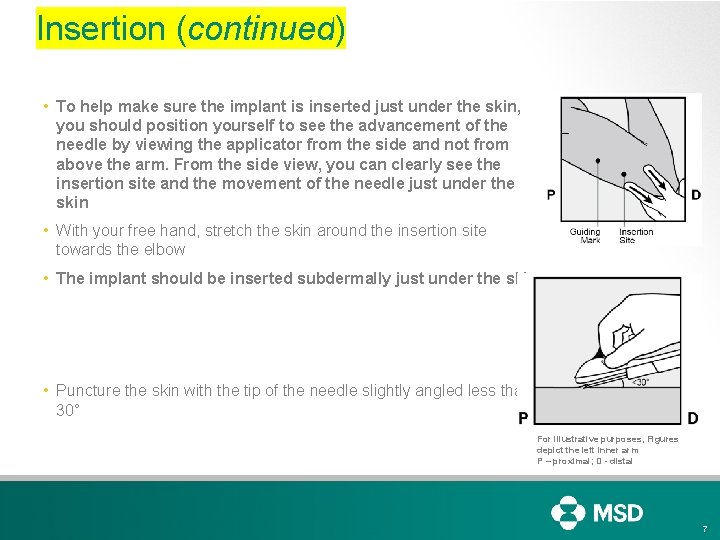
Insertion (continued) • To help make sure the implant is inserted just under the skin, you should position yourself to see the advancement of the needle by viewing the applicator from the side and not from above the arm. From the side view, you can clearly see the insertion site and the movement of the needle just under the skin • With your free hand, stretch the skin around the insertion site towards the elbow • The implant should be inserted subdermally just under the skin • Puncture the skin with the tip of the needle slightly angled less than 30° For illustrative purposes, Figures depict the left inner arm P – proximal; D - distal 7
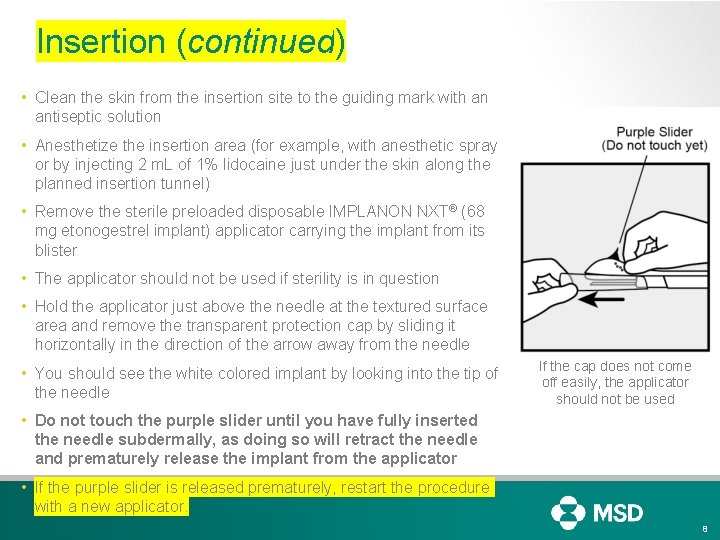
Insertion (continued) • Clean the skin from the insertion site to the guiding mark with an antiseptic solution • Anesthetize the insertion area (for example, with anesthetic spray or by injecting 2 m. L of 1% lidocaine just under the skin along the planned insertion tunnel) • Remove the sterile preloaded disposable IMPLANON NXT® (68 mg etonogestrel implant) applicator carrying the implant from its blister • The applicator should not be used if sterility is in question • Hold the applicator just above the needle at the textured surface area and remove the transparent protection cap by sliding it horizontally in the direction of the arrow away from the needle • You should see the white colored implant by looking into the tip of the needle If the cap does not come off easily, the applicator should not be used • Do not touch the purple slider until you have fully inserted the needle subdermally, as doing so will retract the needle and prematurely release the implant from the applicator • If the purple slider is released prematurely, restart the procedure with a new applicator. 8
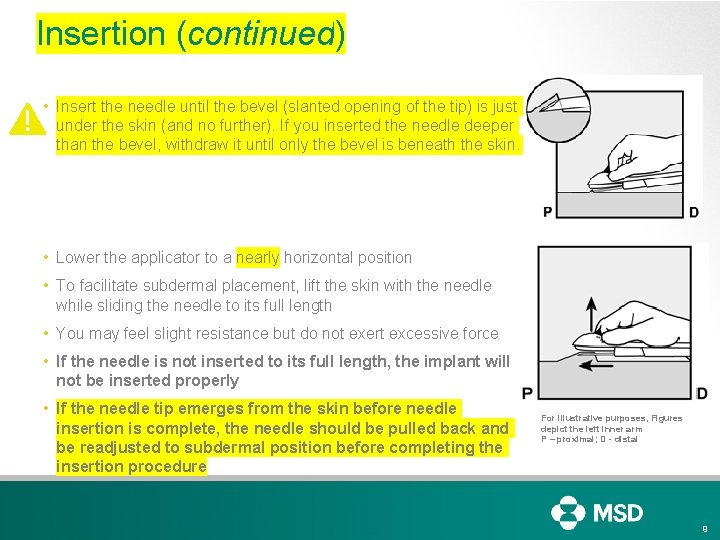
Insertion (continued) • Insert the needle until the bevel (slanted opening of the tip) is just under the skin (and no further). If you inserted the needle deeper than the bevel, withdraw it until only the bevel is beneath the skin. • Lower the applicator to a nearly horizontal position • To facilitate subdermal placement, lift the skin with the needle while sliding the needle to its full length • You may feel slight resistance but do not exert excessive force • If the needle is not inserted to its full length, the implant will not be inserted properly • If the needle tip emerges from the skin before needle insertion is complete, the needle should be pulled back and be readjusted to subdermal position before completing the insertion procedure For illustrative purposes, Figures depict the left inner arm P – proximal; D - distal 9
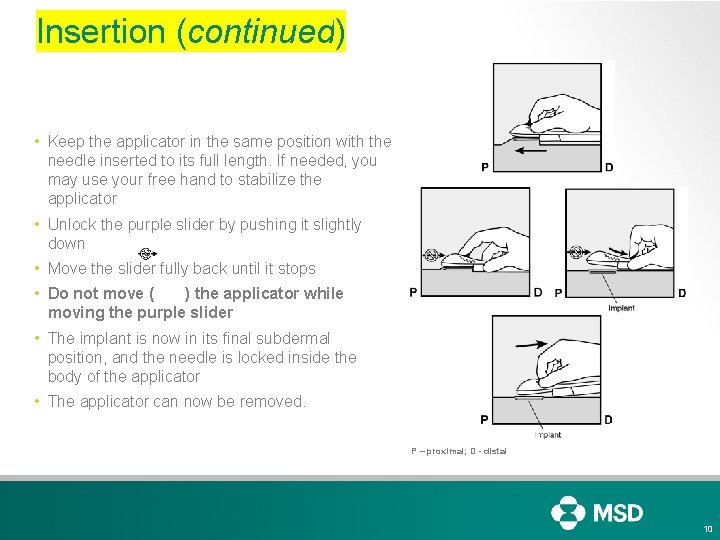
Insertion (continued) • Keep the applicator in the same position with the needle inserted to its full length. If needed, you may use your free hand to stabilize the applicator • Unlock the purple slider by pushing it slightly down • Move the slider fully back until it stops • Do not move ( ) the applicator while moving the purple slider • The implant is now in its final subdermal position, and the needle is locked inside the body of the applicator • The applicator can now be removed. P – proximal; D - distal 10
Insertion (continued) • If the applicator is not kept in the same position during the procedure or if the purple slider is not moved back until it stops, the implant will not be inserted properly and may protrude from the insertion site • If the implant is protruding from the insertion site, remove the implant and perform a new procedure at the same insertion site using a new applicator • Do not push the protruding implant back into the incision 11
If the implant is not palpable after insertion • Until the presence of the implant has been verified, the woman should be advised to use a non-hormonal contraceptive method, such as condoms • Deeply-placed implants should be localized and removed as soon as possible to avoid the potential for distant migration 12
Insertion Video 13
Removal and reinsertion 14
Preparation • Removal of the implant should only be performed under aseptic conditions by a healthcare provider who is familiar with the removal technique. If you are unfamiliar with the removal technique, contact the local MSD office. • The healthcare provider should assess the location of the implant and carefully read the instructions for removal. • The exact location of the implant in the arm should be verified by palpation. • If the implant is not palpable, consult the User Card or medical record to verify which arm contains the implant. • If the implant cannot be palpated, it may be deeply located or have migrated. Consider that it may lie close to vessels and nerves. • Removal of non-palpable implants should only be performed by a healthcare provider experienced in removing deeply placed implants and familiar with localizing the implant and the anatomy of the arm. Contact the local MSD office for further guidance. 15
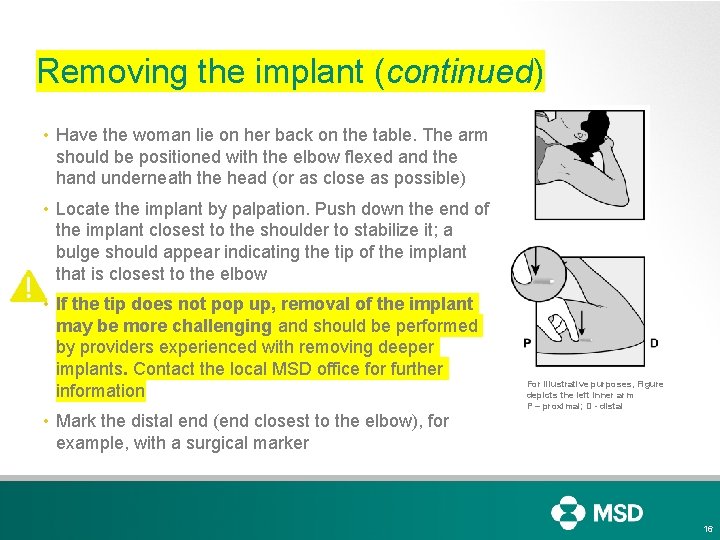
Removing the implant (continued) • Have the woman lie on her back on the table. The arm should be positioned with the elbow flexed and the hand underneath the head (or as close as possible) • Locate the implant by palpation. Push down the end of the implant closest to the shoulder to stabilize it; a bulge should appear indicating the tip of the implant that is closest to the elbow • If the tip does not pop up, removal of the implant may be more challenging and should be performed by providers experienced with removing deeper implants. Contact the local MSD office for further information • Mark the distal end (end closest to the elbow), for example, with a surgical marker For illustrative purposes, Figure depicts the left inner arm P – proximal; D - distal 16
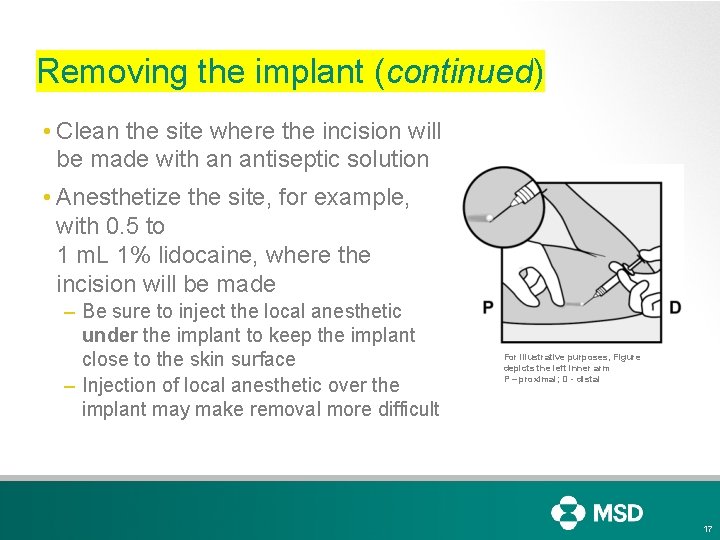
Removing the implant (continued) • Clean the site where the incision will be made with an antiseptic solution • Anesthetize the site, for example, with 0. 5 to 1 m. L 1% lidocaine, where the incision will be made – Be sure to inject the local anesthetic under the implant to keep the implant close to the skin surface – Injection of local anesthetic over the implant may make removal more difficult For illustrative purposes, Figure depicts the left inner arm P – proximal; D - distal 17
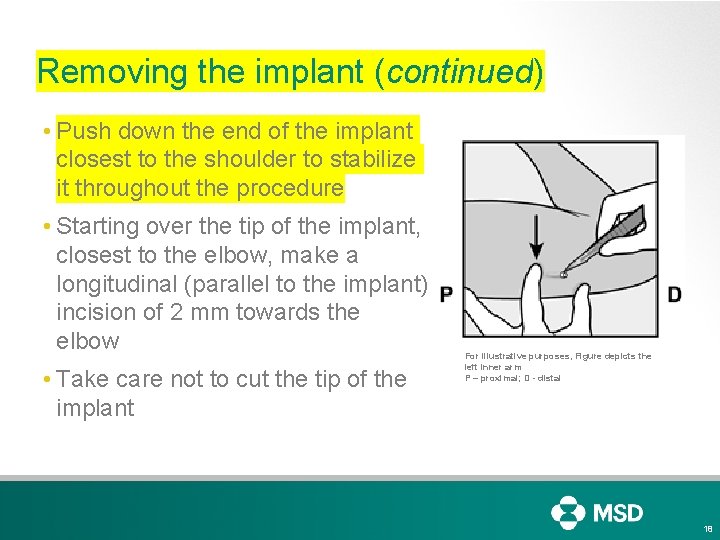
Removing the implant (continued) • Push down the end of the implant closest to the shoulder to stabilize it throughout the procedure • Starting over the tip of the implant, closest to the elbow, make a longitudinal (parallel to the implant) incision of 2 mm towards the elbow • Take care not to cut the tip of the implant For illustrative purposes, Figure depicts the left inner arm P – proximal; D - distal 18
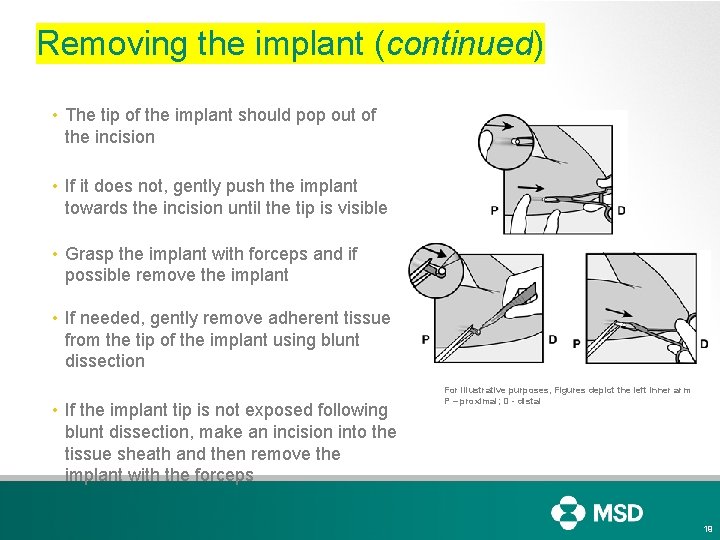
Removing the implant (continued) • The tip of the implant should pop out of the incision • If it does not, gently push the implant towards the incision until the tip is visible • Grasp the implant with forceps and if possible remove the implant • If needed, gently remove adherent tissue from the tip of the implant using blunt dissection • If the implant tip is not exposed following blunt dissection, make an incision into the tissue sheath and then remove the implant with the forceps For illustrative purposes, Figures depict the left inner arm P – proximal; D - distal 19
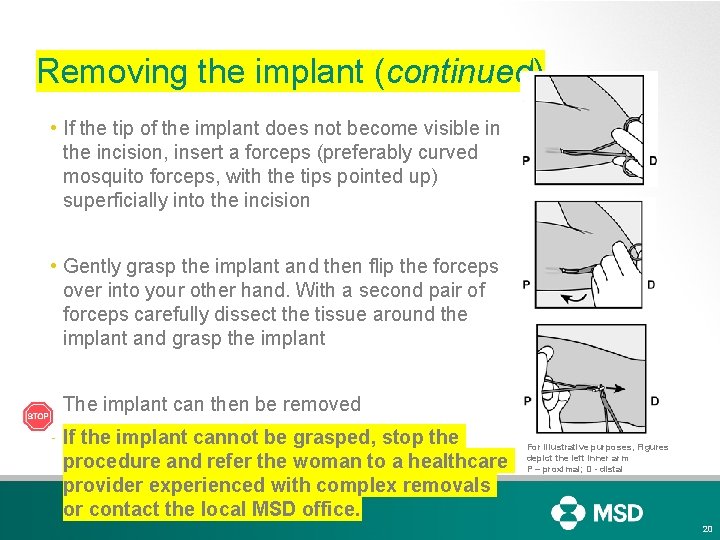
Removing the implant (continued) • If the tip of the implant does not become visible in the incision, insert a forceps (preferably curved mosquito forceps, with the tips pointed up) superficially into the incision • Gently grasp the implant and then flip the forceps over into your other hand. With a second pair of forceps carefully dissect the tissue around the implant and grasp the implant • The implant can then be removed • If the implant cannot be grasped, stop the procedure and refer the woman to a healthcare provider experienced with complex removals or contact the local MSD office. For illustrative purposes, Figures depict the left inner arm P – proximal; D - distal 20
Removal Video 21
Removal of a Non-Palpable Implant (continued) • Removal of deeply inserted implants should be conducted with caution in order to prevent injury to deeper neural or vascular structures in the arm and be performed by healthcare providers familiar with the anatomy of the arm • If you are unfamiliar or uncomfortable with the removal of deeply inserted implants, contact the local MSD office for further information 22
Replacing the implant • Immediate replacement can be done after removal of the previous implant and is similar to the insertion procedure described in the insertion instructions • The new implant may be inserted in the same arm, and through the same incision from which the previous implant was removed, as long as the site is in the correct location, i. e. , 8 -10 cm from the medial epicondyle of the humerus and 3 -5 cm posterior to (below) the sulcus. • If the same incision is being used to insert a new implant, anesthetize the insertion site (eg, 2 ml lidocaine [1%]) applied just under the skin commencing at the removal incision along the ‘insertion canal’ and follow the subsequent steps in the insertion instructions 23
Thank you Copyright © 2020 Merck Sharp & Dohme B. V. , a subsidiary of Merck & Co. , Inc. , Kenilworth, NJ, USA. All rights reserved. HQ-XPL-00035 04/20 24