
Imperial College London Mathematical modelling and computer software


- Slides: 10
Imperial College London Mathematical modelling and computer software development by G. Nikas Determination of Polymeric Sealing Principles for End User High Reliability
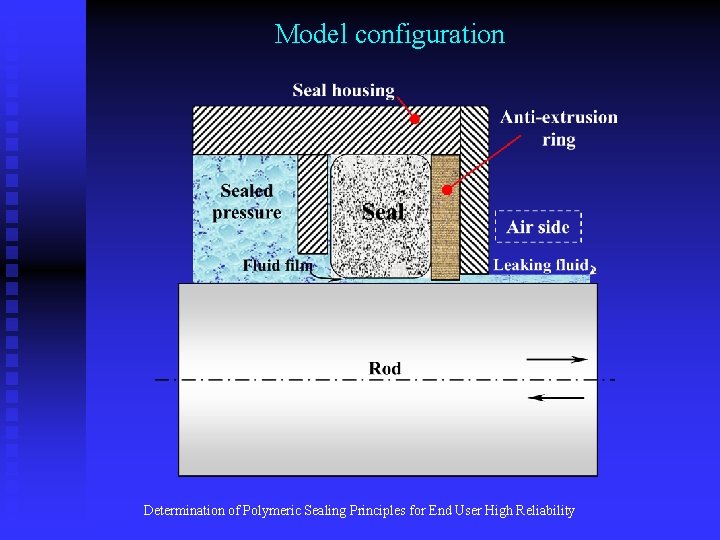
Model configuration Determination of Polymeric Sealing Principles for End User High Reliability
Objectives Determination of Polymeric Sealing Principles for End User High Reliability
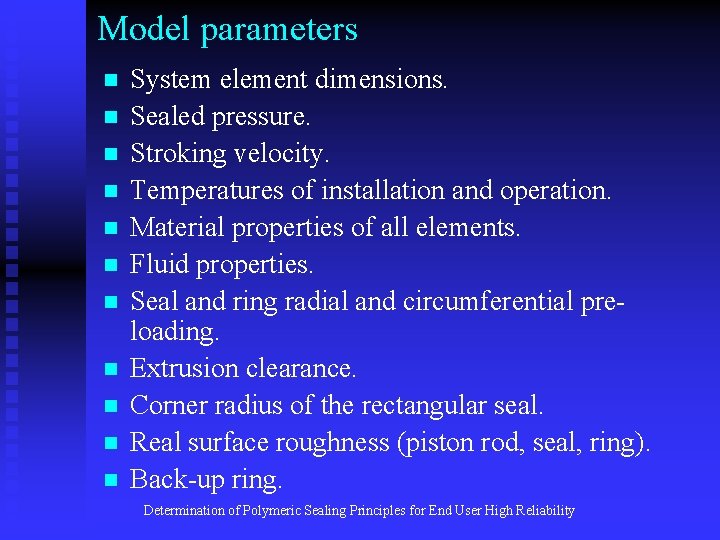
Model parameters n n n System element dimensions. Sealed pressure. Stroking velocity. Temperatures of installation and operation. Material properties of all elements. Fluid properties. Seal and ring radial and circumferential preloading. Extrusion clearance. Corner radius of the rectangular seal. Real surface roughness (piston rod, seal, ring). Back-up ring. Determination of Polymeric Sealing Principles for End User High Reliability
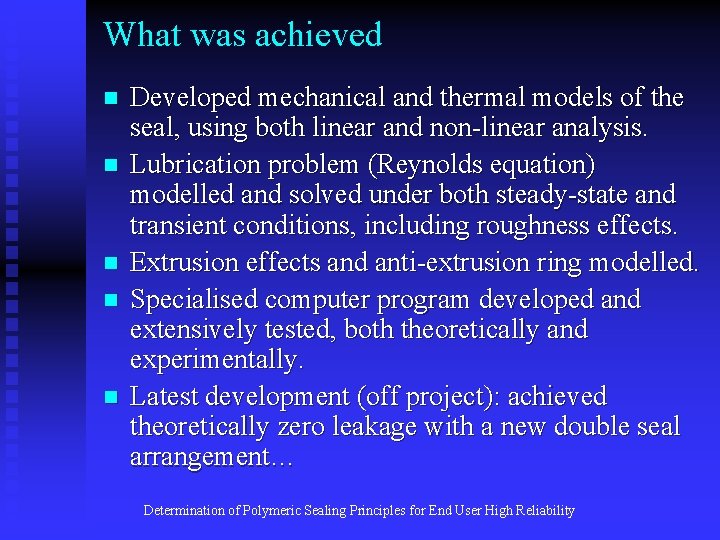
What was achieved n n n Developed mechanical and thermal models of the seal, using both linear and non-linear analysis. Lubrication problem (Reynolds equation) modelled and solved under both steady-state and transient conditions, including roughness effects. Extrusion effects and anti-extrusion ring modelled. Specialised computer program developed and extensively tested, both theoretically and experimentally. Latest development (off project): achieved theoretically zero leakage with a new double seal arrangement… Determination of Polymeric Sealing Principles for End User High Reliability
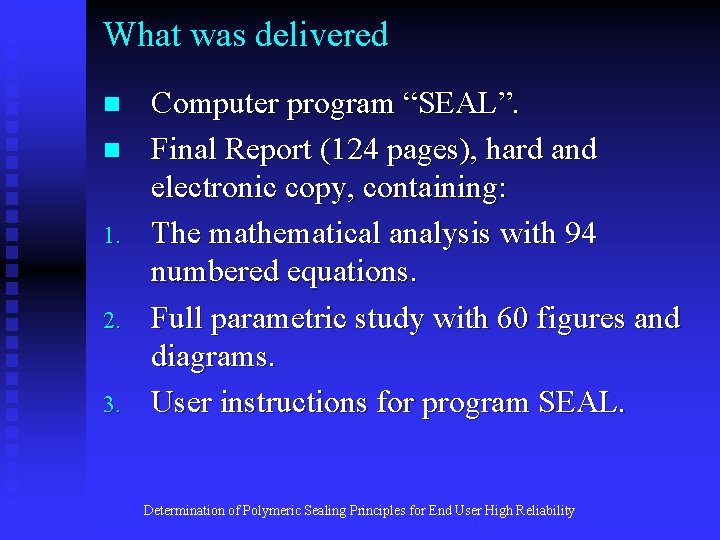
What was delivered n n 1. 2. 3. Computer program “SEAL”. Final Report (124 pages), hard and electronic copy, containing: The mathematical analysis with 94 numbered equations. Full parametric study with 60 figures and diagrams. User instructions for program SEAL. Determination of Polymeric Sealing Principles for End User High Reliability
Publications 1. 2. 3. One paper on the experimental work in the 2 nd World Tribology Congress, Austria, 2001. One paper in the ASME Journal of Tribology. Published in January 2003. Five papers in the IMech. E Journal of Engineering Tribology, 2003 (two already published and three currently under review by the Journal referees). Determination of Polymeric Sealing Principles for End User High Reliability
ASME Journal of Tribology paper: “Elastohydrodynamics and mechanics of rectangular elastomeric seals for reciprocating piston rods”, by G. Nikas. ASME Reviewer 1 wrote: “This is an excellent paper. It has the most detailed analysis of an important type of seal. ” ASME Reviewer 2 wrote: “This is a significant step forward in the computer modelling of this class of seal. ” Determination of Polymeric Sealing Principles for End User High Reliability
Field, G. , and Nau, B. , “A theoretical study of the elastohydrodynamic lubrication of reciprocating rubber seals”, ASLE Trans. , 1975. “…However, the calculated results are for a seal operating under ideal hydrodynamic conditions, whereas experimental values are the result of an unknown mode of lubrication which may have involved boundary and hydrodynamic modes. In practise, the attitude of the test rig may also have a considerable effect on the measured leakage. The friction values calculated are all very low and increase with speed, reflecting the hydrodynamic nature of the lubrication mechanism. However, experimental results under similar conditions show values an order of magnitude or more higher than those calculated which defer also in decreasing with speed. This suggests a boundary mode of lubrication, in spite of the fact that the measured film profiles were very similar to those calculated…”
Flitney, R. , and Nau, B. , “Performance variation in reciprocating rubber seals for fluid power applications”, STLE Trans. , 1988. “A ‘round-robin’ rig-test program was set up to establish statistics for the scatter of hydraulic reciprocatingseal performance, when tested to a carefully prescribed procedure. Seals from a single source were procured and run by seven laboratories in different countries. Despite much closer control over operating conditions than is normal in practical application, the results show a high degree of scatter between laboratories, although generally reasonable within individual laboratories. ”