
Imperfections in Solids Types of imperfections point defects
- Slides: 8
Imperfections in Solids • Types of imperfections: – point defects – line defects (or dislocations) – surface defects 1
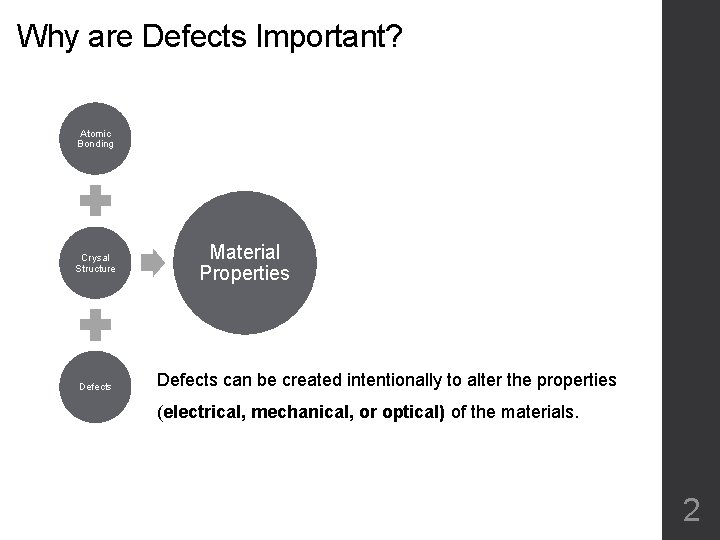
Why are Defects Important? Atomic Bonding Crysal Structure Defects Material Properties Defects can be created intentionally to alter the properties (electrical, mechanical, or optical) of the materials. 2
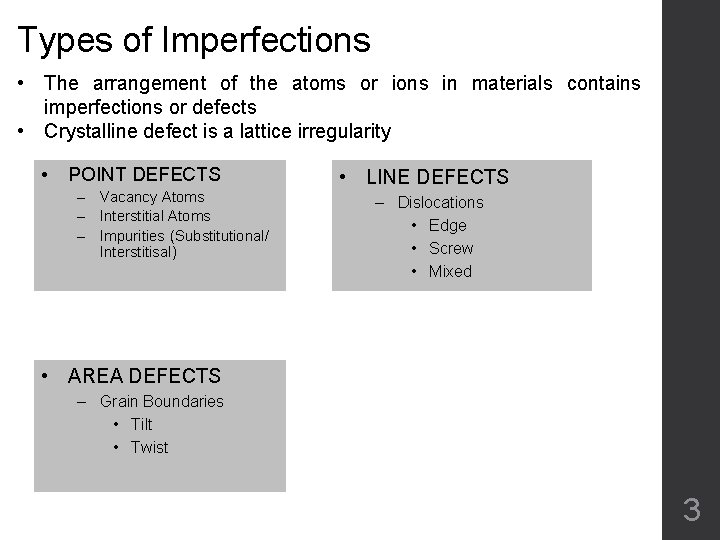
Types of Imperfections • The arrangement of the atoms or ions in materials contains imperfections or defects • Crystalline defect is a lattice irregularity • POINT DEFECTS – Vacancy Atoms – Interstitial Atoms – Impurities (Substitutional/ Interstitisal) • LINE DEFECTS – Dislocations • Edge • Screw • Mixed • AREA DEFECTS – Grain Boundaries • Tilt • Twist 3
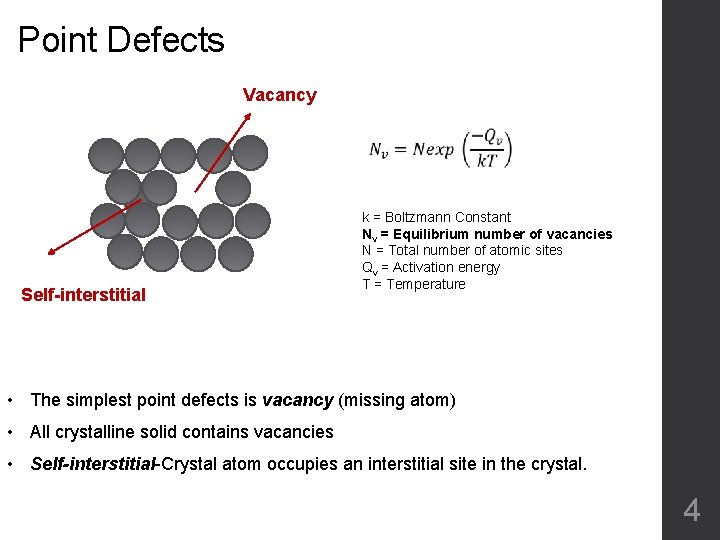
Point Defects Vacancy Self-interstitial k = Boltzmann Constant Nv = Equilibrium number of vacancies N = Total number of atomic sites Qv = Activation energy T = Temperature • The simplest point defects is vacancy (missing atom) • All crystalline solid contains vacancies • Self-interstitial-Crystal atom occupies an interstitial site in the crystal. 4
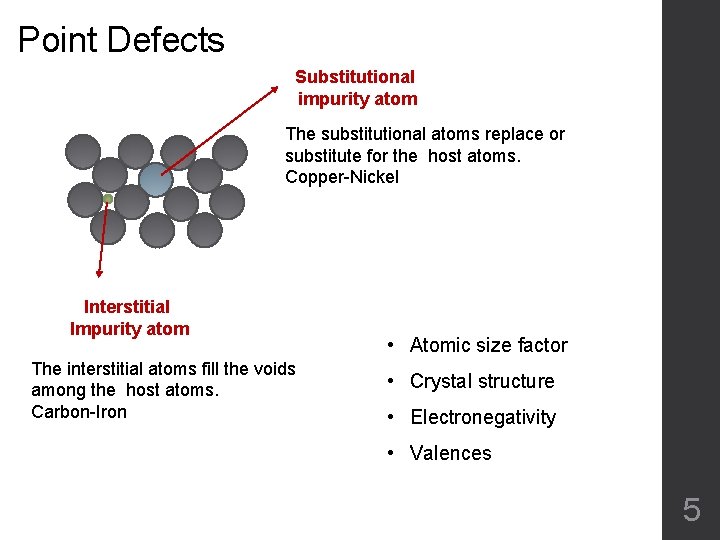
Point Defects Substitutional impurity atom The substitutional atoms replace or substitute for the host atoms. Copper-Nickel Interstitial Impurity atom The interstitial atoms fill the voids among the host atoms. Carbon-Iron • Atomic size factor • Crystal structure • Electronegativity • Valences 5
Linear Defects-Dislocations 6
Linear Defects-Dislocations • Size and the direction of the lattice distortion caused by a dislocation can be defined by Burgers vector b. • b is defined to be closure failure of one atom distance • b is required to complete loop and return to its starting point • b defines magnitude and direction of slip • Dislocation line defect that the boundary between slipped and unslipped region of the crystal. • b is parallel to the screw dislocation and perpendicular to the edge dislocation. 7
References Donald R. Askeland, Pradeep P. Fulay, Wendelin J. Wright, The Science and Engineering of Materials, Sixth Edition William D. Callister, David G. Rethwisch, Materials Science and Engineering, Eighth Edition, Wiley, 2011. 8