
Imperfect information and IT On previous lesson Knowing
- Slides: 21
Imperfect information and IT
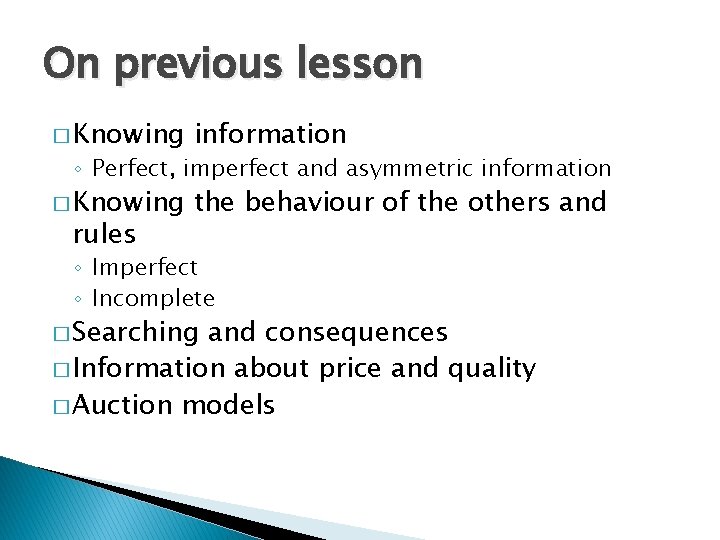
On previous lesson � Knowing information � Knowing the behaviour of the others and ◦ Perfect, imperfect and asymmetric information rules ◦ Imperfect ◦ Incomplete � Searching and consequences � Information about price and quality � Auction models
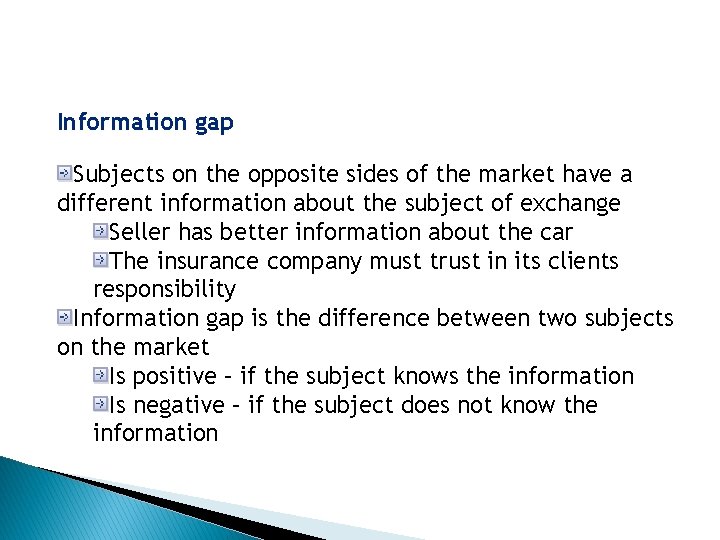
Information gap Subjects on the opposite sides of the market have a different information about the subject of exchange Seller has better information about the car The insurance company must trust in its clients responsibility Information gap is the difference between two subjects on the market Is positive – if the subject knows the information Is negative – if the subject does not know the information
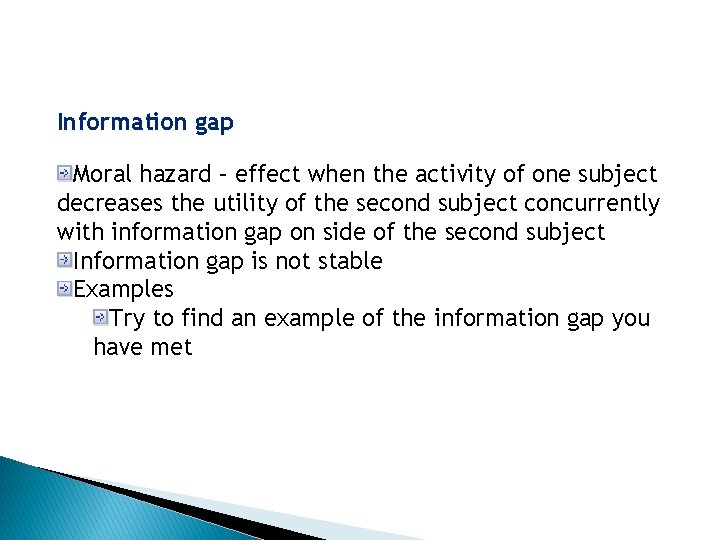
Information gap Moral hazard – effect when the activity of one subject decreases the utility of the second subject concurrently with information gap on side of the second subject Information gap is not stable Examples Try to find an example of the information gap you have met
How to fit information gap? Filling the gap By distribution of the information? Removal of subject‘s disadvantage, based on nascence of particular information Subject must be willing to invest to filling of the gap The first condition is to identify the gap The filling is the function of time Questions How will the subject fill the gap? Can the gap be filled by itself?
Filling the information gap Absolute The information are distributed from one side to the other Example Register of insured persons l. To know a history of new client Register of debtors l. To eliminate to risky clients Subjects facing negative gaps can join even if they are competitors
Filling the information gap Relative If there is no way how to get the information Example l. Bankrupt of travel agency l. The client has no power nor possibility to find the information l. Mandatory insurance of travel agency l. The client does not need to take care about travel agency finance l. Mandatory car insurance Relative filling is the eliminating of the gap’s influence
More general attitude to information gaps Direct methods of filling If the aim is particular information gap Indirect The aim is more general To prevent the creation of information gap To solve whole problem
Indirect method to fill the gaps Source of information Subject that provide the knowledge or information The way of transfer of the information Primary source Author of information No changes on the character of information Secondary source Information is transformed Information channel If more sources of information join to use the same way of transfer
Using the information channel Random consumption of information Using secondary sources TV news, information servers, social networks Subject do not search anything specific Just they need to be informed The need to share information The question of trust to the secondary source
Internet What is internet? Information channel Subject has to know what is he searching for to use it properly Ideal platform to find the market equilibrium
Role of IT IT is a tool to: fill the gap – to distribute information To eliminate the gap – using IT services to interconnect subject with negative effects of a gap Manage the information To prevent the influence of the gaps To eliminate the gaps
The price of information Is almost individual It is equal to the searching (opportunity) costs It is important to divide the price of information and the price of access to information To buy the possibility to search To buy a possibility to share information The question of technology Higher speed means higher probability to find what I am looking for
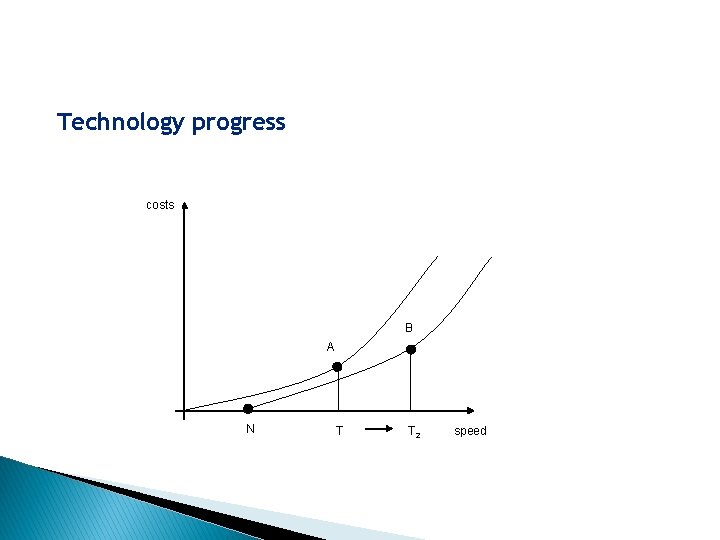
Technology progress costs B A N T T 2 speed
Government and information It needs the information for making of the decisions It is important source of information It is supervisor on the market with information
Government as the information receiver The most of analysis is done by state institutions ministry clerks National bank The government is the source of information for itself The analysis can be wrong The decisions can be wrong – moral hazard The question of time
The government and searching of information Where is the equilibrium of searching Stigler model does not work The process of searching is excluded from the process of evaluating and using of the information The person who is searching does not know the effect We can not be sure that the government has right information We can not be sure the information are correct Moral hazard The Greece
The government as the source of information The government is not one source of information The motivation of the clerks To publish only the information that are good for them Moral hazard The subjects need the information from other source to prove it
The government regulates the market of information Direct approach Problem of the identification of information gap Absolute filling How to do it Law – market subject must give some information to the register Relative filling Not necessary to identify a specific problem, just a group of problems Mandatory insurance
The government regulates the market of information Indirect approach Development of information sources and channels Support of using services Data mail-boxes Digital signature E-government Supporting the development of the information access
Conclusion Information gap Filling the information gap Information source Information channel Role of government Role of IT