
Imperative Constructions in English A Syntactic Analysis Paula
- Slides: 1
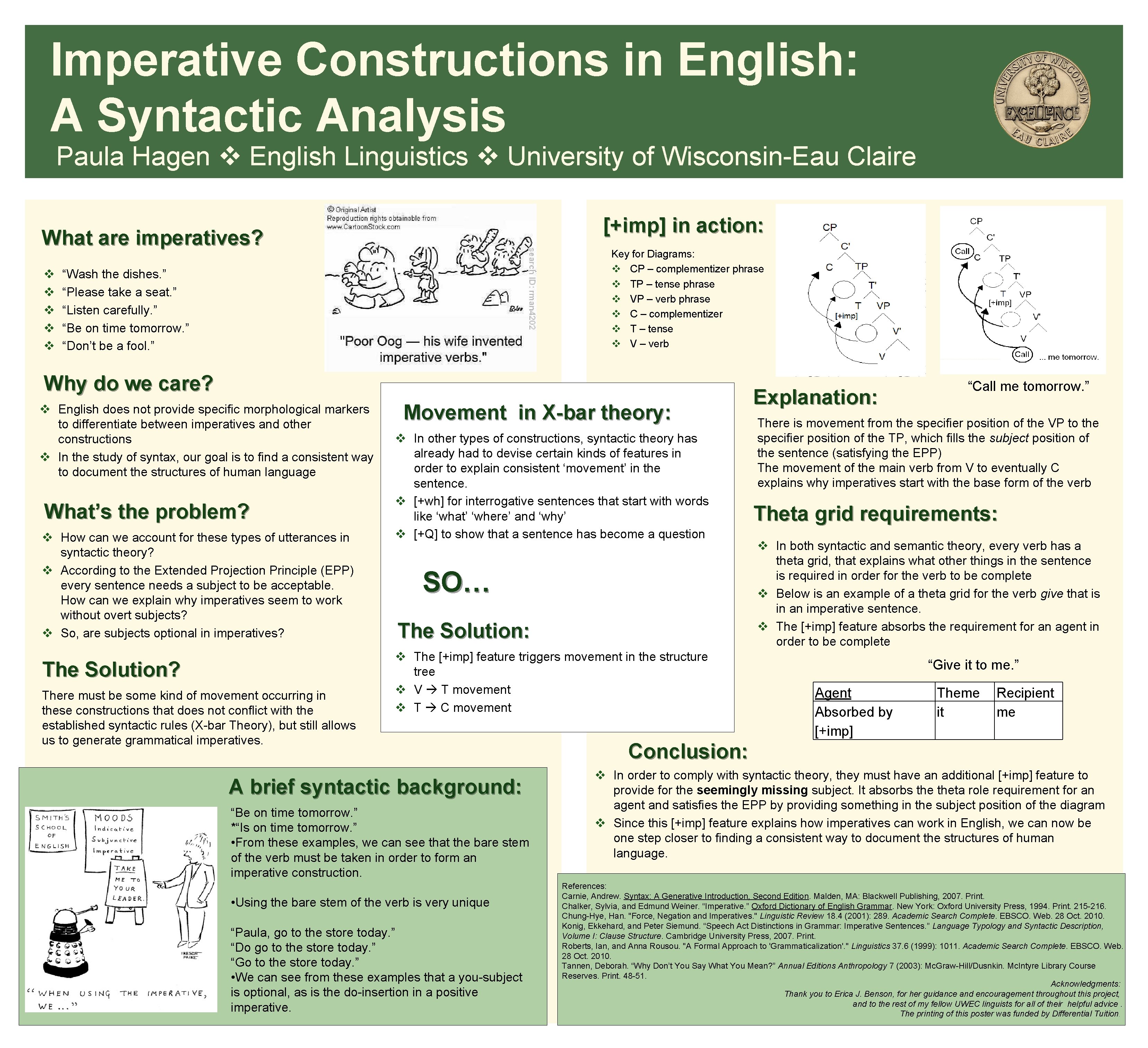
Imperative Constructions in English: A Syntactic Analysis Paula Hagen English Linguistics University of Wisconsin-Eau Claire [+imp] in action: What are imperatives? Key for Diagrams: CP – complementizer phrase TP – tense phrase VP – verb phrase C – complementizer T – tense V – verb “Wash the dishes. ” “Please take a seat. ” “Listen carefully. ” “Be on time tomorrow. ” “Don’t be a fool. ” Why do we care? English does not provide specific morphological markers to differentiate between imperatives and other constructions In the study of syntax, our goal is to find a consistent way to document the structures of human language What’s the problem? How can we account for these types of utterances in syntactic theory? According to the Extended Projection Principle (EPP) every sentence needs a subject to be acceptable. How can we explain why imperatives seem to work without overt subjects? So, are subjects optional in imperatives? The Solution? There must be some kind of movement occurring in these constructions that does not conflict with the established syntactic rules (X-bar Theory), but still allows us to generate grammatical imperatives. Movement in X-bar theory: In other types of constructions, syntactic theory has already had to devise certain kinds of features in order to explain consistent ‘movement’ in the sentence. [+wh] for interrogative sentences that start with words like ‘what’ ‘where’ and ‘why’ [+Q] to show that a sentence has become a question SO… The Solution: The [+imp] feature triggers movement in the structure tree V T movement T C movement A brief syntactic background: “Be on time tomorrow. ” *“Is on time tomorrow. ” • From these examples, we can see that the bare stem of the verb must be taken in order to form an imperative construction. • Using the bare stem of the verb is very unique “Paula, go to the store today. ” “Do go to the store today. ” “Go to the store today. ” • We can see from these examples that a you-subject is optional, as is the do-insertion in a positive imperative. Explanation: “Call me tomorrow. ” There is movement from the specifier position of the VP to the specifier position of the TP, which fills the subject position of the sentence (satisfying the EPP) The movement of the main verb from V to eventually C explains why imperatives start with the base form of the verb Theta grid requirements: In both syntactic and semantic theory, every verb has a theta grid, that explains what other things in the sentence is required in order for the verb to be complete Below is an example of a theta grid for the verb give that is in an imperative sentence. The [+imp] feature absorbs the requirement for an agent in order to be complete “Give it to me. ” Agent Absorbed by [+imp] Theme it Recipient me Conclusion: In order to comply with syntactic theory, they must have an additional [+imp] feature to provide for the seemingly missing subject. It absorbs theta role requirement for an agent and satisfies the EPP by providing something in the subject position of the diagram Since this [+imp] feature explains how imperatives can work in English, we can now be one step closer to finding a consistent way to document the structures of human language. References: Carnie, Andrew. Syntax: A Generative Introduction, Second Edition. Malden, MA: Blackwell Publishing, 2007. Print. Chalker, Sylvia, and Edmund Weiner. “Imperative. ” Oxford Dictionary of English Grammar. New York: Oxford University Press, 1994. Print. 215 -216. Chung-Hye, Han. "Force, Negation and Imperatives. " Linguistic Review 18. 4 (2001): 289. Academic Search Complete. EBSCO. Web. 28 Oct. 2010. Konig, Ekkehard, and Peter Siemund. “Speech Act Distinctions in Grammar: Imperative Sentences. ” Language Typology and Syntactic Description, Volume I: Clause Structure. Cambridge University Press, 2007. Print. Roberts, Ian, and Anna Rousou. "A Formal Approach to 'Grammaticalization'. " Linguistics 37. 6 (1999): 1011. Academic Search Complete. EBSCO. Web. 28 Oct. 2010. Tannen, Deborah. “Why Don’t You Say What You Mean? ” Annual Editions Anthropology 7 (2003): Mc. Graw-Hill/Dusnkin. Mc. Intyre Library Course Reserves. Print. 48 -51. Acknowledgments: Thank you to Erica J. Benson, for her guidance and encouragement throughout this project, and to the rest of my fellow UWEC linguists for all of their helpful advice. The printing of this poster was funded by Differential Tuition.