
Impairment and Derecognition Ind AS 109 Financial Instruments


- Slides: 44
Impairment and Derecognition Ind AS 109 Financial Instruments
Agenda 1. Impairment : Financial Instruments 2. Expected Credit Loss Model 3. Derecognition of Financial Assets 4. Derecognition of Financial Liabilities 5. Modification of Terms Page 2 Financial Instruments : Impairment & Derecognition
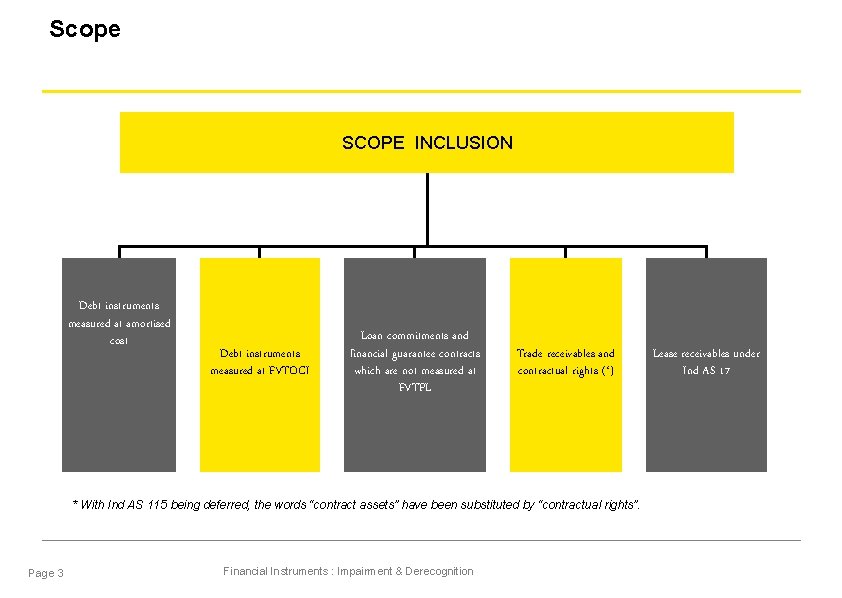
Scope SCOPE INCLUSION Debt instruments measured at amortised cost Debt instruments measured at FVTOCI Loan commitments and financial guarantee contracts which are not measured at FVTPL Trade receivables and contractual rights (*) * With Ind AS 115 being deferred, the words “contract assets” have been substituted by “contractual rights”. Page 3 Financial Instruments : Impairment & Derecognition Lease receivables under Ind AS 17
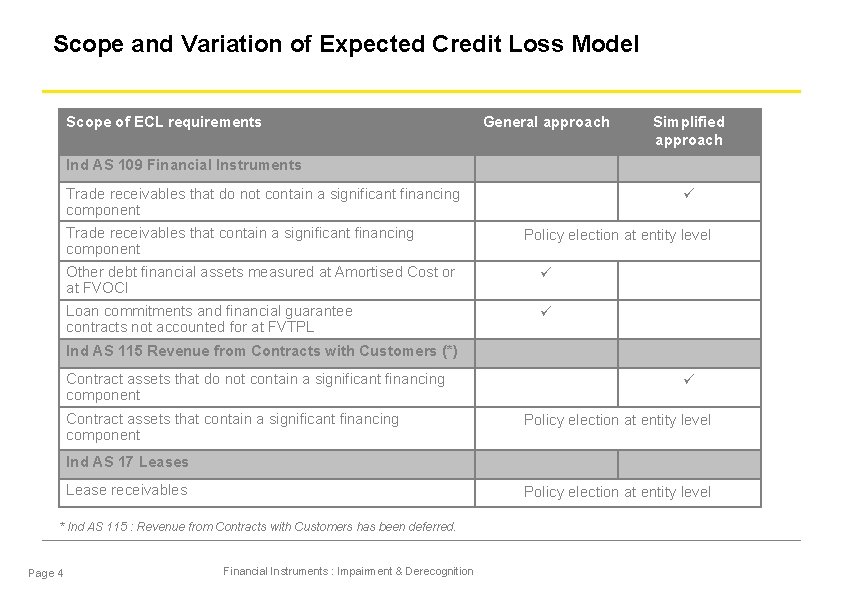
Scope and Variation of Expected Credit Loss Model Scope of ECL requirements General approach Simplified approach Ind AS 109 Financial Instruments Trade receivables that do not contain a significant financing component Trade receivables that contain a significant financing component Policy election at entity level Other debt financial assets measured at Amortised Cost or at FVOCI Loan commitments and financial guarantee contracts not accounted for at FVTPL Ind AS 115 Revenue from Contracts with Customers (*) Contract assets that do not contain a significant financing component Contract assets that contain a significant financing component Policy election at entity level Ind AS 17 Leases Lease receivables Policy election at entity level * Ind AS 115 : Revenue from Contracts with Customers has been deferred. Page 4 Financial Instruments : Impairment & Derecognition
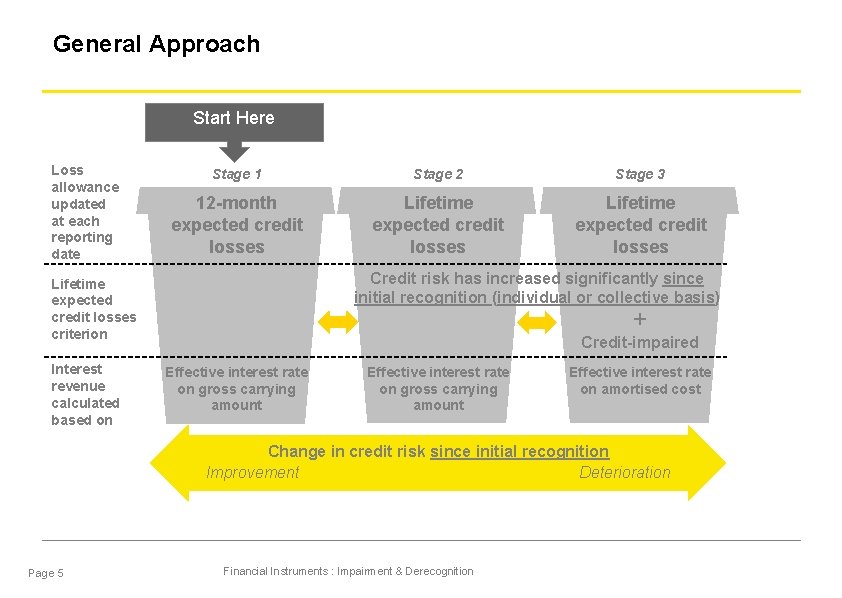
General Approach Start Here Loss allowance updated at each reporting date Stage 1 Stage 2 Stage 3 12 -month expected credit losses Lifetime expected credit losses Credit risk has increased significantly since initial recognition (individual or collective basis) Lifetime expected credit losses criterion Interest revenue calculated based on + Credit-impaired Effective interest rate on gross carrying amount Effective interest rate on amortised cost Change in credit risk since initial recognition Improvement Deterioration Page 5 Financial Instruments : Impairment & Derecognition
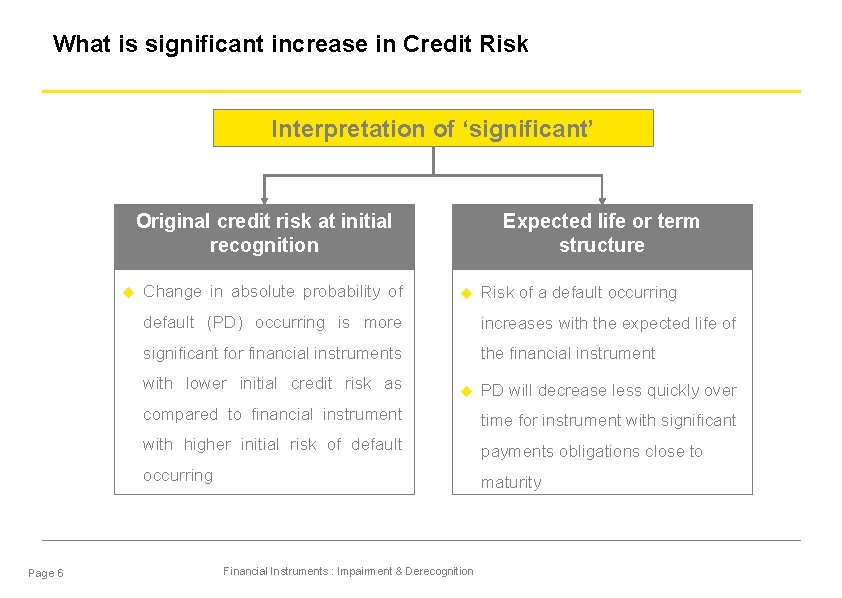
What is significant increase in Credit Risk Interpretation of ‘significant’ Original credit risk at initial recognition u Change in absolute probability of u Risk of a default occurring default (PD) occurring is more increases with the expected life of significant for financial instruments the financial instrument with lower initial credit risk as Page 6 Expected life or term structure u PD will decrease less quickly over compared to financial instrument time for instrument with significant with higher initial risk of default payments obligations close to occurring maturity Financial Instruments : Impairment & Derecognition
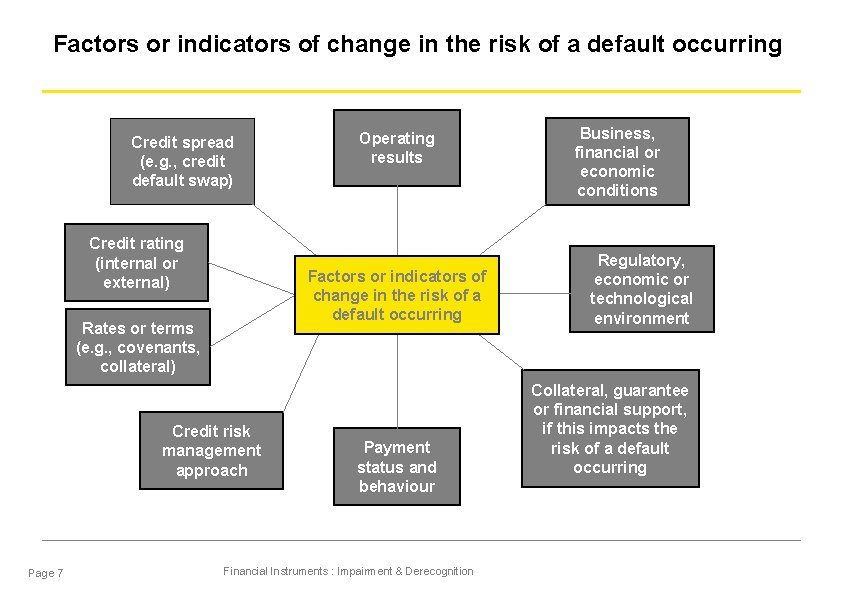
Factors or indicators of change in the risk of a default occurring Credit spread (e. g. , credit default swap) Credit rating (internal or external) Factors or indicators of change in the risk of a default occurring Rates or terms (e. g. , covenants, collateral) Credit risk management approach Page 7 Operating results Payment status and behaviour Financial Instruments : Impairment & Derecognition Business, financial or economic conditions Regulatory, economic or technological environment Collateral, guarantee or financial support, if this impacts the risk of a default occurring
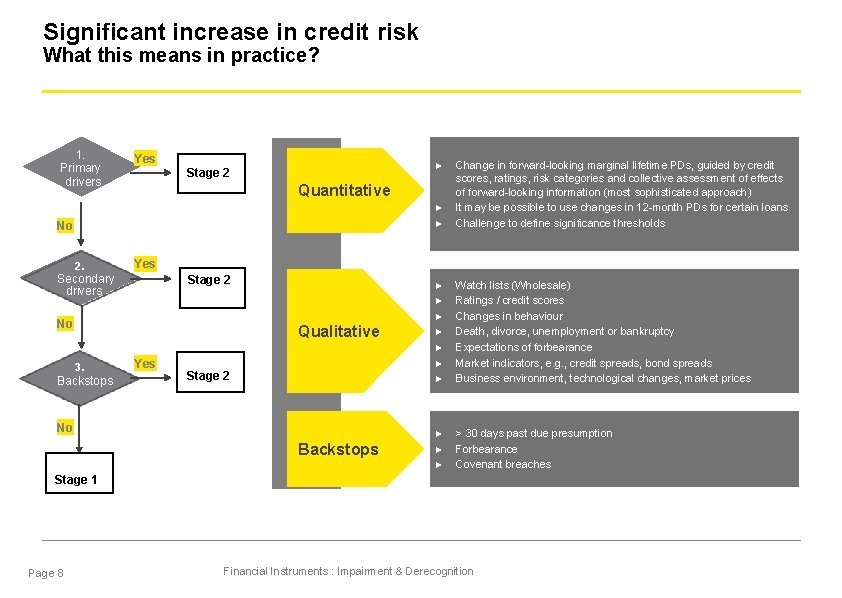
Significant increase in credit risk What this means in practice? 1. Primary drivers Yes ► Stage 2 Quantitative ► No ► 2. Yes Secondary drivers Stage 2 ► ► ► No Qualitative ► ► 3. Backstops Change in forward-looking marginal lifetime PDs, guided by credit scores, ratings, risk categories and collective assessment of effects of forward-looking information (most sophisticated approach) It may be possible to use changes in 12 -month PDs for certain loans Challenge to define significance thresholds Yes ► Stage 2 ► No ► Backstops ► ► Watch lists (Wholesale) Ratings / credit scores Changes in behaviour Death, divorce, unemployment or bankruptcy Expectations of forbearance Market indicators, e. g. , credit spreads, bond spreads Business environment, technological changes, market prices > 30 days past due presumption Forbearance Covenant breaches Stage 1 Page 8 Financial Instruments : Impairment & Derecognition
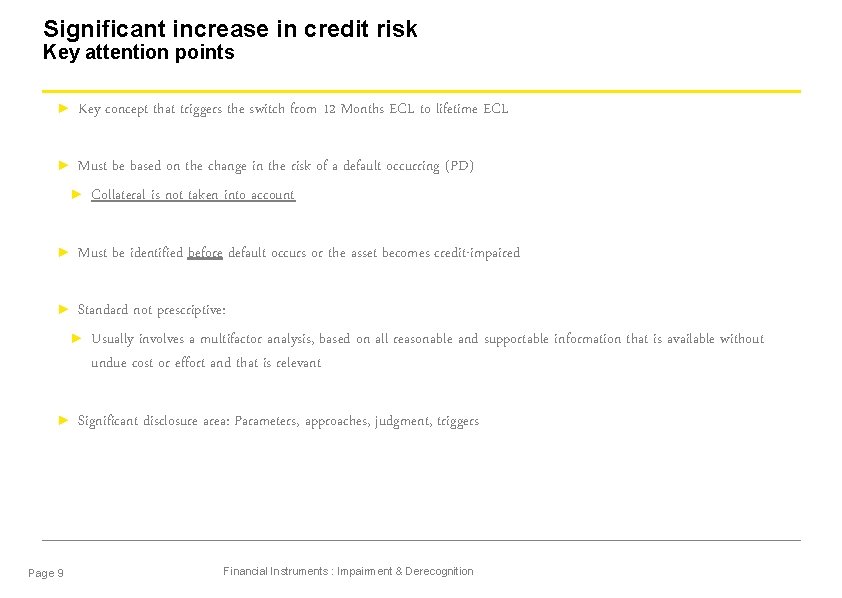
Significant increase in credit risk Key attention points ► Key concept that triggers the switch from 12 Months ECL to lifetime ECL Must be based on the change in the risk of a default occurring (PD) ► Collateral is not taken into account ► ► Must be identified before default occurs or the asset becomes credit-impaired Standard not prescriptive: ► Usually involves a multifactor analysis, based on all reasonable and supportable information that is available without undue cost or effort and that is relevant ► ► Page 9 Significant disclosure area: Parameters, approaches, judgment, triggers Financial Instruments : Impairment & Derecognition
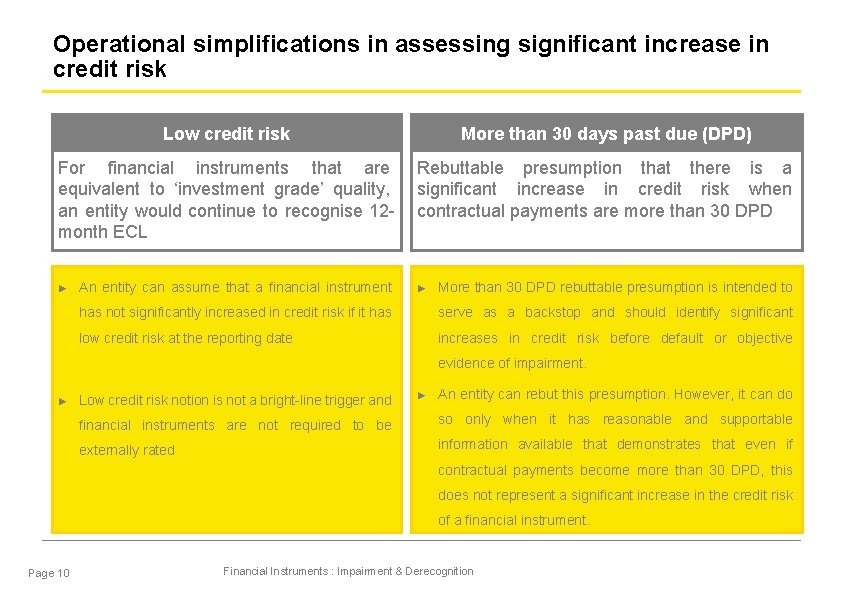
Operational simplifications in assessing significant increase in credit risk Low credit risk More than 30 days past due (DPD) For financial instruments that are equivalent to ‘investment grade’ quality, an entity would continue to recognise 12 month ECL Rebuttable presumption that there is a significant increase in credit risk when contractual payments are more than 30 DPD ► An entity can assume that a financial instrument ► More than 30 DPD rebuttable presumption is intended to has not significantly increased in credit risk if it has serve as a backstop and should identify significant low credit risk at the reporting date increases in credit risk before default or objective evidence of impairment. ► Low credit risk notion is not a bright-line trigger and ► An entity can rebut this presumption. However, it can do financial instruments are not required to be so only when it has reasonable and supportable externally rated information available that demonstrates that even if contractual payments become more than 30 DPD, this does not represent a significant increase in the credit risk of a financial instrument. Page 10 Financial Instruments : Impairment & Derecognition
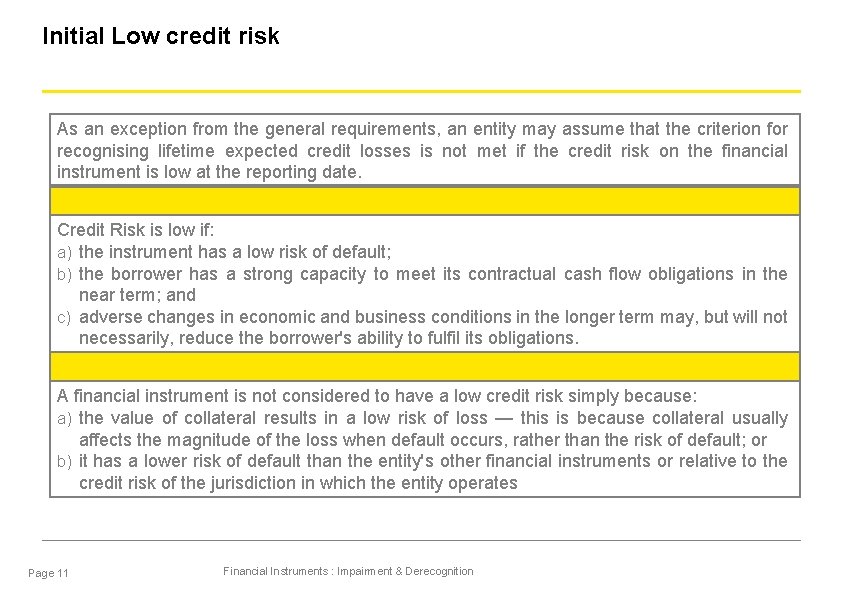
Initial Low credit risk As an exception from the general requirements, an entity may assume that the criterion for recognising lifetime expected credit losses is not met if the credit risk on the financial instrument is low at the reporting date. Credit Risk is low if: a) the instrument has a low risk of default; b) the borrower has a strong capacity to meet its contractual cash flow obligations in the near term; and c) adverse changes in economic and business conditions in the longer term may, but will not necessarily, reduce the borrower's ability to fulfil its obligations. A financial instrument is not considered to have a low credit risk simply because: a) the value of collateral results in a low risk of loss — this is because collateral usually affects the magnitude of the loss when default occurs, rather than the risk of default; or b) it has a lower risk of default than the entity's other financial instruments or relative to the credit risk of the jurisdiction in which the entity operates Page 11 Financial Instruments : Impairment & Derecognition
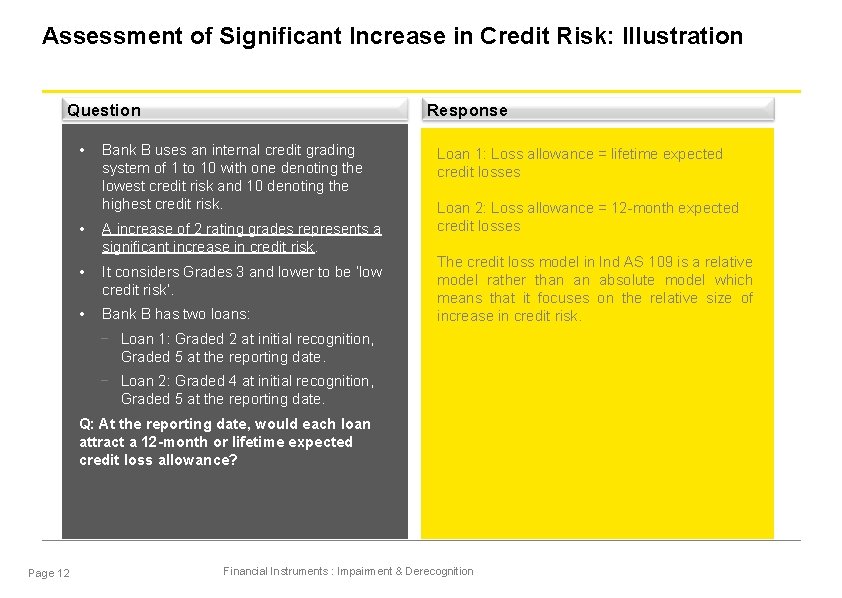
Assessment of Significant Increase in Credit Risk: Illustration Question • Response Bank B uses an internal credit grading system of 1 to 10 with one denoting the lowest credit risk and 10 denoting the highest credit risk. • A increase of 2 rating grades represents a significant increase in credit risk. • It considers Grades 3 and lower to be ‘low credit risk’. • Bank B has two loans: Loan 1: Loss allowance = lifetime expected credit losses Loan 2: Loss allowance = 12 -month expected credit losses The credit loss model in Ind AS 109 is a relative model rather than an absolute model which means that it focuses on the relative size of increase in credit risk. − Loan 1: Graded 2 at initial recognition, Graded 5 at the reporting date. − Loan 2: Graded 4 at initial recognition, Graded 5 at the reporting date. Q: At the reporting date, would each loan attract a 12 -month or lifetime expected credit loss allowance? Page 12 Financial Instruments : Impairment & Derecognition
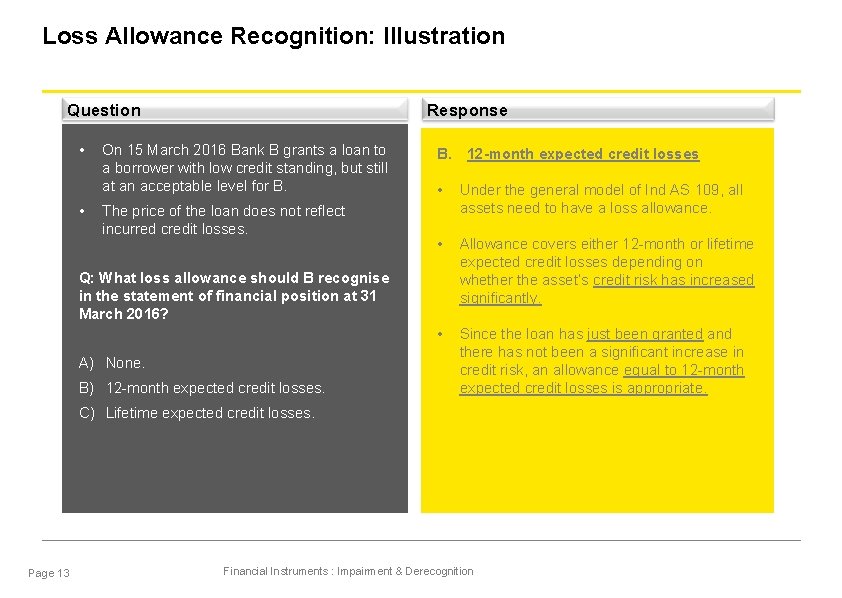
Loss Allowance Recognition: Illustration Question • • Response On 15 March 2016 Bank B grants a loan to a borrower with low credit standing, but still at an acceptable level for B. The price of the loan does not reflect incurred credit losses. B. 12 -month expected credit losses • Under the general model of Ind AS 109, all assets need to have a loss allowance. • Allowance covers either 12 -month or lifetime expected credit losses depending on whether the asset’s credit risk has increased significantly. • Since the loan has just been granted and there has not been a significant increase in credit risk, an allowance equal to 12 -month expected credit losses is appropriate. Q: What loss allowance should B recognise in the statement of financial position at 31 March 2016? A) None. B) 12 -month expected credit losses. C) Lifetime expected credit losses. Page 13 Financial Instruments : Impairment & Derecognition
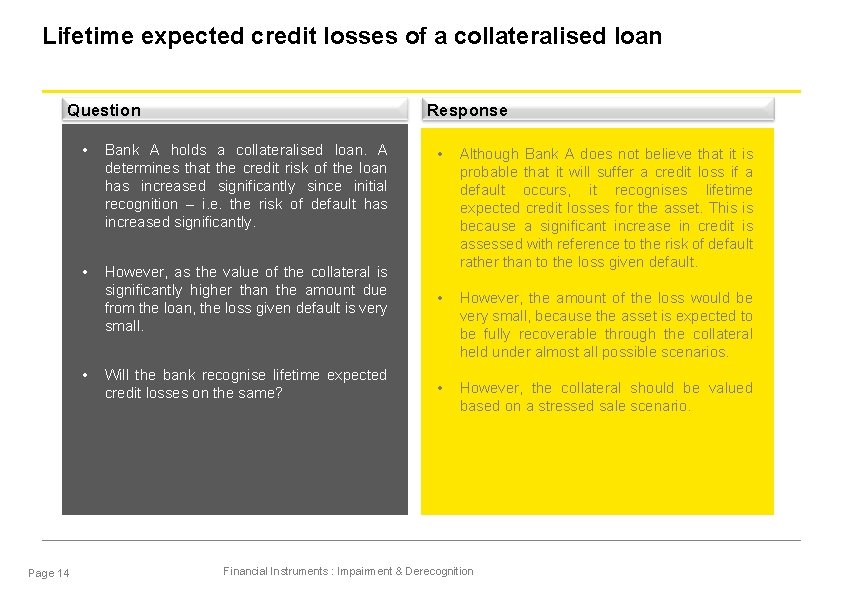
Lifetime expected credit losses of a collateralised loan Question • Bank A holds a collateralised loan. A determines that the credit risk of the loan has increased significantly since initial recognition – i. e. the risk of default has increased significantly. • • Page 14 Response • However, as the value of the collateral is significantly higher than the amount due from the loan, the loss given default is very small. Although Bank A does not believe that it is probable that it will suffer a credit loss if a default occurs, it recognises lifetime expected credit losses for the asset. This is because a significant increase in credit is assessed with reference to the risk of default rather than to the loss given default. • However, the amount of the loss would be very small, because the asset is expected to be fully recoverable through the collateral held under almost all possible scenarios. Will the bank recognise lifetime expected credit losses on the same? • However, the collateral should be valued based on a stressed sale scenario. Financial Instruments : Impairment & Derecognition
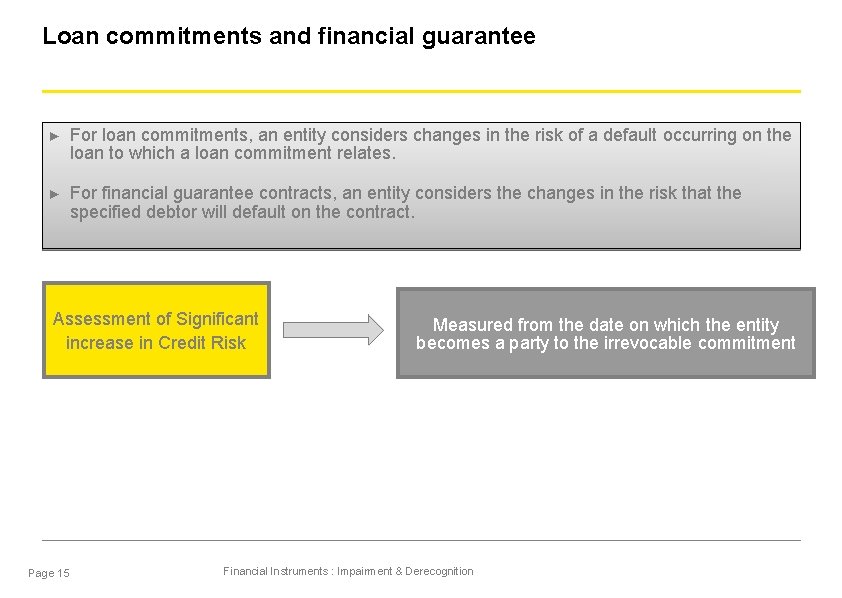
Loan commitments and financial guarantee ► For loan commitments, an entity considers changes in the risk of a default occurring on the loan to which a loan commitment relates. ► For financial guarantee contracts, an entity considers the changes in the risk that the specified debtor will default on the contract. Assessment of Significant increase in Credit Risk Page 15 Measured from the date on which the entity becomes a party to the irrevocable commitment Financial Instruments : Impairment & Derecognition
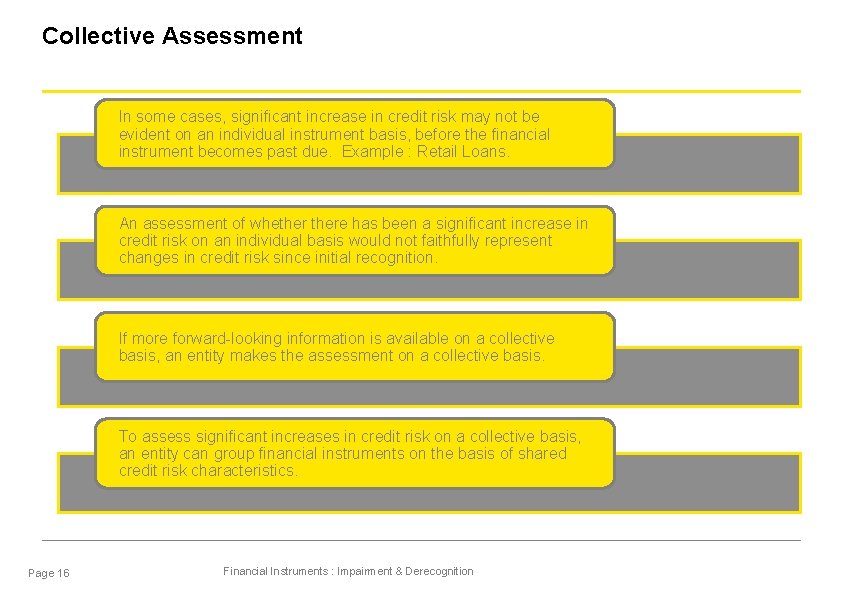
Collective Assessment In some cases, significant increase in credit risk may not be evident on an individual instrument basis, before the financial instrument becomes past due. Example : Retail Loans. An assessment of whethere has been a significant increase in credit risk on an individual basis would not faithfully represent changes in credit risk since initial recognition. If more forward-looking information is available on a collective basis, an entity makes the assessment on a collective basis. To assess significant increases in credit risk on a collective basis, an entity can group financial instruments on the basis of shared credit risk characteristics. Page 16 Financial Instruments : Impairment & Derecognition
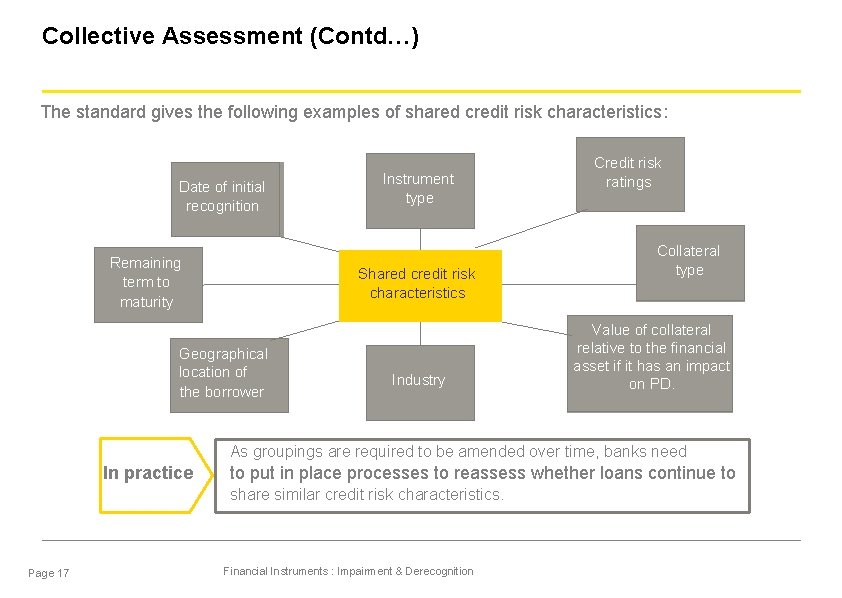
Collective Assessment (Contd…) The standard gives the following examples of shared credit risk characteristics: Date of initial recognition Remaining term to maturity Instrument type Shared credit risk characteristics Geographical location of the borrower Industry Credit risk ratings Collateral type Value of collateral relative to the financial asset if it has an impact on PD. As groupings are required to be amended over time, banks need In practice to put in place processes to reassess whether loans continue to share similar credit risk characteristics. Page 17 Financial Instruments : Impairment & Derecognition
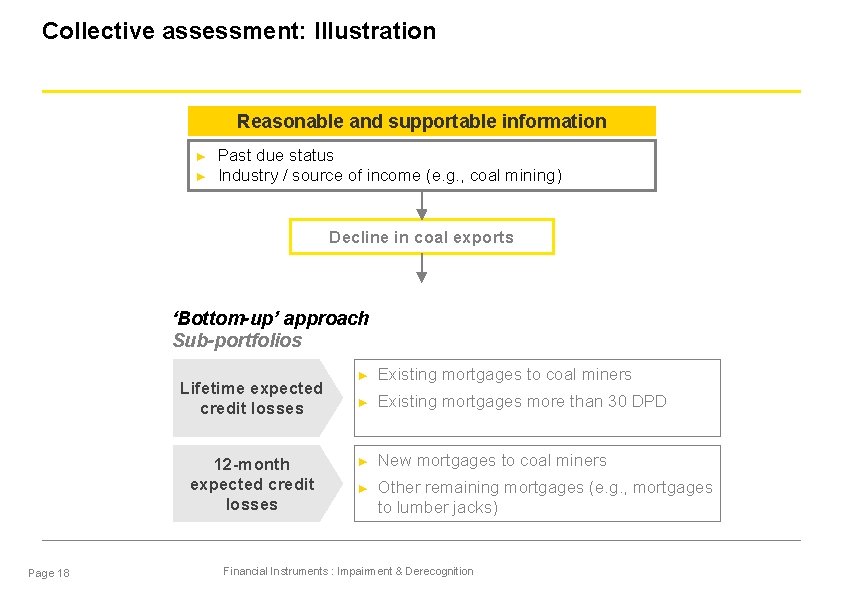
Collective assessment: Illustration Reasonable and supportable information ► ► Past due status Industry / source of income (e. g. , coal mining) Decline in coal exports ‘Bottom-up’ approach Sub-portfolios Lifetime expected credit losses 12 -month expected credit losses Page 18 ► Existing mortgages to coal miners ► Existing mortgages more than 30 DPD ► New mortgages to coal miners ► Other remaining mortgages (e. g. , mortgages to lumber jacks) Financial Instruments : Impairment & Derecognition
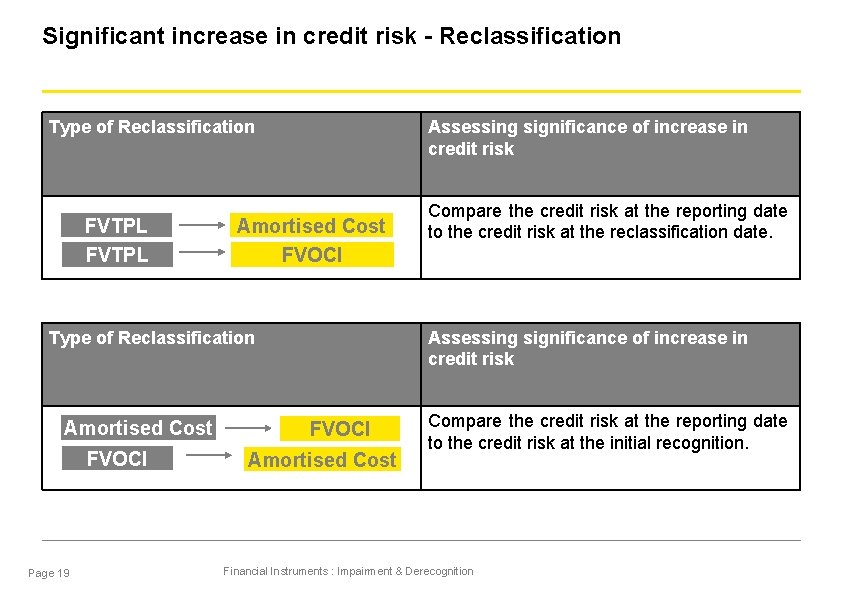
Significant increase in credit risk - Reclassification Type of Reclassification FVTPL Assessing significance of increase in credit risk Amortised Cost FVOCI Type of Reclassification Amortised Cost FVOCI Page 19 Compare the credit risk at the reporting date to the credit risk at the reclassification date. Assessing significance of increase in credit risk FVOCI Amortised Cost Compare the credit risk at the reporting date to the credit risk at the initial recognition. Financial Instruments : Impairment & Derecognition
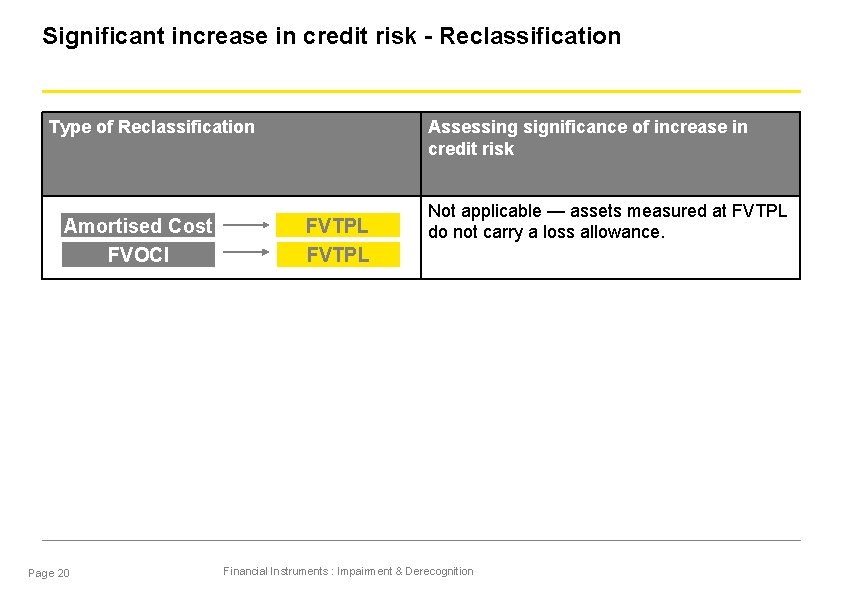
Significant increase in credit risk - Reclassification Type of Reclassification Amortised Cost FVOCI Page 20 Assessing significance of increase in credit risk FVTPL Not applicable — assets measured at FVTPL do not carry a loss allowance. Financial Instruments : Impairment & Derecognition
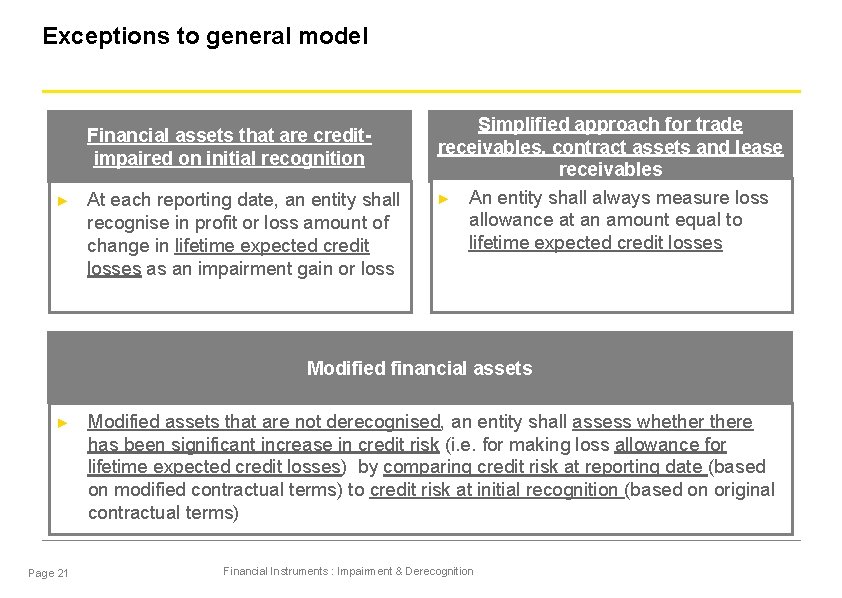
Exceptions to general model Financial assets that are creditimpaired on initial recognition ► At each reporting date, an entity shall recognise in profit or loss amount of change in lifetime expected credit losses as an impairment gain or loss Simplified approach for trade receivables, contract assets and lease receivables ► An entity shall always measure loss allowance at an amount equal to lifetime expected credit losses Modified financial assets ► Page 21 Modified assets that are not derecognised, an entity shall assess whethere has been significant increase in credit risk (i. e. for making loss allowance for lifetime expected credit losses) by comparing credit risk at reporting date (based on modified contractual terms) to credit risk at initial recognition (based on original contractual terms) Financial Instruments : Impairment & Derecognition
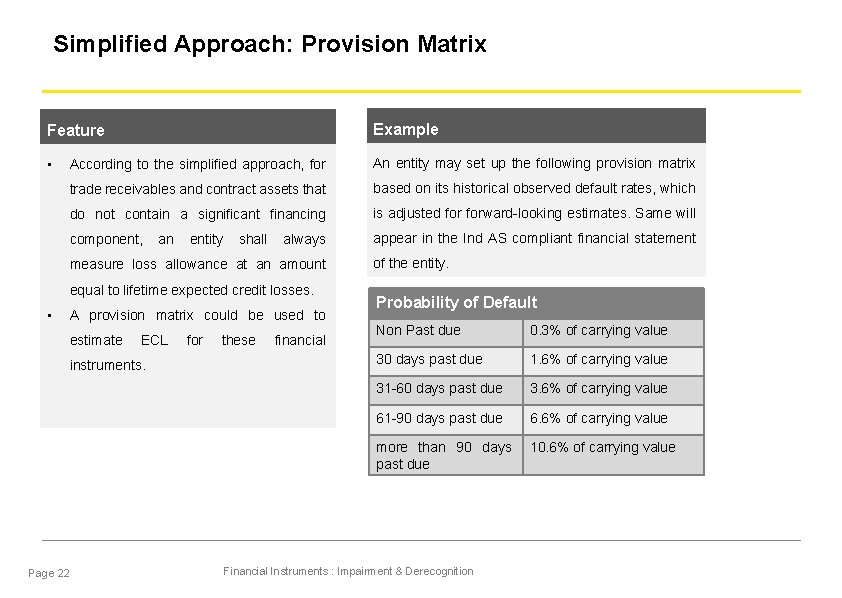
Simplified Approach: Provision Matrix Feature Example • According to the simplified approach, for An entity may set up the following provision matrix trade receivables and contract assets that based on its historical observed default rates, which do not contain a significant financing is adjusted forward-looking estimates. Same will component, appear in the Ind AS compliant financial statement an entity shall always measure loss allowance at an amount equal to lifetime expected credit losses. • A provision matrix could be used to estimate ECL instruments. Page 22 for these financial of the entity. Probability of Default Non Past due 0. 3% of carrying value 30 days past due 1. 6% of carrying value 31 -60 days past due 3. 6% of carrying value 61 -90 days past due 6. 6% of carrying value more than 90 days past due 10. 6% of carrying value Financial Instruments : Impairment & Derecognition
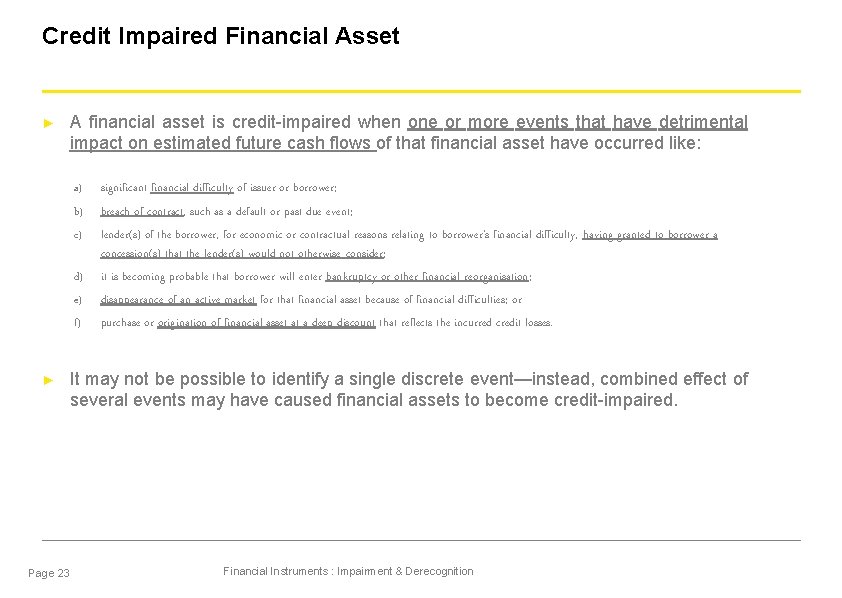
Credit Impaired Financial Asset ► A financial asset is credit-impaired when one or more events that have detrimental impact on estimated future cash flows of that financial asset have occurred like: a) b) c) d) e) f) ► significant financial difficulty of issuer or borrower; breach of contract, such as a default or past due event; lender(s) of the borrower, for economic or contractual reasons relating to borrower's financial difficulty, having granted to borrower a concession(s) that the lender(s) would not otherwise consider; it is becoming probable that borrower will enter bankruptcy or other financial reorganisation; disappearance of an active market for that financial asset because of financial difficulties; or purchase or origination of financial asset at a deep discount that reflects the incurred credit losses. It may not be possible to identify a single discrete event—instead, combined effect of several events may have caused financial assets to become credit-impaired. Page 23 Financial Instruments : Impairment & Derecognition
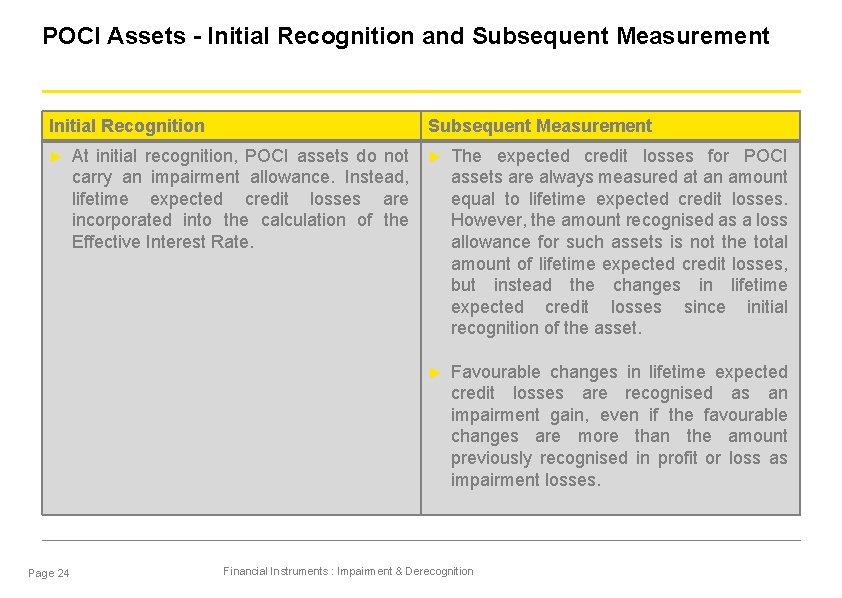
POCI Assets - Initial Recognition and Subsequent Measurement Initial Recognition ► Page 24 Subsequent Measurement At initial recognition, POCI assets do not carry an impairment allowance. Instead, lifetime expected credit losses are incorporated into the calculation of the Effective Interest Rate. ► The expected credit losses for POCI assets are always measured at an amount equal to lifetime expected credit losses. However, the amount recognised as a loss allowance for such assets is not the total amount of lifetime expected credit losses, but instead the changes in lifetime expected credit losses since initial recognition of the asset. ► Favourable changes in lifetime expected credit losses are recognised as an impairment gain, even if the favourable changes are more than the amount previously recognised in profit or loss as impairment losses. Financial Instruments : Impairment & Derecognition
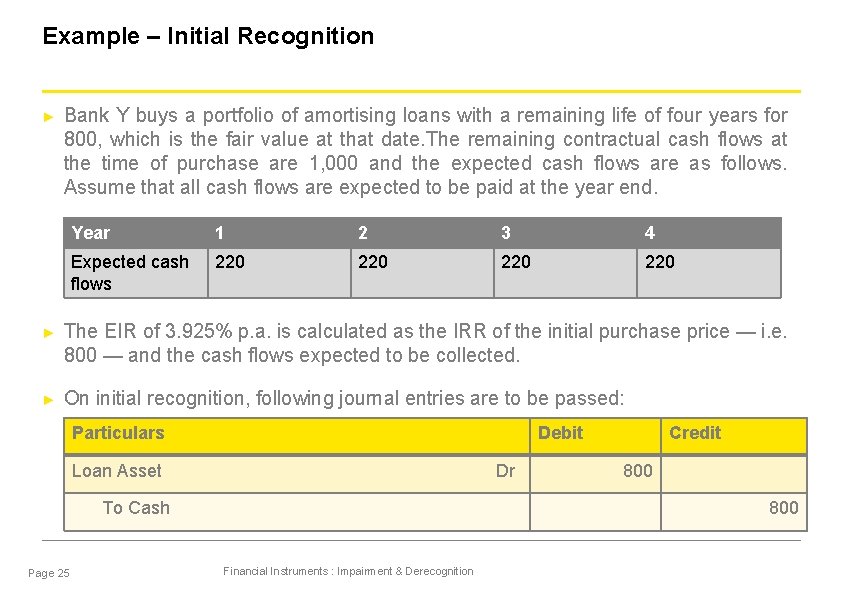
Example – Initial Recognition ► Bank Y buys a portfolio of amortising loans with a remaining life of four years for 800, which is the fair value at that date. The remaining contractual cash flows at the time of purchase are 1, 000 and the expected cash flows are as follows. Assume that all cash flows are expected to be paid at the year end. Year 1 2 3 4 Expected cash flows 220 220 ► The EIR of 3. 925% p. a. is calculated as the IRR of the initial purchase price — i. e. 800 — and the cash flows expected to be collected. ► On initial recognition, following journal entries are to be passed: Particulars Debit Loan Asset Dr To Cash Page 25 Credit 800 Financial Instruments : Impairment & Derecognition
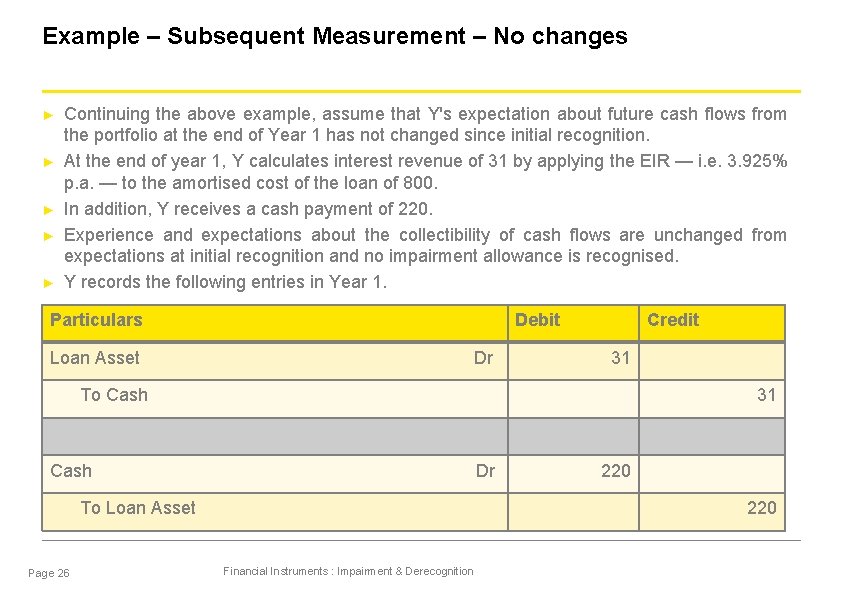
Example – Subsequent Measurement – No changes ► ► ► Continuing the above example, assume that Y's expectation about future cash flows from the portfolio at the end of Year 1 has not changed since initial recognition. At the end of year 1, Y calculates interest revenue of 31 by applying the EIR — i. e. 3. 925% p. a. — to the amortised cost of the loan of 800. In addition, Y receives a cash payment of 220. Experience and expectations about the collectibility of cash flows are unchanged from expectations at initial recognition and no impairment allowance is recognised. Y records the following entries in Year 1. Particulars Loan Asset Debit Dr Credit 31 To Cash 31 Cash Dr To Loan Asset Page 26 220 Financial Instruments : Impairment & Derecognition
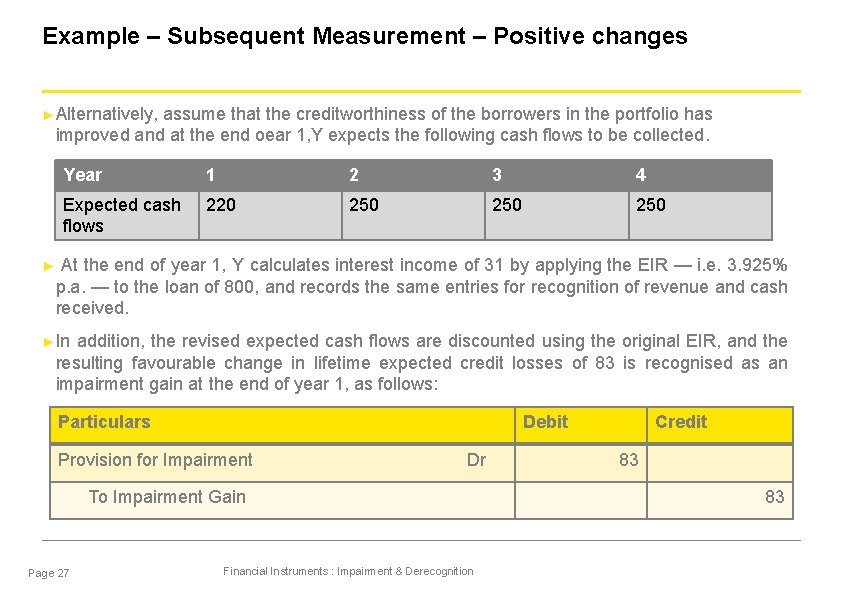
Example – Subsequent Measurement – Positive changes ► Alternatively, assume that the creditworthiness of the borrowers in the portfolio has improved and at the end oear 1, Y expects the following cash flows to be collected. ► Year 1 2 3 4 Expected cash flows 220 250 250 At the end of year 1, Y calculates interest income of 31 by applying the EIR — i. e. 3. 925% p. a. — to the loan of 800, and records the same entries for recognition of revenue and cash received. ► In addition, the revised expected cash flows are discounted using the original EIR, and the resulting favourable change in lifetime expected credit losses of 83 is recognised as an impairment gain at the end of year 1, as follows: Particulars Debit Provision for Impairment Dr To Impairment Gain Page 27 Financial Instruments : Impairment & Derecognition Credit 83 83
Measurement of Expected Credit Losses
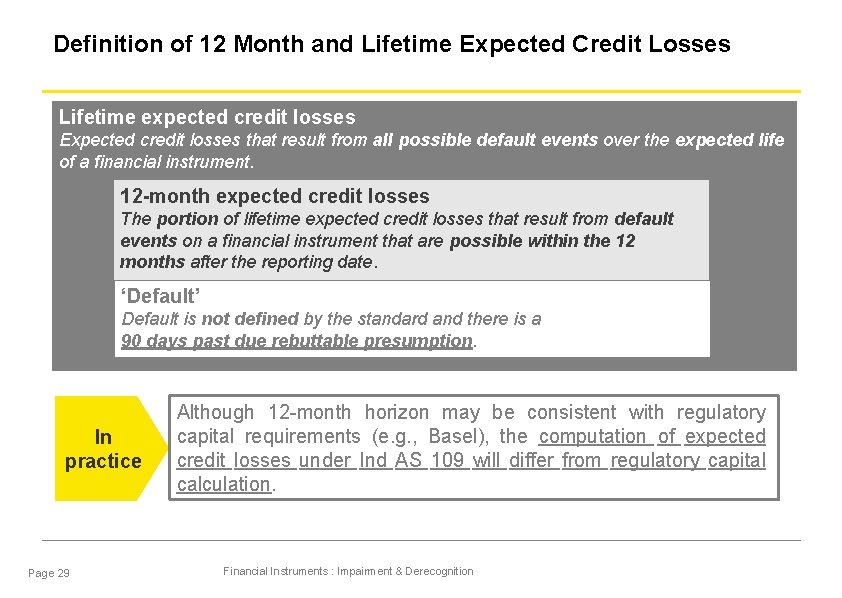
Definition of 12 Month and Lifetime Expected Credit Losses Lifetime expected credit losses Expected credit losses that result from all possible default events over the expected life of a financial instrument. 12 -month expected credit losses The portion of lifetime expected credit losses that result from default events on a financial instrument that are possible within the 12 months after the reporting date. ‘Default’ Default is not defined by the standard and there is a 90 days past due rebuttable presumption. In practice Page 29 Although 12 -month horizon may be consistent with regulatory capital requirements (e. g. , Basel), the computation of expected credit losses under Ind AS 109 will differ from regulatory capital calculation. Financial Instruments : Impairment & Derecognition
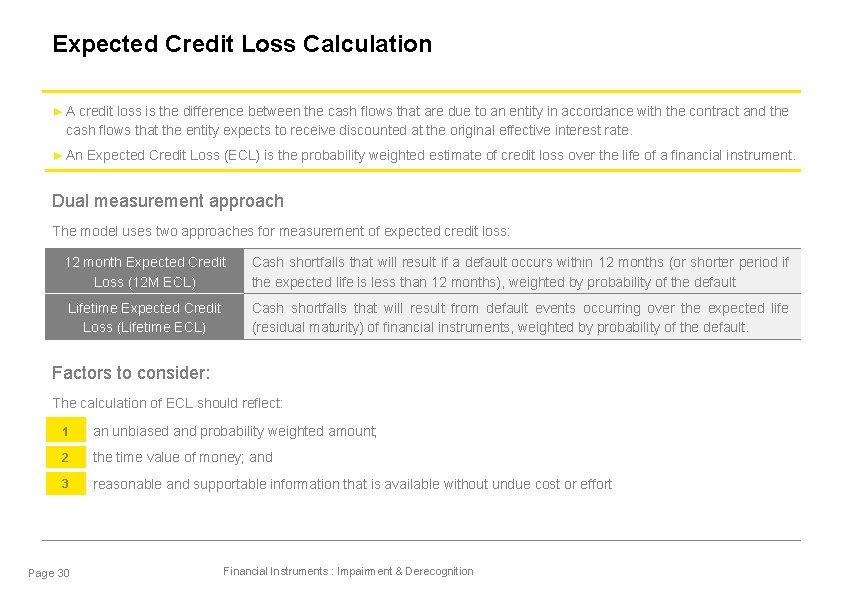
Expected Credit Loss Calculation ► A credit loss is the difference between the cash flows that are due to an entity in accordance with the contract and the cash flows that the entity expects to receive discounted at the original effective interest rate. ► An Expected Credit Loss (ECL) is the probability weighted estimate of credit loss over the life of a financial instrument. Dual measurement approach The model uses two approaches for measurement of expected credit loss: 12 month Expected Credit Loss (12 M ECL) Cash shortfalls that will result if a default occurs within 12 months (or shorter period if the expected life is less than 12 months), weighted by probability of the default Lifetime Expected Credit Loss (Lifetime ECL) Cash shortfalls that will result from default events occurring over the expected life (residual maturity) of financial instruments, weighted by probability of the default. Factors to consider: The calculation of ECL should reflect: 1 an unbiased and probability weighted amount; 2 the time value of money; and 3 reasonable and supportable information that is available without undue cost or effort Page 30 Financial Instruments : Impairment & Derecognition
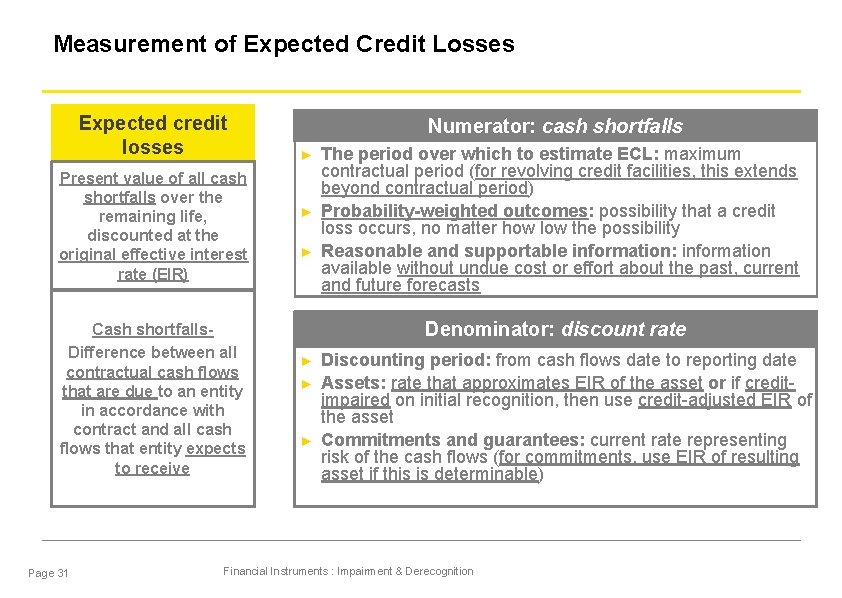
Measurement of Expected Credit Losses Expected credit losses Present value of all cash shortfalls over the remaining life, discounted at the original effective interest rate (EIR) Cash shortfalls. Difference between all contractual cash flows that are due to an entity in accordance with contract and all cash flows that entity expects to receive Page 31 Numerator: cash shortfalls ► ► ► The period over which to estimate ECL: maximum contractual period (for revolving credit facilities, this extends beyond contractual period) Probability-weighted outcomes: possibility that a credit loss occurs, no matter how low the possibility Reasonable and supportable information: information available without undue cost or effort about the past, current and future forecasts Denominator: discount rate ► ► ► Discounting period: from cash flows date to reporting date Assets: rate that approximates EIR of the asset or if creditimpaired on initial recognition, then use credit-adjusted EIR of the asset Commitments and guarantees: current rate representing risk of the cash flows (for commitments, use EIR of resulting asset if this is determinable) Financial Instruments : Impairment & Derecognition
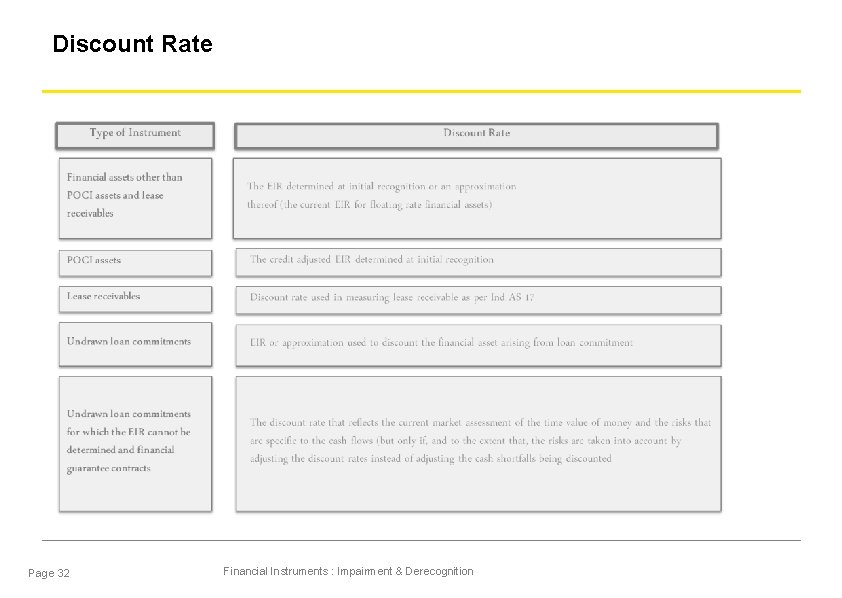
Discount Rate Page 32 Financial Instruments : Impairment & Derecognition
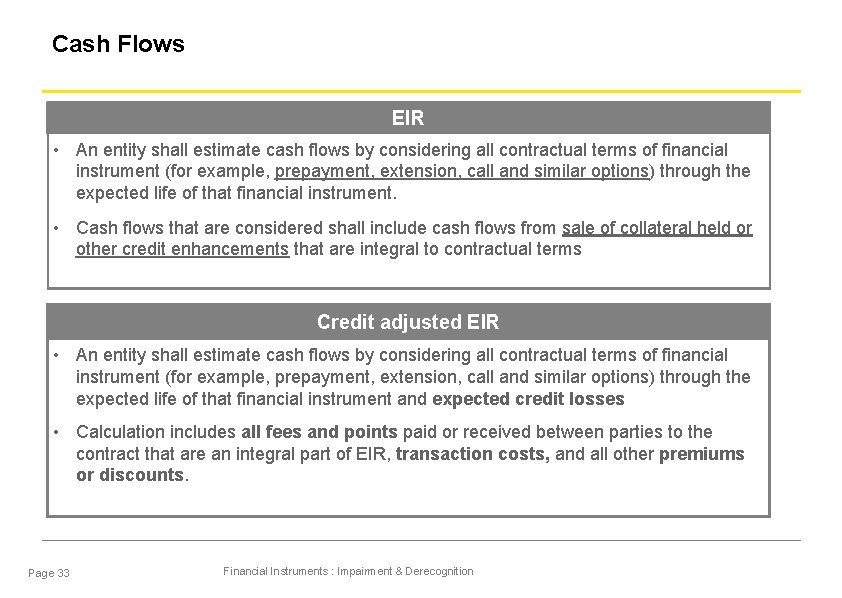
Cash Flows EIR • An entity shall estimate cash flows by considering all contractual terms of financial instrument (for example, prepayment, extension, call and similar options) through the expected life of that financial instrument. • Cash flows that are considered shall include cash flows from sale of collateral held or other credit enhancements that are integral to contractual terms Credit adjusted EIR • An entity shall estimate cash flows by considering all contractual terms of financial instrument (for example, prepayment, extension, call and similar options) through the expected life of that financial instrument and expected credit losses • Calculation includes all fees and points paid or received between parties to the contract that are an integral part of EIR, transaction costs, and all other premiums or discounts. Page 33 Financial Instruments : Impairment & Derecognition
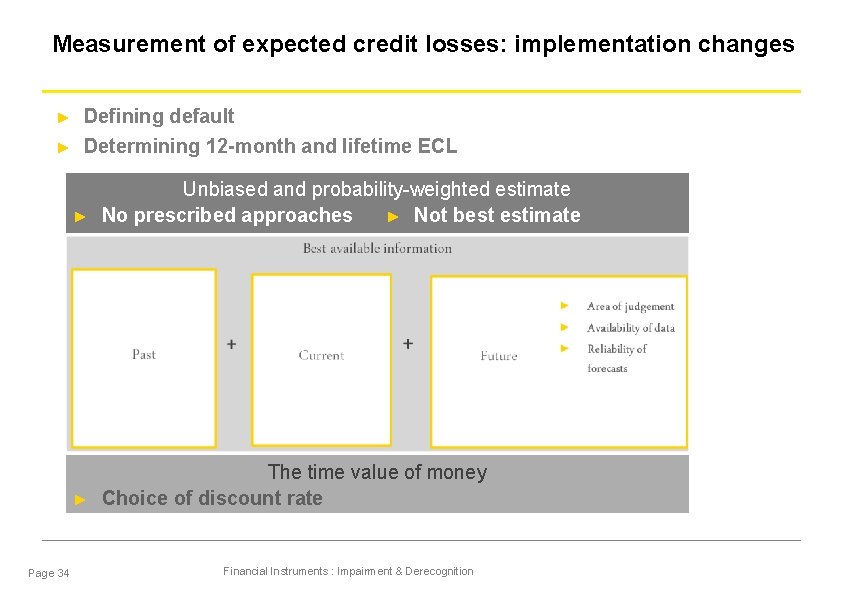
Measurement of expected credit losses: implementation changes ► ► Page 34 Defining default Determining 12 -month and lifetime ECL ► Unbiased and probability-weighted estimate ► Not best estimate No prescribed approaches ► The time value of money Choice of discount rate Financial Instruments : Impairment & Derecognition
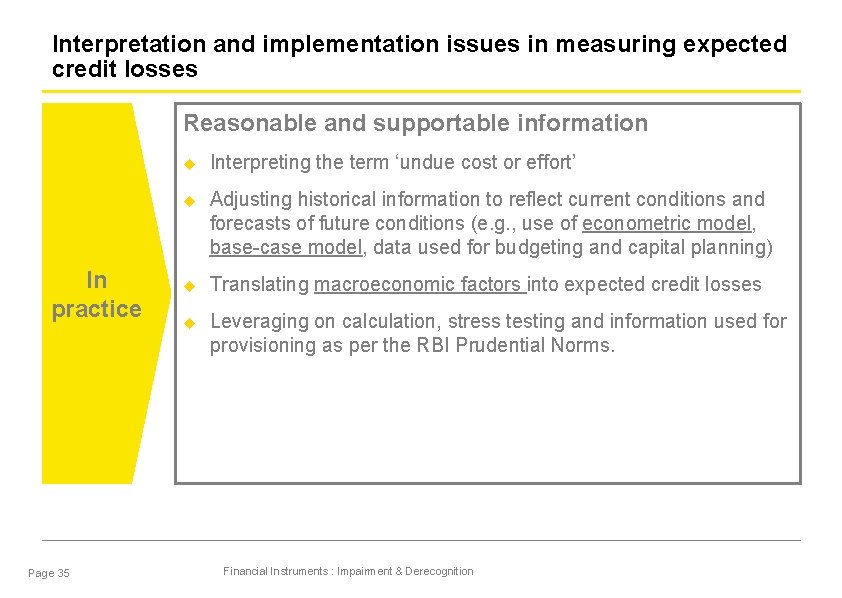
Interpretation and implementation issues in measuring expected credit losses Reasonable and supportable information In practice Page 35 u Interpreting the term ‘undue cost or effort’ u Adjusting historical information to reflect current conditions and forecasts of future conditions (e. g. , use of econometric model, base-case model, data used for budgeting and capital planning) u Translating macroeconomic factors into expected credit losses u Leveraging on calculation, stress testing and information used for provisioning as per the RBI Prudential Norms. Financial Instruments : Impairment & Derecognition
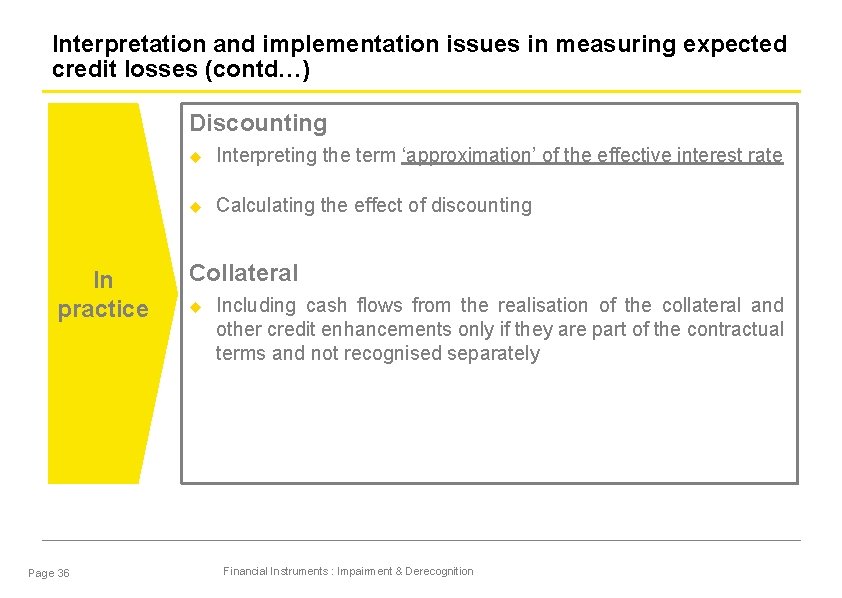
Interpretation and implementation issues in measuring expected credit losses (contd…) Discounting In practice Page 36 u Interpreting the term ‘approximation’ of the effective interest rate u Calculating the effect of discounting Collateral u Including cash flows from the realisation of the collateral and other credit enhancements only if they are part of the contractual terms and not recognised separately Financial Instruments : Impairment & Derecognition
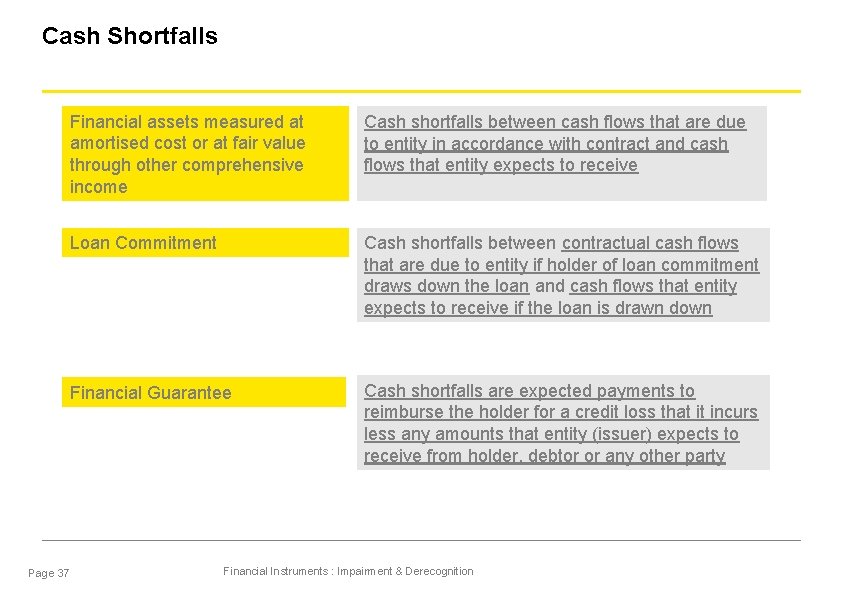
Cash Shortfalls Financial assets measured at amortised cost or at fair value through other comprehensive income Cash shortfalls between cash flows that are due to entity in accordance with contract and cash flows that entity expects to receive Loan Commitment Cash shortfalls between contractual cash flows that are due to entity if holder of loan commitment draws down the loan and cash flows that entity expects to receive if the loan is drawn down Financial Guarantee Cash shortfalls are expected payments to reimburse the holder for a credit loss that it incurs less any amounts that entity (issuer) expects to receive from holder, debtor or any other party Page 37 Financial Instruments : Impairment & Derecognition
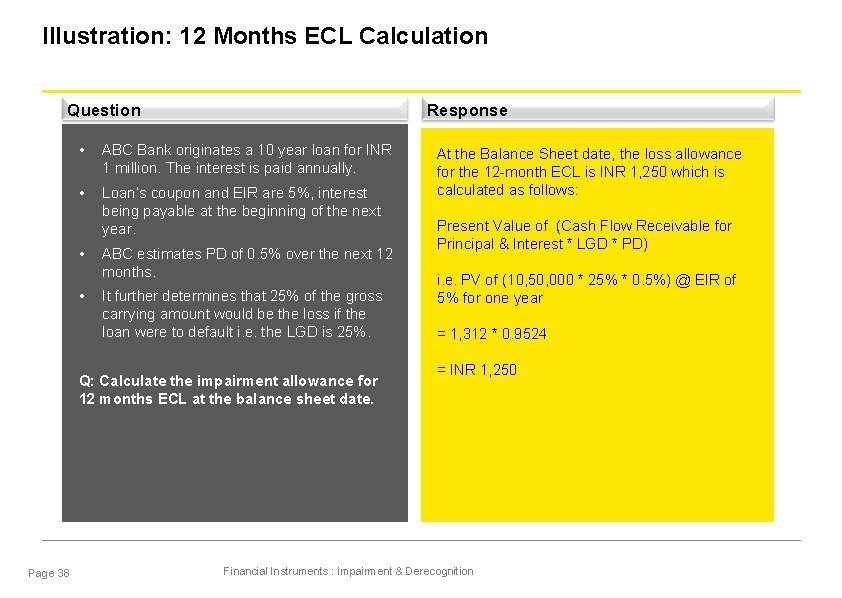
Illustration: 12 Months ECL Calculation Question Response • ABC Bank originates a 10 year loan for INR 1 million. The interest is paid annually. • Loan’s coupon and EIR are 5%, interest being payable at the beginning of the next year. • • ABC estimates PD of 0. 5% over the next 12 months. It further determines that 25% of the gross carrying amount would be the loss if the loan were to default i. e. the LGD is 25%. Q: Calculate the impairment allowance for 12 months ECL at the balance sheet date. Page 38 At the Balance Sheet date, the loss allowance for the 12 -month ECL is INR 1, 250 which is calculated as follows: Present Value of (Cash Flow Receivable for Principal & Interest * LGD * PD) i. e. PV of (10, 50, 000 * 25% * 0. 5%) @ EIR of 5% for one year = 1, 312 * 0. 9524 = INR 1, 250 Financial Instruments : Impairment & Derecognition
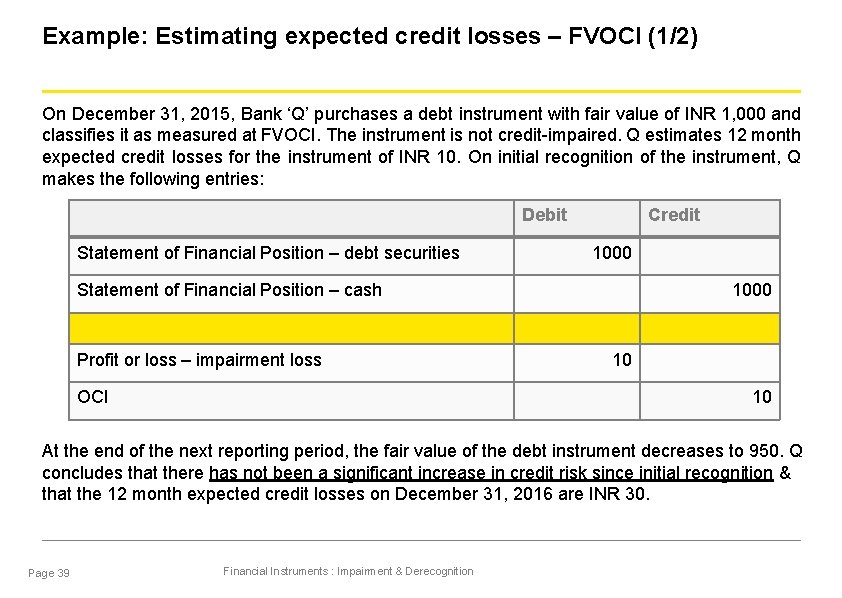
Example: Estimating expected credit losses – FVOCI (1/2) On December 31, 2015, Bank ‘Q’ purchases a debt instrument with fair value of INR 1, 000 and classifies it as measured at FVOCI. The instrument is not credit-impaired. Q estimates 12 month expected credit losses for the instrument of INR 10. On initial recognition of the instrument, Q makes the following entries: Debit Statement of Financial Position – debt securities Credit 1000 Statement of Financial Position – cash Profit or loss – impairment loss OCI 1000 10 10 At the end of the next reporting period, the fair value of the debt instrument decreases to 950. Q concludes that there has not been a significant increase in credit risk since initial recognition & that the 12 month expected credit losses on December 31, 2016 are INR 30. Page 39 Financial Instruments : Impairment & Derecognition
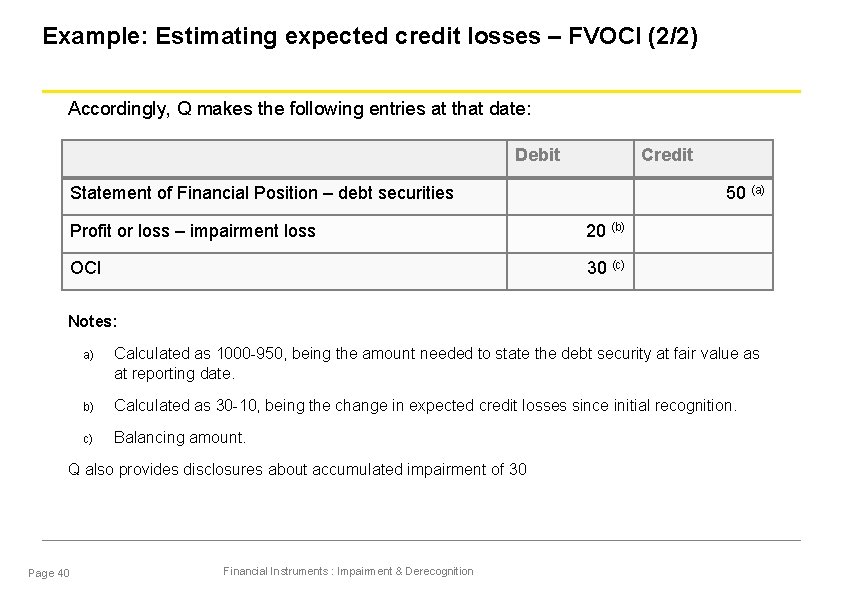
Example: Estimating expected credit losses – FVOCI (2/2) Accordingly, Q makes the following entries at that date: Debit Credit Statement of Financial Position – debt securities 50 (a) Profit or loss – impairment loss 20 (b) OCI 30 (c) Notes: a) Calculated as 1000 -950, being the amount needed to state the debt security at fair value as at reporting date. b) Calculated as 30 -10, being the change in expected credit losses since initial recognition. c) Balancing amount. Q also provides disclosures about accumulated impairment of 30 Page 40 Financial Instruments : Impairment & Derecognition
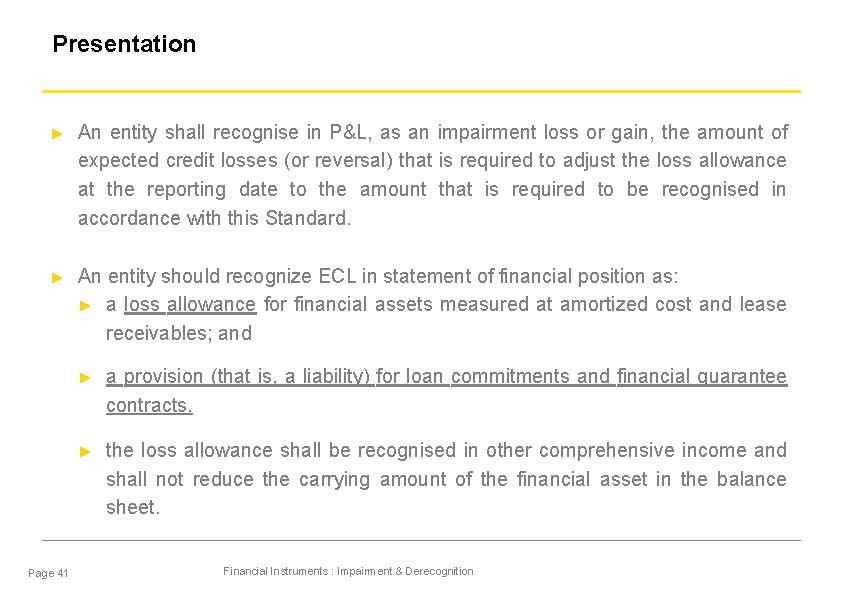
Presentation ► An entity shall recognise in P&L, as an impairment loss or gain, the amount of expected credit losses (or reversal) that is required to adjust the loss allowance at the reporting date to the amount that is required to be recognised in accordance with this Standard. ► An entity should recognize ECL in statement of financial position as: ► a loss allowance for financial assets measured at amortized cost and lease receivables; and Page 41 ► a provision (that is, a liability) for loan commitments and financial guarantee contracts. ► the loss allowance shall be recognised in other comprehensive income and shall not reduce the carrying amount of the financial asset in the balance sheet. Financial Instruments : Impairment & Derecognition
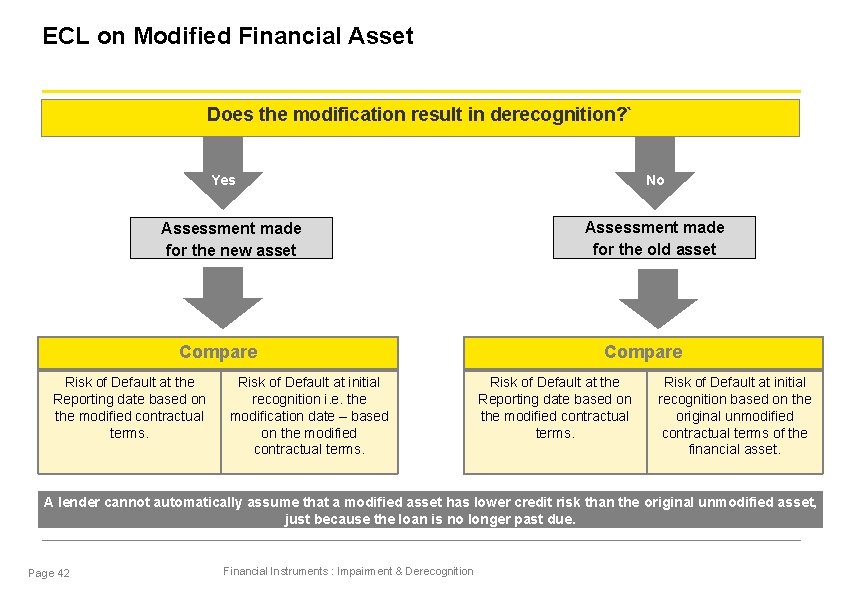
ECL on Modified Financial Asset Does the modification result in derecognition? ` Yes Assessment made for the new asset Compare Risk of Default at the Reporting date based on the modified contractual terms. Risk of Default at initial recognition i. e. the modification date – based on the modified contractual terms. No Assessment made for the old asset Compare Risk of Default at the Reporting date based on the modified contractual terms. Risk of Default at initial recognition based on the original unmodified contractual terms of the financial asset. A lender cannot automatically assume that a modified asset has lower credit risk than the original unmodified asset, just because the loan is no longer past due. Page 42 Financial Instruments : Impairment & Derecognition
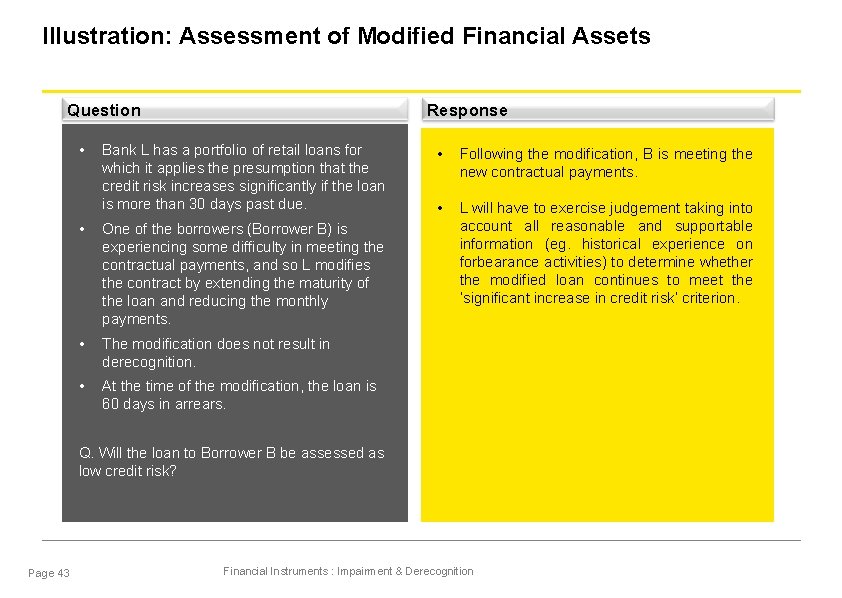
Illustration: Assessment of Modified Financial Assets Question • Response Bank L has a portfolio of retail loans for which it applies the presumption that the credit risk increases significantly if the loan is more than 30 days past due. • One of the borrowers (Borrower B) is experiencing some difficulty in meeting the contractual payments, and so L modifies the contract by extending the maturity of the loan and reducing the monthly payments. • The modification does not result in derecognition. • At the time of the modification, the loan is 60 days in arrears. • Following the modification, B is meeting the new contractual payments. • L will have to exercise judgement taking into account all reasonable and supportable information (eg. historical experience on forbearance activities) to determine whether the modified loan continues to meet the ‘significant increase in credit risk’ criterion. Q. Will the loan to Borrower B be assessed as low credit risk? Page 43 Financial Instruments : Impairment & Derecognition
Thank You