
IMPAIRED DIGESTION AND ABSORPTION MALABSORPTION SYNDROMES CELIACGLUTEN ENTEROPATHY
IMPAIRED DIGESTION AND ABSORPTION MALABSORPTION SYNDROMES CELIAC/GLUTEN ENTEROPATHY NONTROPICAL SPRUE CYSTIC FIBROSIS 2009
CELIAC DISEASE n n n Intolerance to gluten Gluten is a protein found in wheat, barley, rye, and oats Less incidence because of delayed feeding of solids and increased breast feeding
EARLY STAGES OF CELIAC n n n Fat absorption effected Result: large quantities of undigested fat in the stool (steatorrhea) STOOL: frothy, foul odor, excessive quantity
LATER STAGES OF CELIAC Absorption of the following becomes impaired: n Protein n Calcium n Iron n Folic acid n Vitamin D, K, B 12
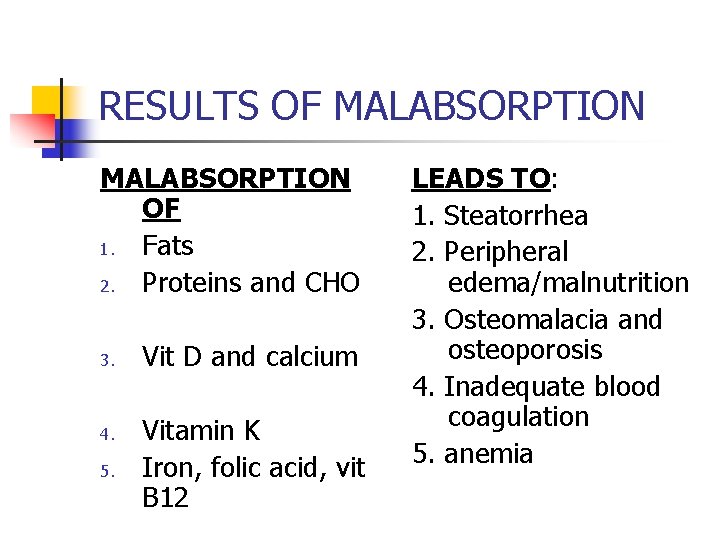
RESULTS OF MALABSORPTION OF 1. Fats 2. Proteins and CHO 3. 4. 5. Vit D and calcium Vitamin K Iron, folic acid, vit B 12 LEADS TO: 1. Steatorrhea 2. Peripheral edema/malnutrition 3. Osteomalacia and osteoporosis 4. Inadequate blood coagulation 5. anemia
PROGRESSION OF THE DISEASE n n If disease process is not stopped GROWTH FAILURE RESULTS Begins slowly when child starts to ingest grains within 3 -6 month of introduction
FIRST EVIDENCE OF DISEASE n n n n Failure to gain weight Poor appetite Bout of diarrhea Steatorrhea Constipation vomiting Abdominal pain Irritability
AS DISEASE PROGRESSES n n See signs of general wasting Some children do not manifest symptoms until 5 years of age
CELIAC CRISIS Acute episodes in which the child has: Profuse, pale, bulky, rancid, poorly formed stools Vomiting Wasted appearance Dependent edema Smooth tongue
CELIAC CRISIS PRECIPITATED BY n n n GI infections Prolonged fasting Eating gluten
DIAGNOSIS n n n n Stool analysis for fat Serum albumin (for hypoproteinemia) CBC, Hct, Hgb, for anemia PT for hypoprothrombinenemia Serum iron Folic acid levels Vit B 12 levels Immunoglobulin levels
DIAGNOSIS CONTINUED n n n Xrays for bone age Bowel studies for dilated flaccid bowel loops Pancreatic function studies Sweat test to rule out CF Small bowel bx
TREATMENT n n n Remove foods from diet having gluten (wheat, rye, barley, oats) Substitute with corn, rice, potato, hominy Provide supplements for malnutrition (vitamins, Fe) High calorie diet Peripheral hyperal may be required

TREATMENT OF CRISIS n n n n Considered life threatening event Correct dehydration Correct metabolic acidosis NGT to decrease abdominal distention IV fluids with K, Ca, mg Albumin infusions to treat hypoproteinemia IV steroids to decrease inflammation of bowel
NURSING CARE: teach about diet AVOID n Cereals and baked goods n Check food labels for hydrolyzed vegetable protein n Check for grains used in processed foods as fillers CANNOT HAVE: Bread, Cake, Cookies, chocolate candy, malts Crackers, Doughnuts, Pies, some ice cream Spaghetti, Pizza Prepared soups, hot dogs Luncheon meats, meat gravy Some prepared hamburgers

FOODS THEY CAN HAVE n Tacos and Mexican dishes
GENERAL GUIDELINES n n Very difficult for adolescents Must do forever If diet not followed increased incidence of lymphoma or GI cancer Anticholinergic drugs precipitate crisis: inform MD’s and dentists
CYSTIC FIBROSIS
DEFINED n n Most common serious pulmonary genetic disease in children Multisymptom disorder affecting the exocrine glands (mucous producing glands) of white children
SURVIVAL n Changed from a short life expectancy in the 1950’s to 50% of patients survive to adulthood, living an average of 33 years
ETIOLOGY n n Inherited autosomal recessive trait (inheriting the defective genes from both parents is a 1: 4 chance) Gene responsible is located on chromosome #7
INCIDENCE n n 1: 1600 births get the disease 1: 20 are carriers; can pass on to children Equal sex distribution Seen mostly with whites, rare among African Americans or Asians
PATHOPHYSIOLOGY n n Increased viscosity of mucous gland secretions which causes mechanical obstruction in small passages in organs Elevation of sweat electrolytes: Na and Chloride content of sweat is 2 -5 times greater than that of normal children
DIAGNOSIS Suspected when the child is identified as FTT or suffers frequent repeated URI n Positive family history aids in diagnosis Sweat test: stimulate the production of sweat, collecting & measuring the sweat electrolytes NL SWEAT CHLORIDE: 5 -35 m. Eq/L CHLORIDE greater than 60 m. Eq/L up to 200 m. Eq/: : means diagnosis of CF Test is done on two separate occasions n
DIAGNOSIS n n Chest xray reveals atelectasis and obstructive emphysema PFT’s indicate abnormally small airway function in CF Stool analysis for fat DNA studies are helpful in the 70% of CF carriers; prenatal testing not yet available
RESPIRATORY TRACT CHANGES n n n Increased viscosity of bronchial mucous leads to slower flow rate of mucous, incomplete expectoration and leads to bronchial obstruction Retained mucous provides medium for bacterial growth Reduced O 2/CO 2 exchange leads to hypoxia, hypercapnia (increased CO 2 in blood) acidosis
RESPIRATORY TRACT CHANGES n n n Atelectasis and emphysema Repeated infections (s. aureus, h. influenzae, **pseudomonis aeruginosa) Become resistant to multiple drugs making the bacteria difficult to eradicate Fibrotic areas develop Pneumothorax and hemoptysis can occur
GASTROINTESTINAL TRACT CHANGES n n n Thick secretions in the pancreas block the ducts leading to degeneration and fibrosis Fibrosis prevents pancreatic enzymes from reaching the duodenum (lipase, trypsin, amylase) which impairs digestion and absorption of fats, proteins and to a lesser degree carbohydrates Result: excessive stool fat (steatorrhea) and protein (azotorrhea)
GASTROINTESTINAL TRACT CHANGES n n n Diabetes mellitus develops frequently (may result from the diminished blood supply to the pancreas) In the liver: biliary obstruction and fibrosis are common leading to biliary cirrhosis leading to portal hypertension Salivary glands are blocked so this leads to dry mouth and susceptibility to infection
SIGNS AND SYMPTOMS n n n Vary widely Could be diagnosed at birth or not until years later Intensity of involvement varies
RESPIRATORY TRACT SYMPTOMS n n n Chest congestion, Cough, crackles Limited exercise tolerance Sputum production, with hemoptysis Use of accessory muscles Decreased pulmonary function Repeated bronchitis and bronchopneumonia
LABORATORY TESTS RELATED TO RESPIRATORY FUNCTION Arterial blood gas (ABG): acidosis n Decreased Pa. O 2 n Increased Pa. CO 2 n Increased bicarbonate levels n Low p. H DECREASED PULSE OX
n Progressive disease see over-inflated, barrel shaped chest and cyanosis, clubbing of fingers and toes
GASTROINTESTINAL TRACT SYMPTOMS n n IN INFANTS: may be diagnosed as having meconium ileus SEE signs of intestinal obstruction: abdominal distention, vomiting, failure to pass stools, dehydration
GASTROINTESTINAL TRACT SYMPTOMS n n n Increased bulk of stools: 2 -3 times nl amount, frothy, foul smelling flatus FTT due to malabsorption Have good appetite Abdomen distended from flatus, but extremities are thin Deficiency fat-soluble vit (A, D, E, K) Easy bruising (vit K); anemia
REPRODUCTIVE SYSTEM n n Females: fertility inhibited by highly viscous cervical secretions Males: most are sterile
INTEGRUMENTARY SYSTEM: n n Parents when kiss infant taste salt Risk during hyperthermic conditions

TUNE UP n n n Child hospitalized about every 6 months Intensive chest PT with vibrating vest Inhaled antibiotics, IV antibiotics PURPOSE: prophylactic prevention of serious infections Done extensively at Dupont Hospital for Children
MANAGEMENT OF PULMONARY PROBLEMS n n n Prevention of pulmonary infection Removing secretions Administering antimicrobials Administer bronchodilators Administer antiinflammatory agents Administer mucolytics
METHODS OF MANAGING PULMONARY PROBLEMS n n Daily chest PT twice a day on rising and in evening Incorporate play (hanging by knees from a bar, somersaults, playing wheelbarrow) Bronchodilators given before chest PT Forced expiration (moves secretions)
ANTIBIOTICS Prophylactic antibiotics n Antibiotics for actual infection n C & S helps guide choice of antibiotics n pseudomonis aeruginosa; this is serious n Inhaled antibiotics helpful: tobramycin n IV antibiotics best: AMINOGLYCOSIDES (class): tobramycin (Nebcin), CARBAPENEMS (class): meropenem (Merrem) n CF metabolize antibiotics rapidly n
PULMONARY MANAGEMENT CONTINUED n n n Oxygen used cautiously because of chronic CO 2 retention Pneumothorax common, may resolve on own or require chest tubes Hemoptysis with pneumothorax of greater than 300 cc/24 hr is considered to be life threatening
MANAGEMENT OF GASTROINTESTINAL PROBLEMS n n n Replace pancreatic enzymes with meals and snacks so that when the food reaches the duodenum will have the appropriate enzymes Use 1 -5 with each meal Comes in capsules, can sprinkle on food
PSYCHOLOGICAL SUPPORT n n Dealing with child and family facing a chronic fatal illness Refer to Cystic Fibrosis Foundation Child and family may resent the restrictions the disease places on their lives Constant fear of death
DIET n n n High in calories (150% of recommended daily allowance) Fat restriction not necessary Multivitamins Vit K Hyperalimentation for FTT (short term) Salt supplements in hot weather
SURGICAL MANAGEMENT Lung transplant/pancreatic transplant n Not a cure n Reduces symptoms n Gradual progression of disease n Extends life 10 -20 years
- Slides: 46