
Impacts on Academic Success Lack of access to
- Slides: 20
Impacts on Academic Success • Lack of access to early childhood education • Lower test scores • Lower graduation rates • Lower quality teachers/education
Early Childhood Education (ECE) • Children in poverty have less access to ECE: – Low-income families cannot afford to put children in quality ECE (preschool) programs – Only about 40% of low-income children are enrolled in quality pre-school programs – 10 states do not have a publicly funded preschool programs of any kind
Early Childhood Education (ECE) • 90 % of child’s brain growth occurs between birth and the age of three. • first five years of a child’s development establish critical foundation for learning • low-income children enter school an average of 12 to 14 months behind peers from higherincome brackets
Early Childhood Education (ECE) • Without access to ECE poor children are far less likely than their middle/high income peers to enter Kindergarten with school readiness. • School Readiness: degree of preparedness for learning • School readiness has lasting effect throughout school and life.
Early Childhood Education (ECE) • ECE influences academic success: • Children w/o school readiness are: – 50 % more likely to be placed in special education – More likely to repeat grades and not graduate – 25% likely to drop out of school – 60 %more likely never to attend college • Children who attend ECE programs are 4 times more likely to earn a college degree
Early Childhood Education (ECE) • ECE influences life success • Children who don’t receive ECE are: – 40 % more likely to become a teen parent – 39 % more likely to have spent time in jail and/or prison – More likely to become dependent on government social services – More likely to have lower median incomes
Early Childhood Education (ECE) • ECE access closes the school readiness gap • School readiness closes achievement gaps and fights poverty!
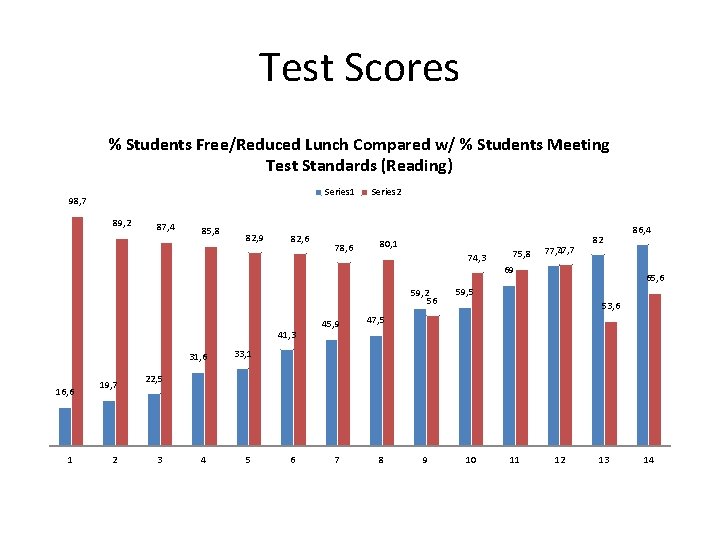
Test Scores • Children in poverty have lower standardized test scores • Local example: Seattle Public High Schools
Test Scores % Students Free/Reduced Lunch Compared w/ % Students Meeting Test Standards (Reading) Series 1 98, 7 89, 2 87, 4 85, 8 82, 9 82, 6 78, 6 Series 2 80, 1 74, 3 59, 2 56 41, 3 16, 6 1 19, 7 2 31, 6 33, 1 4 5 45, 9 47, 5 7 8 75, 8 77, 7 77, 4 82 69 86, 4 65, 6 59, 5 53, 6 22, 5 3 6 9 10 11 12 13 14
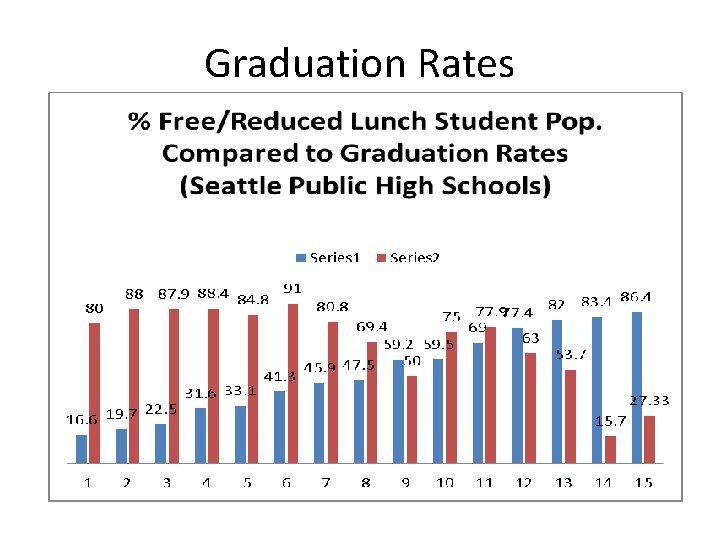
Graduation Rates • Children in poverty have lower graduation rates • Local example: Seattle Public High Schools
Graduation Rates
Lower Quality Teachers/Education • High poverty students are often taught by the least experienced/effective teacher • Often the low quality of curriculum/support in high poverty schools deters high quality teachers from serving or staying in these schools
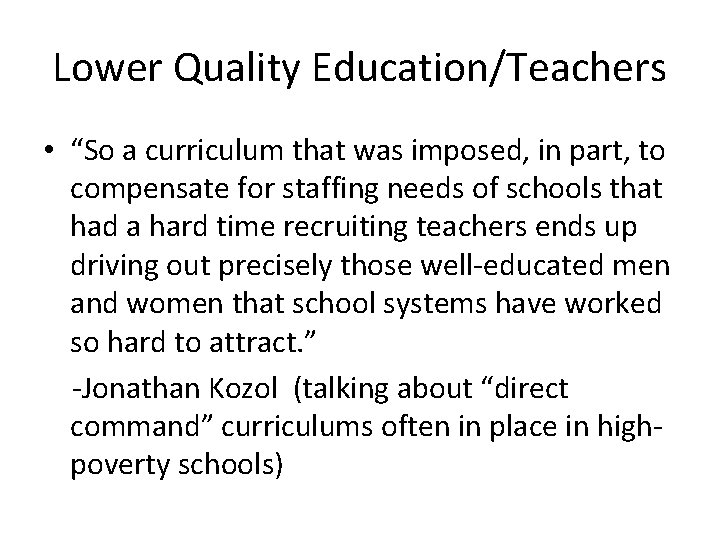
Lower Quality Education/Teachers • “So a curriculum that was imposed, in part, to compensate for staffing needs of schools that had a hard time recruiting teachers ends up driving out precisely those well-educated men and women that school systems have worked so hard to attract. ” -Jonathan Kozol (talking about “direct command” curriculums often in place in highpoverty schools)
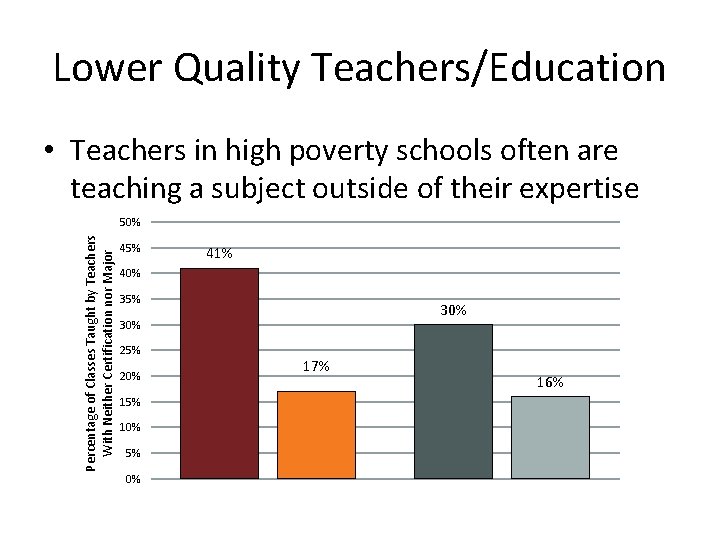
Lower Quality Teachers/Education • Teachers in high poverty schools often are teaching a subject outside of their expertise Percentage of Classes Taught by Teachers With Neither Certification nor Major 50% 45% 41% 40% 35% 30% 25% 20% 15% 10% 5% 0% 17% 16%
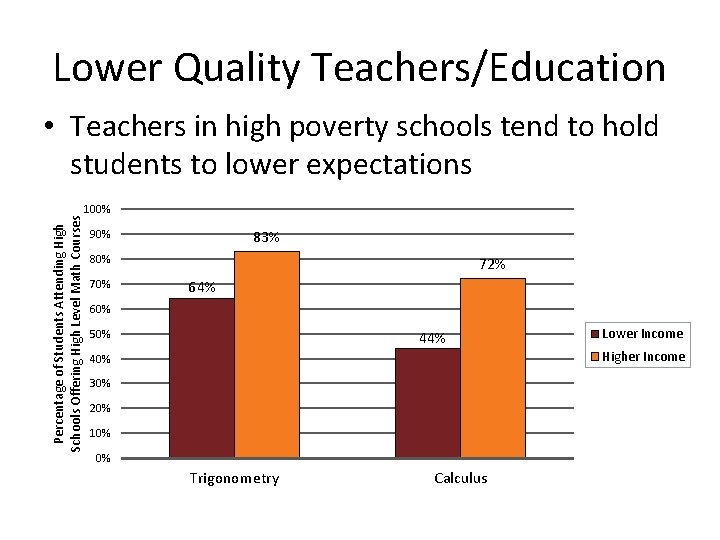
Lower Quality Teachers/Education Percentage of Students Attending High Schools Offering High Level Math Courses • Teachers in high poverty schools tend to hold students to lower expectations 100% 83% 90% 80% 72% 64% 60% 50% 44% Lower Income Higher Income 40% 30% 20% 10% 0% Trigonometry Calculus
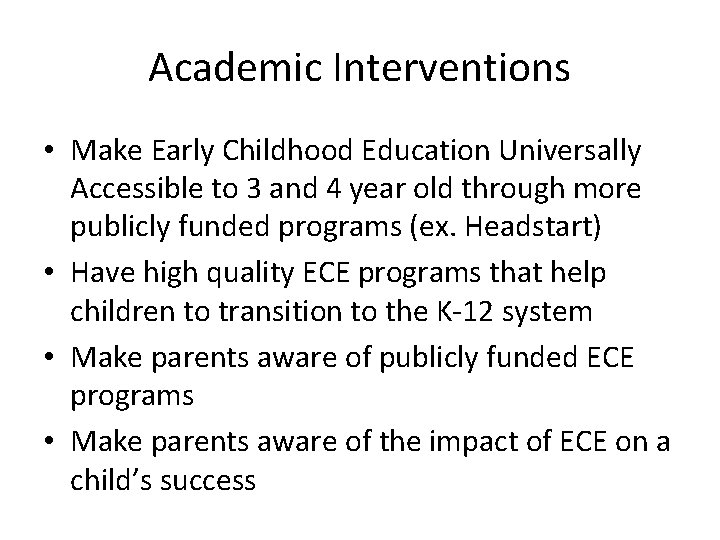
Academic Interventions • Make Early Childhood Education Universally Accessible to 3 and 4 year old through more publicly funded programs (ex. Headstart) • Have high quality ECE programs that help children to transition to the K-12 system • Make parents aware of publicly funded ECE programs • Make parents aware of the impact of ECE on a child’s success
Academic Interventions • Transitions Programs – Programs that help students prepare for the next level of school (middle school, high school) – Supports students successfully transitioning through K-12 until final transition from high school to college or a career
Academic Interventions • Provide extra academic support through mentoring and tutoring • Different ways: • Peer groups • Older to younger students • Collaboration w/ educational institutions & community adults • Supplemental and/or afterschool programming
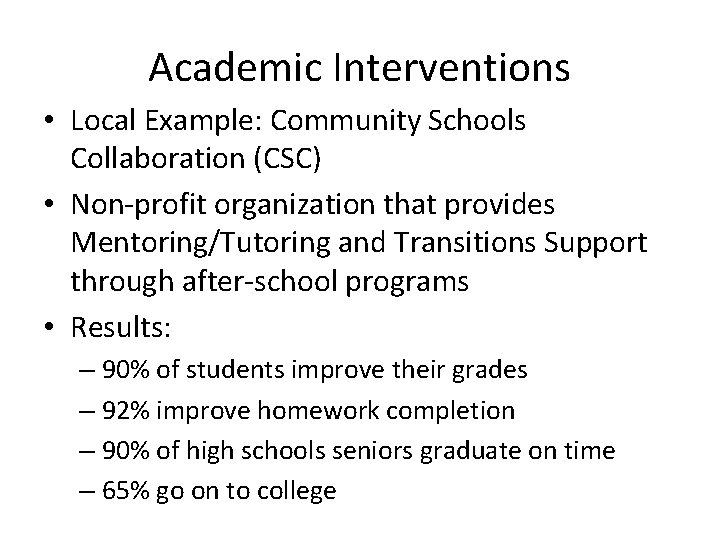
Academic Interventions • Local Example: Community Schools Collaboration (CSC) • Non-profit organization that provides Mentoring/Tutoring and Transitions Support through after-school programs • Results: – 90% of students improve their grades – 92% improve homework completion – 90% of high schools seniors graduate on time – 65% go on to college
Academic Interventions • Support Quality Teachers and Curriculums – Fund teacher-support materials and professional development – Make teachers aware of the importance of high expectations for students, even in high poverty schools – Give teachers the tools to have high expectations for students