
Impacts of Natural Shoreline Features on Water Levels

- Slides: 31
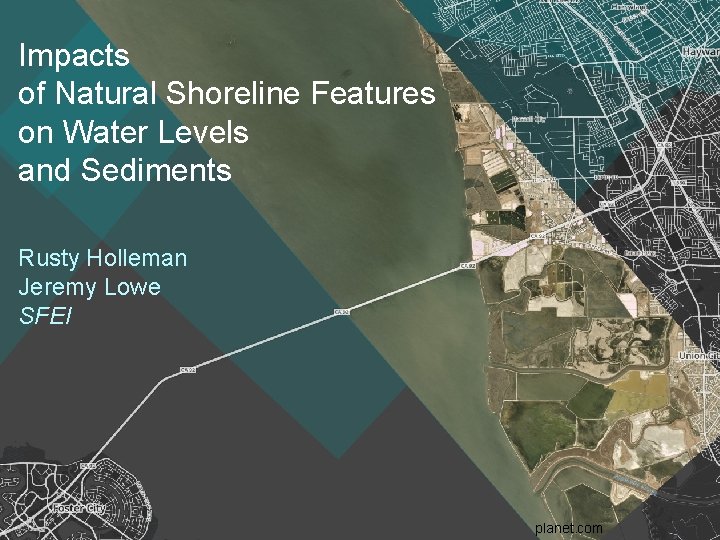
Impacts of Natural Shoreline Features on Water Levels and Sediments Rusty Holleman Jeremy Lowe SFEI planet. com
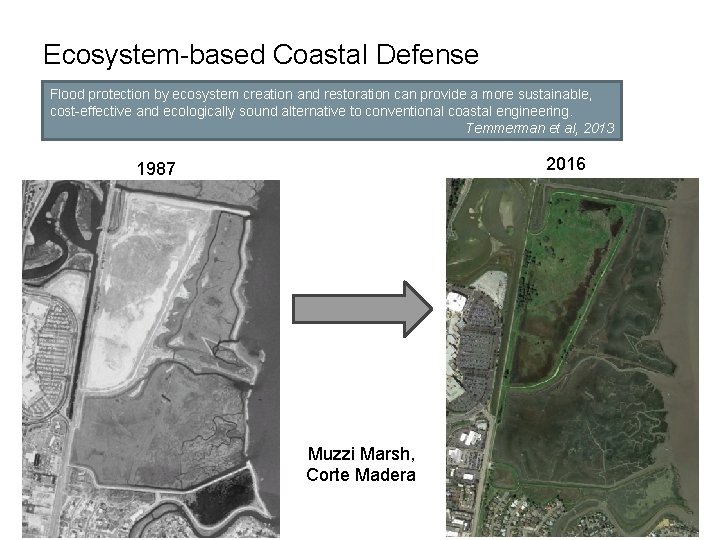
Ecosystem-based Coastal Defense Flood protection by ecosystem creation and restoration can provide a more sustainable, cost-effective and ecologically sound alternative to conventional coastal engineering. Temmerman et al, 2013 2016 1987 Muzzi Marsh, Corte Madera
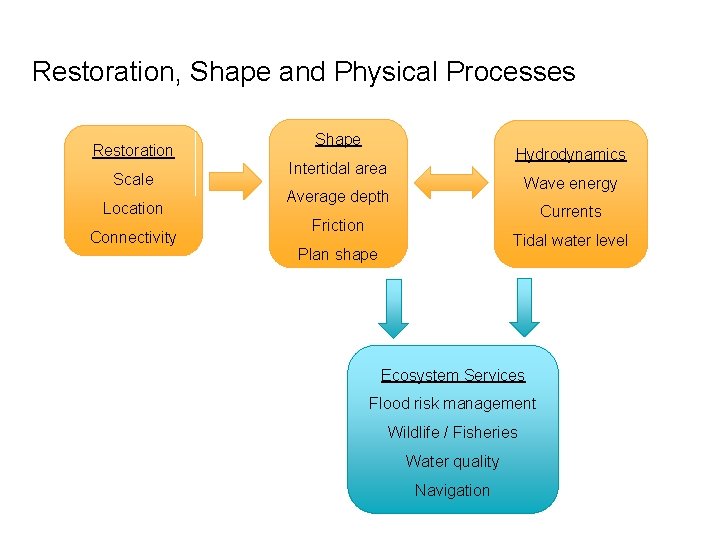
Restoration, Shape and Physical Processes Restoration Scale Location Connectivity Shape Hydrodynamics Intertidal area Wave energy Average depth Currents Friction Tidal water level Plan shape Ecosystem Services Flood risk management Wildlife / Fisheries Water quality Navigation
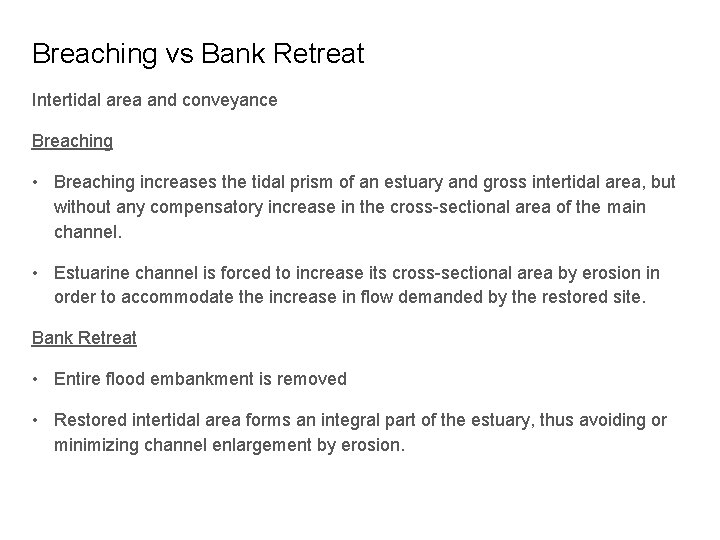
Breaching vs Bank Retreat Intertidal area and conveyance Breaching • Breaching increases the tidal prism of an estuary and gross intertidal area, but without any compensatory increase in the cross-sectional area of the main channel. • Estuarine channel is forced to increase its cross-sectional area by erosion in order to accommodate the increase in flow demanded by the restored site. Bank Retreat • Entire flood embankment is removed • Restored intertidal area forms an integral part of the estuary, thus avoiding or minimizing channel enlargement by erosion.
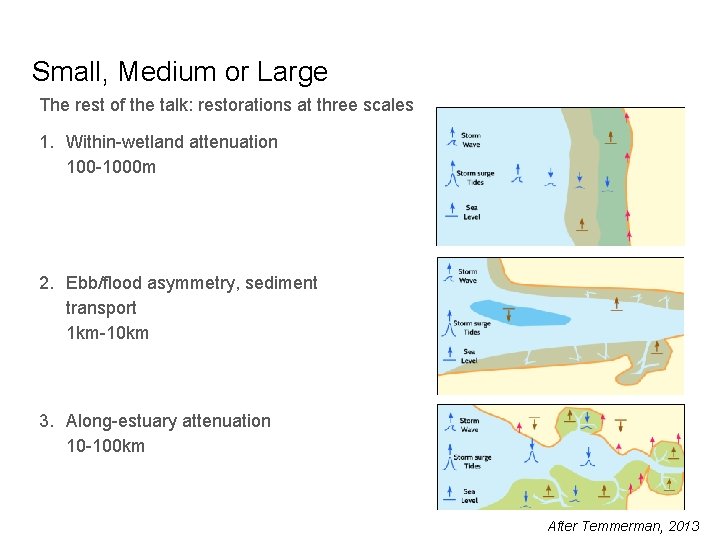
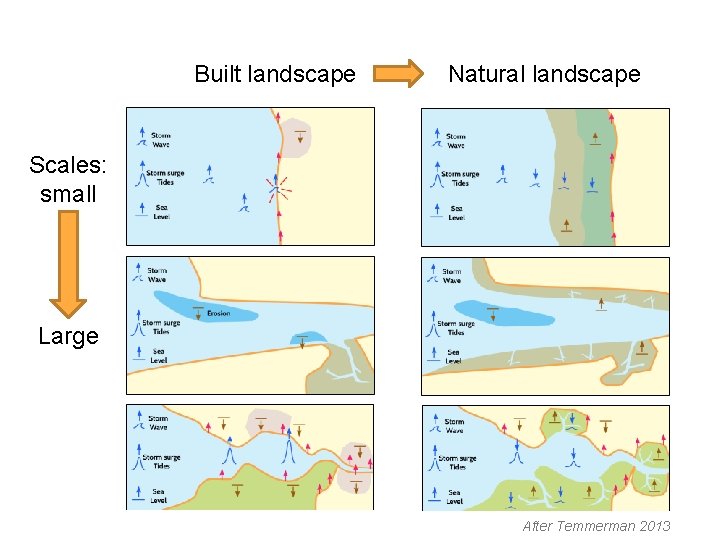
Small, Medium or Large The rest of the talk: restorations at three scales 1. Within-wetland attenuation 100 -1000 m 2. Ebb/flood asymmetry, sediment transport 1 km-10 km 3. Along-estuary attenuation 10 -100 km After Temmerman, 2013
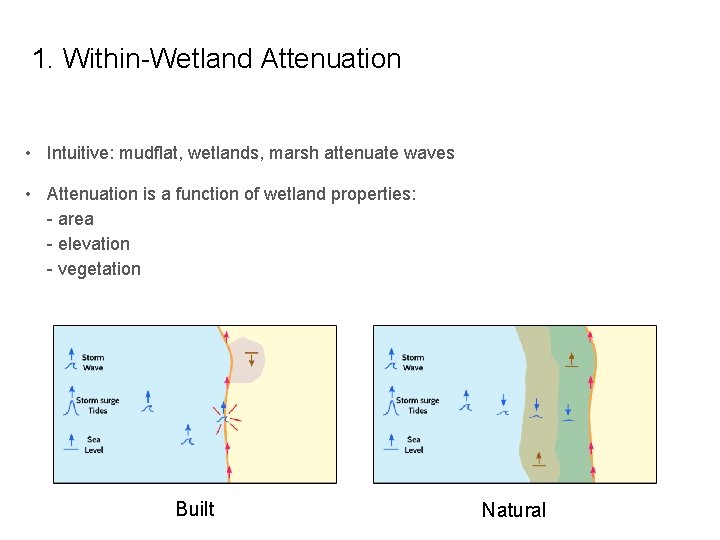
1. Within-Wetland Attenuation • Intuitive: mudflat, wetlands, marsh attenuate waves • Attenuation is a function of wetland properties: - area - elevation - vegetation Built Natural
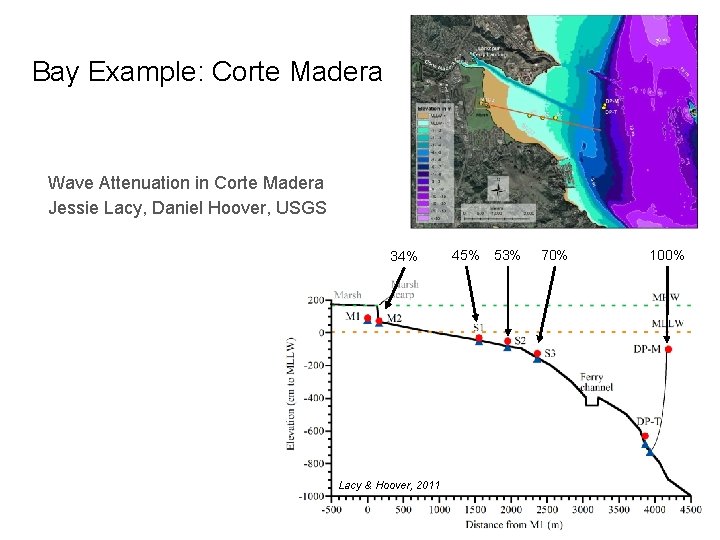
Bay Example: Corte Madera Wave Attenuation in Corte Madera Jessie Lacy, Daniel Hoover, USGS 34% Lacy & Hoover, 2011 45% 53% 70% 100%
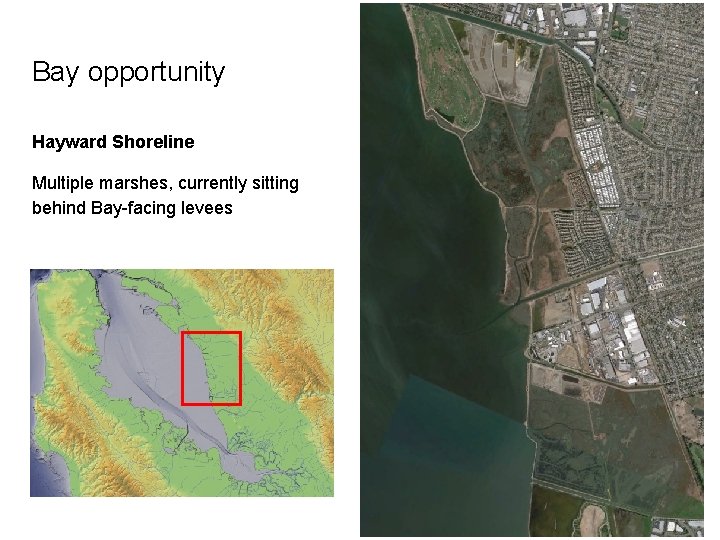
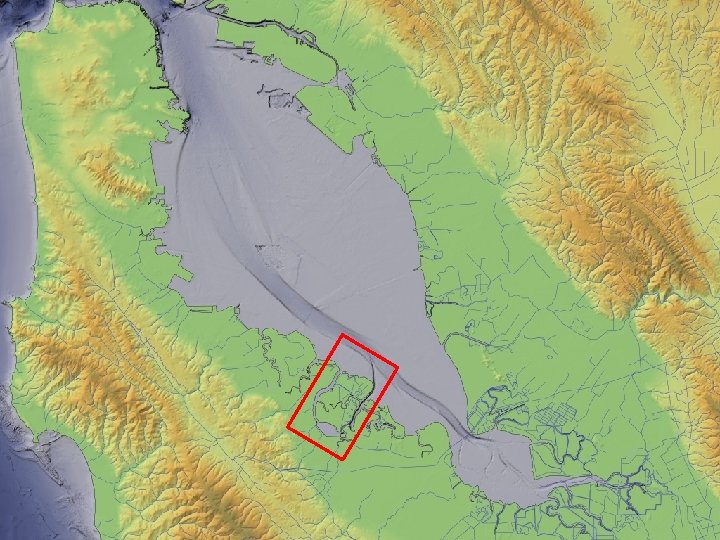
Bay opportunity Hayward Shoreline Multiple marshes, currently sitting behind Bay-facing levees
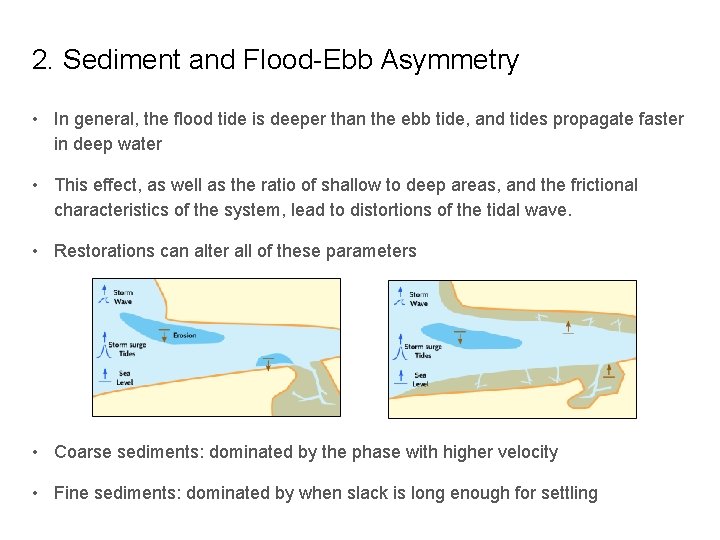
2. Sediment and Flood-Ebb Asymmetry • In general, the flood tide is deeper than the ebb tide, and tides propagate faster in deep water • This effect, as well as the ratio of shallow to deep areas, and the frictional characteristics of the system, lead to distortions of the tidal wave. • Restorations can alter all of these parameters • Coarse sediments: dominated by the phase with higher velocity • Fine sediments: dominated by when slack is long enough for settling
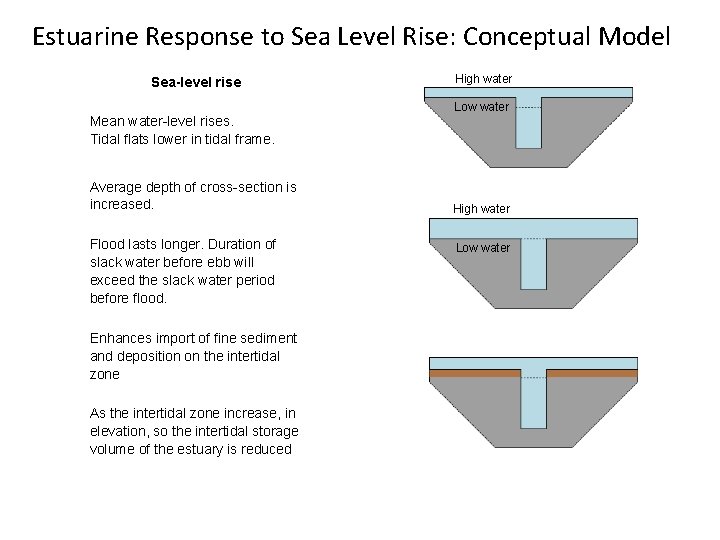
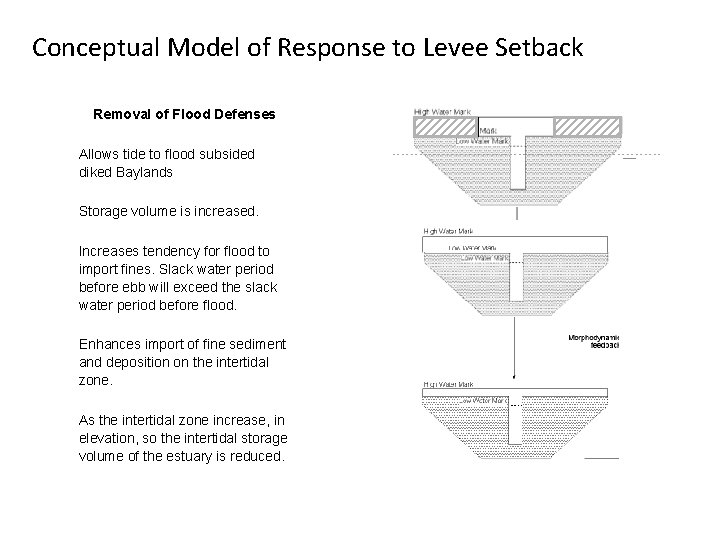
Estuarine Response to Sea Level Rise: Conceptual Model Sea-level rise Mean water-level rises. Tidal flats lower in tidal frame. Average depth of cross-section is increased. Flood lasts longer. Duration of slack water before ebb will exceed the slack water period before flood. Enhances import of fine sediment and deposition on the intertidal zone As the intertidal zone increase, in elevation, so the intertidal storage volume of the estuary is reduced High water Low water
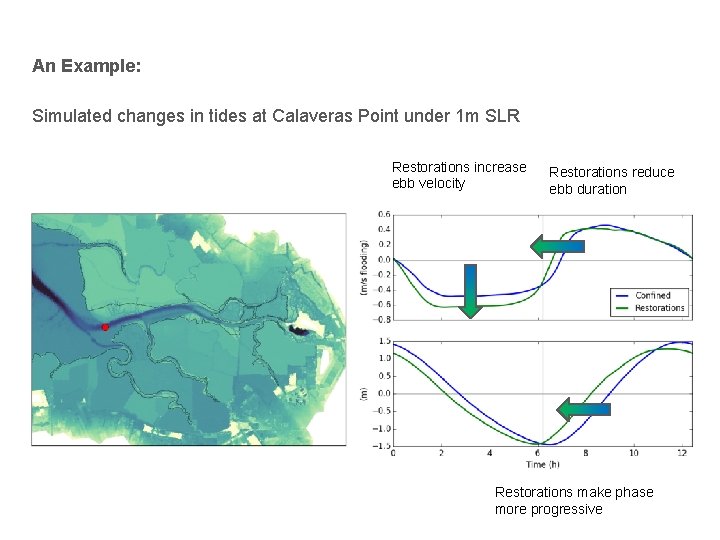
An Example: Simulated changes in tides at Calaveras Point under 1 m SLR Restorations increase ebb velocity Restorations reduce ebb duration Restorations make phase more progressive
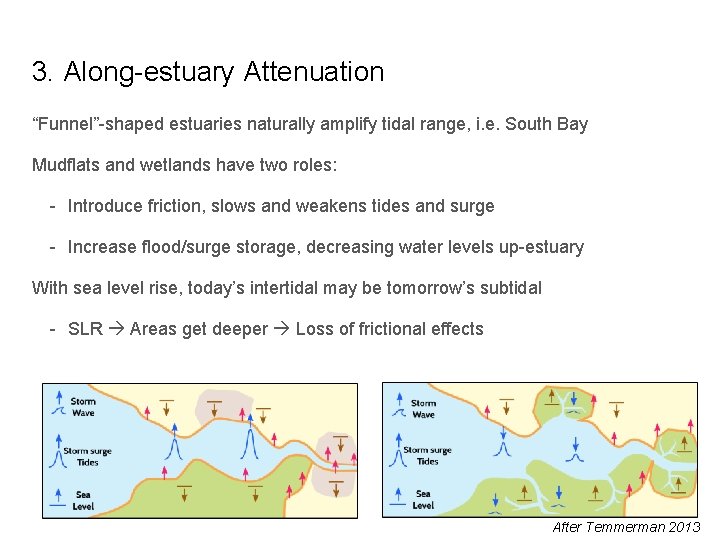
3. Along-estuary Attenuation “Funnel”-shaped estuaries naturally amplify tidal range, i. e. South Bay Mudflats and wetlands have two roles: - Introduce friction, slows and weakens tides and surge - Increase flood/surge storage, decreasing water levels up-estuary With sea level rise, today’s intertidal may be tomorrow’s subtidal - SLR Areas get deeper Loss of frictional effects After Temmerman 2013
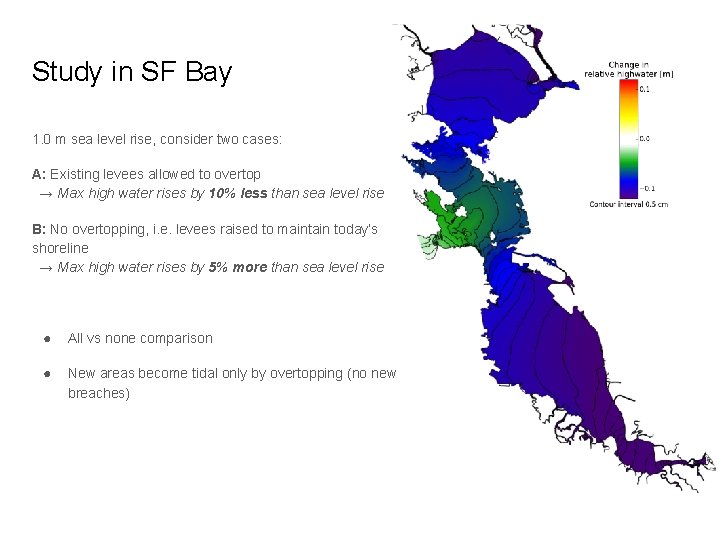
Study in SF Bay 1. 0 m sea level rise, consider two cases: A: Existing levees allowed to overtop → Max high water rises by 10% less than sea level rise B: No overtopping, i. e. levees raised to maintain today’s shoreline → Max high water rises by 5% more than sea level rise ● All vs none comparison ● New areas become tidal only by overtopping (no new breaches)
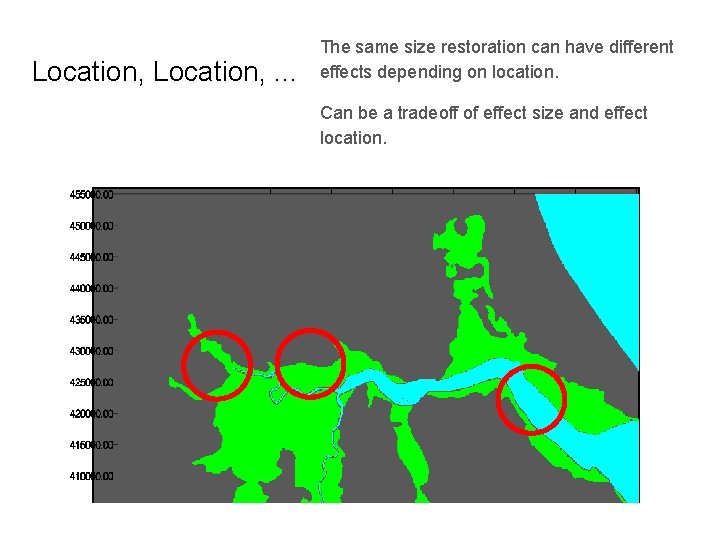
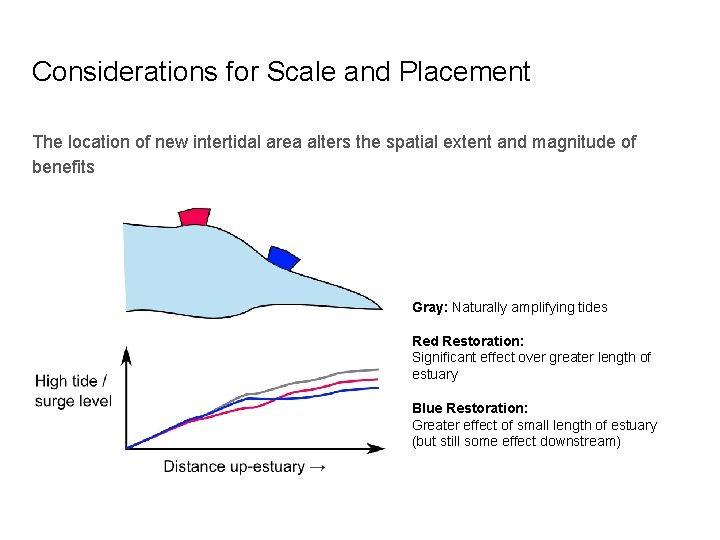
Location, . . . The same size restoration can have different effects depending on location. Can be a tradeoff of effect size and effect location.
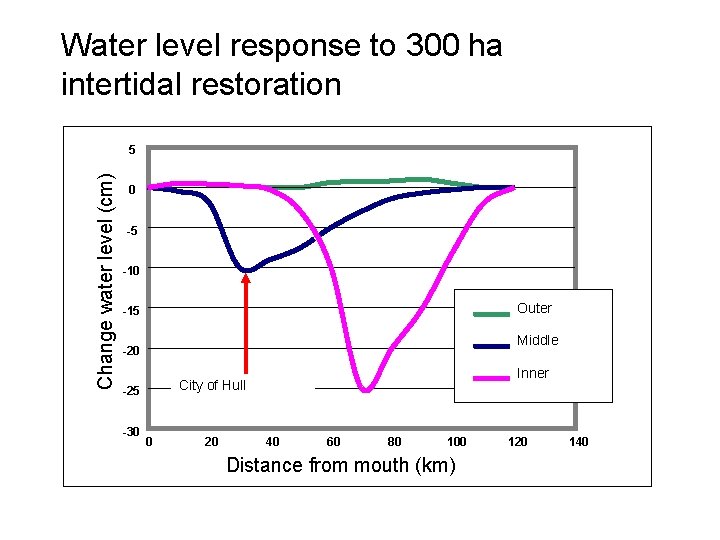
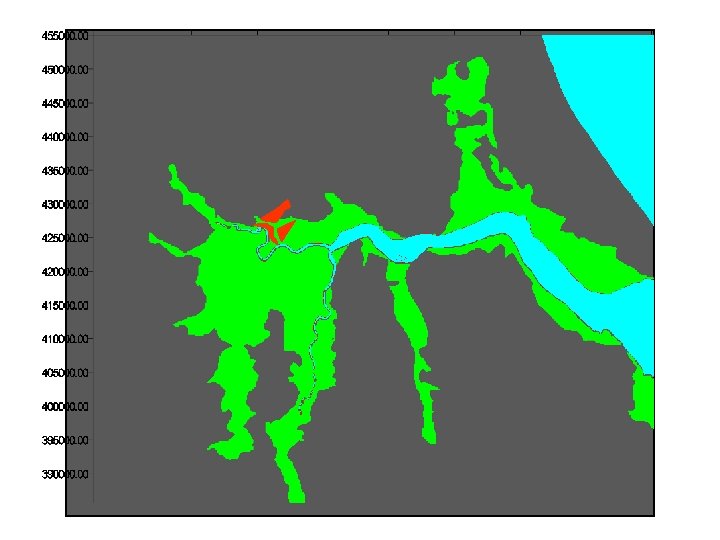
Water level response to 300 ha intertidal restoration Change water level (cm) 5 0 -5 -10 Outer -15 Middle -20 -25 -30 Inner City of Hull 0 20 40 60 80 100 Distance from mouth (km) 120 140
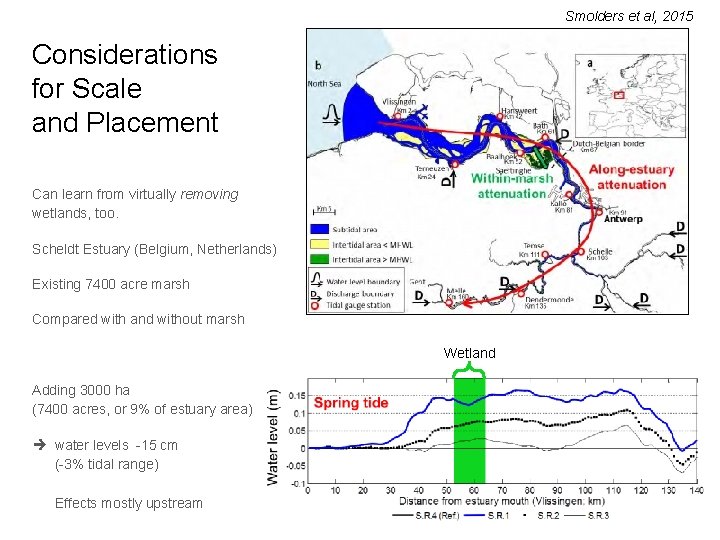
Smolders et al, 2015 Considerations for Scale and Placement Can learn from virtually removing wetlands, too. Scheldt Estuary (Belgium, Netherlands) Existing 7400 acre marsh Compared with and without marsh Wetland Adding 3000 ha (7400 acres, or 9% of estuary area) è water levels -15 cm (-3% tidal range) Effects mostly upstream
Built landscape Natural landscape Scales: small Large After Temmerman 2013
stop.
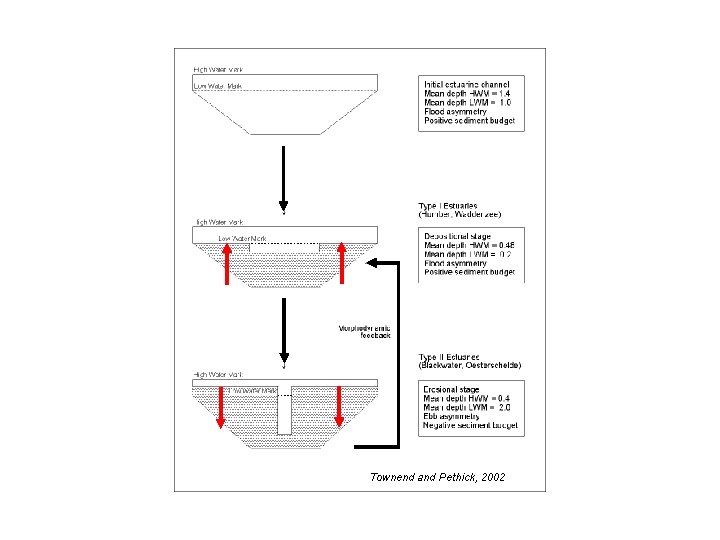
2. Flood-Ebb Asymmetry flood dominant adjective 1. having a flood tide of longer duration than ebb tide 2. (of hydrodynamics) tending to import sediment antonyms: ebb dominant The asymmetry / dominance can be modified by restoration actions. • Increase in intertidal storage, via levee realignment, increases the ebb dominance of an estuary. (Townend and Pethick, 2002) • French (2008) performed a hydrodynamic study of the effects of estuarine intertidal wetland creation by managed retreat, focusing on the effects of increased intertidal area on increased tidal currents and discharges in the estuary.
Townend and Pethick, 2002
The Aim. . . Usher estuaries towards a self-regulating state that meets our needs for Flood Risk Management Wildlife Support Navigation Water Quality Fisheries
Management Issues Realign in the: • outer estuary, increases water levels • inner estuary, decreases water levels • tidal rivers, has significant impact Location and size are important
Potential Problems? Velocity increases Changes in net sediment transport Changing water levels Changing areas of erosion and deposition …or Opportunities
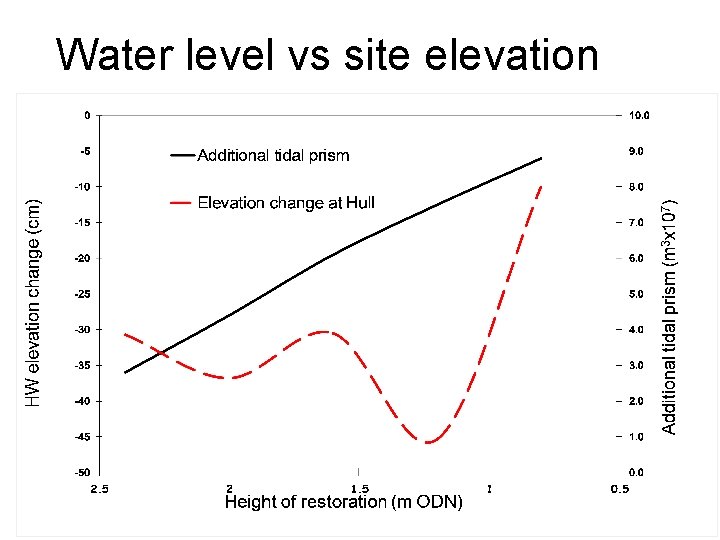
Water level vs site elevation
Management Issues Ebb/flood asymmetry • intertidal elevation • subtidal depth • intertidal area
Considerations for Scale and Placement The location of new intertidal area alters the spatial extent and magnitude of benefits Gray: Naturally amplifying tides Red Restoration: Significant effect over greater length of estuary Blue Restoration: Greater effect of small length of estuary (but still some effect downstream)
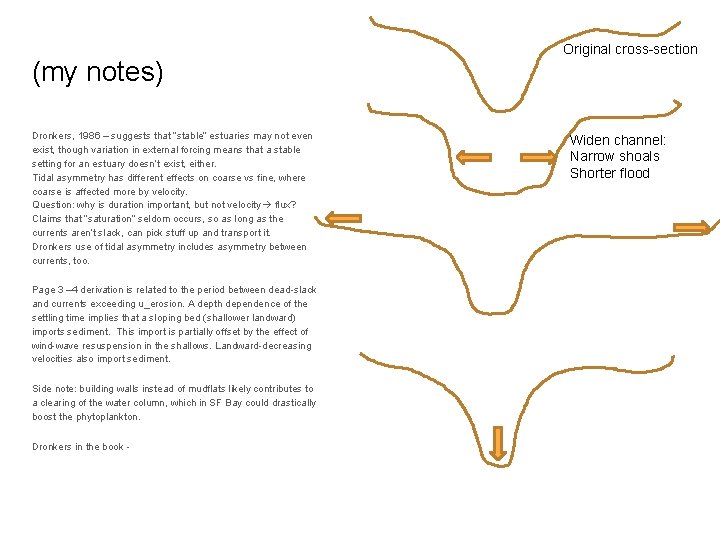
(my notes) Dronkers, 1986 – suggests that “stable” estuaries may not even exist, though variation in external forcing means that a stable setting for an estuary doesn’t exist, either. Tidal asymmetry has different effects on coarse vs fine, where coarse is affected more by velocity. Question: why is duration important, but not velocity flux? Claims that “saturation” seldom occurs, so as long as the currents aren’t slack, can pick stuff up and transport it. Dronkers use of tidal asymmetry includes asymmetry between currents, too. Page 3 – 4 derivation is related to the period between dead-slack and currents exceeding u_erosion. A depth dependence of the settling time implies that a sloping bed (shallower landward) imports sediment. This import is partially offset by the effect of wind-wave resuspension in the shallows. Landward-decreasing velocities also import sediment. Side note: building walls instead of mudflats likely contributes to a clearing of the water column, which in SF Bay could drastically boost the phytoplankton. Dronkers in the book - Original cross-section Widen channel: Narrow shoals Shorter flood
Conceptual Model of Response to Levee Setback Removal of Flood Defenses Allows tide to flood subsided diked Baylands Storage volume is increased. Increases tendency for flood to import fines. Slack water period before ebb will exceed the slack water period before flood. Enhances import of fine sediment and deposition on the intertidal zone. As the intertidal zone increase, in elevation, so the intertidal storage volume of the estuary is reduced.