
ImpactIonization Process of Fast Electron Hydrogenlike Ions in


- Slides: 22
Impact-Ionization Process of Fast- Electron- Hydrogen-like Ions in Debye Plasmas Yueying Qi, Lina Ning Jiaxing University Jianguo Wang Institute of Applied Physics and Computational Mathematics Yizhi Qu University of the Chinese Academy of Sciences R. K. Janev Macedonian Academy of Sciences and Arts
content ØPlasma conditions Øpossible atomic processes in plasmas ØFast-electron impact ionization process ØResults and Discussion
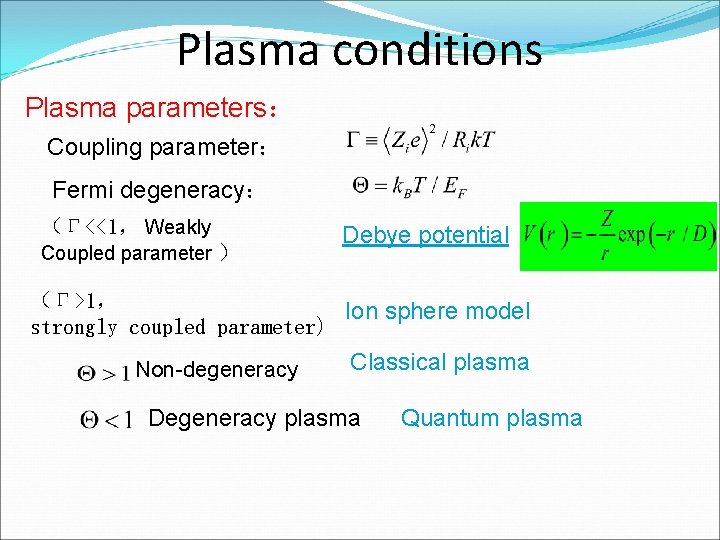
Plasma conditions Plasma parameters: Coupling parameter: Fermi degeneracy: (Γ<<1, Weakly Coupled parameter ) Debye potential (Γ>1, Ion sphere model strongly coupled parameter) Non-degeneracy Classical plasma Degeneracy plasma Quantum plasma
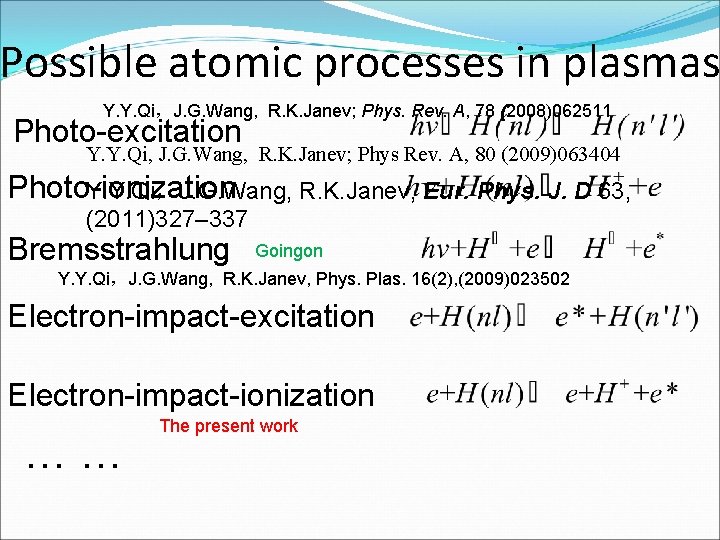
Possible atomic processes in plasmas Y. Y. Qi,J. G. Wang, R. K. Janev; Phys. Rev. A, 78 (2008)062511 Photo-excitation Y. Y. Qi, J. G. Wang, R. K. Janev; Phys Rev. A, 80 (2009)063404 Photo-ionization Y. Y. Qi,J. G. Wang, R. K. Janev, Eur. Phys. J. D 63, (2011)327– 337 Bremsstrahlung Goingon Y. Y. Qi,J. G. Wang, R. K. Janev, Phys. Plas. 16(2), (2009)023502 Electron-impact-excitation Electron-impact-ionization …… The present work
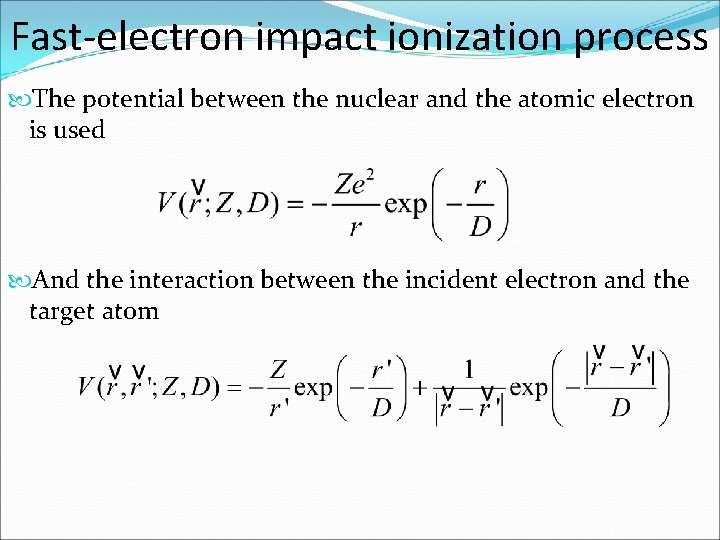
Fast-electron impact ionization process The potential between the nuclear and the atomic electron is used And the interaction between the incident electron and the target atom
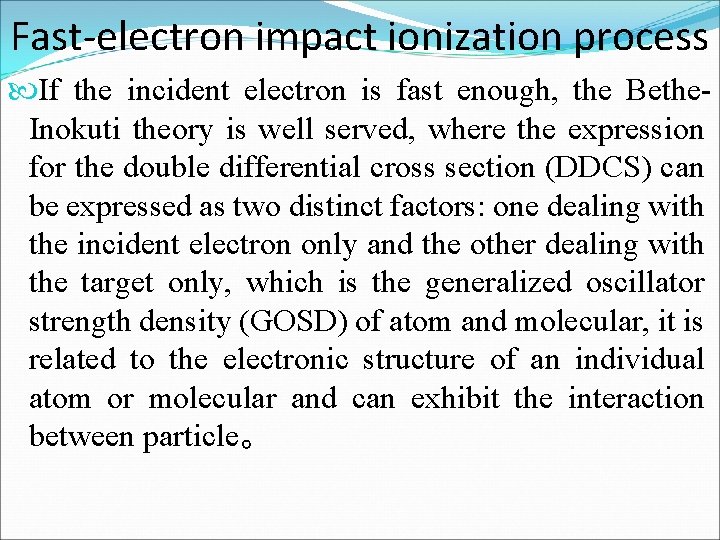
Fast-electron impact ionization process If the incident electron is fast enough, the Bethe. Inokuti theory is well served, where the expression for the double differential cross section (DDCS) can be expressed as two distinct factors: one dealing with the incident electron only and the other dealing with the target only, which is the generalized oscillator strength density (GOSD) of atom and molecular, it is related to the electronic structure of an individual atom or molecular and can exhibit the interaction between particle。
Fast-electron impact ionization process Similar to Bethe theory, GOSD is defined as Then DDCS is written as The integration is used
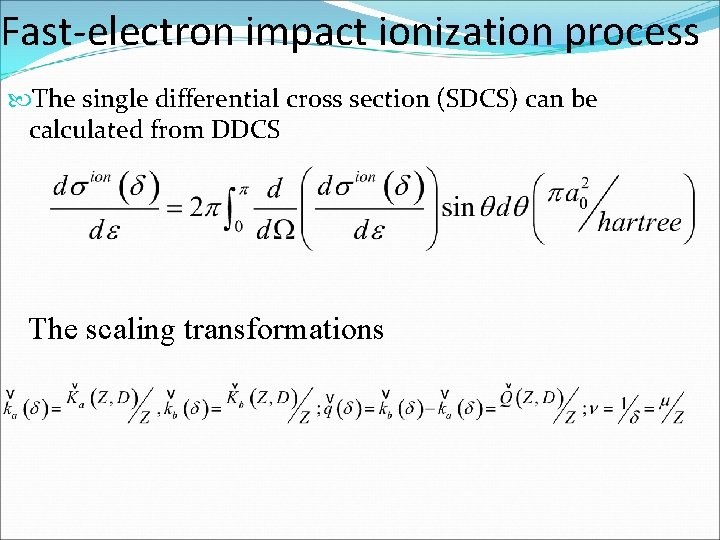
Fast-electron impact ionization process The single differential cross section (SDCS) can be calculated from DDCS The scaling transformations
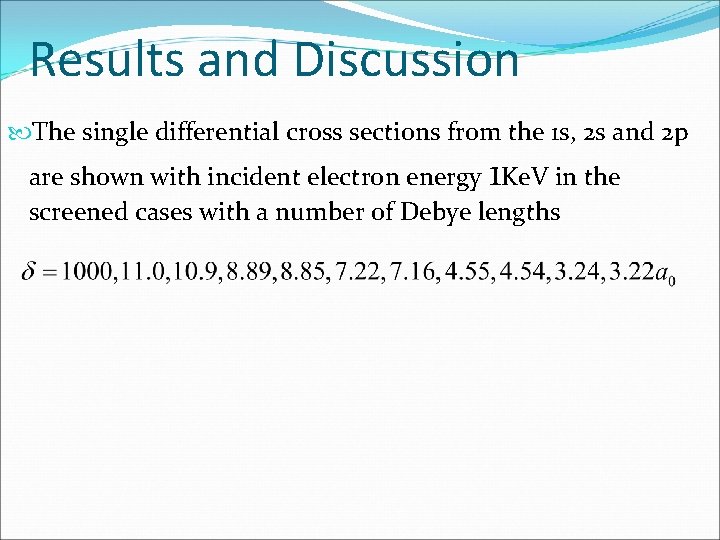
Results and Discussion The single differential cross sections from the 1 s, 2 s and 2 p are shown with incident electron energy 1 Ke. V in the screened cases with a number of Debye lengths
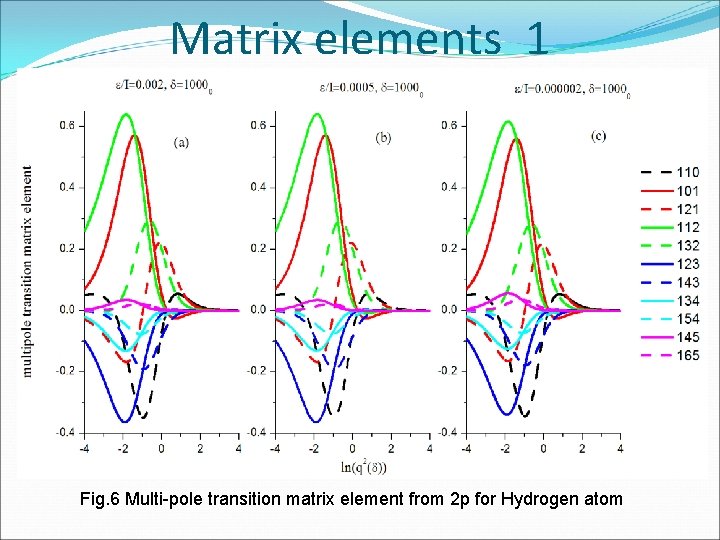
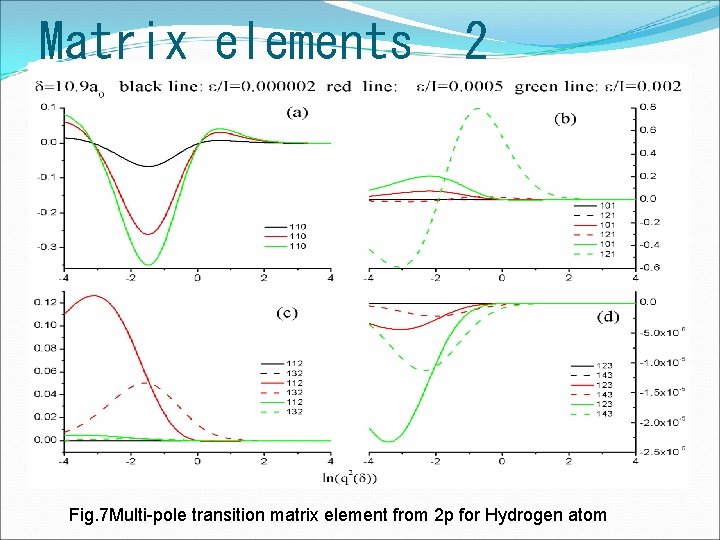
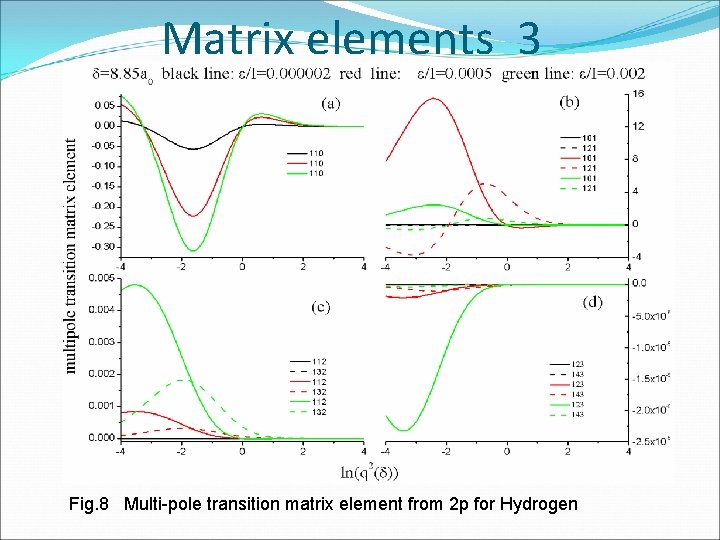
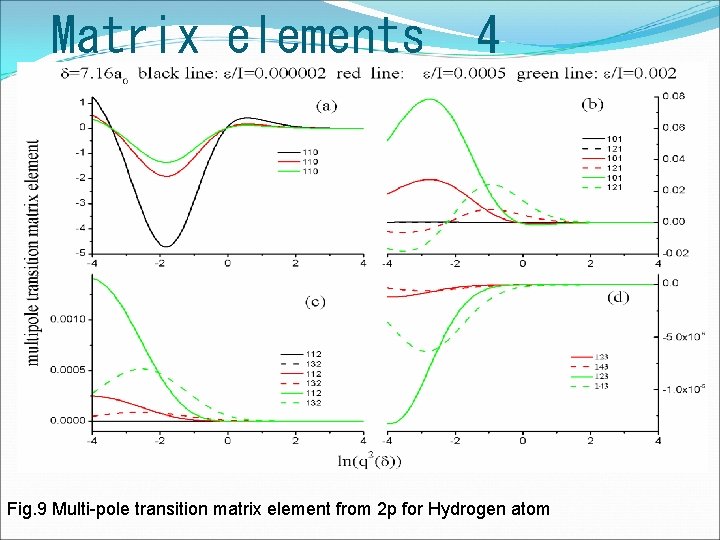
The ionization of the electron-Hydrogen-like ions collision is a multi-pole transition process, and the final continuum electron is perhaps trapped in any angular-momentum states, not only dipole transition corresponding to the photo-ionization,multi-pole shapes and the virtual-state resonances potentially happen in the electron-impact ionization process for the screened Coulomb interaction.
Results 1: SDCS from 2 p. FIG. 1 Electron-impact SDCS 2 p orbital for atomic hydrogen in Debye plasmas
Results 2: SDCS from 2 p. FIG. 2 Electron-impact SDCS 2 p orbital for atomic hydrogen in Debye plasmas
Results 3: SDCS from 2 s FIG. 3 Electron-impact SDCS 2 s orbital for atomic hydrogen in Debye plasmas
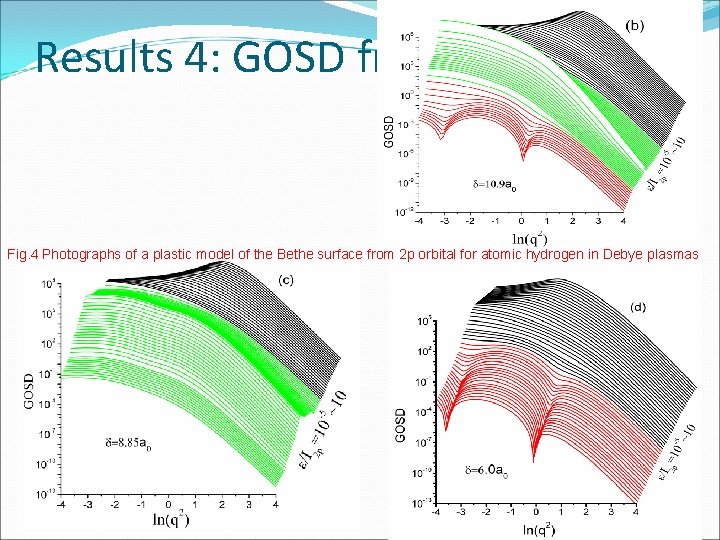
GOSD is represented comprehensively by a threedimensional plot , called the Bethe surface, which embodies all information concerning the inelastic scattering of charged particles by an atom or molecular in FBA, and is useful for analysis of quantities such as the stopping power and the total inelastic-scattering. The Bethe surface is separated into three domains: the above-threshold domain (red lines), the resonance domain (green lines) and the large energy domain (black lines).
Results 4: GOSD from 2 p Fig. 4 Photographs of a plastic model of the Bethe surface from 2 p orbital for atomic hydrogen in Debye plasmas
Fig. 5 (Color online)Photographs of a plastic model of DDCS from 2 p orbital in Debye plasmas
Matrix elements 1 Fig. 6 Multi-pole transition matrix element from 2 p for Hydrogen atom
Matrix elements 2 Fig. 7 Multi-pole transition matrix element from 2 p for Hydrogen atom
Matrix elements 3 Fig. 8 Multi-pole transition matrix element from 2 p for Hydrogen
Matrix elements 4 Fig. 9 Multi-pole transition matrix element from 2 p for Hydrogen atom
CONCLUSION In conclusion, we studied the plasma effects on the generalized oscillator strength densities (Bethe surfaces), the double differential cross sections, and the single cross sections from 2 p state of hydrogen-like ions in the Debye plasma environments in present work. The results demonstrated that GOSD from 2 p state happened to enormously vary due to the plasma screening interactions, especially near the smaller energy transfer (in the extremely low-energy) and the resonance domain (the appearance of the quasi-bound state for l>0 or near-zero-energy enhancement of the virtual state for l=0). The accessional minima, the new broaden peak and remarkable augmentation always exist in GOSD and DDCS; the multiple shape resonance and near-zero-energy enhancement appear in SDCS, all which are dependent of the plasma conditions. These effects should be considered in the simulation of spectroscopy in the hot, dense plasmas.
Thanks for your attention!