
Impacting Design Quality through Key Parameter Development Management
- Slides: 54
Impacting Design Quality through Key Parameter Development & Management Using KPD&M during Technology & Product Development Processes to Prevent Design Problems
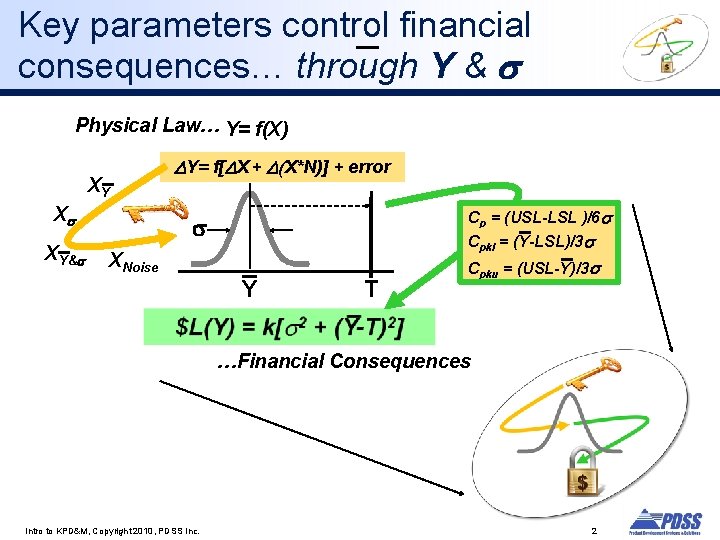
Key parameters control financial consequences… through Y & s Physical Law… Y= f(X) XY Xs XY&s DY= f[DX + D(X*N)] + error Cp = (USL-LSL )/6 s Cpkl = (Y-LSL)/3 s s XNoise Y T Cpku = (USL-Y)/3 s …Financial Consequences Intro to KPD&M, Copyright 2010, PDSS Inc. 2
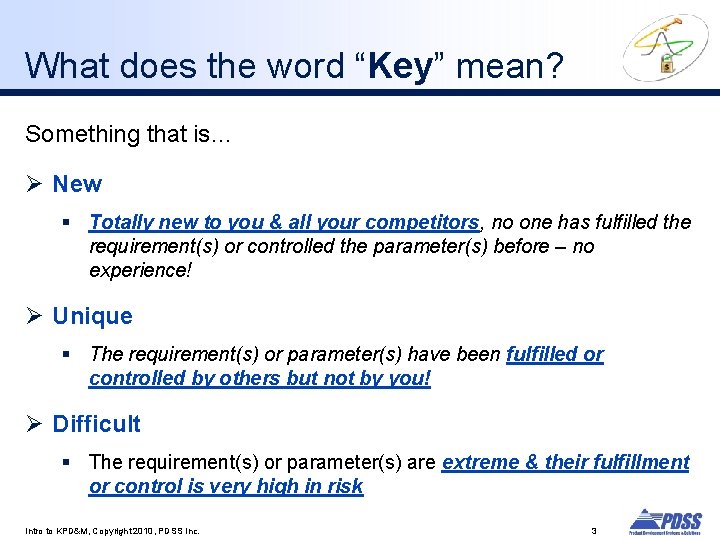
What does the word “Key” mean? Something that is… Ø New § Totally new to you & all your competitors, no one has fulfilled the requirement(s) or controlled the parameter(s) before – no experience! Ø Unique § The requirement(s) or parameter(s) have been fulfilled or controlled by others but not by you! Ø Difficult § The requirement(s) or parameter(s) are extreme & their fulfillment or control is very high in risk Intro to KPD&M, Copyright 2010, PDSS Inc. 3
Things that are NOT “Key”… Something that is… Ø Easy Ø Common Ø Old These are functions, part specifications & mfg. functions that we place under normal Q. C. metrics - Little or no SPC investment (low need to detect & prevent) - Cp & Cpk checked periodically - Use Six Sigma to react to problems in this area Intro to KPD&M, Copyright 2010, PDSS Inc. 4
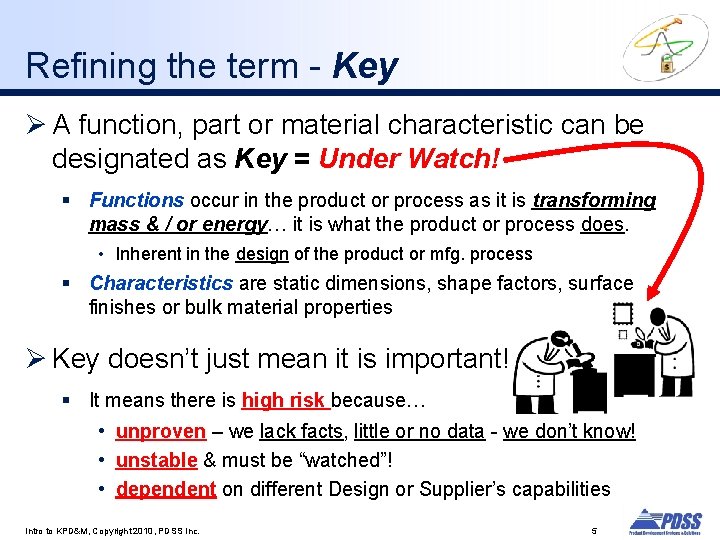
Refining the term - Key Ø A function, part or material characteristic can be designated as Key = Under Watch! § Functions occur in the product or process as it is transforming mass & / or energy… it is what the product or process does. • Inherent in the design of the product or mfg. process § Characteristics are static dimensions, shape factors, surface finishes or bulk material properties Ø Key doesn’t just mean it is important! § It means there is high risk because… • unproven – we lack facts, little or no data - we don’t know! • unstable & must be “watched”! • dependent on different Design or Supplier’s capabilities Intro to KPD&M, Copyright 2010, PDSS Inc. 5
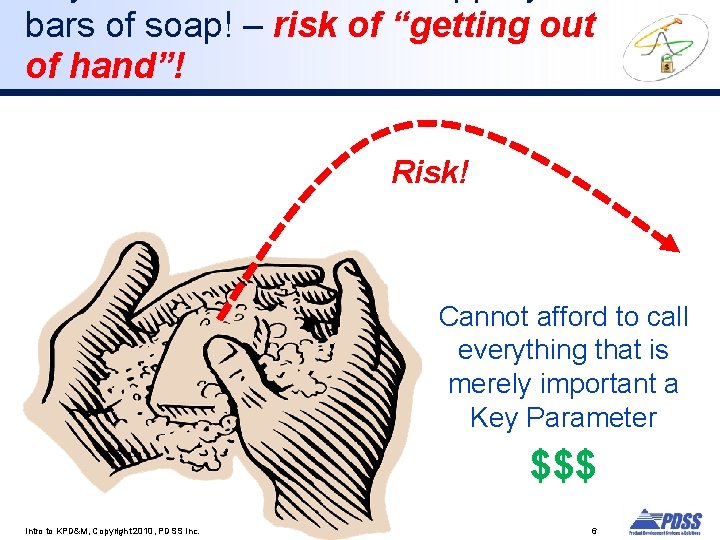
bars of soap! – risk of “getting out of hand”! Risk! Cannot afford to call everything that is merely important a Key Parameter $$$ Intro to KPD&M, Copyright 2010, PDSS Inc. 6
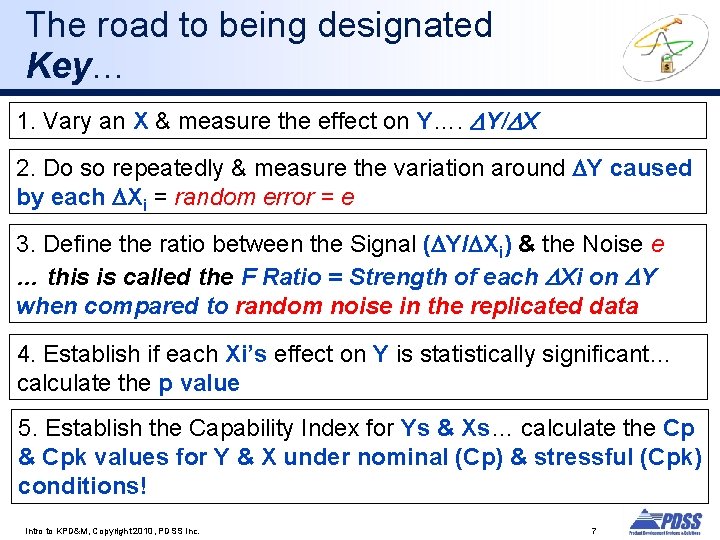
The road to being designated Key… 1. Vary an X & measure the effect on Y…. DY/DX 2. Do so repeatedly & measure the variation around DY caused by each DXi = random error = e 3. Define the ratio between the Signal (DY/DXi) & the Noise e … this is called the F Ratio = Strength of each DXi on DY when compared to random noise in the replicated data 4. Establish if each Xi’s effect on Y is statistically significant… calculate the p value 5. Establish the Capability Index for Ys & Xs… calculate the Cp & Cpk values for Y & X under nominal (Cp) & stressful (Cpk) conditions! Intro to KPD&M, Copyright 2010, PDSS Inc. 7
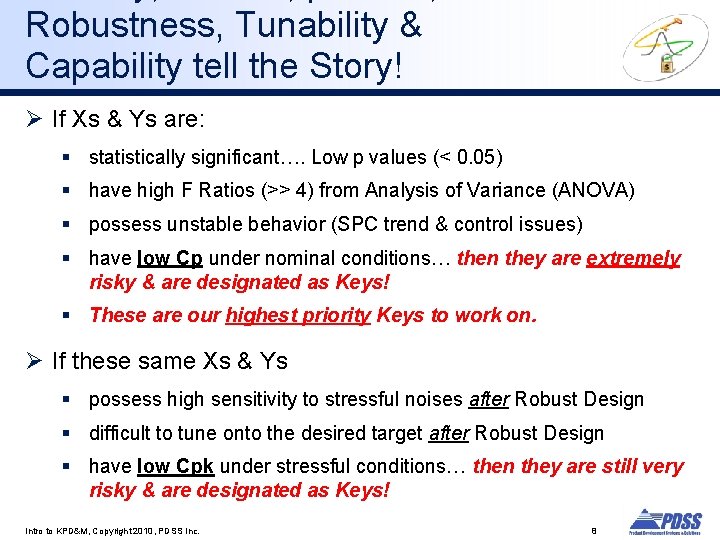
Robustness, Tunability & Capability tell the Story! Ø If Xs & Ys are: § statistically significant…. Low p values (< 0. 05) § have high F Ratios (>> 4) from Analysis of Variance (ANOVA) § possess unstable behavior (SPC trend & control issues) § have low Cp under nominal conditions… then they are extremely risky & are designated as Keys! § These are our highest priority Keys to work on. Ø If these same Xs & Ys § possess high sensitivity to stressful noises after Robust Design § difficult to tune onto the desired target after Robust Design § have low Cpk under stressful conditions… then they are still very risky & are designated as Keys! Intro to KPD&M, Copyright 2010, PDSS Inc. 8
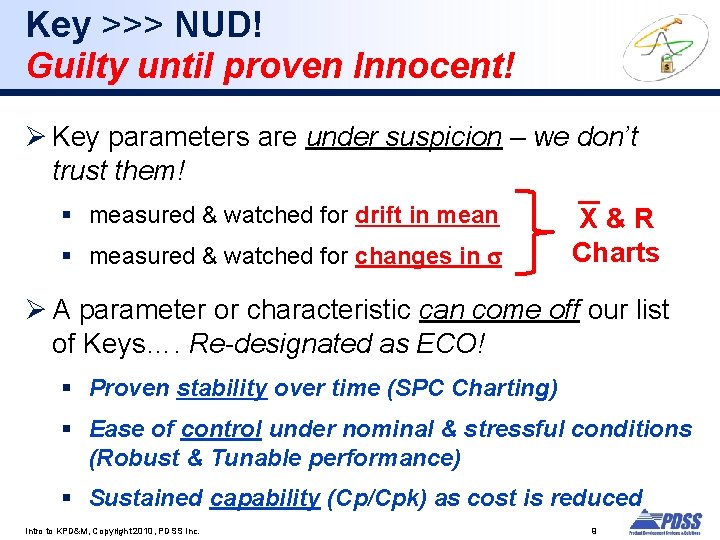
Key >>> NUD! Guilty until proven Innocent! Ø Key parameters are under suspicion – we don’t trust them! § measured & watched for drift in mean § measured & watched for changes in s X&R Charts Ø A parameter or characteristic can come off our list of Keys…. Re-designated as ECO! § Proven stability over time (SPC Charting) § Ease of control under nominal & stressful conditions (Robust & Tunable performance) § Sustained capability (Cp/Cpk) as cost is reduced Intro to KPD&M, Copyright 2010, PDSS Inc. 9
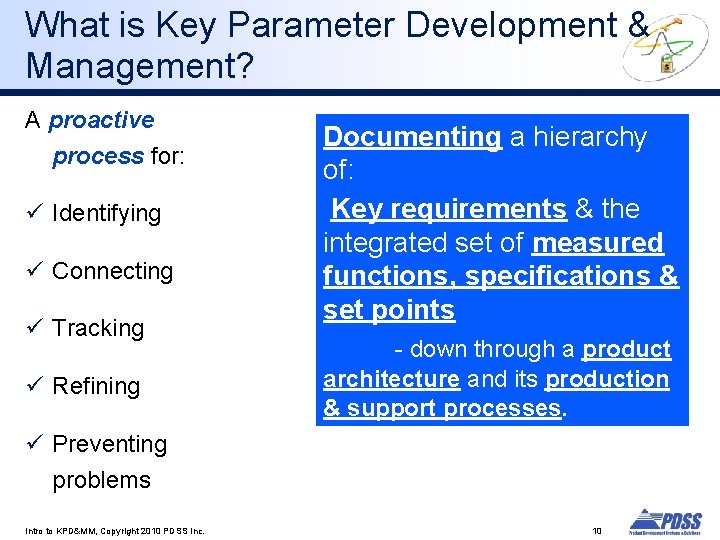
What is Key Parameter Development & Management? A proactive process for: ü Identifying ü Connecting ü Tracking ü Refining Documenting a hierarchy of: Key requirements & the integrated set of measured functions, specifications & set points - down through a product architecture and its production & support processes. ü Preventing problems Intro to KPD&MM, Copyright 2010 PDSS Inc. 10
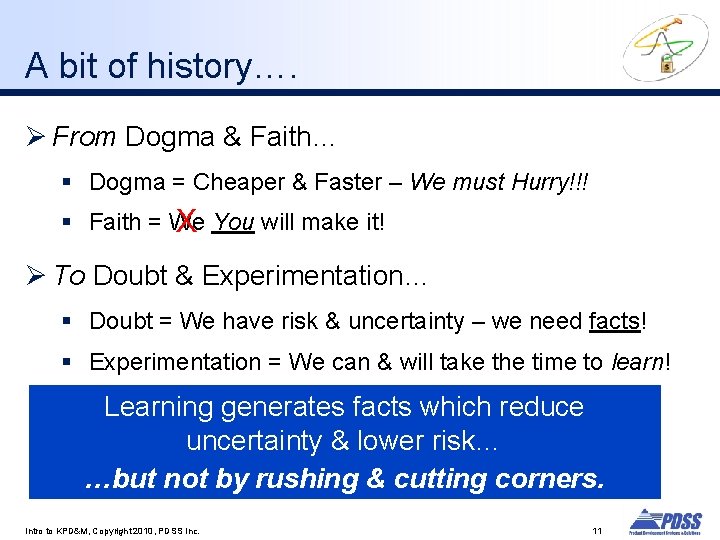
A bit of history…. Ø From Dogma & Faith… § Dogma = Cheaper & Faster – We must Hurry!!! § Faith = We X You will make it! Ø To Doubt & Experimentation… § Doubt = We have risk & uncertainty – we need facts! § Experimentation = We can & will take the time to learn! Learning generates facts which reduce uncertainty & lower risk… …but not by rushing & cutting corners. Intro to KPD&M, Copyright 2010, PDSS Inc. 11
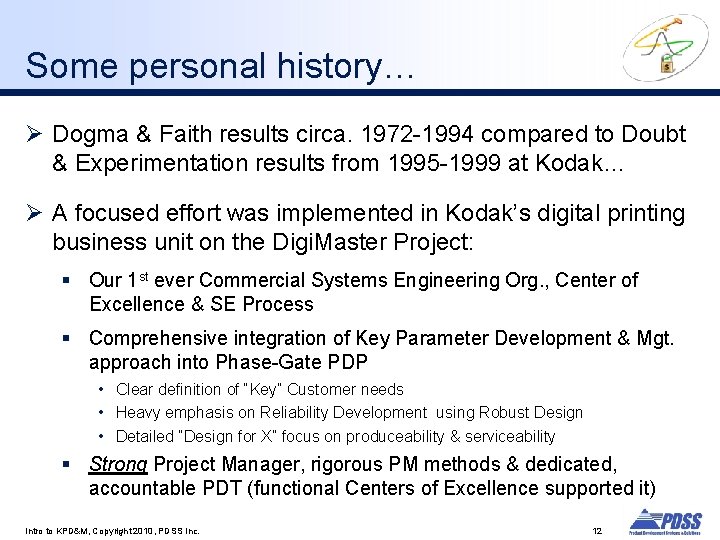
Some personal history… Ø Dogma & Faith results circa. 1972 -1994 compared to Doubt & Experimentation results from 1995 -1999 at Kodak… Ø A focused effort was implemented in Kodak’s digital printing business unit on the Digi. Master Project: § Our 1 st ever Commercial Systems Engineering Org. , Center of Excellence & SE Process § Comprehensive integration of Key Parameter Development & Mgt. approach into Phase-Gate PDP • Clear definition of “Key” Customer needs • Heavy emphasis on Reliability Development using Robust Design • Detailed “Design for X” focus on produceability & serviceability § Strong Project Manager, rigorous PM methods & dedicated, accountable PDT (functional Centers of Excellence supported it) Intro to KPD&M, Copyright 2010, PDSS Inc. 12
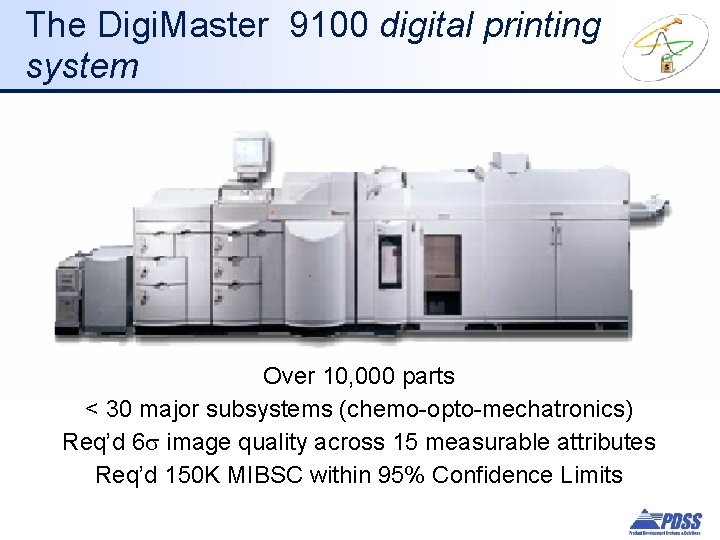
The Digi. Master 9100 digital printing system Over 10, 000 parts < 30 major subsystems (chemo-opto-mechatronics) Req’d 6 s image quality across 15 measurable attributes Req’d 150 K MIBSC within 95% Confidence Limits
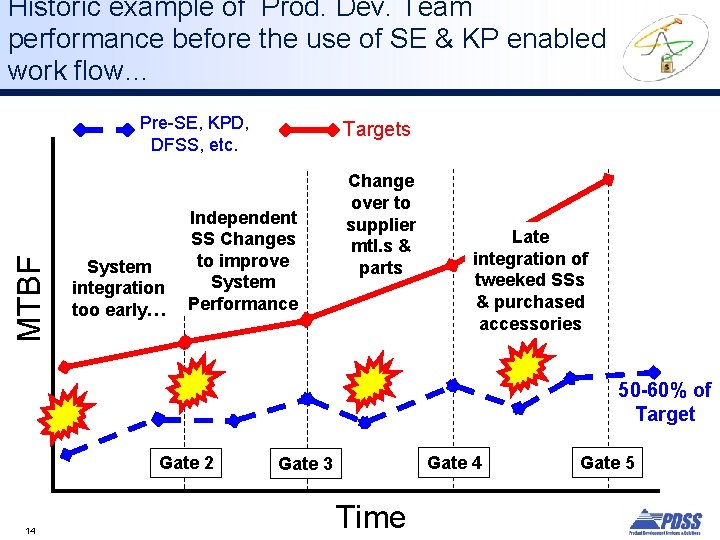
Historic example of Prod. Dev. Team performance before the use of SE & KP enabled work flow… MTBF Pre-SE, KPD, DFSS, etc. System integration too early… Targets Independent SS Changes to improve System Performance Change over to supplier mtl. s & parts Late integration of tweeked SSs & purchased accessories 50 -60% of Target Gate 2 14 Gate 3 Time Gate 5
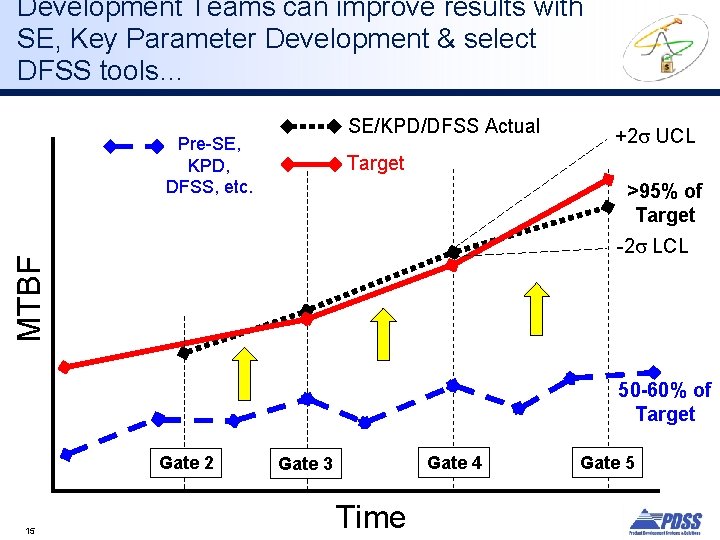
Development Teams can improve results with SE, Key Parameter Development & select DFSS tools… SE/KPD/DFSS Actual Pre-SE, KPD, DFSS, etc. +2 s UCL Target >95% of Target MTBF -2 s LCL 50 -60% of Target Gate 2 15 Gate 4 Gate 3 Time Gate 5
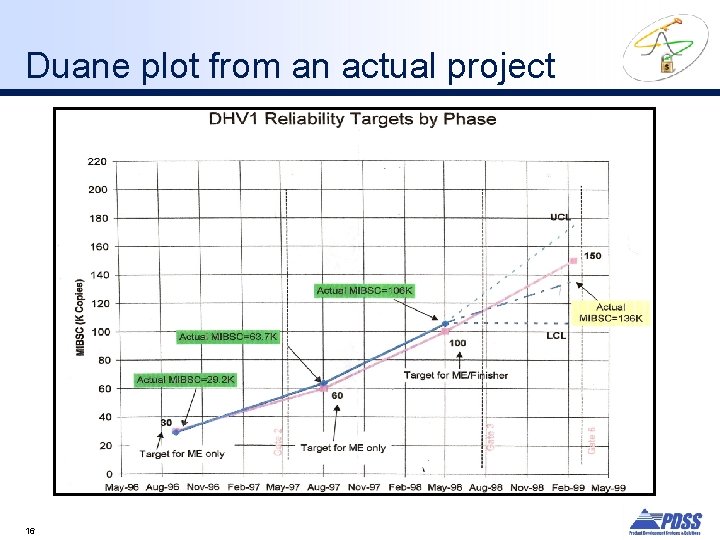
Duane plot from an actual project 16
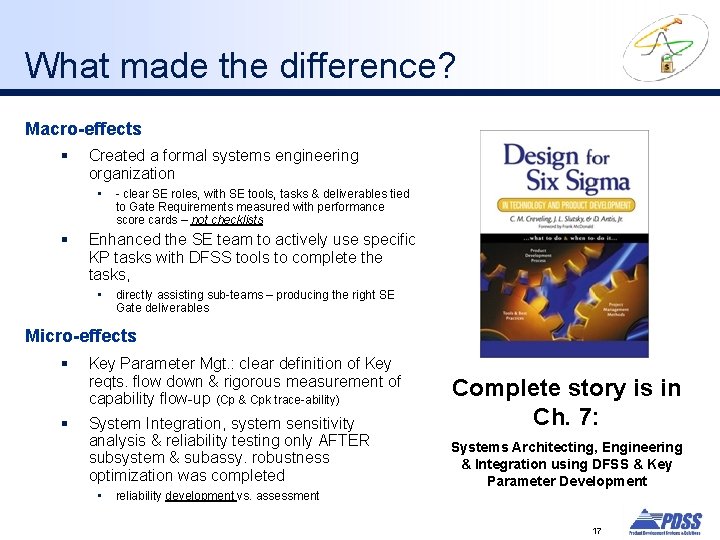
What made the difference? Macro-effects § Created a formal systems engineering organization • § - clear SE roles, with SE tools, tasks & deliverables tied to Gate Requirements measured with performance score cards – not checklists Enhanced the SE team to actively use specific KP tasks with DFSS tools to complete the tasks, • directly assisting sub-teams – producing the right SE Gate deliverables Micro-effects § § Key Parameter Mgt. : clear definition of Key reqts. flow down & rigorous measurement of capability flow-up (Cp & Cpk trace-ability) System Integration, system sensitivity analysis & reliability testing only AFTER subsystem & subassy. robustness optimization was completed • Complete story is in Ch. 7: Systems Architecting, Engineering & Integration using DFSS & Key Parameter Development reliability development vs. assessment 17
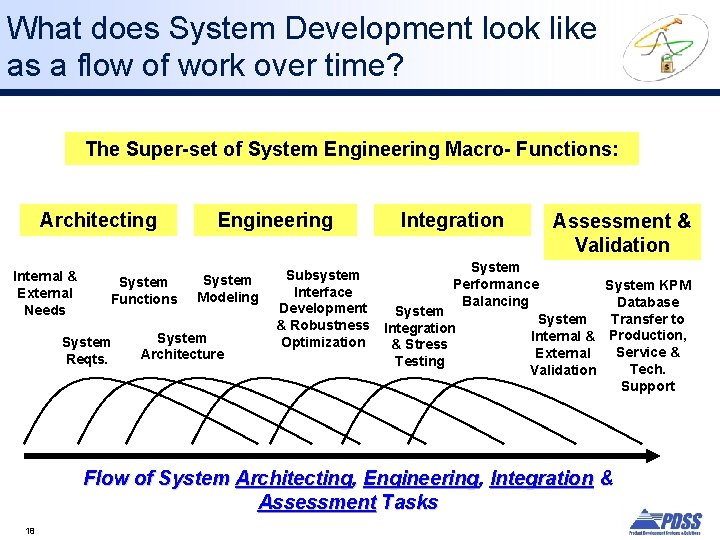
What does System Development look like as a flow of work over time? The Super-set of System Engineering Macro- Functions: Architecting Internal & External Needs System Functions System Reqts. Engineering System Modeling System Architecture Integration Assessment & Validation System Subsystem Performance System KPM Interface Balancing Database Development System Transfer to System & Robustness Integration Internal & Production, Optimization & Stress Service & External Testing Tech. Validation Support Flow of System Architecting, Engineering, Integration & Assessment Tasks 18
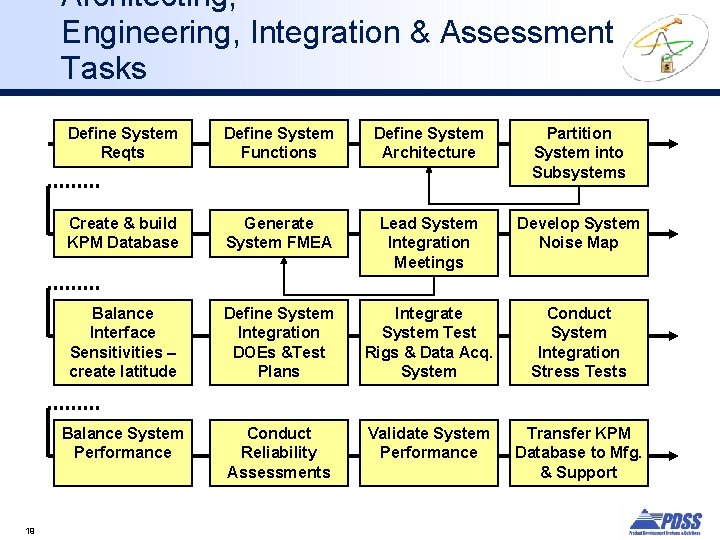
Architecting, Engineering, Integration & Assessment Tasks 19 Define System Reqts Define System Functions Define System Architecture Partition System into Subsystems Create & build KPM Database Generate System FMEA Lead System Integration Meetings Develop System Noise Map Balance Interface Sensitivities – create latitude Define System Integration DOEs &Test Plans Integrate System Test Rigs & Data Acq. System Conduct System Integration Stress Tests Balance System Performance Conduct Reliability Assessments Validate System Performance Transfer KPM Database to Mfg. & Support
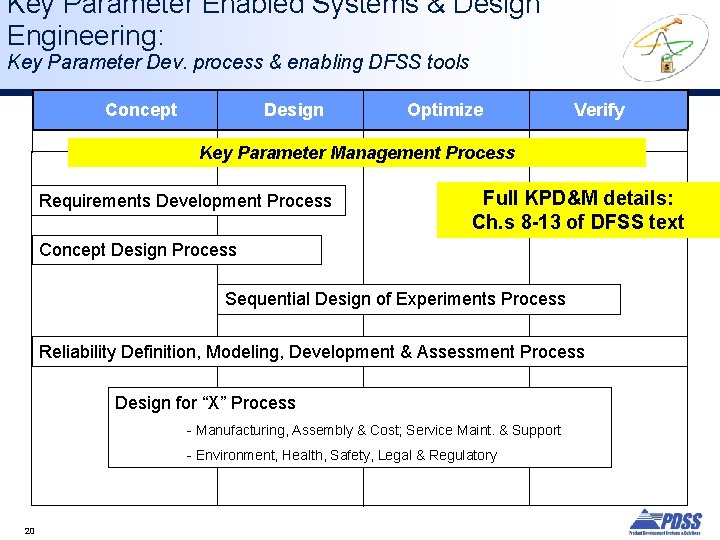
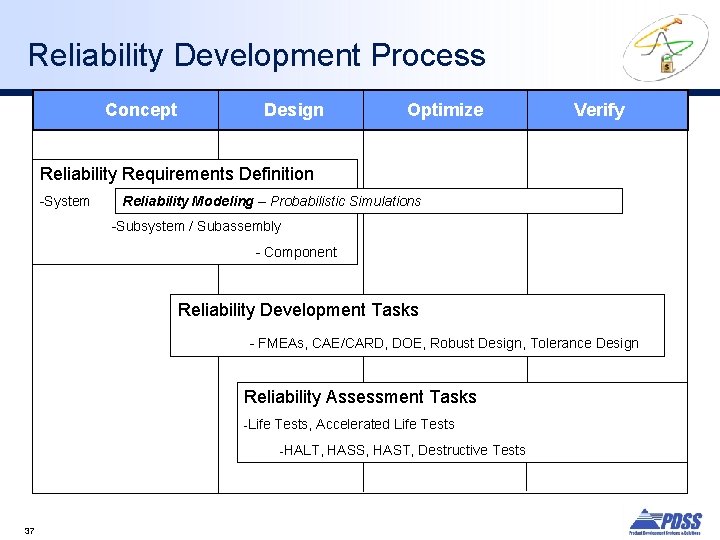
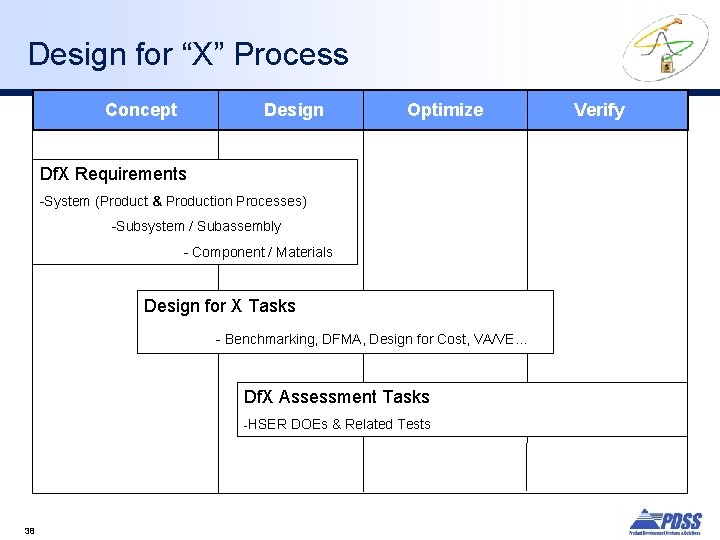
Key Parameter Enabled Systems & Design Engineering: Key Parameter Dev. process & enabling DFSS tools Design Concept Optimize Verify Key Parameter Management Process Requirements Development Process Full KPD&M details: Ch. s 8 -13 of DFSS text Concept Design Process Sequential Design of Experiments Process Reliability Definition, Modeling, Development & Assessment Process Design for “X” Process - Manufacturing, Assembly & Cost; Service Maint. & Support - Environment, Health, Safety, Legal & Regulatory 20
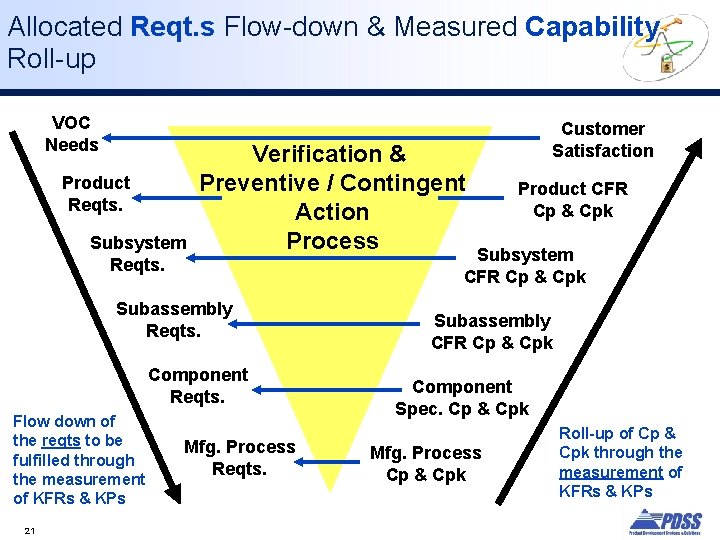
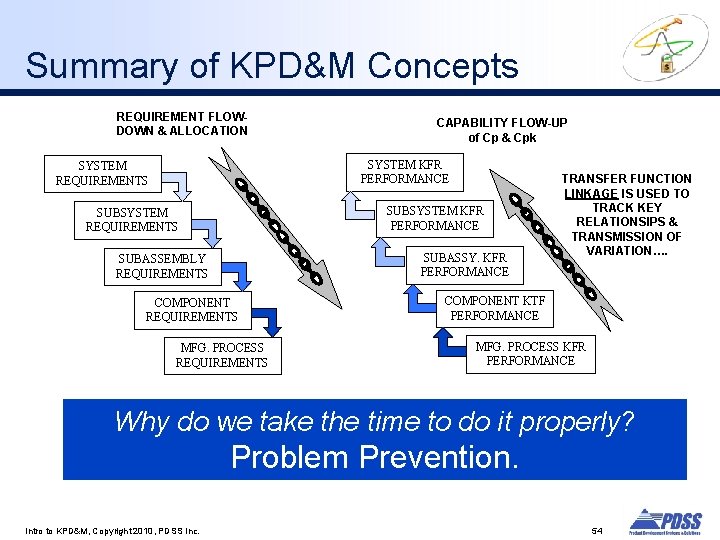
Allocated Reqt. s Flow-down & Measured Capability Roll-up VOC Needs Product Reqts. Subsystem Reqts. Verification & Preventive / Contingent Action Process Subassembly Reqts. Component Reqts. Flow down of the reqts to be fulfilled through the measurement of KFRs & KPs 21 Mfg. Process Reqts. Customer Satisfaction Product CFR Cp & Cpk Subsystem CFR Cp & Cpk Subassembly CFR Cp & Cpk Component Spec. Cp & Cpk Mfg. Process Cp & Cpk Roll-up of Cp & Cpk through the measurement of KFRs & KPs
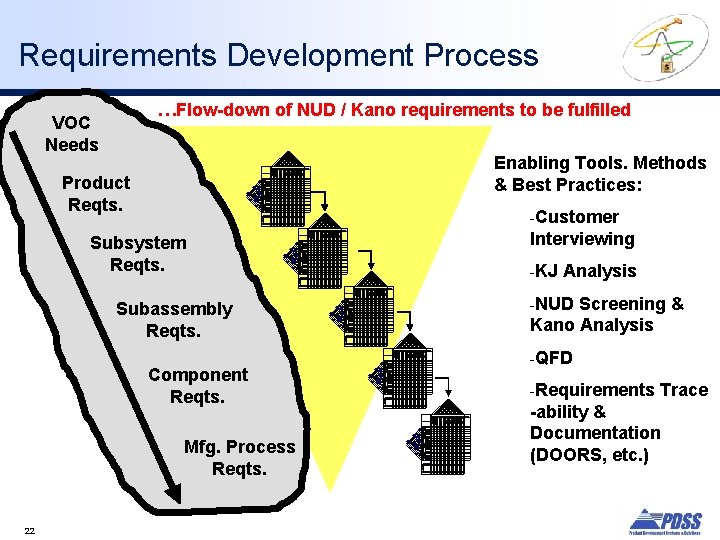
Requirements Development Process …Flow-down of NUD / Kano requirements to be fulfilled VOC Needs Enabling Tools. Methods & Best Practices: Product Reqts. -Customer Subsystem Reqts. Subassembly Reqts. Component Reqts. Mfg. Process Reqts. 22 Interviewing -KJ Analysis -NUD Screening & Kano Analysis -QFD -Requirements Trace -ability & Documentation (DOORS, etc. )
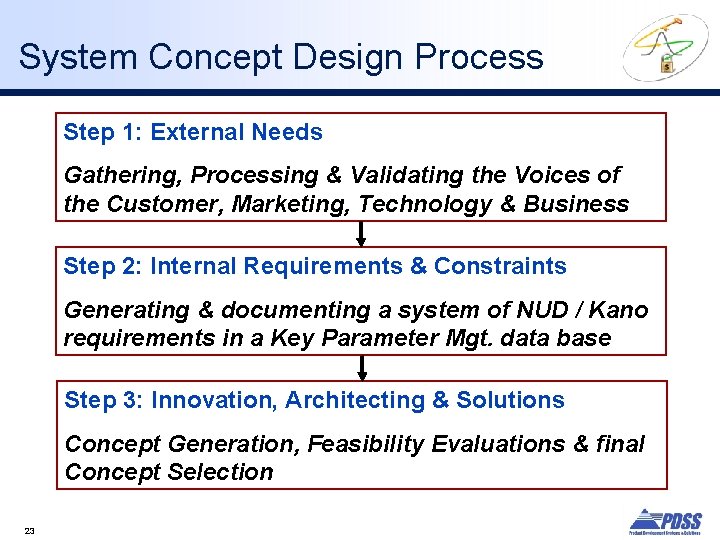
System Concept Design Process Step 1: External Needs Gathering, Processing & Validating the Voices of the Customer, Marketing, Technology & Business Step 2: Internal Requirements & Constraints Generating & documenting a system of NUD / Kano requirements in a Key Parameter Mgt. data base Step 3: Innovation, Architecting & Solutions Concept Generation, Feasibility Evaluations & final Concept Selection 23
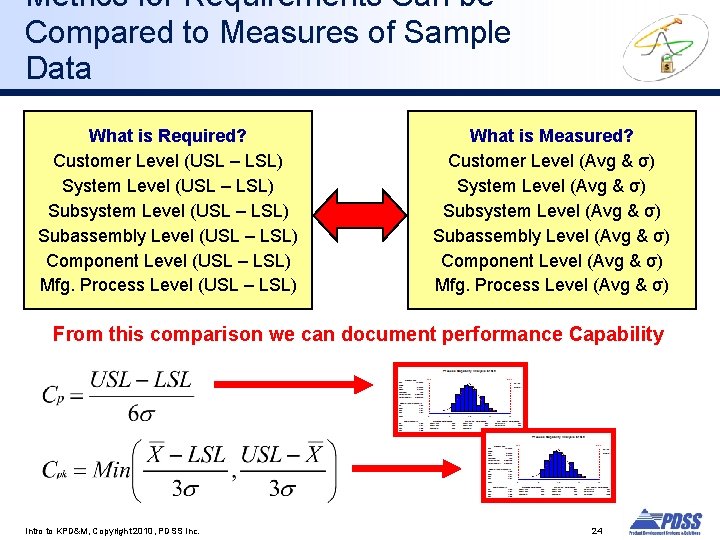
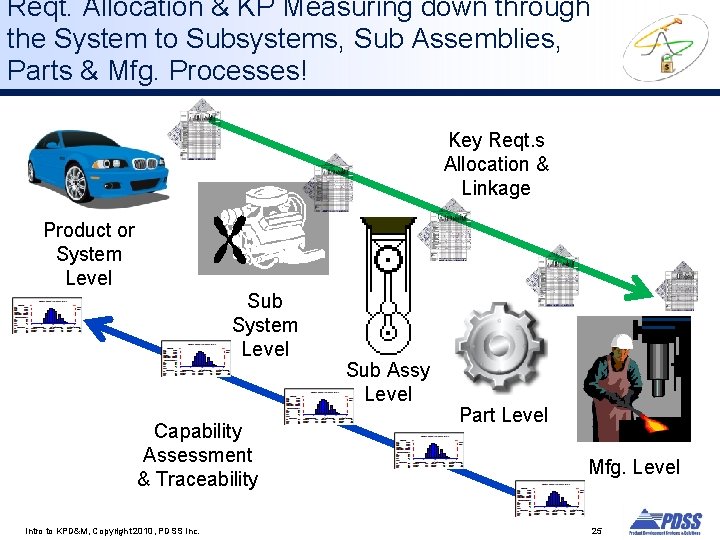
Metrics for Requirements Can be Compared to Measures of Sample Data What is Required? Customer Level (USL – LSL) System Level (USL – LSL) Subsystem Level (USL – LSL) Subassembly Level (USL – LSL) Component Level (USL – LSL) Mfg. Process Level (USL – LSL) What is Measured? Customer Level (Avg & σ) System Level (Avg & σ) Subsystem Level (Avg & σ) Subassembly Level (Avg & σ) Component Level (Avg & σ) Mfg. Process Level (Avg & σ) From this comparison we can document performance Capability Intro to KPD&M, Copyright 2010, PDSS Inc. 24
Reqt. Allocation & KP Measuring down through the System to Subsystems, Sub Assemblies, Parts & Mfg. Processes! Key Reqt. s Allocation & Linkage Product or System Level Sub System Level Capability Assessment & Traceability Intro to KPD&M, Copyright 2010, PDSS Inc. Sub Assy Level Part Level Mfg. Level 25
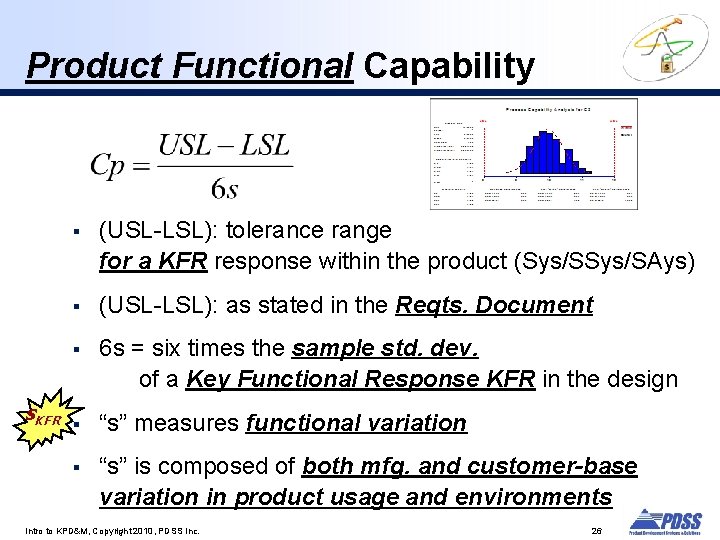
Product Functional Capability s. KFR § (USL-LSL): tolerance range for a KFR response within the product (Sys/SAys) § (USL-LSL): as stated in the Reqts. Document § 6 s = six times the sample std. dev. of a Key Functional Response KFR in the design § “s” measures functional variation § “s” is composed of both mfg. and customer-base variation in product usage and environments Intro to KPD&M, Copyright 2010, PDSS Inc. 26
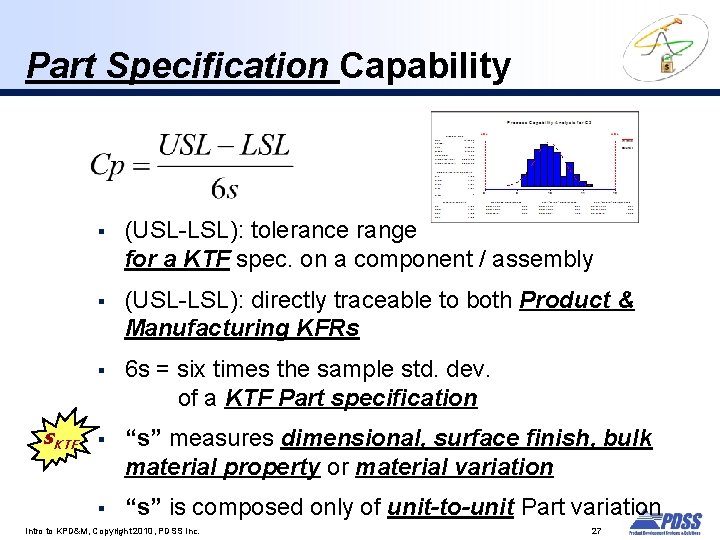
Part Specification Capability § (USL-LSL): tolerance range for a KTF spec. on a component / assembly § (USL-LSL): directly traceable to both Product & Manufacturing KFRs § 6 s = six times the sample std. dev. of a KTF Part specification s. KTF § “s” measures dimensional, surface finish, bulk material property or material variation § “s” is composed only of unit-to-unit Part variation Intro to KPD&M, Copyright 2010, PDSS Inc. 27
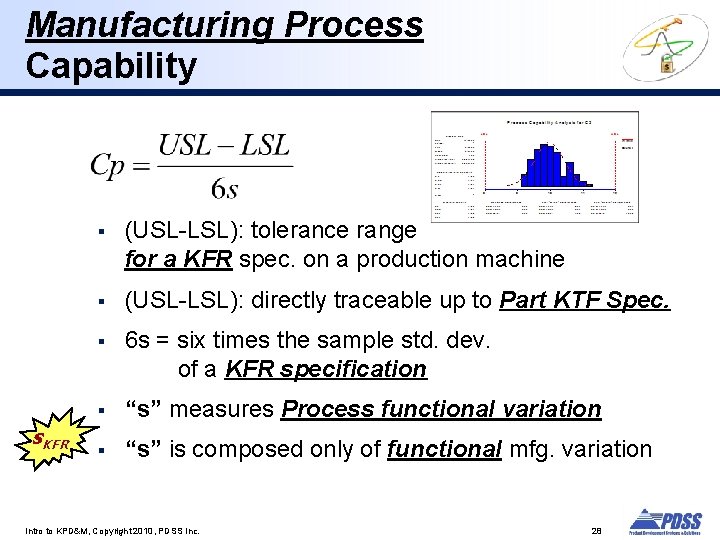
Manufacturing Process Capability s. KFR § (USL-LSL): tolerance range for a KFR spec. on a production machine § (USL-LSL): directly traceable up to Part KTF Spec. § 6 s = six times the sample std. dev. of a KFR specification § “s” measures Process functional variation § “s” is composed only of functional mfg. variation Intro to KPD&M, Copyright 2010, PDSS Inc. 28
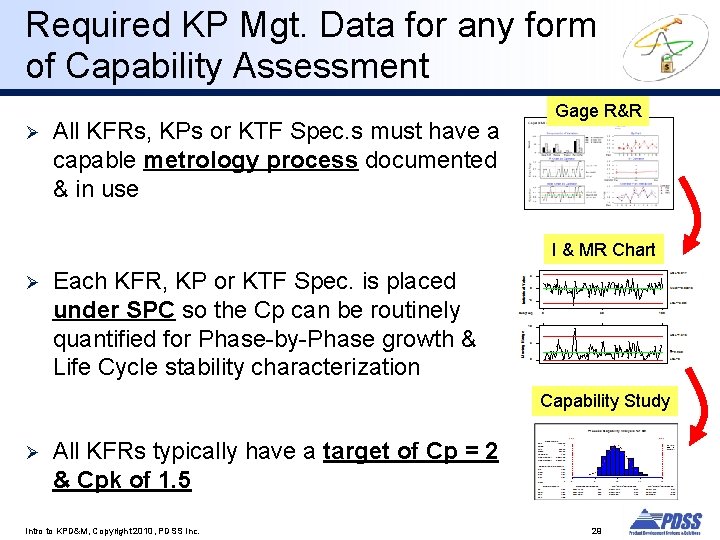
Required KP Mgt. Data for any form of Capability Assessment Ø All KFRs, KPs or KTF Spec. s must have a capable metrology process documented & in use Gage R&R I & MR Chart Ø Each KFR, KP or KTF Spec. is placed under SPC so the Cp can be routinely quantified for Phase-by-Phase growth & Life Cycle stability characterization Capability Study Ø All KFRs typically have a target of Cp = 2 & Cpk of 1. 5 Intro to KPD&M, Copyright 2010, PDSS Inc. 29
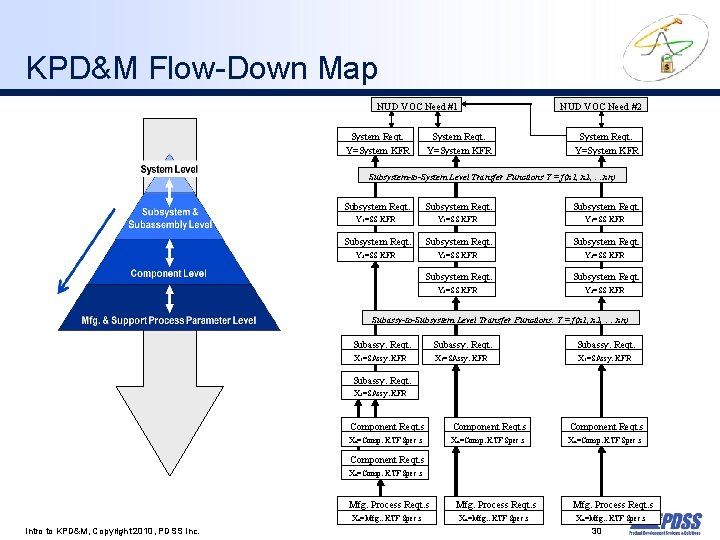
KPD&M Flow-Down Map NUD VOC Need #1 System Reqt. Y=System KFR NUD VOC Need #2 System Reqt. Y=System KFR Subsystem-to-System Level Transfer Functions Y = f(x 1, x 2, …xn) Subsystem Reqt. Y 1=SS KFR Subsystem Reqt. Y 2=SS KFR Subsystem Reqt. Y 3=SS KFR Subassy-to-Subsystem Level Transfer Functions: Y = f(x 1, x 2, … xn) Subassy. Reqt. X 1=SAssy. KFR Subassy. Reqt. X 2=SAssy. KFR Component Reqt. s Xn=Comp. KTF Spec. s Component Reqt. s Xn=Comp. KTF Spec. s Intro to KPD&M, Copyright 2010, PDSS Inc. Mfg. Process Reqt. s Xn=Mfg. . KTF Spec. s 30
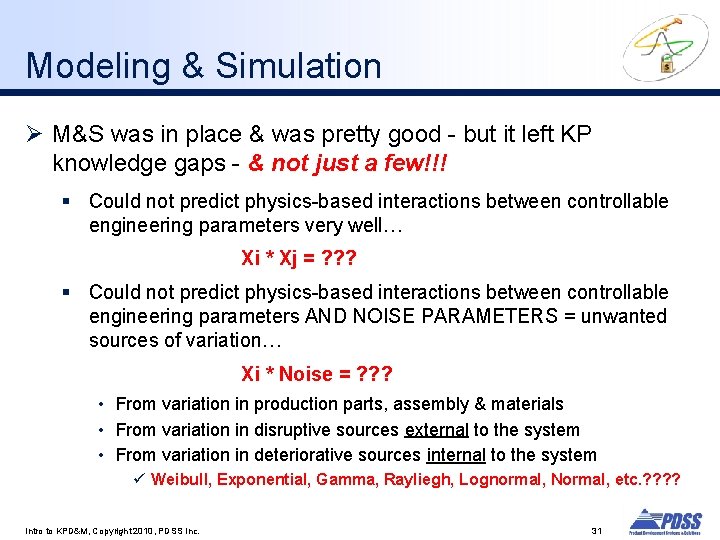
Modeling & Simulation Ø M&S was in place & was pretty good - but it left KP knowledge gaps - & not just a few!!! § Could not predict physics-based interactions between controllable engineering parameters very well… Xi * Xj = ? ? ? § Could not predict physics-based interactions between controllable engineering parameters AND NOISE PARAMETERS = unwanted sources of variation… Xi * Noise = ? ? ? • From variation in production parts, assembly & materials • From variation in disruptive sources external to the system • From variation in deteriorative sources internal to the system ü Weibull, Exponential, Gamma, Rayliegh, Lognormal, Normal, etc. ? ? Intro to KPD&M, Copyright 2010, PDSS Inc. 31
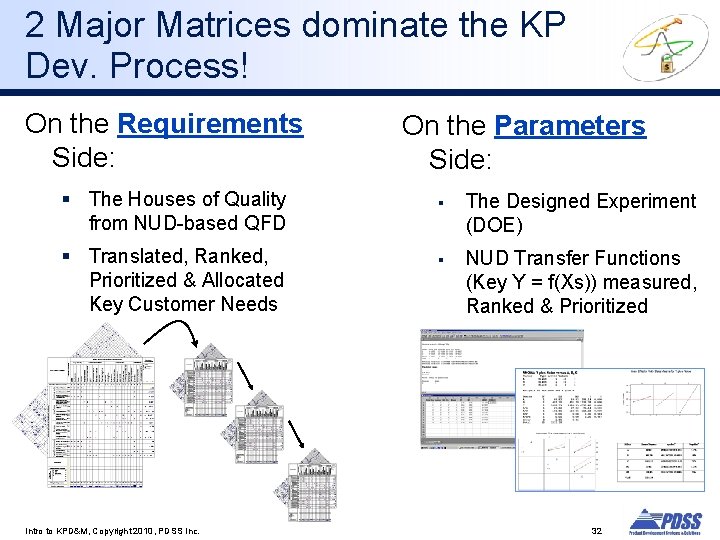
2 Major Matrices dominate the KP Dev. Process! On the Requirements Side: On the Parameters Side: § The Houses of Quality from NUD-based QFD § The Designed Experiment (DOE) § Translated, Ranked, Prioritized & Allocated Key Customer Needs § NUD Transfer Functions (Key Y = f(Xs)) measured, Ranked & Prioritized Intro to KPD&M, Copyright 2010, PDSS Inc. 32
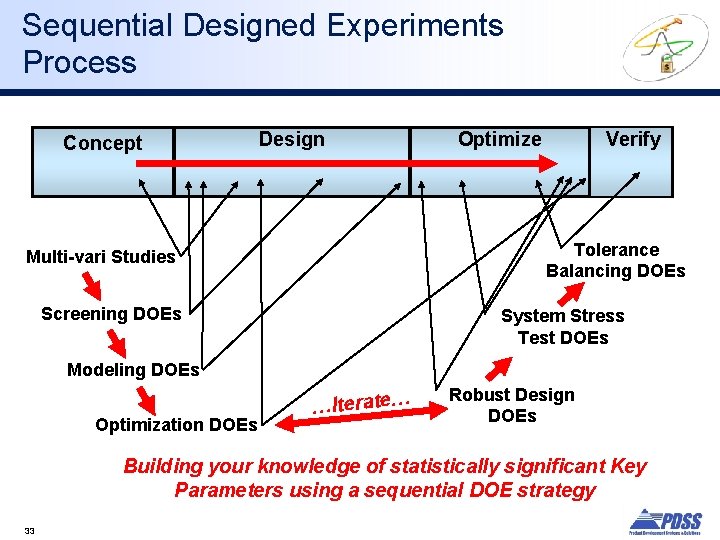
Sequential Designed Experiments Process Concept Design Optimize Verify Tolerance Balancing DOEs Multi-vari Studies Screening DOEs System Stress Test DOEs Modeling DOEs Optimization DOEs …Iterate… Robust Design DOEs Building your knowledge of statistically significant Key Parameters using a sequential DOE strategy 33
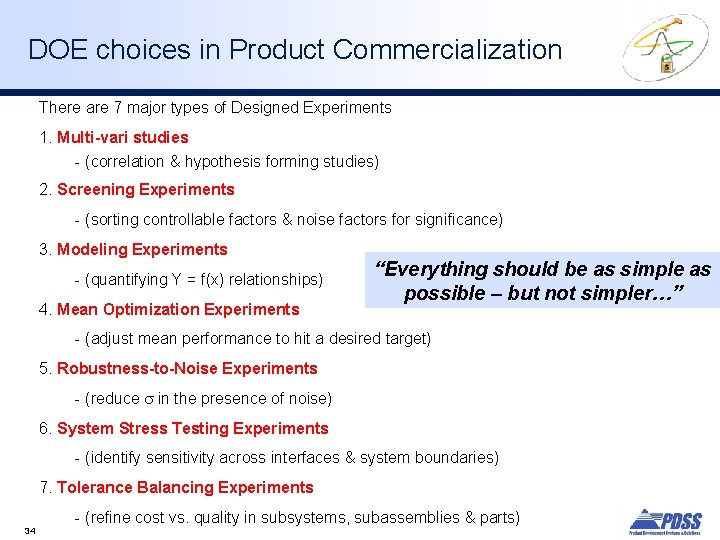
DOE choices in Product Commercialization There are 7 major types of Designed Experiments 1. Multi-vari studies - (correlation & hypothesis forming studies) 2. Screening Experiments - (sorting controllable factors & noise factors for significance) 3. Modeling Experiments - (quantifying Y = f(x) relationships) 4. Mean Optimization Experiments “Everything should be as simple as possible – but not simpler…” - (adjust mean performance to hit a desired target) 5. Robustness-to-Noise Experiments - (reduce s in the presence of noise) 6. System Stress Testing Experiments - (identify sensitivity across interfaces & system boundaries) 7. Tolerance Balancing Experiments 34 - (refine cost vs. quality in subsystems, subassemblies & parts)
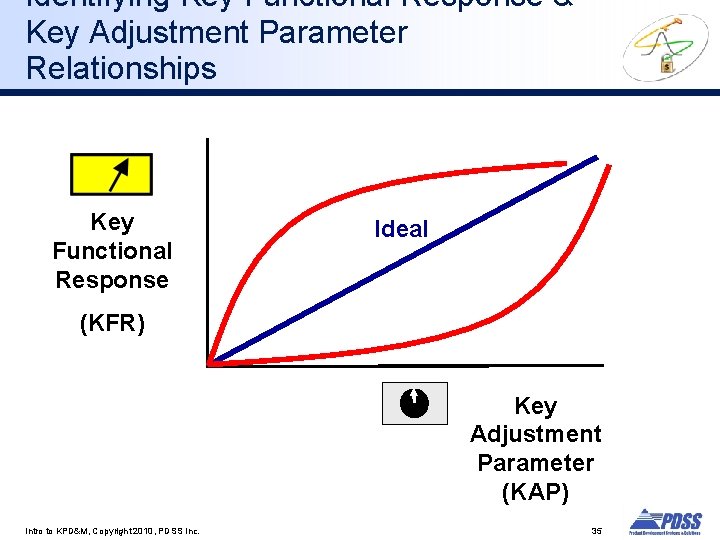
Identifying Key Functional Response & Key Adjustment Parameter Relationships Key Functional Response Ideal (KFR) Key Adjustment Parameter (KAP) Intro to KPD&M, Copyright 2010, PDSS Inc. 35
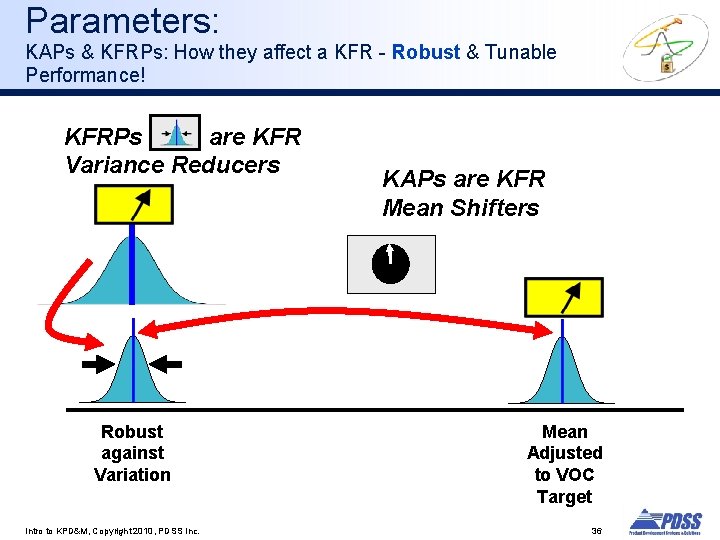
Parameters: KAPs & KFRPs: How they affect a KFR - Robust & Tunable Performance! KFRPs are KFR Variance Reducers Robust against Variation Intro to KPD&M, Copyright 2010, PDSS Inc. KAPs are KFR Mean Shifters Mean Adjusted to VOC Target 36
Reliability Development Process Concept Design Optimize Verify Reliability Requirements Definition -System Reliability Modeling – Probabilistic Simulations -Subsystem / Subassembly - Component Reliability Development Tasks - FMEAs, CAE/CARD, DOE, Robust Design, Tolerance Design Reliability Assessment Tasks -Life Tests, Accelerated Life Tests -HALT, 37 HASS, HAST, Destructive Tests
Design for “X” Process Design Concept Optimize Df. X Requirements -System (Product & Production Processes) -Subsystem / Subassembly - Component / Materials Design for X Tasks - Benchmarking, DFMA, Design for Cost, VA/VE… Df. X Assessment Tasks -HSER 38 DOEs & Related Tests Verify
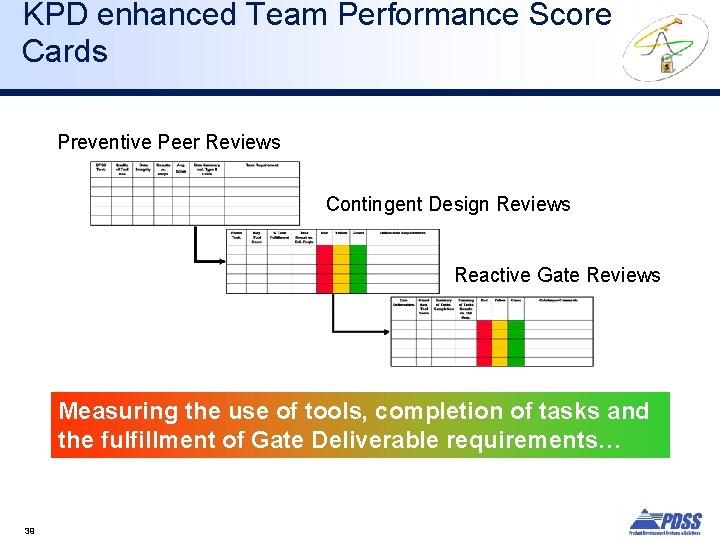
KPD enhanced Team Performance Score Cards Preventive Peer Reviews Contingent Design Reviews Reactive Gate Reviews Measuring the use of tools, completion of tasks and the fulfillment of Gate Deliverable requirements… 39
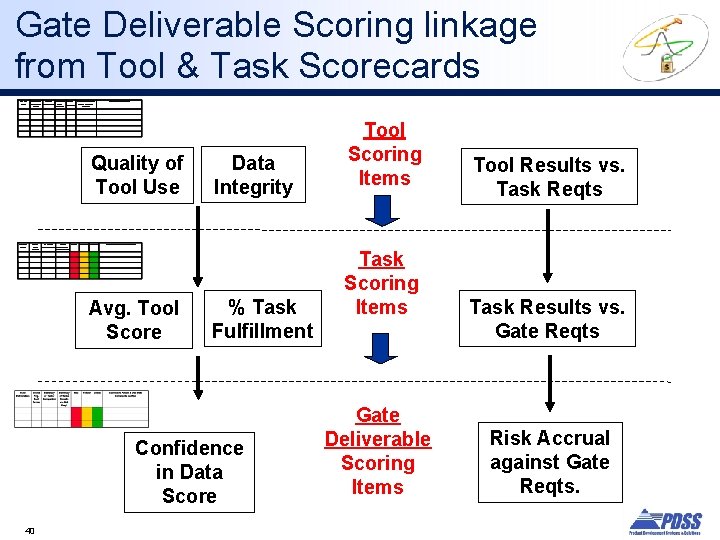
Gate Deliverable Scoring linkage from Tool & Task Scorecards Quality of Tool Use Avg. Tool Score Data Integrity % Task Fulfillment Confidence in Data Score 40 Tool Scoring Items Task Scoring Items Gate Deliverable Scoring Items Tool Results vs. Task Reqts Task Results vs. Gate Reqts Risk Accrual against Gate Reqts.
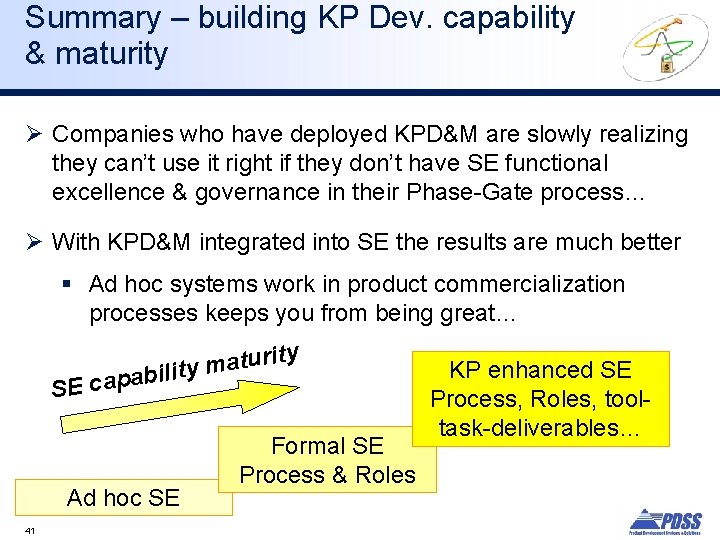
Summary – building KP Dev. capability & maturity Ø Companies who have deployed KPD&M are slowly realizing they can’t use it right if they don’t have SE functional excellence & governance in their Phase-Gate process… Ø With KPD&M integrated into SE the results are much better § Ad hoc systems work in product commercialization processes keeps you from being great… rity u t a m ity l i b a p a SE c Ad hoc SE 41 Formal SE Process & Roles KP enhanced SE Process, Roles, tooltask-deliverables…
The ARDEC Story: Defining a process for Pro-active KPD&M Ø What approaches are available for conducting KP Development & Management? Ø Are the steps during Development different from those conducted when defining KPs after Launch? § Technology & Product Development? § Post-launch Production & Ongoing Life cycle Management out to Discontinuance? Intro to KPD&M, Copyright 2010, PDSS Inc. 42
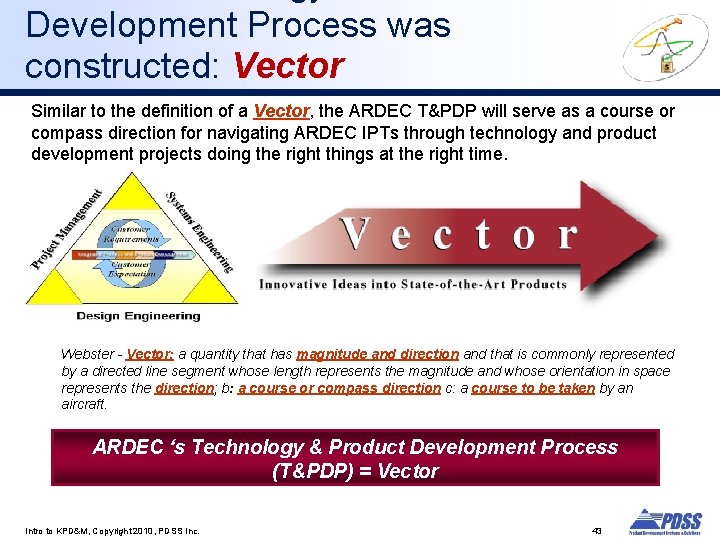
Development Process was constructed: Vector Similar to the definition of a Vector, the ARDEC T&PDP will serve as a course or compass direction for navigating ARDEC IPTs through technology and product development projects doing the right things at the right time. Webster - Vector: a quantity that has magnitude and direction and that is commonly represented by a directed line segment whose length represents the magnitude and whose orientation in space represents the direction; b: a course or compass direction c: a course to be taken by an aircraft. ARDEC ‘s Technology & Product Development Process (T&PDP) = Vector Intro to KPD&M, Copyright 2010, PDSS Inc. 43
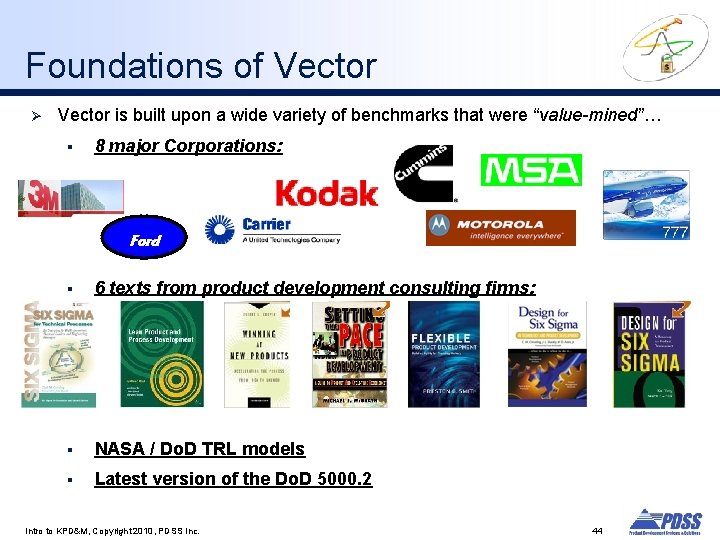
Foundations of Vector Ø Vector is built upon a wide variety of benchmarks that were “value-mined”… § 8 major Corporations: Ford § 6 texts from product development consulting firms: § NASA / Do. D TRL models § Latest version of the Do. D 5000. 2 Intro to KPD&M, Copyright 2010, PDSS Inc. 44
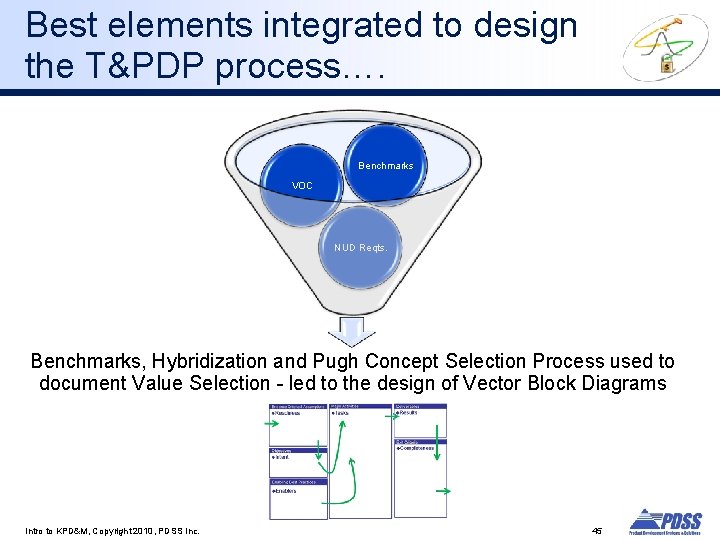
Best elements integrated to design the T&PDP process…. Benchmarks VOC NUD Reqts. Benchmarks, Hybridization and Pugh Concept Selection Process used to document Value Selection - led to the design of Vector Block Diagrams Intro to KPD&M, Copyright 2010, PDSS Inc. 45
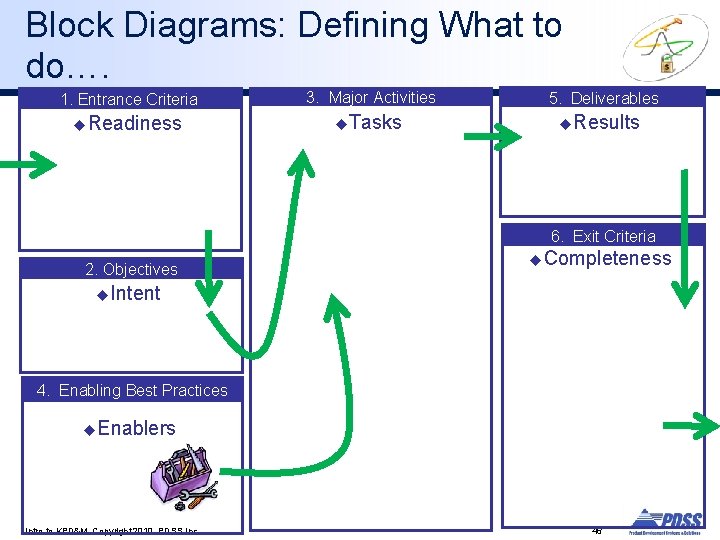
Block Diagrams: Defining What to do…. 1. Entrance Criteria 3. Major Activities 5. Deliverables u. Readiness u. Tasks u. Results 6. Exit Criteria 2. Objectives u. Completeness u. Intent 4. Enabling Best Practices u. Enablers Intro to KPD&M, Copyright 2010, PDSS Inc. 46
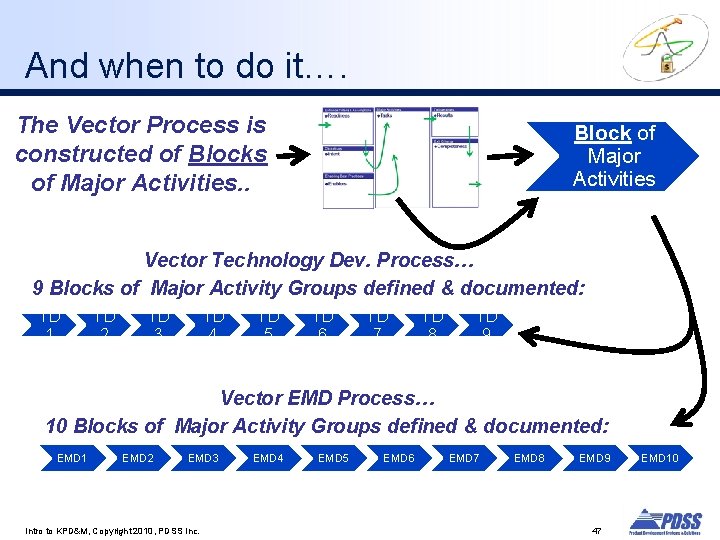
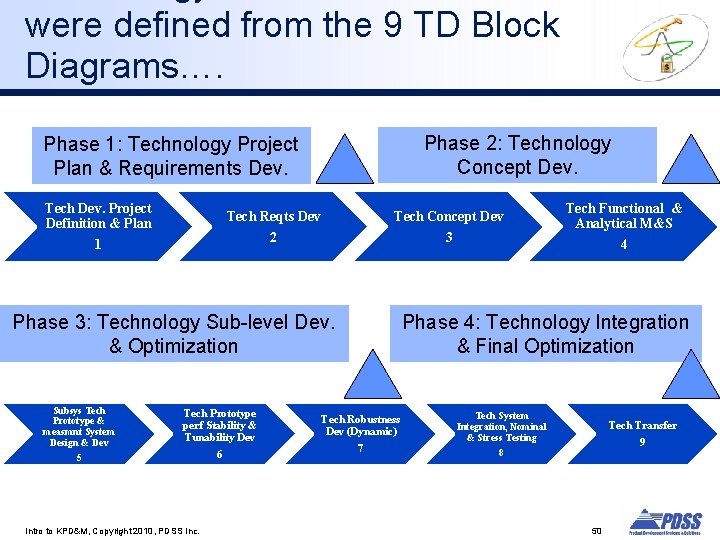
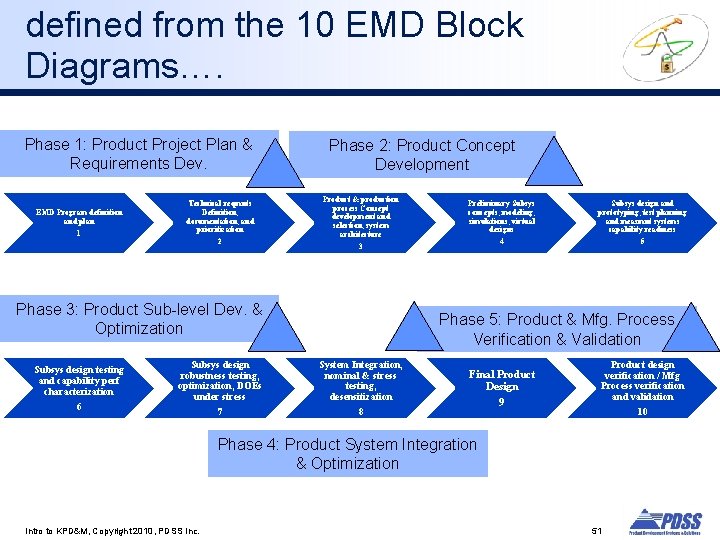
And when to do it…. The Vector Process is constructed of Blocks of Major Activities. . Block of Major Activities Vector Technology Dev. Process… 9 Blocks of Major Activity Groups defined & documented: TD 1 TD 2 TD 3 TD 4 TD 5 TD 6 TD 7 TD 8 TD 9 Vector EMD Process… 10 Blocks of Major Activity Groups defined & documented: EMD 1 EMD 2 EMD 3 Intro to KPD&M, Copyright 2010, PDSS Inc. EMD 4 EMD 5 EMD 6 EMD 7 EMD 8 EMD 9 47 EMD 10
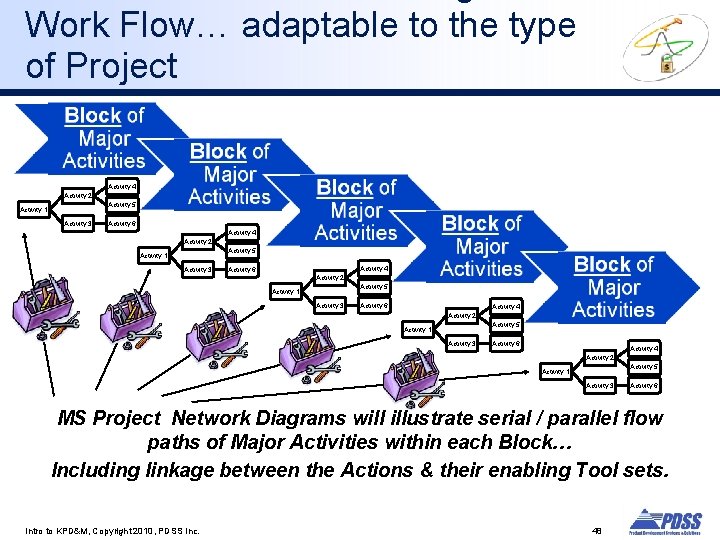
Work Flow… adaptable to the type of Project Activity 4 Activity 2 Activity 5 Activity 1 Activity 3 Activity 6 Activity 4 Activity 2 Activity 5 Activity 1 Activity 3 Activity 4 Activity 6 Activity 2 Activity 5 Activity 1 Activity 3 Activity 6 Activity 4 Activity 2 Activity 5 Activity 1 Activity 3 Activity 6 MS Project Network Diagrams will illustrate serial / parallel flow paths of Major Activities within each Block… Including linkage between the Actions & their enabling Tool sets. Intro to KPD&M, Copyright 2010, PDSS Inc. 48
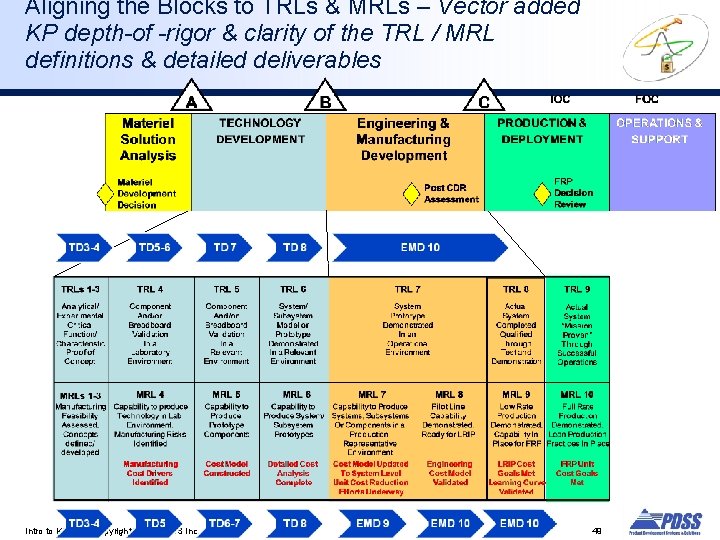
Aligning the Blocks to TRLs & MRLs – Vector added KP depth-of -rigor & clarity of the TRL / MRL definitions & detailed deliverables Intro to KPD&M, Copyright 2010, PDSS Inc. 49
were defined from the 9 TD Block Diagrams…. Phase 2: Technology Concept Dev. Phase 1: Technology Project Plan & Requirements Dev. Tech Dev. Project Definition & Plan 1 Tech Reqts Dev 2 Tech Concept Dev 3 Phase 3: Technology Sub-level Dev. & Optimization Subsys Tech Prototype & measmnt System Design & Dev 5 Tech Prototype perf Stability & Tunability Dev 6 Intro to KPD&M, Copyright 2010, PDSS Inc. Tech Robustness Dev (Dynamic) 7 Tech Functional & Analytical M&S 4 Phase 4: Technology Integration & Final Optimization Tech System Integration, Nominal & Stress Testing 8 Tech Transfer 9 50
defined from the 10 EMD Block Diagrams…. Phase 1: Product Project Plan & Requirements Dev. EMD Program definition and plan 1 Technical reqmnts Definition, documentation, and prioritization 2 Phase 2: Product Concept Development Product & production process Concept development and selection, system architecture 3 Phase 3: Product Sub-level Dev. & Optimization Subsys design testing and capability perf characterization 6 Subsys design robustness testing, optimization, DOEs under stress 7 Preliminary Subsys concepts, modeling, simulations, virtual designs 4 Subsys design and prototyping, test planning and measmnt systems capability readiness 5 Phase 5: Product & Mfg. Process Verification & Validation System Integration, nominal & stress testing, desensitization 8 Final Product Design 9 Product design verification / Mfg Process verification and validation 10 Phase 4: Product System Integration & Optimization Intro to KPD&M, Copyright 2010, PDSS Inc. 51
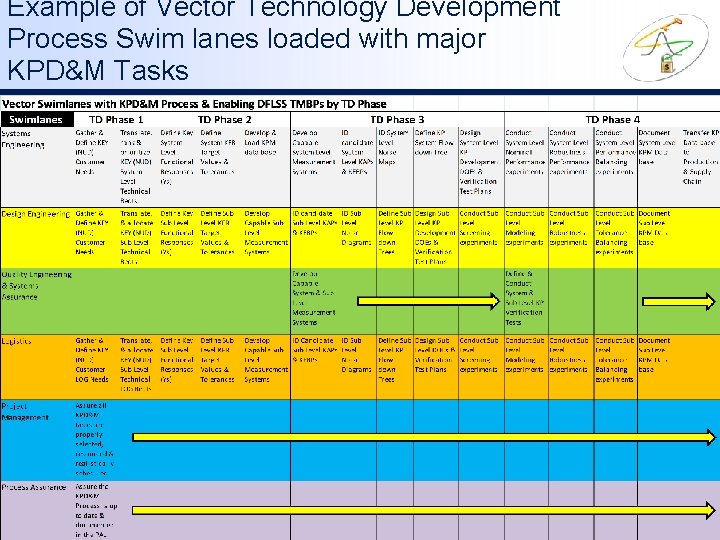
Example of Vector Technology Development Process Swim lanes loaded with major KPD&M Tasks Intro to KPD&M, Copyright 2010, PDSS Inc. 52
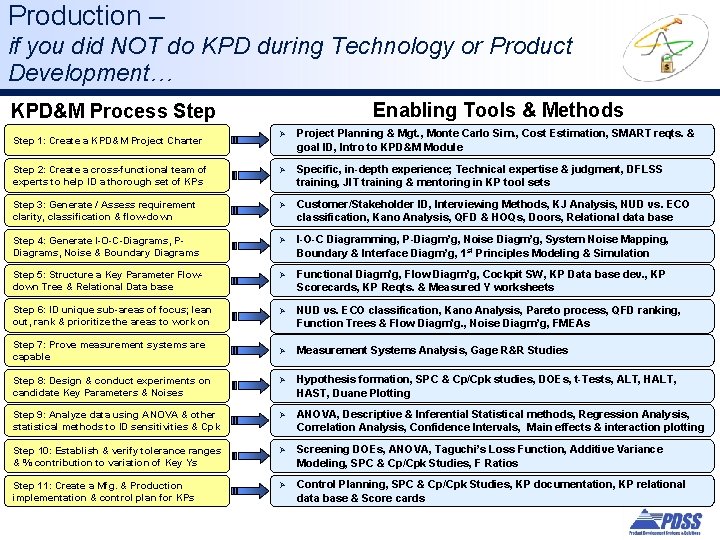
Production – if you did NOT do KPD during Technology or Product Development… Enabling Tools & Methods KPD&M Process Step Ø Project Planning & Mgt. , Monte Carlo Sim. , Cost Estimation, SMART reqts. & goal ID, Intro to KPD&M Module Step 2: Create a cross-functional team of experts to help ID a thorough set of KPs Ø Specific, in-depth experience; Technical expertise & judgment, DFLSS training, JIT training & mentoring in KP tool sets Step 3: Generate / Assess requirement clarity, classification & flow-down Ø Customer/Stakeholder ID, Interviewing Methods, KJ Analysis, NUD vs. ECO classification, Kano Analysis, QFD & HOQs, Doors, Relational data base Step 4: Generate I-O-C-Diagrams, PDiagrams, Noise & Boundary Diagrams Ø I-O-C Diagramming, P-Diagm’g, Noise Diagm’g, System Noise Mapping, Boundary & Interface Diagm’g, 1 st Principles Modeling & Simulation Step 5: Structure a Key Parameter Flowdown Tree & Relational Data base Ø Functional Diagm’g, Flow Diagm’g, Cockpit SW, KP Data base dev. , KP Scorecards, KP Reqts. & Measured Y worksheets Step 6: ID unique sub-areas of focus; lean out, rank & prioritize the areas to work on Ø NUD vs. ECO classification, Kano Analysis, Pareto process, QFD ranking, Function Trees & Flow Diagm’g. , Noise Diagm’g, FMEAs Ø Measurement Systems Analysis, Gage R&R Studies Step 8: Design & conduct experiments on candidate Key Parameters & Noises Ø Hypothesis formation, SPC & Cp/Cpk studies, DOEs, t-Tests, ALT, HAST, Duane Plotting Step 9: Analyze data using ANOVA & other statistical methods to ID sensitivities & Cpk Ø ANOVA, Descriptive & Inferential Statistical methods, Regression Analysis, Correlation Analysis, Confidence Intervals, Main effects & interaction plotting Step 10: Establish & verify tolerance ranges & % contribution to variation of Key Ys Ø Screening DOEs, ANOVA, Taguchi’s Loss Function, Additive Variance Modeling, SPC & Cp/Cpk Studies, F Ratios Step 11: Create a Mfg. & Production implementation & control plan for KPs Ø Control Planning, SPC & Cp/Cpk Studies, KP documentation, KP relational data base & Score cards Step 1: Create a KPD&M Project Charter Step 7: Prove measurement systems are capable
Summary of KPD&M Concepts REQUIREMENT FLOWDOWN & ALLOCATION CAPABILITY FLOW-UP of Cp & Cpk SYSTEM KFR PERFORMANCE SYSTEM REQUIREMENTS SUBSYSTEM KFR PERFORMANCE SUBSYSTEM REQUIREMENTS SUBASSY. KFR PERFORMANCE SUBASSEMBLY REQUIREMENTS COMPONENT REQUIREMENTS MFG. PROCESS REQUIREMENTS TRANSFER FUNCTION LINKAGE IS USED TO TRACK KEY RELATIONSIPS & TRANSMISSION OF VARIATION…. COMPONENT KTF PERFORMANCE MFG. PROCESS KFR PERFORMANCE Why do we take the time to do it properly? Problem Prevention. Intro to KPD&M, Copyright 2010, PDSS Inc. 54