
IMPACT WP 2 1 Breach Formation Large Scale
IMPACT WP 2. 1 Breach Formation Large Scale Embankment Failure Kjetil Arne Vaskinn Statkraft Grøner AS Kav 2002 -05 -16 HMK-02

IMPACT Norwegian national project: Stability and Breaching of Rockfill dams Kav 2002 -05 -16 HMK-02
WP 2. 1 Breach Formation Large Scale Embankment Failure The objective of this work package is to undertake controlled failure of large scale embankments in order to monitor and record the failure process and mechanisms in detail. This will provide valuable data to assist in understanding the fundamental failure process, for developing predictive models and for assessing the validity of smaller scale laboratory testing. Kav 2002 -05 -16
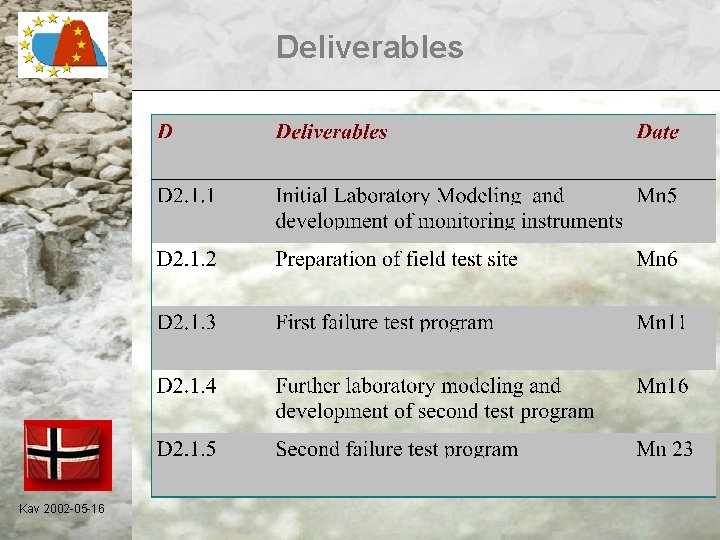
Deliverables Kav 2002 -05 -16
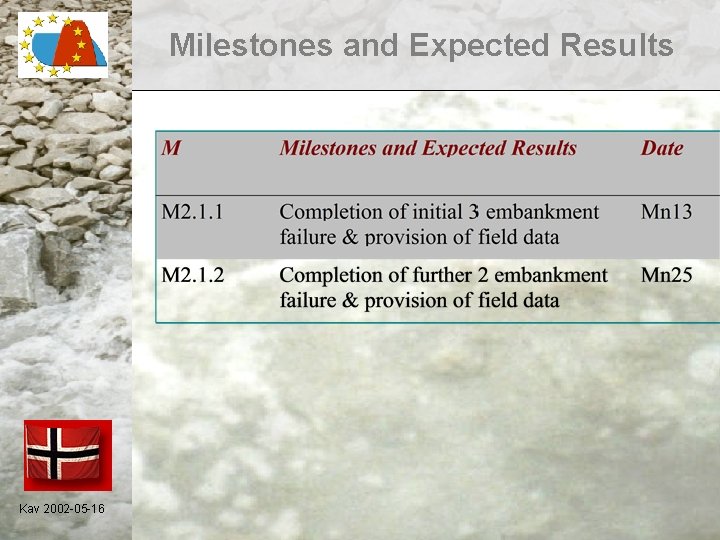
Milestones and Expected Results Kav 2002 -05 -16
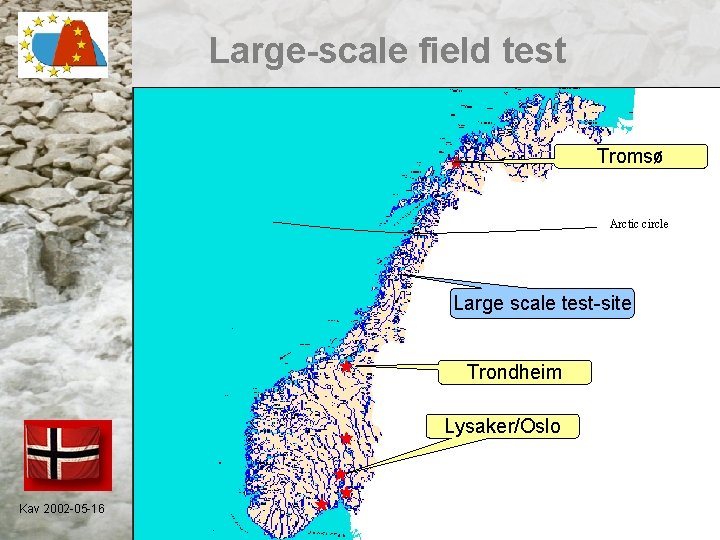
Large-scale field test Tromsø Arctic circle Large scale test-site Trondheim Lysaker/Oslo Kav 2002 -05 -16
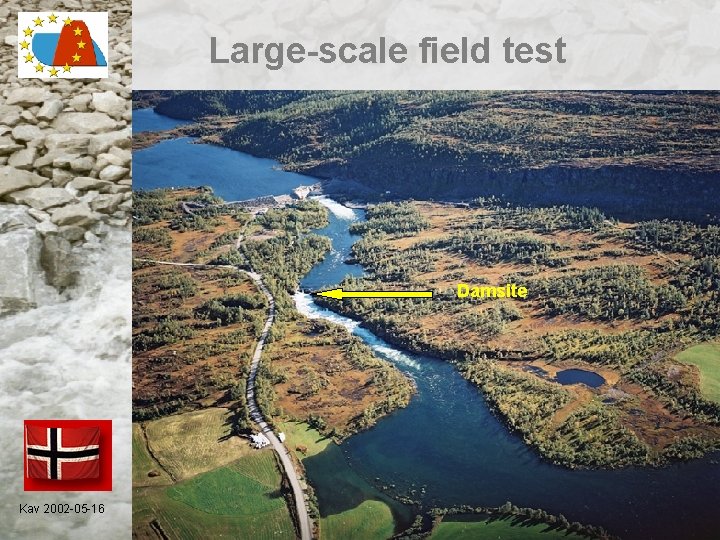
Large-scale field test Damsite Kav 2002 -05 -16
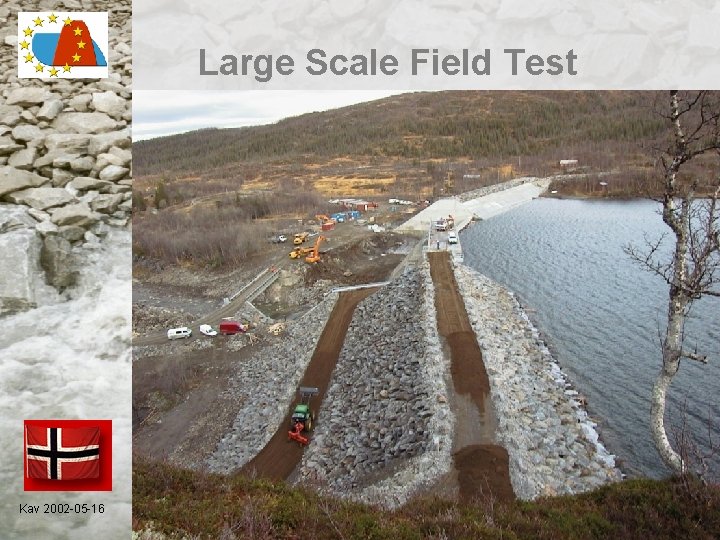
Large Scale Field Test Kav 2002 -05 -16
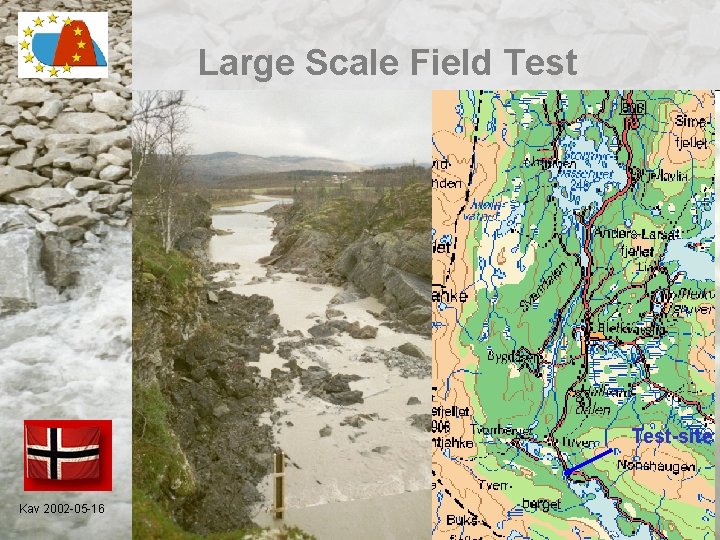
Large Scale Field Test-site Kav 2002 -05 -16
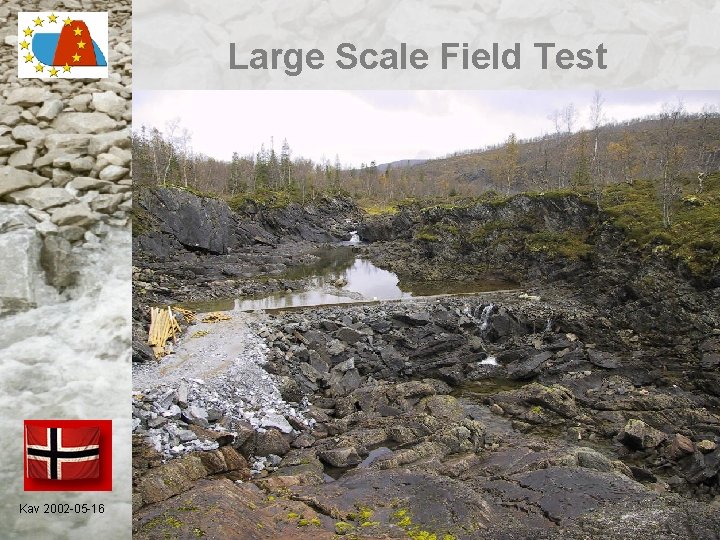
Large Scale Field Test Kav 2002 -05 -16
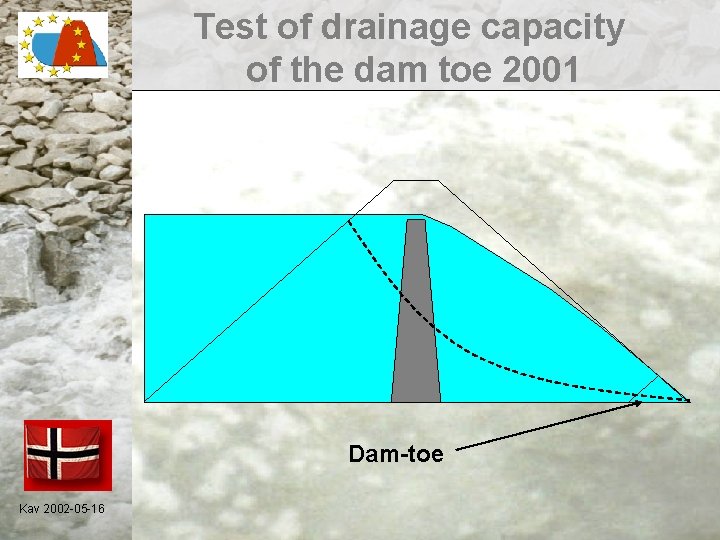
Test of drainage capacity of the dam toe 2001 Dam-toe Kav 2002 -05 -16
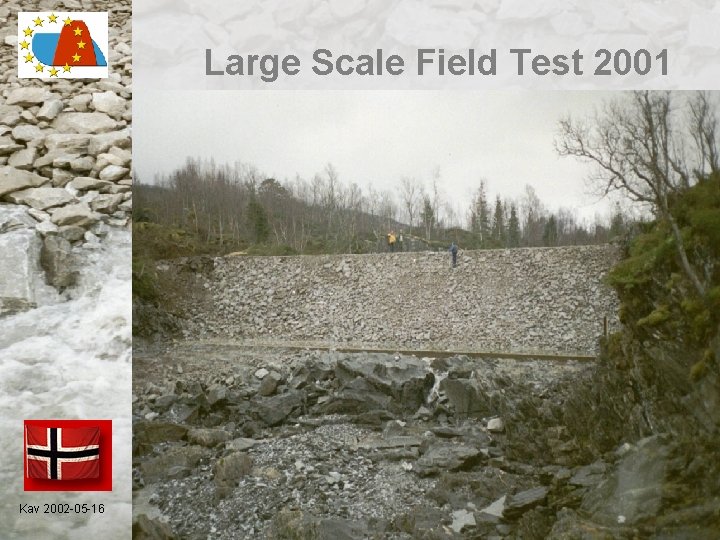
Large Scale Field Test 2001 Kav 2002 -05 -16
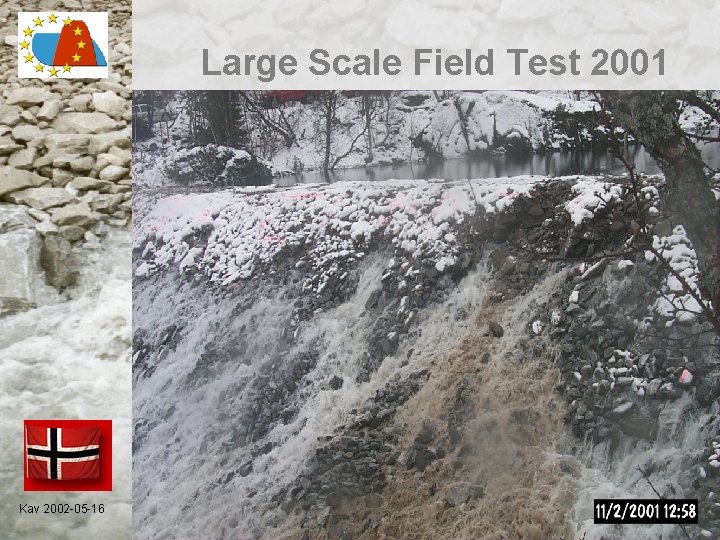
Large Scale Field Test 2001 Kav 2002 -05 -16
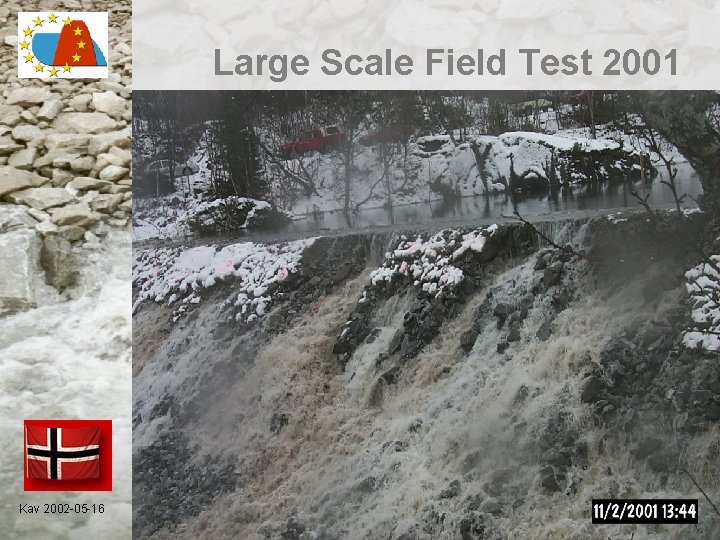
Large Scale Field Test 2001 Kav 2002 -05 -16
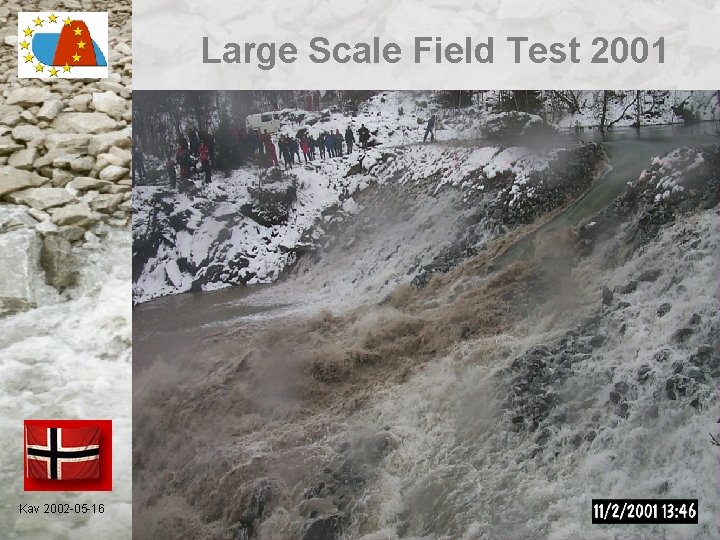
Large Scale Field Test 2001 Kav 2002 -05 -16
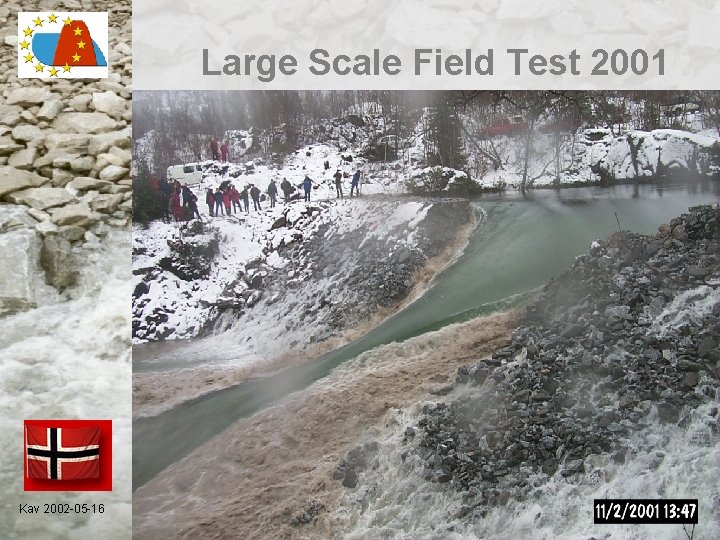
Large Scale Field Test 2001 Kav 2002 -05 -16
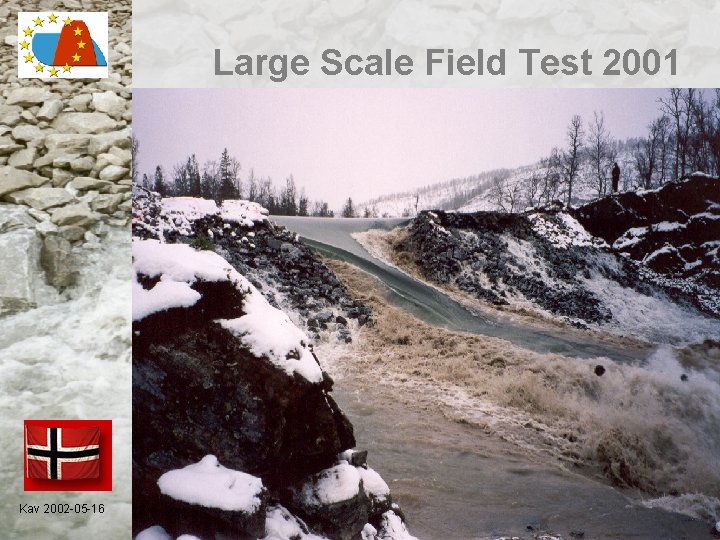
Large Scale Field Test 2001 Kav 2002 -05 -16
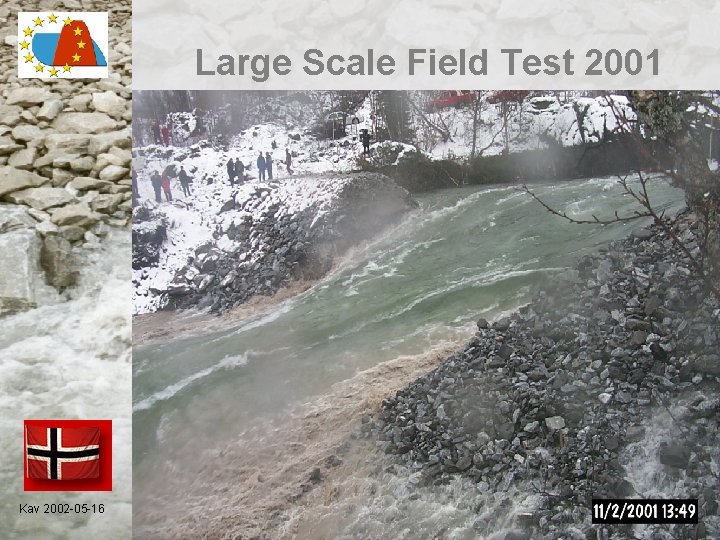
Large Scale Field Test 2001 Kav 2002 -05 -16
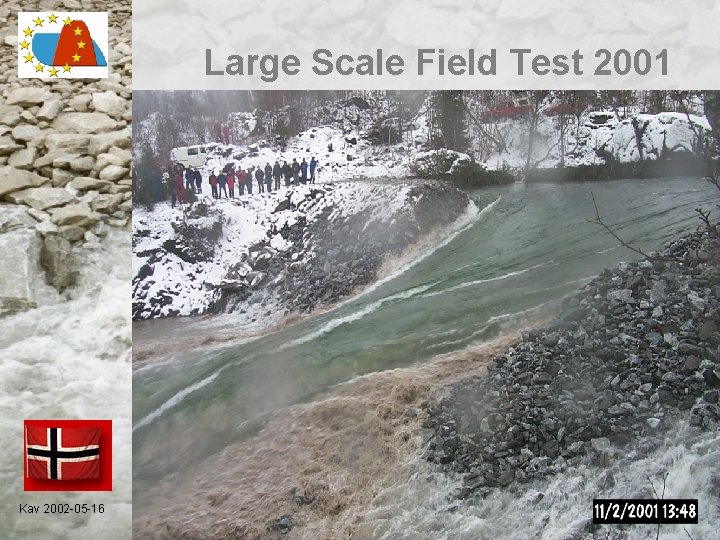
Large Scale Field Test 2001 Kav 2002 -05 -16
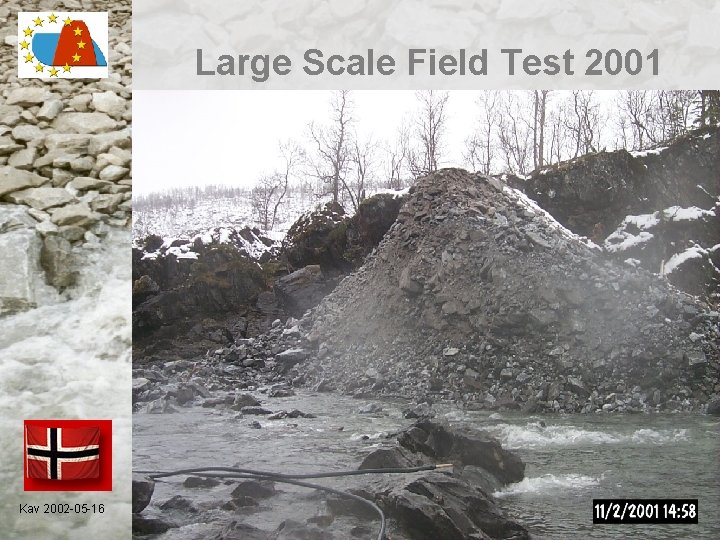
Large Scale Field Test 2001 Kav 2002 -05 -16
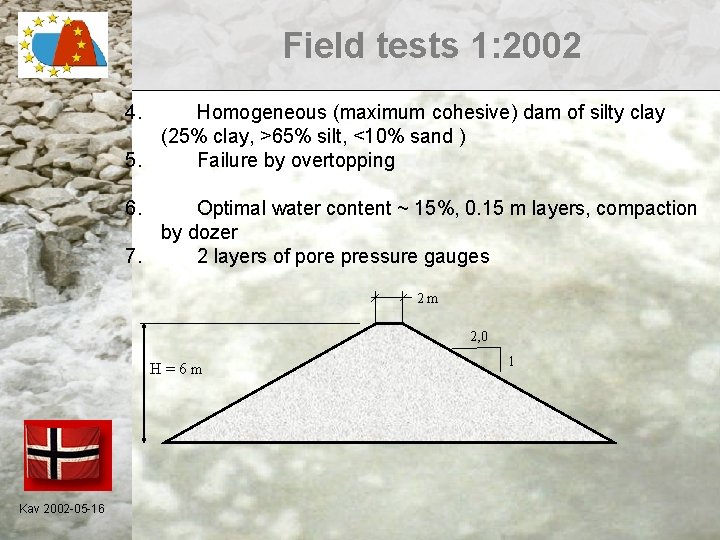
Field tests 1: 2002 4. Homogeneous (maximum cohesive) dam of silty clay (25% clay, >65% silt, <10% sand ) 5. Failure by overtopping 6. Optimal water content ~ 15%, 0. 15 m layers, compaction by dozer 7. 2 layers of pore pressure gauges 2 m 2, 0 H=6 m Kav 2002 -05 -16 1
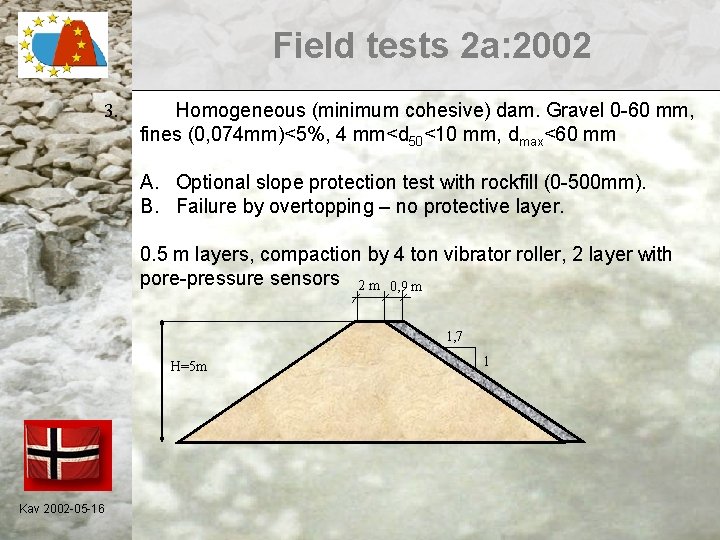
Field tests 2 a: 2002 3. Homogeneous (minimum cohesive) dam. Gravel 0 -60 mm, fines (0, 074 mm)<5%, 4 mm<d 50<10 mm, dmax<60 mm A. Optional slope protection test with rockfill (0 -500 mm). B. Failure by overtopping – no protective layer. 0. 5 m layers, compaction by 4 ton vibrator roller, 2 layer with pore-pressure sensors 2 m 0, 9 m 1, 7 H=5 m Kav 2002 -05 -16 1
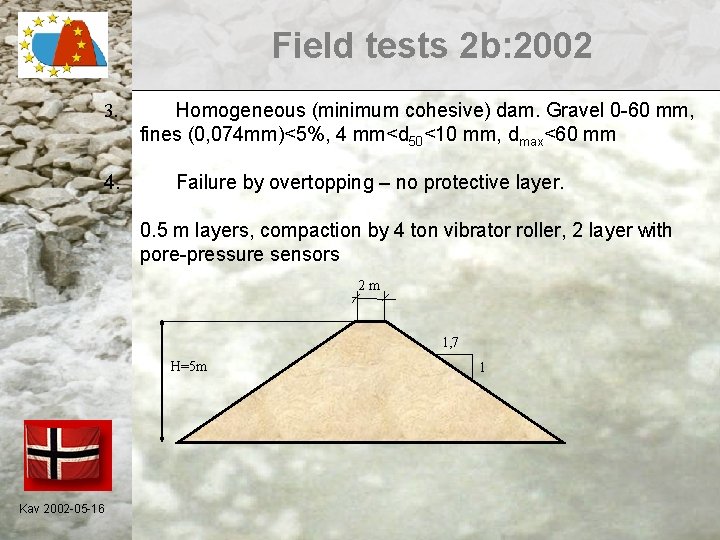
Field tests 2 b: 2002 3. 4. Homogeneous (minimum cohesive) dam. Gravel 0 -60 mm, fines (0, 074 mm)<5%, 4 mm<d 50<10 mm, dmax<60 mm Failure by overtopping – no protective layer. 0. 5 m layers, compaction by 4 ton vibrator roller, 2 layer with pore-pressure sensors 2 m 1, 7 H=5 m Kav 2002 -05 -16 1
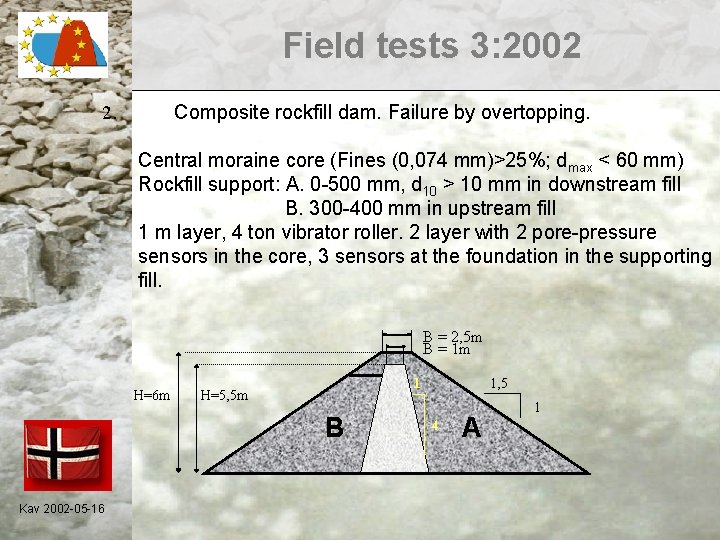
Field tests 3: 2002 2. Composite rockfill dam. Failure by overtopping. Central moraine core (Fines (0, 074 mm)>25%; dmax < 60 mm) Rockfill support: A. 0 -500 mm, d 10 > 10 mm in downstream fill B. 300 -400 mm in upstream fill 1 m layer, 4 ton vibrator roller. 2 layer with 2 pore-pressure sensors in the core, 3 sensors at the foundation in the supporting fill. B = 2, 5 m B = 1 m H=6 m 1 H=5, 5 m B Kav 2002 -05 -16 1, 5 4 A 1
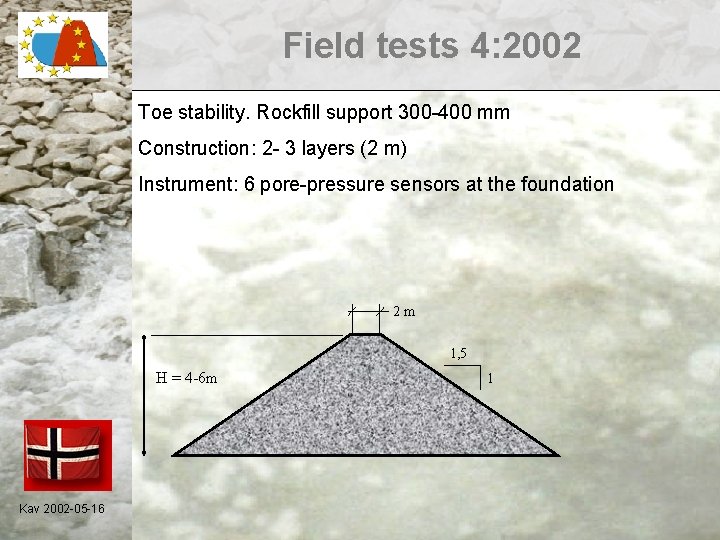
Field tests 4: 2002 Toe stability. Rockfill support 300 -400 mm Construction: 2 - 3 layers (2 m) Instrument: 6 pore-pressure sensors at the foundation 2 m 1, 5 H = 4 -6 m Kav 2002 -05 -16 1
THE PLAN FOR THE FIELD TEST OUTLINE 1. Preparing the site for the test dam • Building of transport road to the riverbed. • Prepare the foundation of the test-dams. • Preparing the side-slopes 2. Selection and transport of the materials for dam-building. 3. Building of test-dam #1 4. Test #1 Kav 2002 -05 -16 5. Cleaning up at dam-site and preparing for test #2. Step 2 -5 will be repeated for each test.
Data Requirements • Breach formation geometry • Water levels • Discharge into the reservoir upstream of the test-dam • Flow/velocity • Sediment movement • Material properties Kav 2002 -05 -16
Breach formation geometry 3 D surface of breach at any time Photo, Video, Photogrammerty Sonar upstream Some points within the body either through wires or 'balls'. Kav 2002 -05 -16
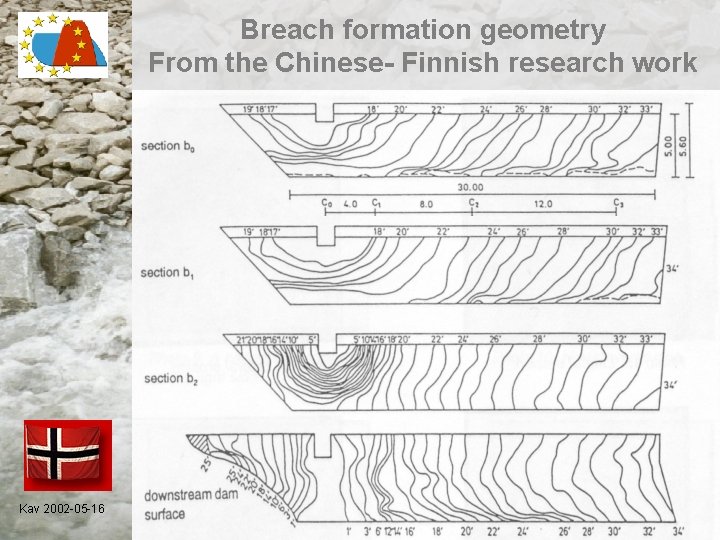
Breach formation geometry From the Chinese- Finnish research work Kav 2002 -05 -16
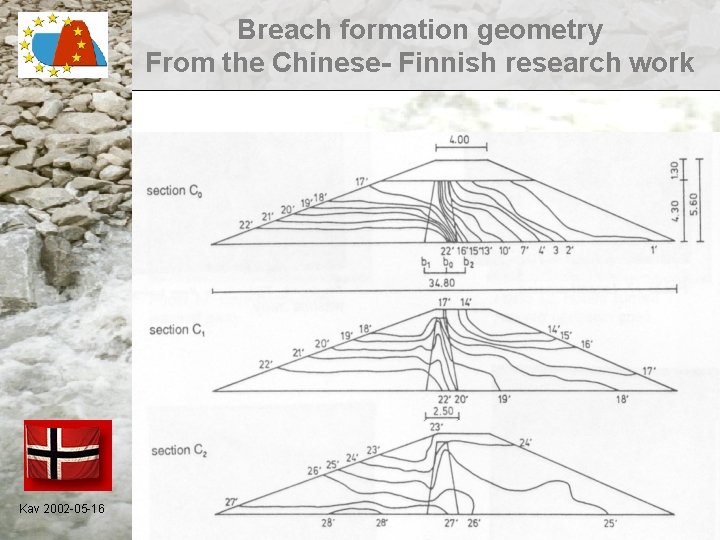
Breach formation geometry From the Chinese- Finnish research work Kav 2002 -05 -16
Breach formation geometry Photo/video Paint a grid across whole of embankment - including crest and upstream face to aid video and photography Video to be taken from: Downstream: 3 camera stations (2001 -2) Above: 1 camera (? ) Upstream: 1 camera Still camera shots Downstream 3 camera or from video footage Quality is high enough. (Morten Strand F&W) Aerial video/photo will require some form of structure to support camera Photogrammetry offers a possible method for identifying movement of embankment material. Requires at least two cameras, firing simultaneously, at a fixed spacing. Kav 2002 -05 -16
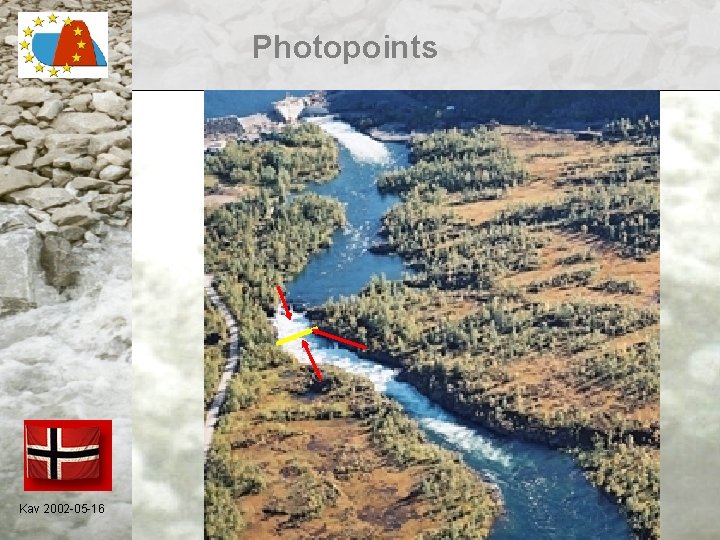
Photopoints Kav 2002 -05 -16
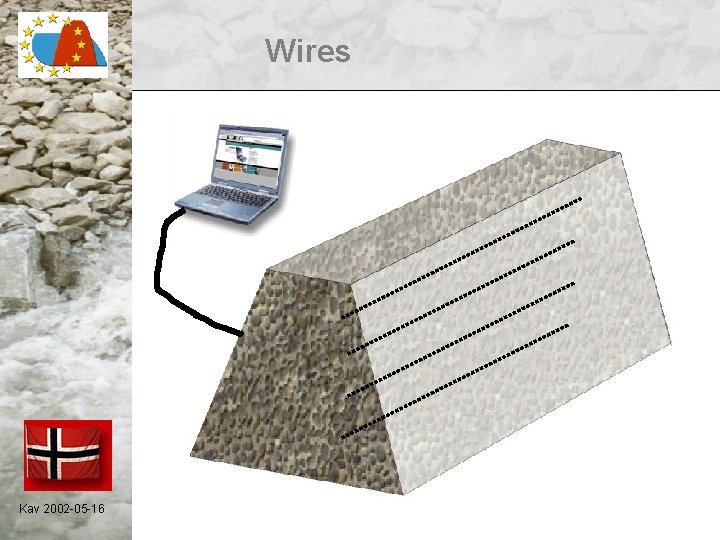
Wires Kav 2002 -05 -16
Movement sensors Use of movement sensors - floating balls etc. A possible solution is to bury sensors within the dam that are released as erosion occurs. These sensors need to be uniquely identifiable, unrestricted by cables, traceable or disposable. Kav 2002 -05 -16
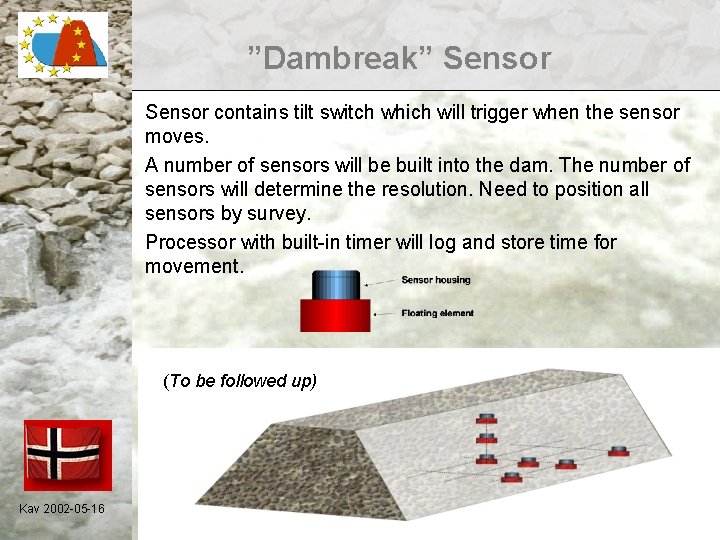
”Dambreak” Sensor contains tilt switch which will trigger when the sensor moves. A number of sensors will be built into the dam. The number of sensors will determine the resolution. Need to position all sensors by survey. Processor with built-in timer will log and store time for movement. Kav 2002 -05 -16 ü (To Stored data together with the sensor ID will be downloaded be followed up) to a PC after collecting the sensors downstream. ü Sensor will be housed in watertight (IP 68) enclosure. ü Floating element will ease location of the sensors after the dambreak. ü Sensor size approx. 10 x 10 cm.
Sonar Offers a possible means of monitoring breach growth underwater. Not appropriate for downstream conditions, but will be placed underwater upstream to show growth of breach through upstream face. Kav 2002 -05 -16
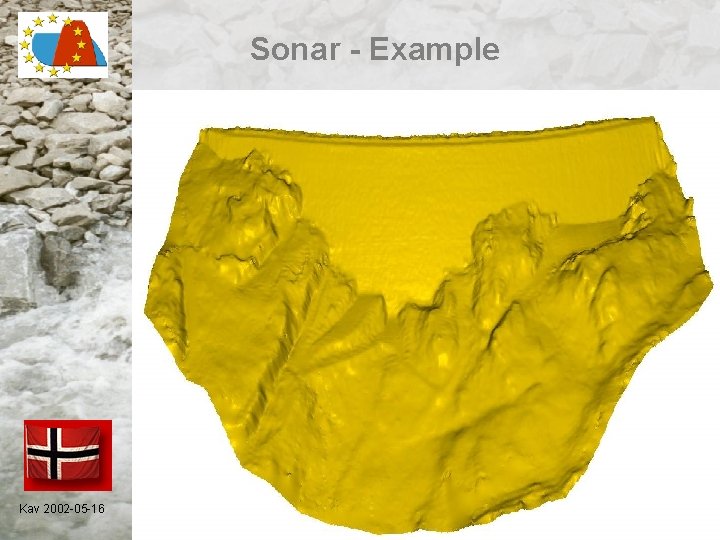
Sonar - Example Kav 2002 -05 -16
Water levels in the river and reservoir Water level - automatic recording (pressure sensors) – upstream of the test-dam (2) – downstream (several along the river to monitor the flood wave) Kav 2002 -05 -16
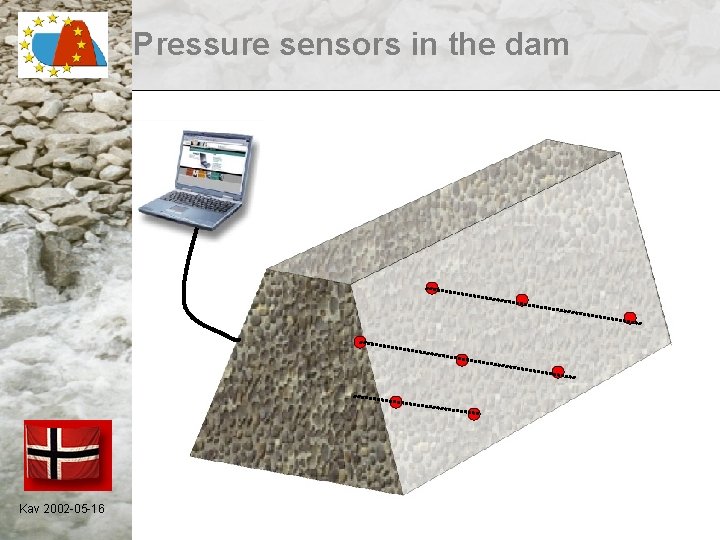
Pressure sensors in the dam Kav 2002 -05 -16
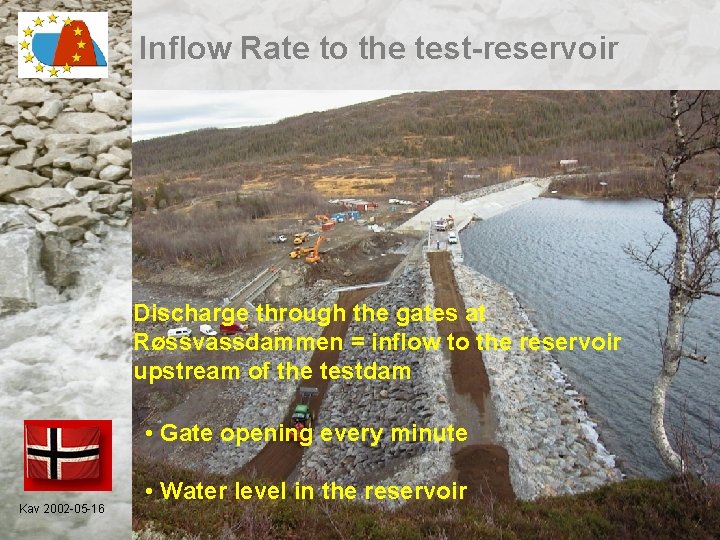
Inflow Rate to the test-reservoir Discharge through the gates at Røssvassdammen = inflow to the reservoir upstream of the testdam • Gate opening every minute Kav 2002 -05 -16 • Water level in the reservoir
Discharges Stage/waterlevel: Discharge from calibrated stage-discharge relationship automatic sampling of water pressure/water level + manual readings Kav 2002 -05 -16
Discharges from water velocity Water-velocity recordings - automatic recording by use of ADCP: 1) Floating on the surface 2) Mounted at the bottom Kav 2002 -05 -16
Discharge/leakage through the test-dam (before failure) 1. Direct measurement Gauge readings ADCP (Easy. Q ) 2. Indirect by simulation/calculation Kav 2002 -05 -16
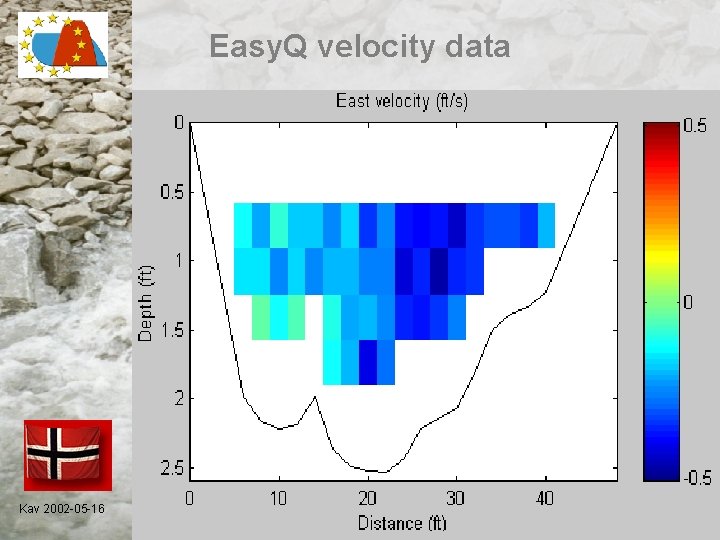
Easy. Q velocity data Kav 2002 -05 -16
Discharge during the faillure 1. Direct measurement ADCP (Aquadopp Profiler - bottom mounted) Gauge readings Problem with gauges downstream due to sediment/debris flow. 2. Indirect by simulation/calculation Kav 2002 -05 -16
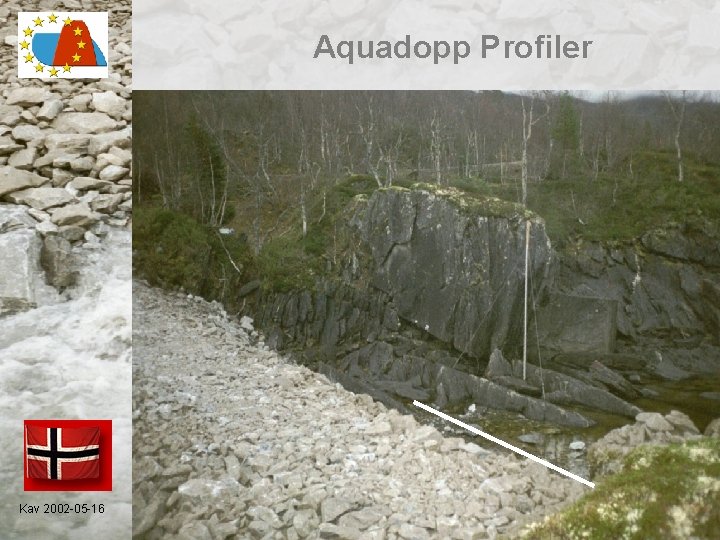
Aquadopp Profiler Kav 2002 -05 -16
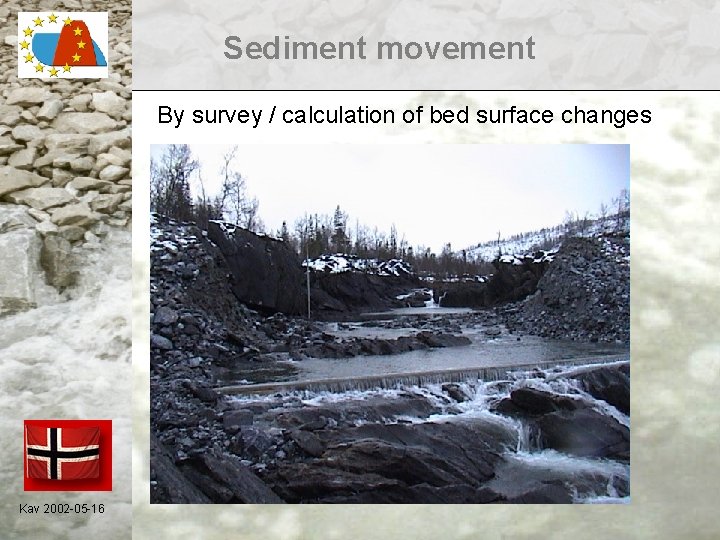
Sediment movement By survey / calculation of bed surface changes Kav 2002 -05 -16
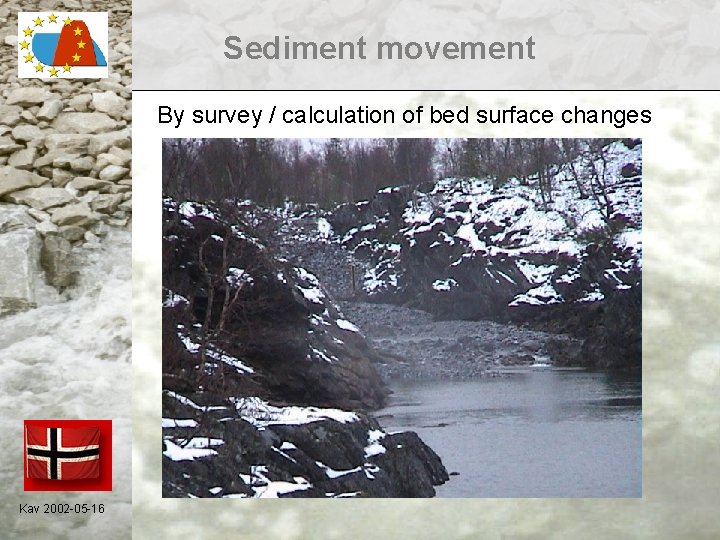
Sediment movement By survey / calculation of bed surface changes Kav 2002 -05 -16
Material properties Particle size distribution Liquid / plastic limit Type of clay Compaction Rock properties (interlocking effect) Clay will require further tests – chemistry Should we be undertaking pre and post failure tests on samples? Kav 2002 -05 -16
- Slides: 49