
Impact Workshop of the SPIRE PPP Brussels 22
Impact Workshop of the SPIRE PPP Brussels, 22 nd April 2015 SPIRE PPP in Horizon 2020 – What Impact ? Clara de la Torre DG Research and Innovation Director for Key Enabling Technologies Policy Research and Innovation
President Juncker's Agenda and the c. PPPs 1. 2. 3. A New Boost for Jobs, Growth and Investment A Connected Digital Single Market A Resilient Energy Union with a Forward-Looking Climate Change Policy 4. A Deeper and Fairer Internal Market with a Strengthened Industrial Base 5. A Deeper and Fairer Economic and Monetary Union 6. A Reasonable and Balanced Free Trade Agreement with the U. S. 7. An Area of Justice and Fundamental Rights Based on Mutual Trust 8. Towards a New Policy on Migration 9. A Stronger Global Actor 10. A Union of Democratic Change Five priority areas are addressed by the c. PPPs Policy Research and Innovation 2
Why Public-Private Partnerships in Horizon 2020? • R&D investments are essential for generating growth and high quality jobs • EU business under-invests in R&D compared to other world regions • Increasing international competition for leadership in strategic technologies • Partnerships create stable frameworks for joint R&I investments in industrial domains • To facilitate prioritisation of R&I in line with the European R&I policy and industry needs • To leverage research and innovation efforts Policy Research and Innovation 3
Outcomes of "contractual" PPPs in FP 7: Fo. F, Ee. B and GV • A quick response in defining the strategy − Multi-Annual Roadmaps • Better success rates & shorter time-to-grant • 3 PPPs launched 366 projects with 4409 participations • Increased participation of industry: 57% (30% in FP 7) − SMEs: 25% of the total participation. The participation of SMEs in FP 7 Cooperation was ~17%. • More innovation related activities − including demonstration & take-up of technology • The full EC contribution was provided: € 1. 6 billion -> combined investment: € 2. 4 billion 4 Policy Research and Innovation
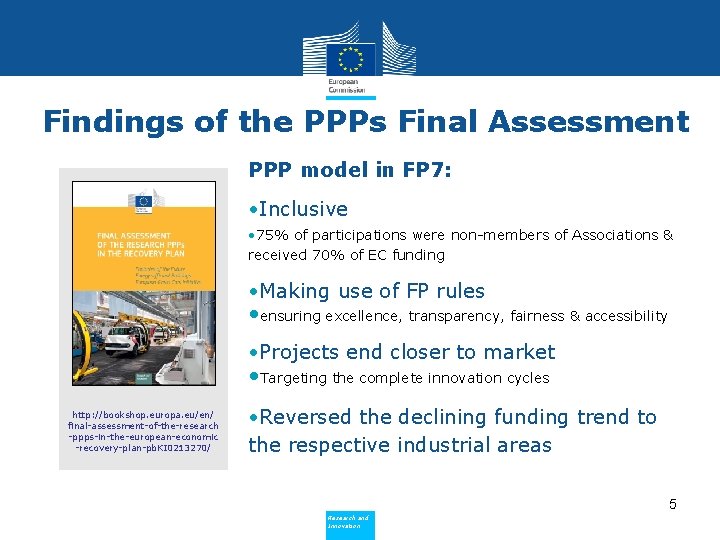
Findings of the PPPs Final Assessment PPP model in FP 7: • Inclusive • 75% of participations were non-members of Associations & received 70% of EC funding • Making use of FP rules • ensuring excellence, transparency, fairness & accessibility • Projects end closer to market • Targeting the complete innovation cycles http: //bookshop. europa. eu/en/ final-assessment-of-the-research -ppps-in-the-european-economic -recovery-plan-pb. KI 0213270/ • Reversed the declining funding trend to the respective industrial areas 5 Policy Research and Innovation
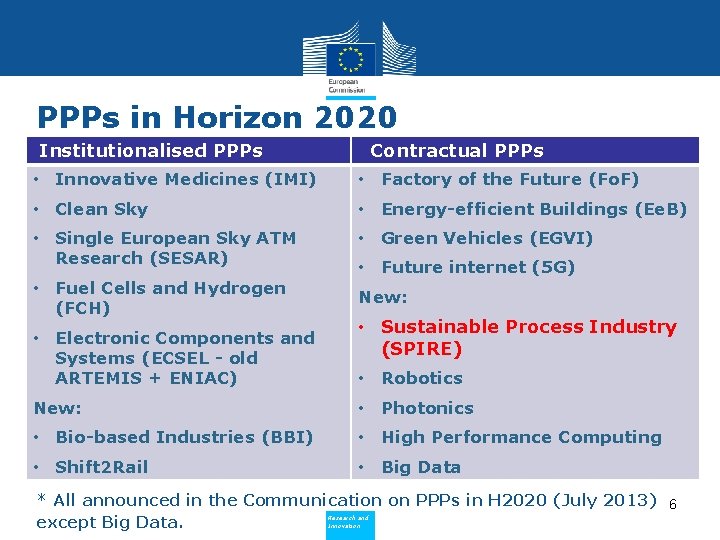
PPPs in Horizon 2020 Institutionalised PPPs Contractual PPPs • Innovative Medicines (IMI) • Factory of the Future (Fo. F) • Clean Sky • Energy-efficient Buildings (Ee. B) • Single European Sky ATM Research (SESAR) • Green Vehicles (EGVI) • Fuel Cells and Hydrogen (FCH) • Electronic Components and Systems (ECSEL - old ARTEMIS + ENIAC) • Future internet (5 G) New: • Sustainable Process Industry (SPIRE) • Robotics New: • Photonics • Bio-based Industries (BBI) • High Performance Computing • Shift 2 Rail • Big Data * All announced in the Communication on PPPs in H 2020 (July 2013) 6 except Big Data. Policy Research and Innovation
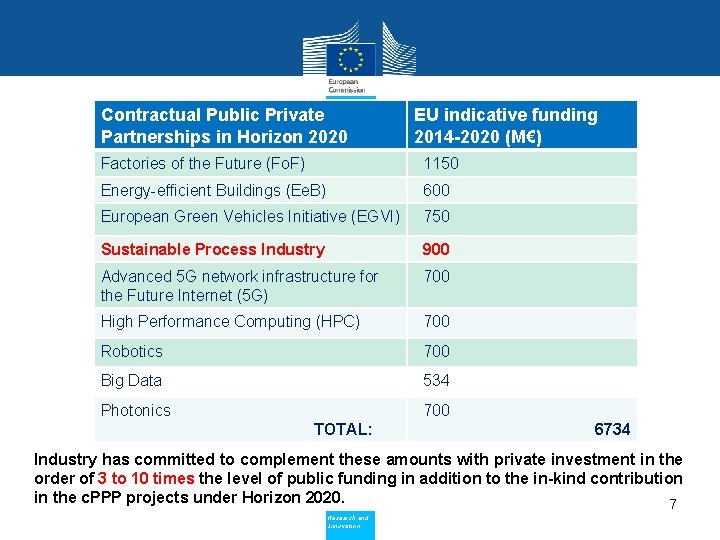
Contractual Public Private Partnerships in Horizon 2020 EU indicative funding 2014 -2020 (M€) Factories of the Future (Fo. F) 1150 Energy-efficient Buildings (Ee. B) 600 European Green Vehicles Initiative (EGVI) 750 Sustainable Process Industry 900 Advanced 5 G network infrastructure for the Future Internet (5 G) 700 High Performance Computing (HPC) 700 Robotics 700 Big Data 534 Photonics 700 TOTAL: 6734 Industry has committed to complement these amounts with private investment in the order of 3 to 10 times the level of public funding in addition to the in-kind contribution in the c. PPP projects under Horizon 2020. 7 Policy Research and Innovation
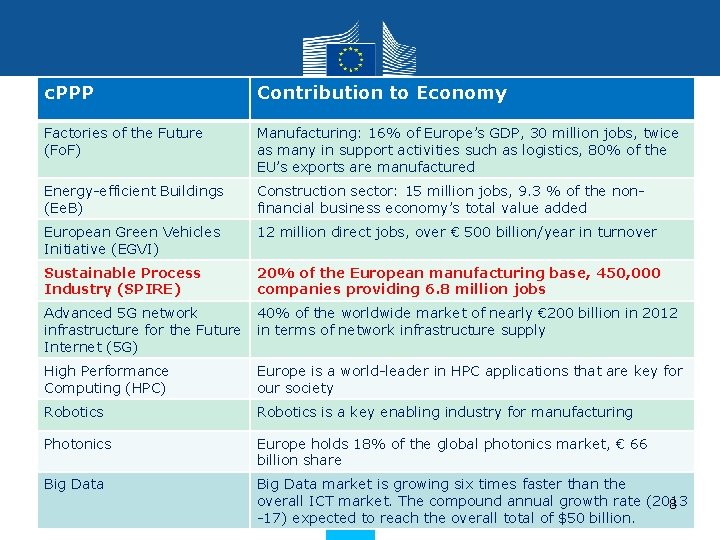
c. PPP Contribution to Economy Factories of the Future (Fo. F) Manufacturing: 16% of Europe’s GDP, 30 million jobs, twice as many in support activities such as logistics, 80% of the EU’s exports are manufactured Energy-efficient Buildings (Ee. B) Construction sector: 15 million jobs, 9. 3 % of the nonfinancial business economy’s total value added European Green Vehicles Initiative (EGVI) 12 million direct jobs, over € 500 billion/year in turnover Sustainable Process Industry (SPIRE) 20% of the European manufacturing base, 450, 000 companies providing 6. 8 million jobs Advanced 5 G network infrastructure for the Future Internet (5 G) 40% of the worldwide market of nearly € 200 billion in 2012 in terms of network infrastructure supply High Performance Computing (HPC) Europe is a world-leader in HPC applications that are key for our society Robotics is a key enabling industry for manufacturing Photonics Europe holds 18% of the global photonics market, € 66 billion share Big Data market is growing six times faster than the overall ICT market. The compound annual growth rate (2013 8 Policy Research and -17) expected to reach the overall total of $50 billion. Innovation
How were PPPs selected ? (Art. 25 in Horizon 2020) • Criteria in Horizon 2020 legislation • • European added value Importance of impacts Scale and long term nature of industry commitments Openess and transparency • Strategic importance • For EU international leadership of the technologies • For EU policy objectives under Europe 2020 • Building on success under FP 7 • Following evaluations and experience • New initiatives (5 new c. PPPs) given policy importance and industry commitment 9 Policy Research and Innovation
Establishment of the contractual PPPs • Based on ETPs and taking into account policy documents the Commission identified possible areas for a contractual PPP • Stakeholders were invited to prepare a PPP proposal • The private sector organised stakeholder consultations, in an open and transparent way, covering the whole value chain • The private sector delivered the proposal to the Commission • The Commission checked compliance with H 2020 criteria for the PPPs (art. 25) with the help of high-level external experts • Commission decision to launch the contractual PPP • Signing of the Contractual arrangement 10 Policy Research and Innovation
The contractual PPP approach • What is the same as in normal Horizon 2020: • The financial rules are those of Horizon 2020 • Final responsibility for the Work Programme stays with the European Commission and is subject to Comitology • Implementation remains with the Commission: selection of proposals, grant preparation, review of progress and payments • What is different from normal Horizon 2020: • Long-term commitment by Commission to support the field • Long-term commitment by industry to invest, with a need to demonstrate its fulfilment (monitoring & KPIs) • Roadmap-based strategy. Close interaction in the Partnership Board to prepare the content of the calls. 11 Policy Research and Innovation
The contractual arrangement (1/3) • Main roles of the public and private sides: • Private sector partners advise the Commission on R&I priorities for the Horizon 2020 work programmes • Implementation via Commission WPs normal calls using Horizon 2020 Rules for Participation and subject to comitology • Content: • Scope and Specific Objectives, • Activities, investment and outputs, • Governance and openness, • Specific commitments of each side, • Monitoring and Key Performance Indicators, • Duration and review • The Multi-annual roadmap is an Annex 12 Policy Research and Innovation
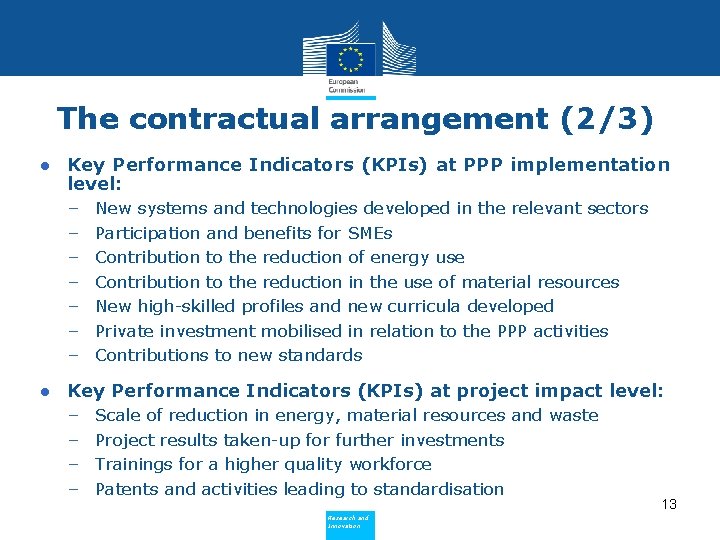
The contractual arrangement (2/3) ● Key Performance Indicators (KPIs) at PPP implementation level: ‒ ‒ ‒ ‒ New systems and technologies developed in the relevant sectors Participation and benefits for SMEs Contribution to the reduction of energy use Contribution to the reduction in the use of material resources New high-skilled profiles and new curricula developed Private investment mobilised in relation to the PPP activities Contributions to new standards ● Key Performance Indicators (KPIs) at project impact level: ‒ ‒ Scale of reduction in energy, material resources and waste Project results taken-up for further investments Trainings for a higher quality workforce Patents and activities leading to standardisation Policy Research and Innovation 13
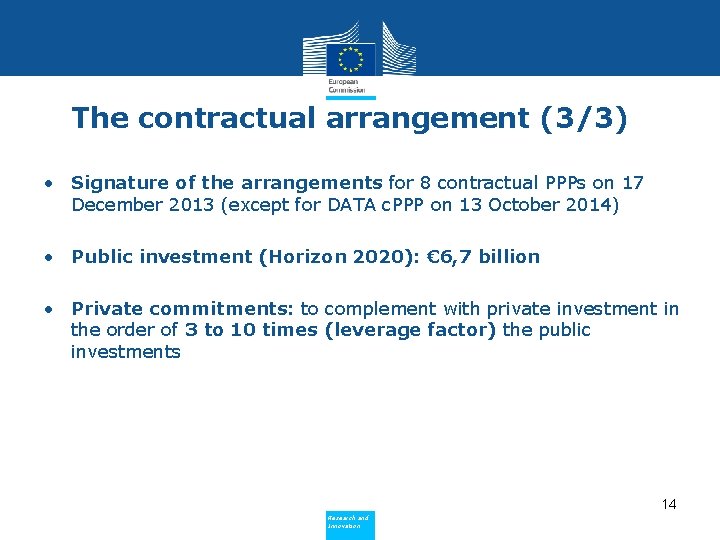
The contractual arrangement (3/3) • Signature of the arrangements for 8 contractual PPPs on 17 December 2013 (except for DATA c. PPP on 13 October 2014) • Public investment (Horizon 2020): € 6, 7 billion • Private commitments: to complement with private investment in the order of 3 to 10 times (leverage factor) the public investments 14 Policy Research and Innovation
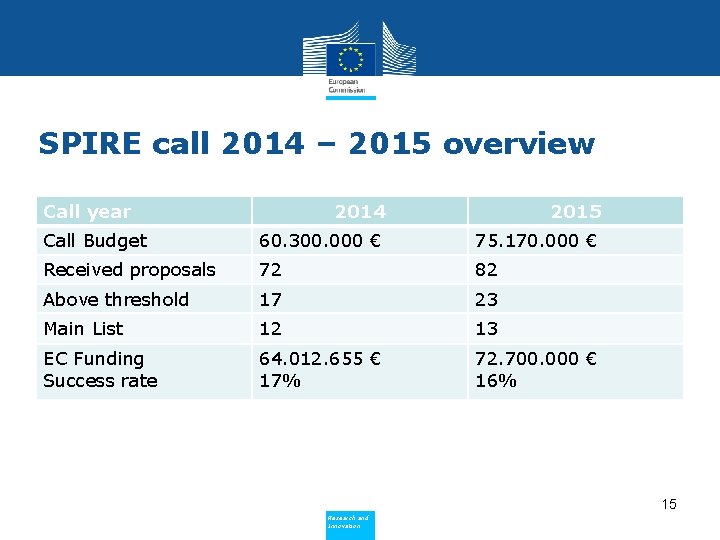
SPIRE call 2014 – 2015 overview Call year 2014 2015 Call Budget 60. 300. 000 € 75. 170. 000 € Received proposals 72 82 Above threshold 17 23 Main List 12 13 EC Funding Success rate 64. 012. 655 € 17% 72. 700. 000 € 16% 15 Policy Research and Innovation
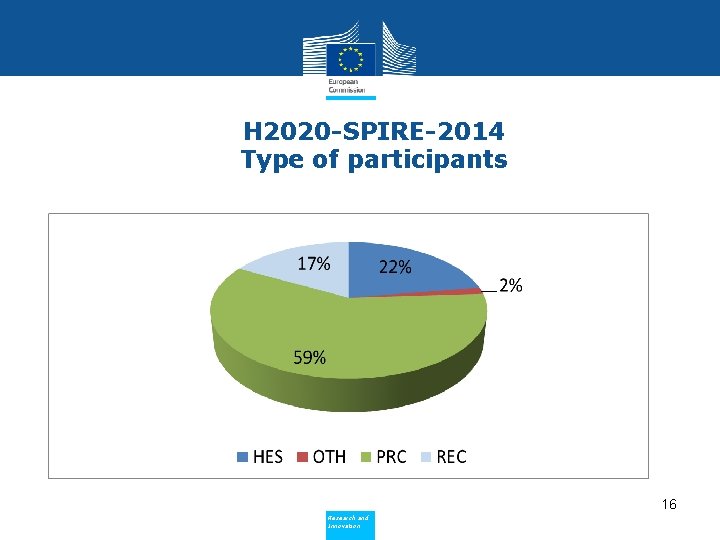
H 2020 -SPIRE-2014 Type of participants 16 Policy Research and Innovation
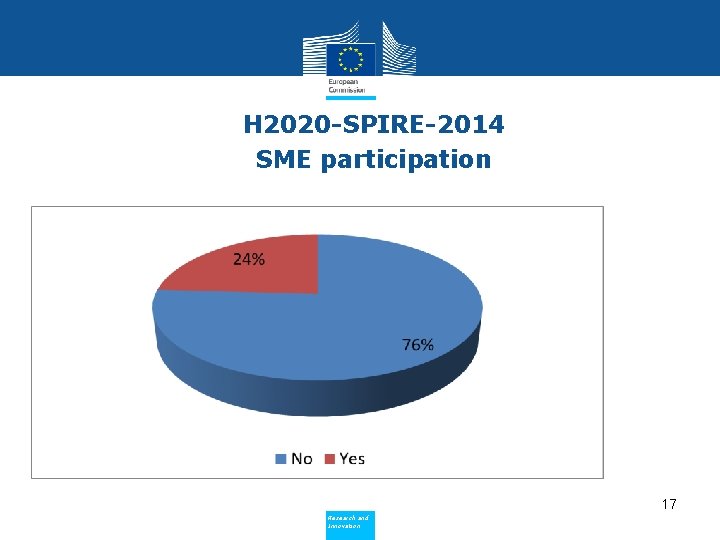
H 2020 -SPIRE-2014 SME participation 17 Policy Research and Innovation
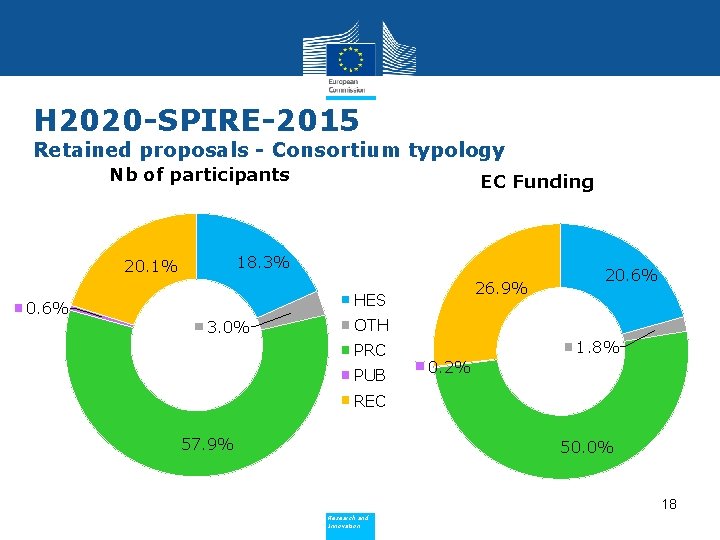
H 2020 -SPIRE-2015 Retained proposals - Consortium typology Nb of participants 18. 3% 20. 1% 0. 6% EC Funding 26. 9% HES 3. 0% 20. 6% OTH PRC PUB 1. 8% 0. 2% REC 57. 9% 50. 0% 18 Policy Research and Innovation
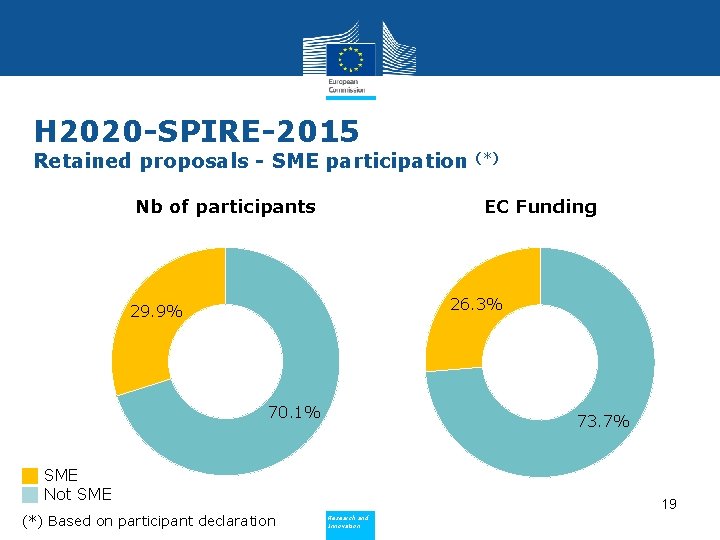
H 2020 -SPIRE-2015 Retained proposals - SME participation Nb of participants (*) EC Funding 26. 3% 29. 9% 70. 1% 73. 7% SME Not SME (*) Based on participant declaration 19 Policy Research and Innovation
20 Policy Research and Innovation
IMPACT • IS THE NAME OF THE GAME 21 Policy Research and Innovation
Thank you for your attention More information: HORIZON 2020: http: //ec. europa. eu/research/participants/portal/desktop/en/home. html Contractual Public-Private Partnerships in research and innovation: http: //ec. europa. eu/research/industrial_technologies/ppp-in-research_en. html Policy Research and Innovation
- Slides: 22