
IMPACT Simulation of feature profile evolution for thin
- Slides: 1
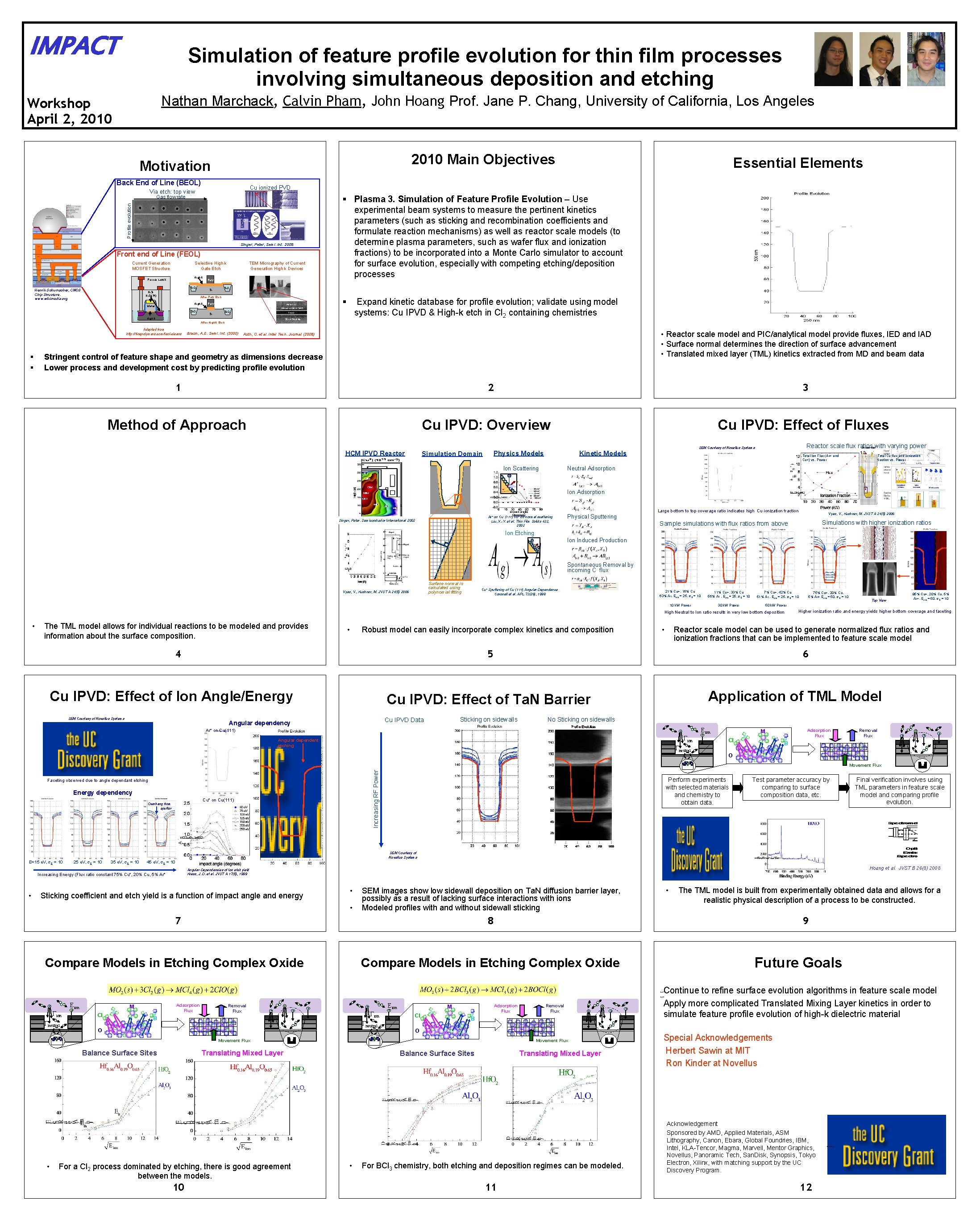
IMPACT Simulation of feature profile evolution for thin film processes involving simultaneous deposition and etching Nathan Marchack, Calvin Pham, John Hoang Prof. Jane P. Chang, University of California, Los Angeles Workshop April 2, 2010 Main Objectives Motivation Back End of Line (BEOL) Cu ionized PVD Via etch: top view § Plasma 3. Simulation of Feature Profile Evolution – Use experimental beam systems to measure the pertinent kinetics parameters (such as sticking and recombination coefficients and formulate reaction mechanisms) as well as reactor scale models (to determine plasma parameters, such as wafer flux and ionization fractions) to be incorporated into a Monte Carlo simulator to account for surface evolution, especially with competing etching/deposition processes Profile evolution Gas flow rate Singer, Peter, Semi. Int. 2008 Front end of Line (FEOL) Current Generation MOSFET Structure Selective High k Gate Etch High k Porous Low k Si. O 2 Henrik Schumacher, CMOS Chip Structure. www. wikimedia. org Ni. Si, Ni. Si(Pt) TEM Micrography of Current Generation High k Devices Poly Si. O 2 Si After Poly Etch High k Metal Si. O 2 Essential Elements § Poly Si Expand kinetic database for profile evolution; validate using model systems: Cu IPVD & High-k etch in Cl 2 containing chemistries Si. O 2 High k After High k Etch Adapted from http: //finepolymers. com/feol-cleans § § Braun, A. E. Semi. Int. (2000) • Reactor scale model and PIC/analytical model provide fluxes, IED and IAD • Surface normal determines the direction of surface advancement • Translated mixed layer (TML) kinetics extracted from MD and beam data Auth, C. et al. Intel Tech. Journal (2008) Stringent control of feature shape and geometry as dimensions decrease Lower process and development cost by predicting profile evolution 1 2 Method of Approach 3 Cu IPVD: Effect of Fluxes Cu IPVD: Overview HCM IPVD Reactor Simulation Domain Physics Models Kinetic Models Ion Scattering Reactor scale flux ratios with varying power SEM Courtesy of Novellus Systems Total Ion Flux (Ar+ and Cu+) vs. Power Total Cu flux and ionization fraction vs. Power Neutral Adsorption + Ion Adsorption Ar+ on Cu (111) 45° off normal scattering Liu, X. -Y. et al. Thin Film Solids 422, 2002 Singer, Peter. Semiconductor International 2002 Large bottom to top coverage ratio indicates high Cu ionization fraction Physical Sputtering Vyas, V. , Kushner, M. JVST A 24(5) 2006 Simulations with higher ionization ratios Sample simulations with flux ratios from above Ion Etching + q Ion Induced Production Spontaneous Removal by incoming C flux Surface normal is calculated using polynomial fitting Vyas, V. , Kushner, M. JVST A 24(5) 2006 Cu+ Sputtering of Cu (111) Angular Dependence Coronell et al. APL 73(26), 1998 21% Cu+, 16% Cu 63% Ar, Eion = 25, s. E = 10 11% Cu+, 33% Cu 56% Ar , Eion = 25, s. E = 10 10 k. W Power 30 k. W Power 7% Cu+, 42% Cu 51% Ar , Eion = 25, s. E = 10 The TML model allows for individual reactions to be modeled and provides information about the surface composition. • • Robust model can easily incorporate complex kinetics and composition 4 SEM Courtesy of Novellus Systems Reactor scale model can be used to generate normalized flux ratios and ionization fractions that can be implemented to feature scale model 6 Application of TML Model Cu IPVD: Effect of Ta. N Barrier Sticking on sidewalls Cu IPVD Data Angular dependency Top View Higher ionization ratio and energy yields higher bottom coverage and faceting 5 Cu IPVD: Effect of Ion Angle/Energy 85% Cu+, 20% Cu, 5% Ar+, Eion = 50, s. E = 10 50 k. W Power High Neutral to Ion ratio results in very low bottom deposition • 75% Cu+, 20% Cu, 5% Ar+ Eion = 50, s. E = 10 No Sticking on sidewalls Ar+ on Cu(111) Eion + Γion Angular dependent etching + Adsorption Flux M Cl Γneutral Removal Flux + + B O Increasing RF Power Movement Flux Faceting observed due to angle dependant etching Energy dependency Cu+ on Cu(111) Overhang from sputter E=15 e. V, s. E = 10 25 e. V, s. E = 10 35 e. V, s. E = 10 Test parameter accuracy by comparing to surface composition data, etc. 45 e. V, s. E = 10 Hoang et al. JVST B 26(8) 2008 Angular Dependencies of Ion etch yield Kress, J. D. et al. JVST A 17(5), 1999 • Sticking coefficient and etch yield is a function of impact angle and energy • • SEM images show low sidewall deposition on Ta. N diffusion barrier layer, possibly as a result of lacking surface interactions with ions Modeled profiles with and without sidewall sticking 7 The TML model is built from experimentally obtained data and allows for a realistic physical description of a process to be constructed. 8 Compare Models in Etching Complex Oxide 9 Future Goals Compare Models in Etching Complex Oxide Continue to refine surface evolution algorithms in feature scale model Apply more complicated Translated Mixing Layer kinetics in order to simulate feature profile evolution of high-k dielectric material Goal 1 Goal 2 Eion + Γion Γneutral + Adsorption Flux M Cl Removal Flux + + + Eion + + Γion B Γneutral O + Adsorption Flux M Cl Balance Surface Sites 10 + + + O Movement Flux Translating Mixed Layer For a Cl 2 process dominated by etching, there is good agreement between the models. Removal Flux B Movement Flux • Final verification involves using TML parameters in feature scale model and comparing profile evolution. SEM Courtesy of Novellus Systems Increasing Energy (Flux ratio constant 75% Cu+, 20% Cu, 5% Ar+ • Perform experiments with selected materials and chemistry to obtain data. Balance Surface Sites • Translating Mixed Layer For BCl 3 chemistry, both etching and deposition regimes can be modeled. 11 + Special Acknowledgements Herbert Sawin at MIT Ron Kinder at Novellus Acknowledgement Sponsored by AMD, Applied Materials, ASM Lithography, Canon, Ebara, Global Foundries, IBM, Intel, KLA-Tencor, Magma, Marvell, Mentor Graphics, Novellus, Panoramic Tech, San. Disk, Synopsis, Tokyo Electron, Xilinx, with matching support by the UC Discovery Program. 12 Funded by