
Impact of Water Quality on Herbicide Efficacy Calvin
Impact of Water Quality on Herbicide Efficacy Calvin Odero Everglades REC Belle Glade
Water Quality and Herbicides • Water is the primary carrier for herbicide applications • Spray solutions commonly contain 95% or more water • Interaction is determined by water chemistry and herbicide chemistry
Water Chemistry • Water p. H, hardness, alkalinity, and turbidity can affect herbicide efficacy • Water p. H is the concentration of H+ ions in the water • Hard water is caused by high levels of calcium, magnesium, sodium, or iron
Water Chemistry • Hardness is expressed as an equivalent of calcium carbonate in water analysis tests • Turbidity is caused by suspended solids, soils, or organic matter • Alkalinity refers to carbonate and bicarbonate levels in water
Common Dissolved Materials • Below are the 6 most common ions found in water • Other ions can also have an effect Cations (+ charge) • Calcium • Magnesium • Sodium Anions (- charge) • Sulfate • Chloride • Bicarbonate
TSD and EC • The sum of all the minerals dissolved in a water sample is the TSD • TSD is total dissolved solids • The higher the TDS, the more electrical current water can conduct • EC is electrical conductivity • EC is used as a simple method to test for TSD
Turbidity • The dirt and color you see in the water • They can easily deactivate herbicides with Koc values • Clean water is very important for these herbicides • Herbicides with low Koc values are not affected
Herbicide Chemistry • Weak acids-compounds that release some H+ ions when dissolved in water • Many herbicides are weak acids: glyphosate, paraquat, sethoxydim • Weak acid herbicides partially dissociate in water • For most herbicides, the portion that does not dissociate is more easily absorbed by plant leaves
Herbicide Chemistry • The solubility of sulfonylurea herbicides (Envoke, Sandea) increases with higher p. H • The amount of dissociation depends on the p. H of the water • Dissociated herbicide molecules have a negative charge • Herbicides with high Koc values are sensitive to turbid water • Koc is the organic carbon sorption coefficient
Glyphosate • Hardness higher than 350 mg/L can affect low rates and over 700 mg/L can affect high rates • Glyphosate has a high Koc and is greatly affected by turbidity • Effects can be reduced by • Using higher rates – Adding ammonium sulfate to the spray solution – Using the spray immediately after mixing – Reducing carrier volume
2, 4 -D Amine • Water hardness levels of above 600 mg/L will likely cause interference • Alkalinity above 500 mg/L can reduce effectiveness • Consider alternate formulations or water sources
Clethodim, Sethoxydim, others • These grass herbicides are weak acids • Have low Koc values so they aren’t affected by turbidity • At p. H values below 6 they are not affected by hard water • Higher p. H allows dissociation and cation formation
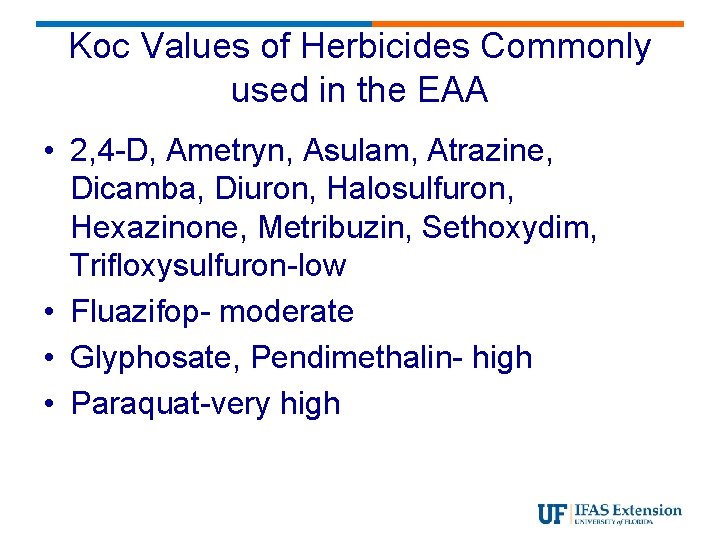
Koc Values of Herbicides Commonly used in the EAA • 2, 4 -D, Ametryn, Asulam, Atrazine, Dicamba, Diuron, Halosulfuron, Hexazinone, Metribuzin, Sethoxydim, Trifloxysulfuron-low • Fluazifop- moderate • Glyphosate, Pendimethalin- high • Paraquat-very high
- Slides: 13