
Impact of the Disability on Academic Performance Students
Impact of the Disability on Academic Performance Students who are labeled EBD
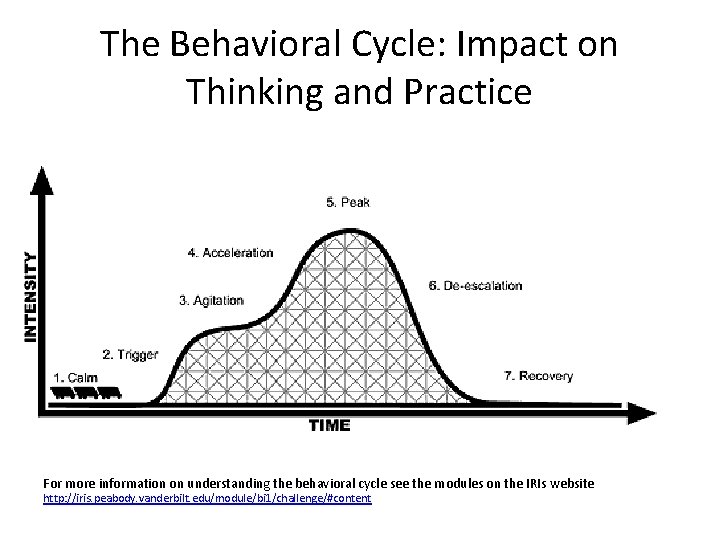
The Behavioral Cycle: Impact on Thinking and Practice For more information on understanding the behavioral cycle see the modules on the IRIs website http: //iris. peabody. vanderbilt. edu/module/bi 1/challenge/#content
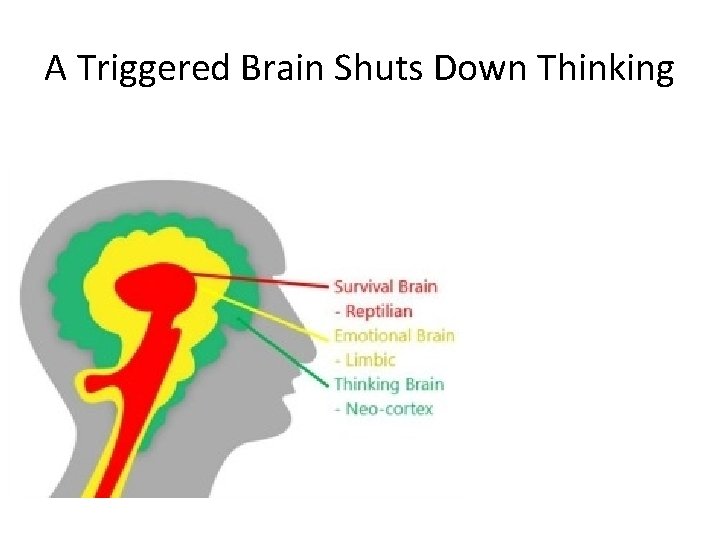
A Triggered Brain Shuts Down Thinking
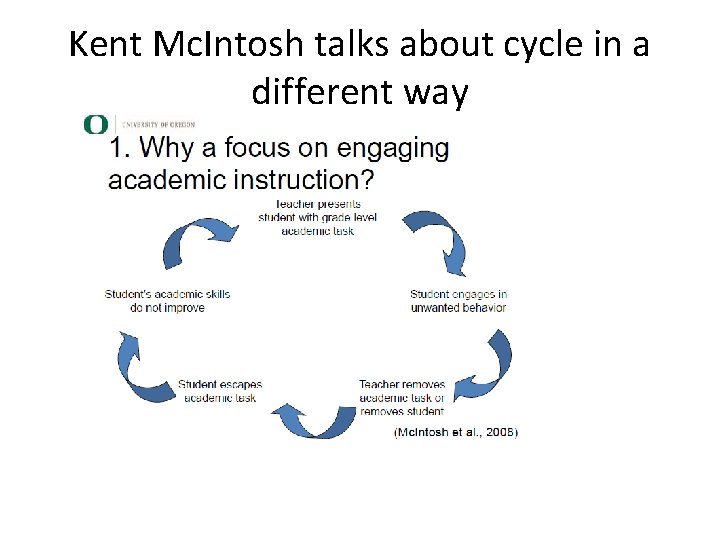
Kent Mc. Intosh talks about cycle in a different way
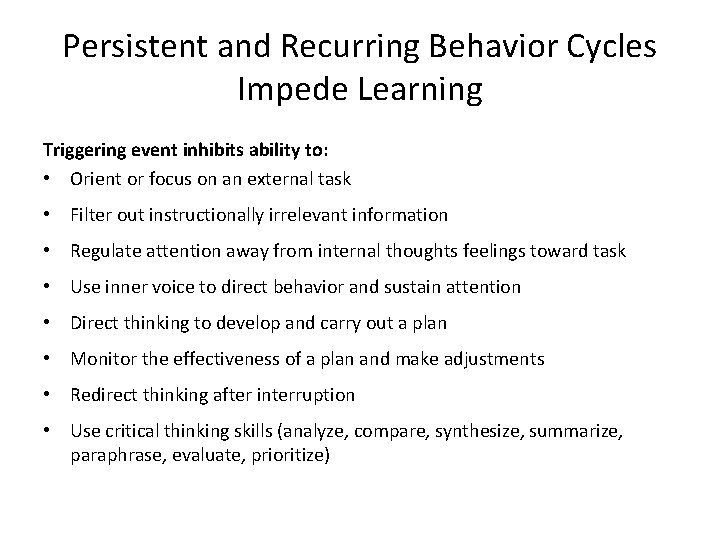
Persistent and Recurring Behavior Cycles Impede Learning Triggering event inhibits ability to: • Orient or focus on an external task • Filter out instructionally irrelevant information • Regulate attention away from internal thoughts feelings toward task • Use inner voice to direct behavior and sustain attention • Direct thinking to develop and carry out a plan • Monitor the effectiveness of a plan and make adjustments • Redirect thinking after interruption • Use critical thinking skills (analyze, compare, synthesize, summarize, paraphrase, evaluate, prioritize)
Decision Tree Connecting Behavior to Academic Progress
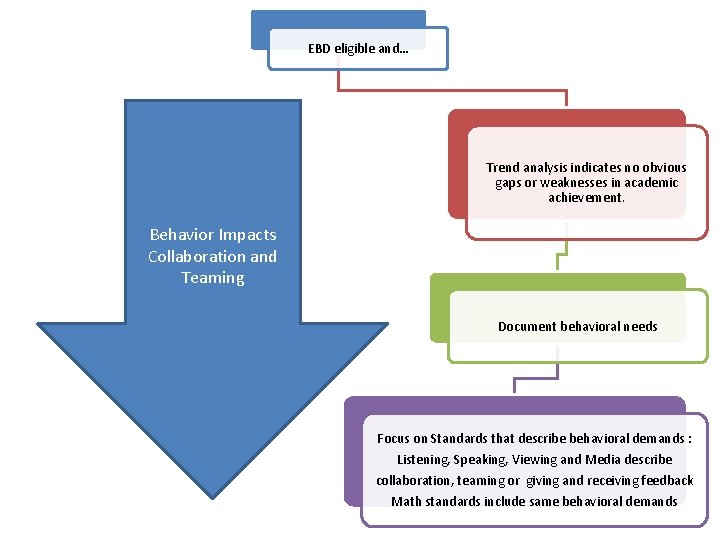
EBD eligible and… Trend analysis indicates no obvious gaps or weaknesses in academic achievement. Behavior Impacts Collaboration and Teaming Document behavioral needs Focus on Standards that describe behavioral demands : Listening, Speaking, Viewing and Media describe collaboration, teaming or giving and receiving feedback Math standards include same behavioral demands
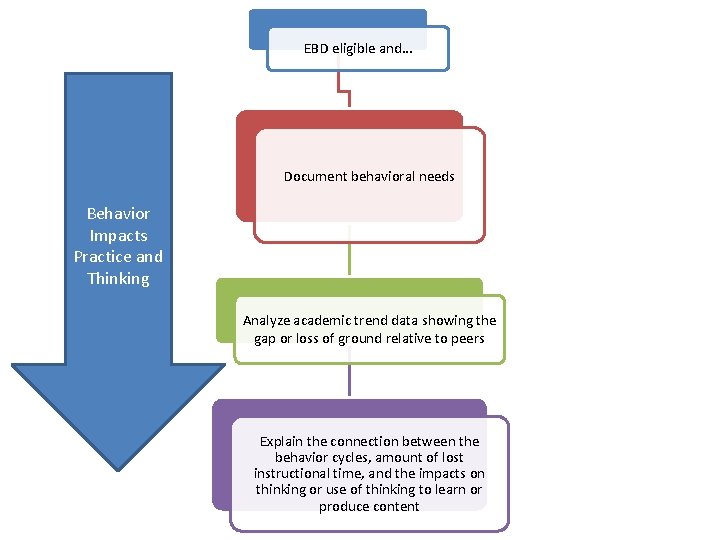
EBD eligible and… Document behavioral needs Behavior Impacts Practice and Thinking Analyze academic trend data showing the gap or loss of ground relative to peers Explain the connection between the behavior cycles, amount of lost instructional time, and the impacts on thinking or use of thinking to learn or produce content
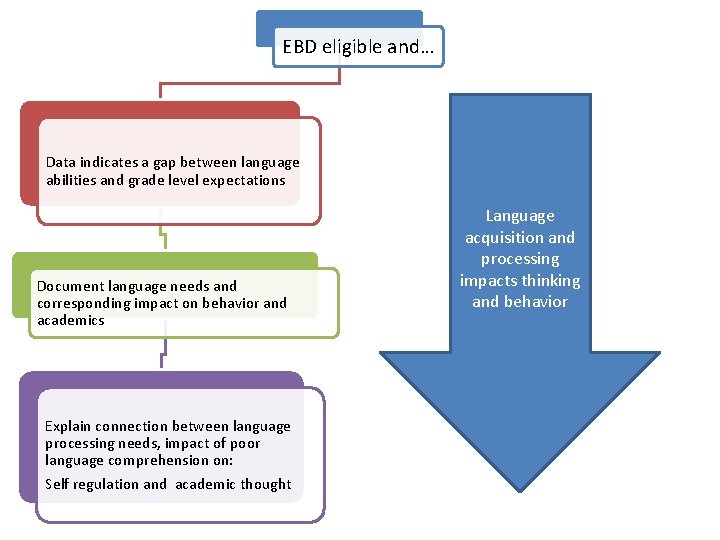
EBD eligible and… Data indicates a gap between language abilities and grade level expectations Document language needs and corresponding impact on behavior and academics Explain connection between language processing needs, impact of poor language comprehension on: Self regulation and academic thought Language acquisition and processing impacts thinking and behavior
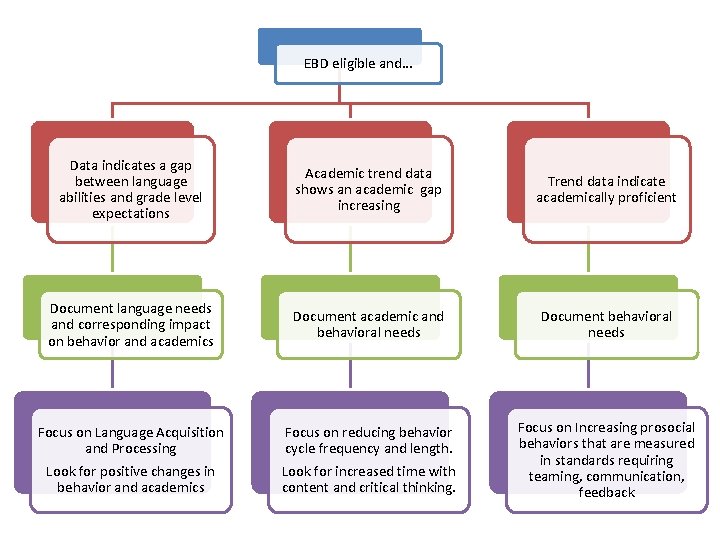
EBD eligible and… Data indicates a gap between language abilities and grade level expectations Academic trend data shows an academic gap increasing Trend data indicate academically proficient Document language needs and corresponding impact on behavior and academics Document academic and behavioral needs Document behavioral needs Focus on Language Acquisition and Processing Look for positive changes in behavior and academics Focus on reducing behavior cycle frequency and length. Look for increased time with content and critical thinking. Focus on Increasing prosocial behaviors that are measured in standards requiring teaming, communication, feedback
Recipe for Writing Disability Impact Statements
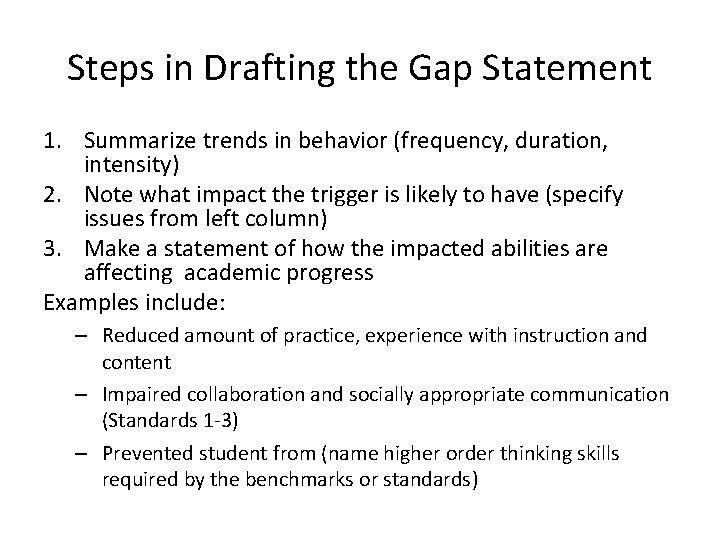
Steps in Drafting the Gap Statement 1. Summarize trends in behavior (frequency, duration, intensity) 2. Note what impact the trigger is likely to have (specify issues from left column) 3. Make a statement of how the impacted abilities are affecting academic progress Examples include: – Reduced amount of practice, experience with instruction and content – Impaired collaboration and socially appropriate communication (Standards 1 3) – Prevented student from (name higher order thinking skills required by the benchmarks or standards)
Practical Examples Each type has an example
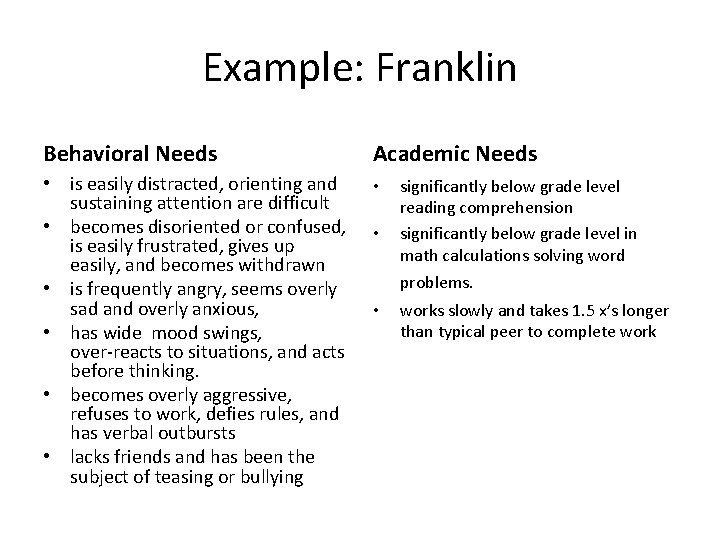
Example: Franklin Behavioral Needs Academic Needs • is easily distracted, orienting and sustaining attention are difficult • becomes disoriented or confused, is easily frustrated, gives up easily, and becomes withdrawn • is frequently angry, seems overly sad and overly anxious, • has wide mood swings, over reacts to situations, and acts before thinking. • becomes overly aggressive, refuses to work, defies rules, and has verbal outbursts • lacks friends and has been the subject of teasing or bullying • • significantly below grade level reading comprehension significantly below grade level in math calculations solving word problems. • works slowly and takes 1. 5 x’s longer than typical peer to complete work
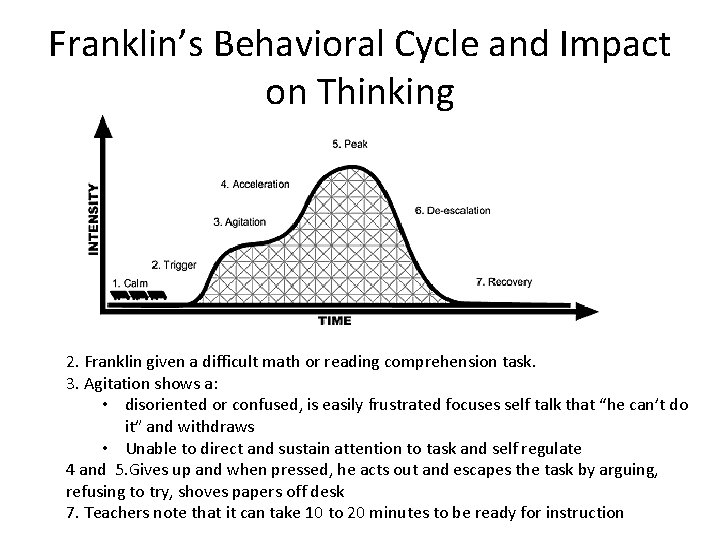
Franklin’s Behavioral Cycle and Impact on Thinking 2. Franklin given a difficult math or reading comprehension task. 3. Agitation shows a: • disoriented or confused, is easily frustrated focuses self talk that “he can’t do it” and withdraws • Unable to direct and sustain attention to task and self regulate 4 and 5. Gives up and when pressed, he acts out and escapes the task by arguing, refusing to try, shoves papers off desk 7. Teachers note that it can take 10 to 20 minutes to be ready for instruction
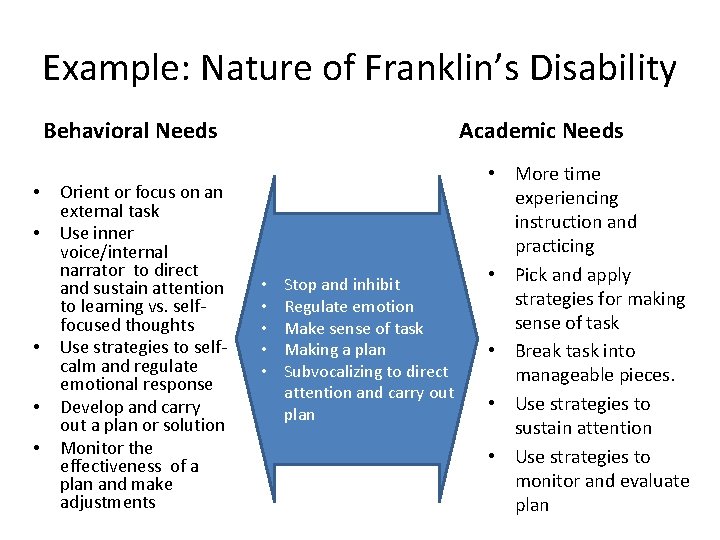
Example: Nature of Franklin’s Disability Behavioral Needs • • • Orient or focus on an external task Use inner voice/internal narrator to direct and sustain attention to learning vs. self focused thoughts Use strategies to self calm and regulate emotional response Develop and carry out a plan or solution Monitor the effectiveness of a plan and make adjustments Academic Needs • • • Stop and inhibit Regulate emotion Make sense of task Making a plan Subvocalizing to direct attention and carry out plan • More time experiencing instruction and practicing • Pick and apply strategies for making sense of task • Break task into manageable pieces. • Use strategies to sustain attention • Use strategies to monitor and evaluate plan
Sample Statement Franklin’s behavioral concerns impact access and progress in the general curriculum when he is presented with challenging tasks or experiences frustration. He regularly has difficulty focusing and sustaining attention. When he is frustrated he withdraws and becomes disoriented. He has limited strategies to regulate his emotions when he encounters a task that he doesn’t understand or when he is frustrated. If pressed he will act out to escape the task. This behavioral cycle leads him to miss 10 20 minutes of instruction and practice each time he encounters tasks that are difficult or becomes frustrated. Limitations in regulating his emotions also impact his progress with reading comprehension and math calculations and problem solving tasks. With increased ability to regulate his emotions, Franklin will be able to benefit from instruction on how to make sense of tasks, break tasks into manageable parts, and use the strategies he knows to solve the task.
Sample Impact Statement: Trace Due to his disability, Trace’s behavior impedes his learning and the learning of others due to his refusal to follow directions, his ability to control his anger, defiance, verbal and physical aggression, impulsivity, and withdrawal behaviors. His behaviors impede his ability to be in the general education setting due to how he handles pressure and stress. When he is under pressure or stress, he displays behaviors such as refusal to speak, refusal to stay in place (wanders hall, sits in office areas, etc. ), physically aggressive behaviors such as balling his fists, throwing objects, and tipping over furniture. The behavioral outbursts reduce the amount of practice and ability to demonstrate learning that is expected of non disabled peers. He completes fewer assignments in class, misses instruction, and feedback. He experiences fewer outbursts and reports less anxiety when provided an adjusted beginning time to move to classes separate from peers as well as time preview content that will be covered during the general education reading and science class.
Sample Impact Statement: Hunter’s behavioral difficulties make progress in the general classroom challenging. Tasks such as cooperative learning, giving and receiving feedback from peers, working as part of a team trigger his anxiety and frustration. While he is maintaining average grades in classwork, this is due to teachers adapting assignments and tasks so that he does not have to work cooperatively. Hunter needs to be able to express his thoughts and feelings in an appropriate way, and learn skills for collaborating and working as a member of a team. He needs to use socially appropriate skills for disagreeing and working through problems as a replacement to swearing, intimidating peers, walking out of class and throwing papers. These skills will also be necessary to practice in workplace situations in order for Hunter to successfully maintain employment.
- Slides: 19