
Impact of the CAS service element on IBDP

Impact of the CAS service element on IBDP graduates Iara Lindemann Ed. D Student Supervisors: Prof Jeff Thompson and Dr Mary Hayden University of Bath, UK Additional support: International School of London - Qatar
Overview 1. Background 1. 2. 3. 4. 5. International Education International Baccalaureate Diploma Programme Creativity, Action, Service What is Service? Experiential Learning 2. Research outline 1. 2. 3. 4. 5. 6. Research Aim Key Research Questions Methodology Data Collection Methods Data Analysis (Preliminary findings) Further Work
1. 1 International Education • The role of international education in the formation of active citizens • Education of the ‘whole person’ – International Baccalaureate Diploma Programme (IBDP) – Creativity, Action, Service (CAS)
1. 1 International Education & Citizenship “An international education develops attitudes and values which respect human dignity and which transcend barriers of race, class, religion, gender and politics” (IBO 2001, p. 8)
1. 2 IBDP • • pre-university course 16 - 19 years two-year curriculum fulfills requirements of various national education systems • incorporates the best elements of many countries (IB Guide 2001, p. 1)
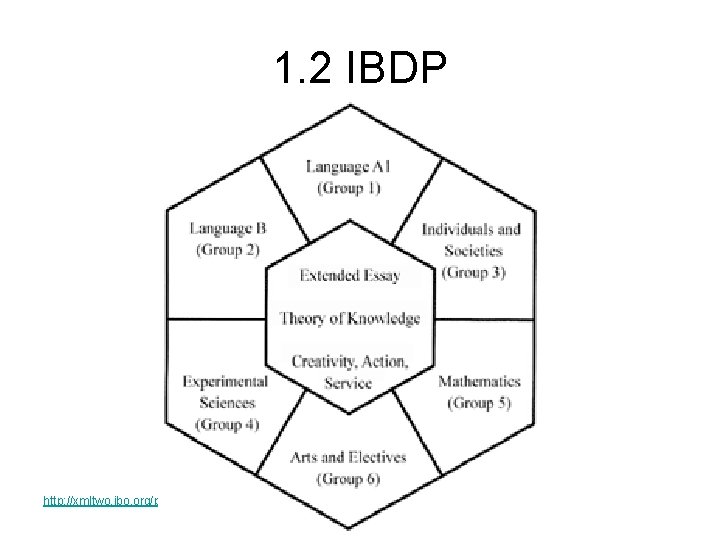
1. 2 IBDP http: //xmltwo. ibo. org/publications/images/DPprogramme. Model. En. png

1. 2 IBDP – Mission Statement • Emphasis on the ideals of international understanding and responsible citizenship • Students to become: - critical and compassionate thinkers - lifelong learned - informed participants - conscious of shared humanity - respectful of a variety of cultures & attitudes (IBO mission statement, 1996)
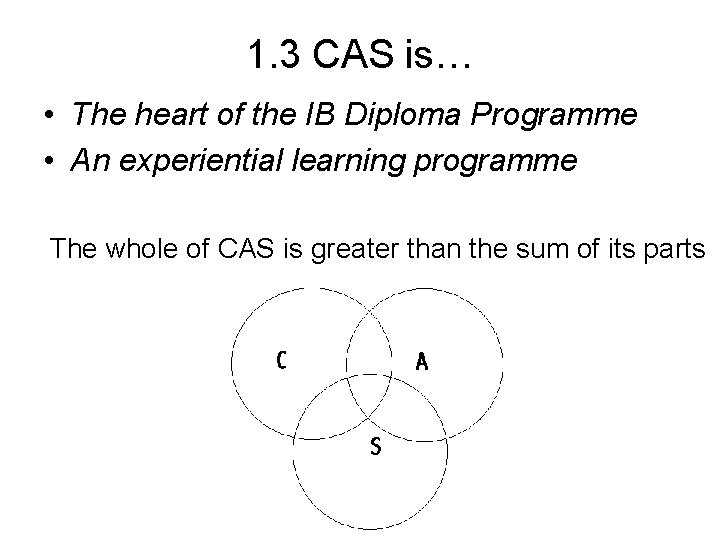
1. 3 CAS is… • The heart of the IB Diploma Programme • An experiential learning programme The whole of CAS is greater than the sum of its parts

1. 3 CAS & Citizenship “CAS activities contribute very personally to citizenship at a local, national & international level” (Hill, 2003, p. 56)
1. 4 What is Service? • Service is the action(s) taken by youth to address a community issue in a positive manner (Terry & Bohnenberger 2007, p. 6) • Service activities are often the most transforming element of the Diploma Programme for the individual student; they have the potential to nurture and mould the global citizen (IB 2001, p. 7)
1. 4 What is Service? “Service is not simply an emotional impulse, it is a demonstration of attitudes and values” María Piaggio (IB 2001, p. 4)
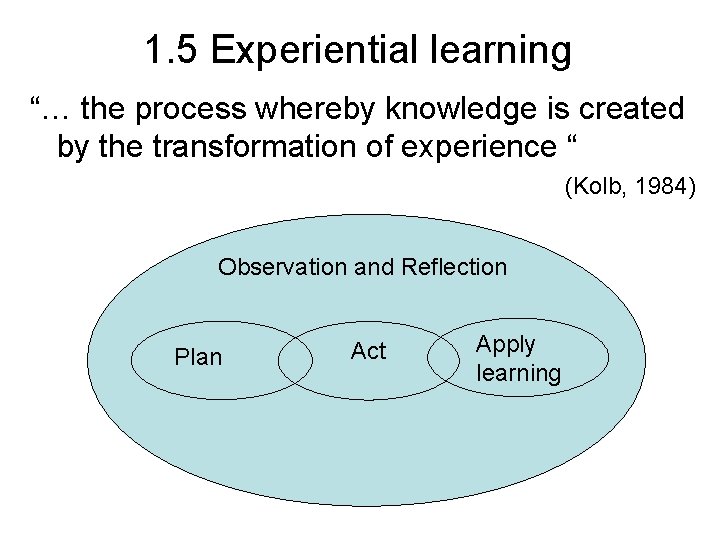
1. 5 Experiential learning “… the process whereby knowledge is created by the transformation of experience “ (Kolb, 1984) Observation and Reflection Plan Act Apply learning
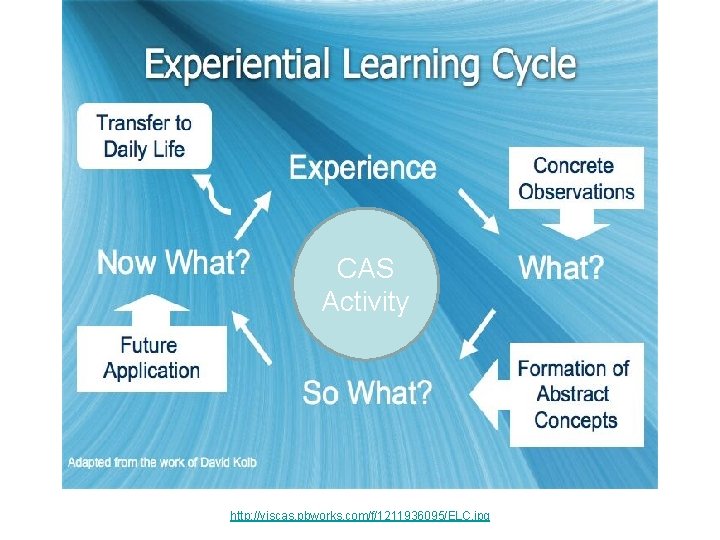
CAS Activity http: //yiscas. pbworks. com/f/1211936095/ELC. jpg
2. 1 Research Aim • To explore the extent to which the service element of CAS can affect the education of the ‘whole person’ as a lifelong learner in a particular context
2. 2 Key Research Questions • What were the main Service CAS experiences by students? • After having completed the CAS Programme, what personal awareness of social issues did the students acquire? • What are the perceptions of students about how their abilities and skills may have further developed (or regressed) since leaving school?
2. 2 Key Research Questions • Are students who have completed the CAS Programme interested in being involved with service activities (i. e. any form of aid, social projects or volunteering)? • To what extent has the service element of CAS influenced alumni in adopting practices of active citizenship at the local, regional, national or international levels?
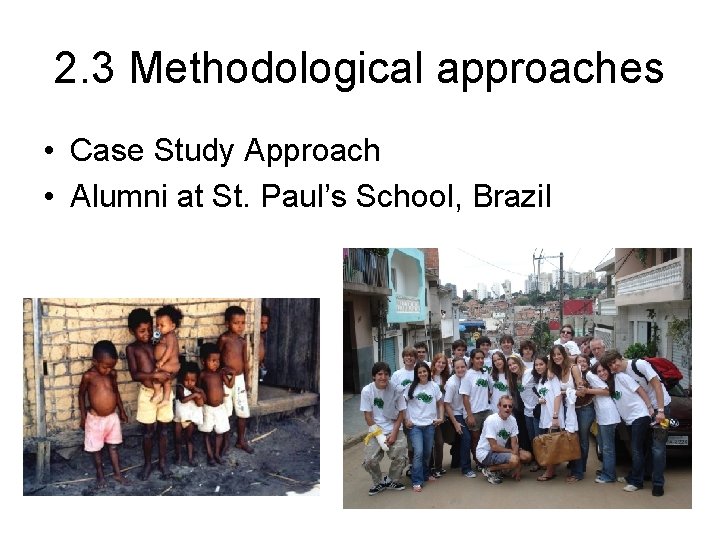
2. 3 Methodological approaches • Case Study Approach • Alumni at St. Paul’s School, Brazil
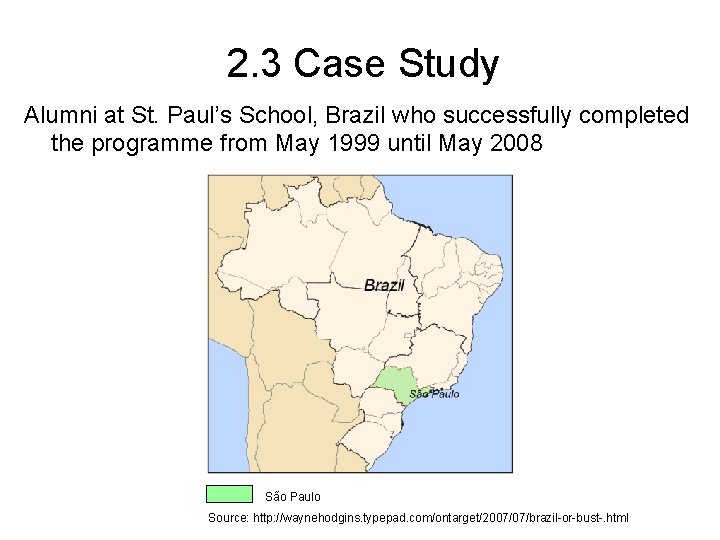
2. 3 Case Study Alumni at St. Paul’s School, Brazil who successfully completed the programme from May 1999 until May 2008 São Paulo Source: http: //waynehodgins. typepad. com/ontarget/2007/07/brazil-or-bust-. html
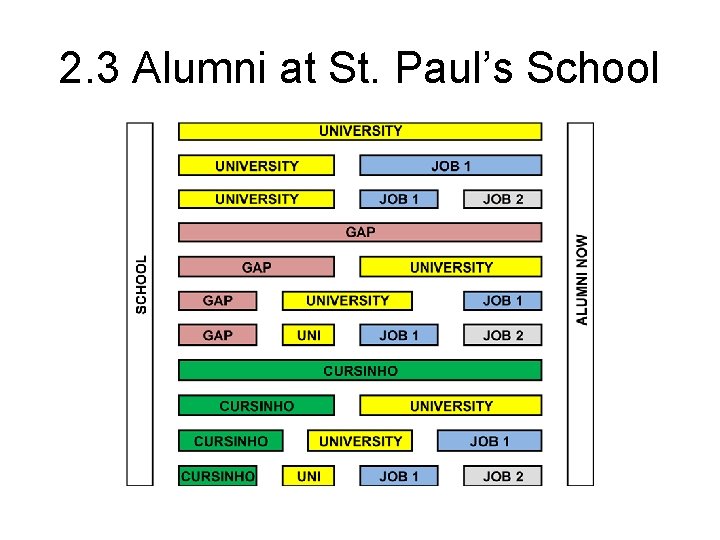
2. 3 Alumni at St. Paul’s School
2. 4 Data Collection Methods • Web based questionnaire -301 IBDP graduates from 1999 -2008 -71 responses • Semi-structured interview -12 interviews • Documentary analysis -67 students’ annual reports -IBO CAS Guides 1996 & 2003
2. 5 Preliminary findings 1. What were the main Service CAS experiences by students? Service within the school Recycling projects Charity campaigns Caring for and teaching / learning – underprivileged elderly in nursing home – underprivileged children (babies/toddlers/teenagers) in nurseries/schools – underprivileged adults – HIV positive children – children with cancer – orphans – disabled
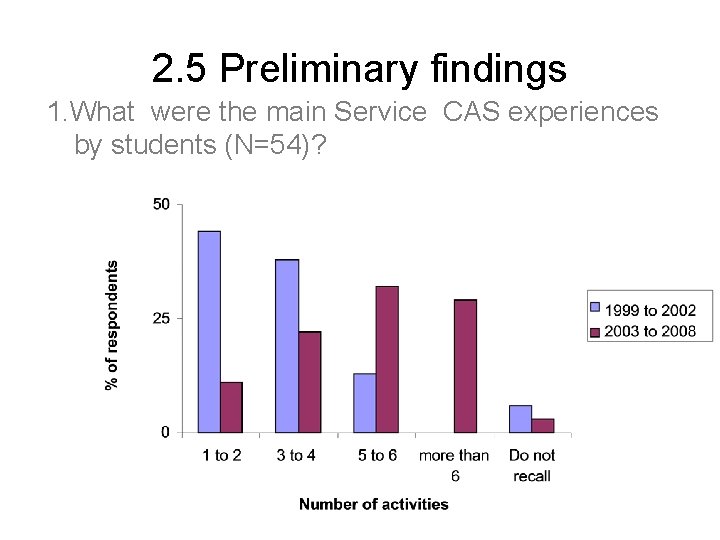
2. 5 Preliminary findings 1. What were the main Service CAS experiences by students (N=54)?
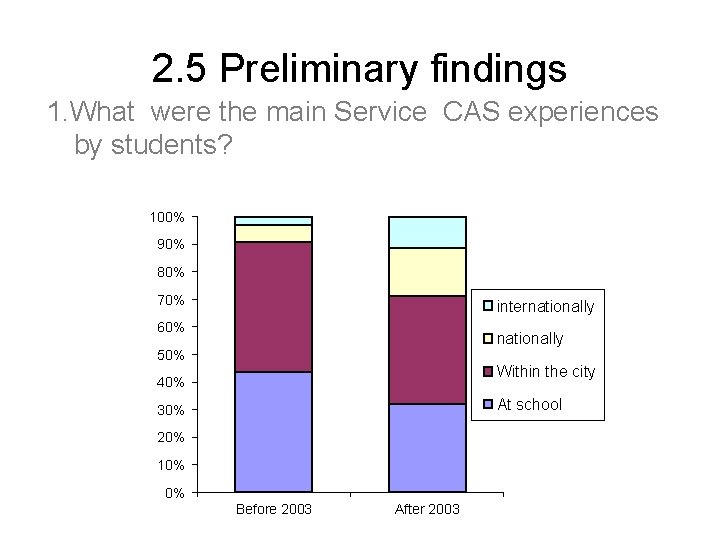
2. 5 Preliminary findings 1. What were the main Service CAS experiences by students? 100% 90% 80% 70% internationally 60% nationally 50% Within the city 40% At school 30% 20% 10% 0% Before 2003 After 2003
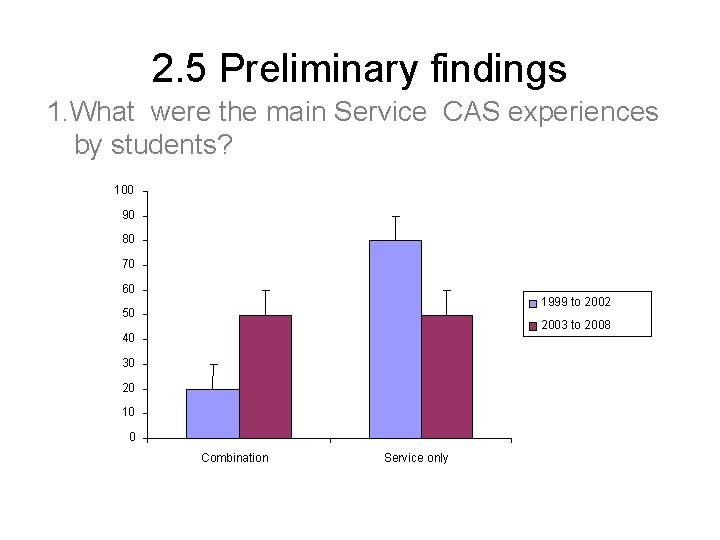
2. 5 Preliminary findings 1. What were the main Service CAS experiences by students? 100 90 80 70 60 1999 to 2002 50 2003 to 2008 40 30 20 10 0 Combination Service only
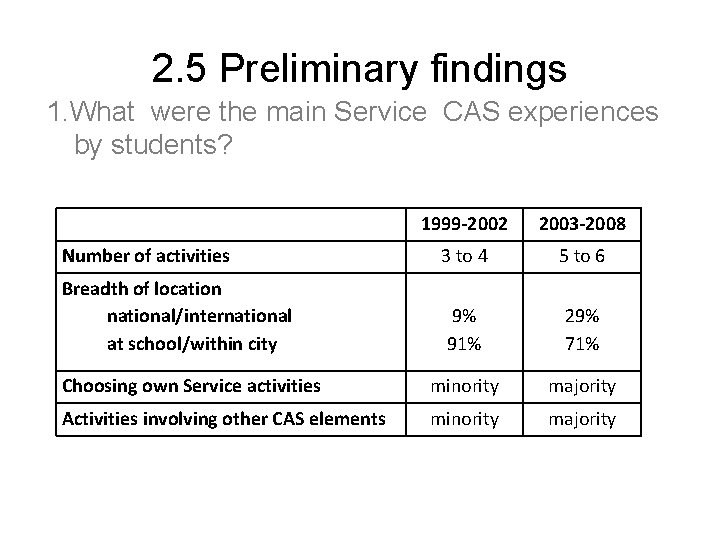
2. 5 Preliminary findings 1. What were the main Service CAS experiences by students? 1999 -2002 2003 -2008 Number of activities 3 to 4 5 to 6 Breadth of location national/international at school/within city 9% 91% 29% 71% Choosing own Service activities minority majority Activities involving other CAS elements minority majority
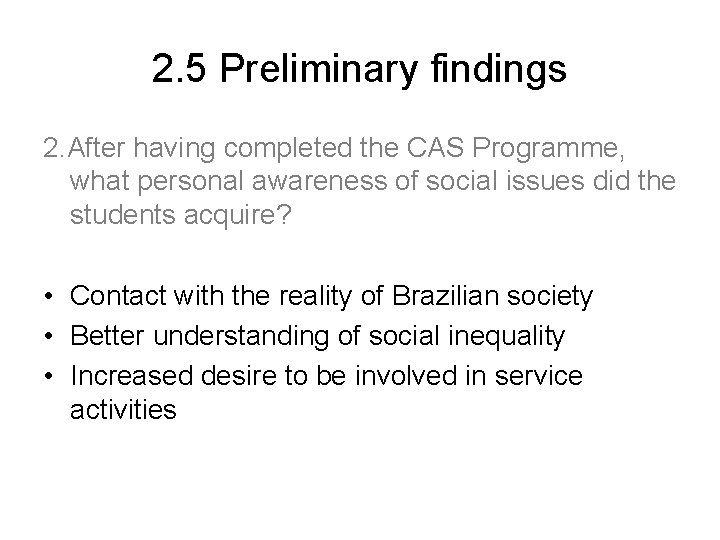
2. 5 Preliminary findings 2. After having completed the CAS Programme, what personal awareness of social issues did the students acquire? • Contact with the reality of Brazilian society • Better understanding of social inequality • Increased desire to be involved in service activities
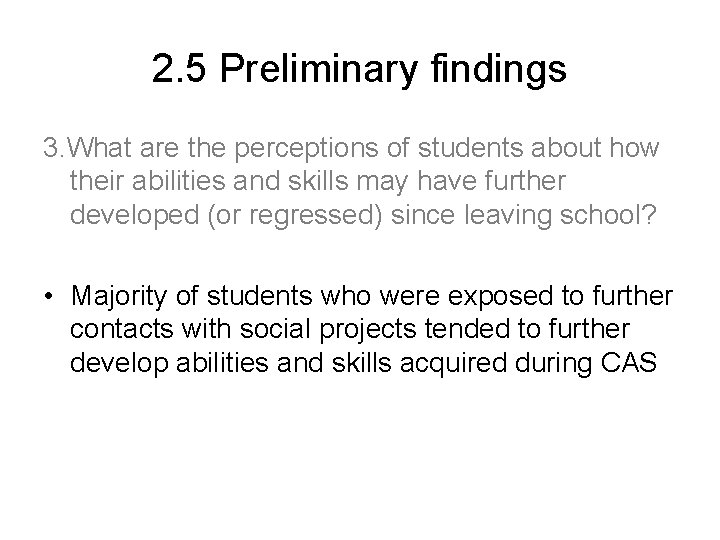
2. 5 Preliminary findings 3. What are the perceptions of students about how their abilities and skills may have further developed (or regressed) since leaving school? • Majority of students who were exposed to further contacts with social projects tended to further develop abilities and skills acquired during CAS
2. 5 Preliminary findings 4. Are students who have completed the CAS Programme interested in being involved with service activities (i. e. any form of aid, social projects or volunteering)? • Majority of students who engaged in social projects acknowledged that their CAS experience was crucial to their continuing involvement in the wider society.
2. 5 Preliminary findings 5. To what extent has the service element of CAS influenced alumni in adopting practices of active citizenship at the local, regional, national or international levels? • Under investigation
2. 6 Further Work • Extent to which the service element of CAS can affect the education of the ‘whole person’ as a lifelong learner – Compare before and after 2003 – Cross-reference questionnaires/interviews/school reports – Assess influence of Service in life after completion of programme (1 to 10 years) and how it changed with time and experiences – How students with different life experiences perceive their role as citizens as a consequence of the Service experience

Thank You
Additional Slides • To be used to clarify possible questions, if required
IBO • Non-profitable education foundation • Founded in 1968 • Offers three programmes for students aged 3 to 19 • Over 812, 000 IB students • 2, 935 schools • 139 countries
IB Mission Statement (1) The International Baccalaureate aims to develop inquiring, knowledgeable and caring young people who help to create a better and more peaceful world through intercultural understanding and respect. To this end the organization works with schools, governments and international organizations to develop challenging programmes of international education and rigorous assessment.
IB Mission Statement (2) These programmes encourage students across the world to become active, compassionate and lifelong learners who understand that other people, with their differences, can also be right” (www. ibo. org/mission/ accessed on 22. 06. 2010).
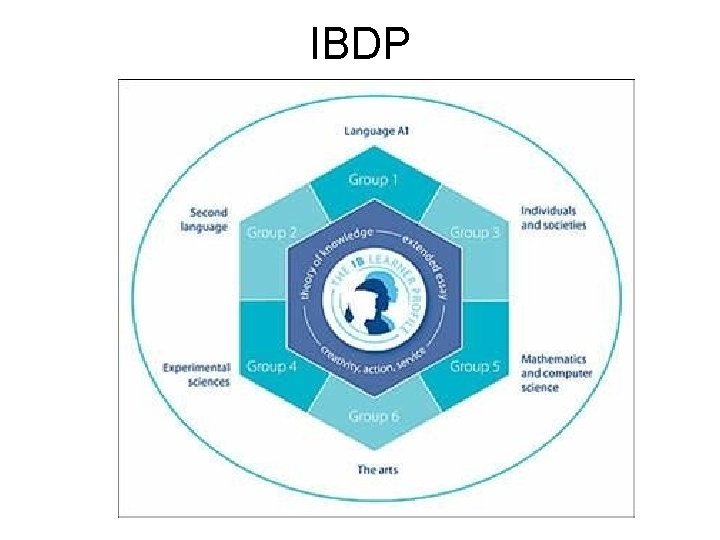
IBDP
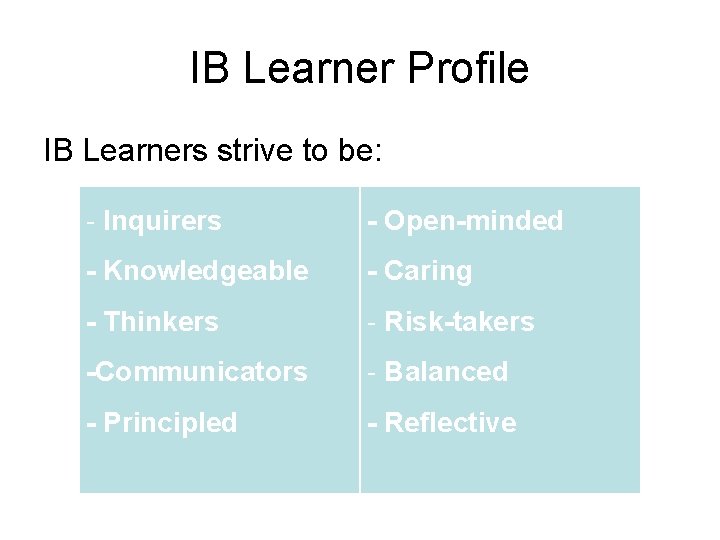
IB Learner Profile IB Learners strive to be: - Inquirers - Open-minded - Knowledgeable - Caring - Thinkers - Risk-takers -Communicators - Balanced - Principled - Reflective
What is CAS? María Piaggio • “It is an inside vibration, it is how and not how much” (IB 2001, p. 7).
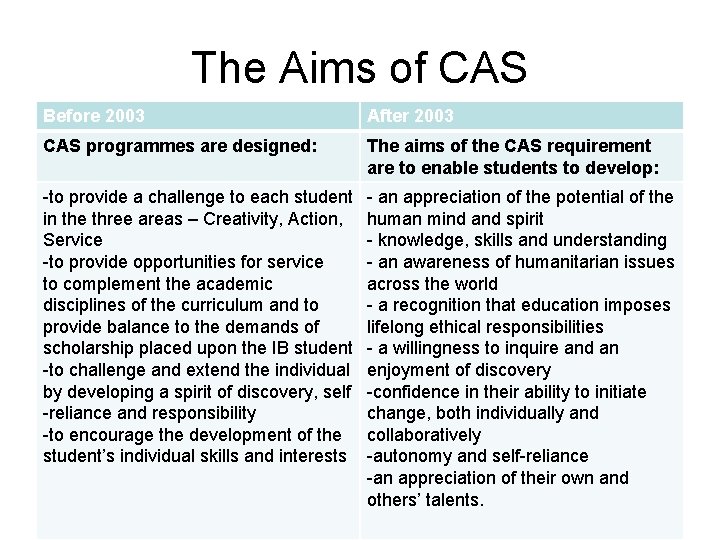
The Aims of CAS Before 2003 After 2003 CAS programmes are designed: The aims of the CAS requirement are to enable students to develop: -to provide a challenge to each student in the three areas – Creativity, Action, Service -to provide opportunities for service to complement the academic disciplines of the curriculum and to provide balance to the demands of scholarship placed upon the IB student -to challenge and extend the individual by developing a spirit of discovery, self -reliance and responsibility -to encourage the development of the student’s individual skills and interests - an appreciation of the potential of the human mind and spirit - knowledge, skills and understanding - an awareness of humanitarian issues across the world - a recognition that education imposes lifelong ethical responsibilities - a willingness to inquire and an enjoyment of discovery -confidence in their ability to initiate change, both individually and collaboratively -autonomy and self-reliance -an appreciation of their own and others’ talents.
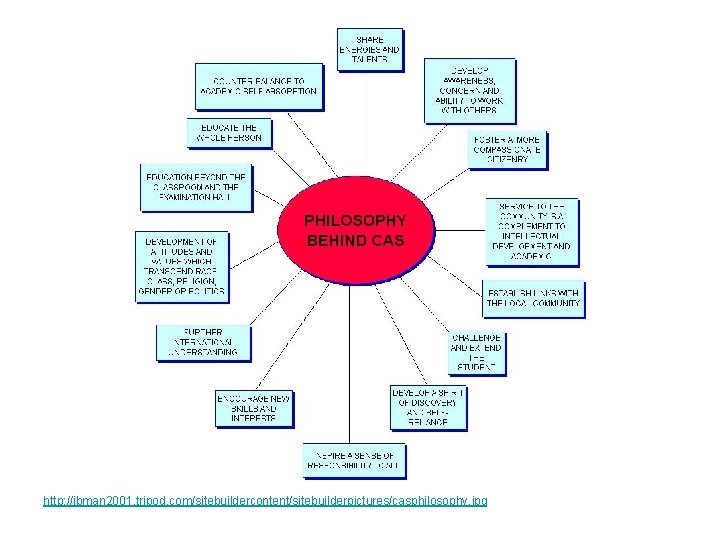
http: //ibman 2001. tripod. com/sitebuildercontent/sitebuilderpictures/casphilosophy. jpg
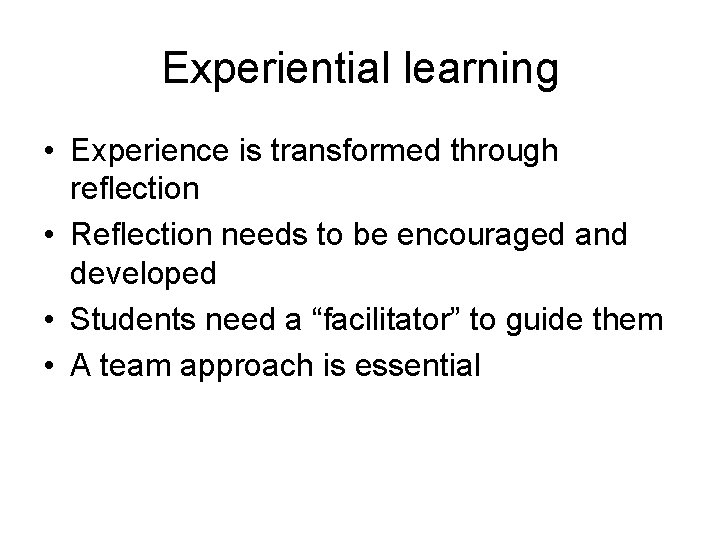
Experiential learning • Experience is transformed through reflection • Reflection needs to be encouraged and developed • Students need a “facilitator” to guide them • A team approach is essential h the transformation of experience. ” (Kolb, 1984)
- Slides: 41