
Impact of Southern Hemisphere Stratospheric Polar Vortex Weakening
![Predicting the S-T coupled mode • Project ensemble mean forecasts of Antarctic sub-polar [U]'](https://slidetodoc.com/presentation_image_h/929cee6e20813fd37fce01d7f687ffe4/image-12.jpg "Predicting the S-T coupled mode • Project ensemble mean forecasts of Antarctic sub-polar [U]'")
- Slides: 15
Impact of Southern Hemisphere Stratospheric Polar Vortex Weakening on Australian Climate Extremes Eun-Pa Lim 1, Harry H. Hendon 1, Ghyslaine Boschat 2, Debra Hudson 1, David W. J. Thompson 3, Andrew Dowdy 1 & Julie Arblaster 2 Bureau of Meteorology 2 ARC Centre of Excellence for Climate Extremes, Monash University 1 3 Colorado State University Bo. M R&D workshop 2019
Background • Sudden stratospheric warming (SSW) over the Arctic region extreme weather and climate conditions over Europe and North America in the NH winter-early spring (occurs every 13 years) • SSW is rare in the SH – one in the SH in the past 40 years observed in late September 2002 SH polar stratosphere has been paid little attention as a source of predictability of SH surface seasonal climate
• SH stratospheric polar vortex variability and its downward coupling Southern Annular Mode (SAM) in austral spring • SAM SH surface climate especially over AUS in springsummer We did 1. Develop an index that could capture the SH stratospheretroposphere (S-T) coupling (Lim et al. 2018 JGR) 2. Explore the response of AUS climate extremes to the S-T coupled variability over Antarctica (Lim et al. 2019 Nat Geosci)
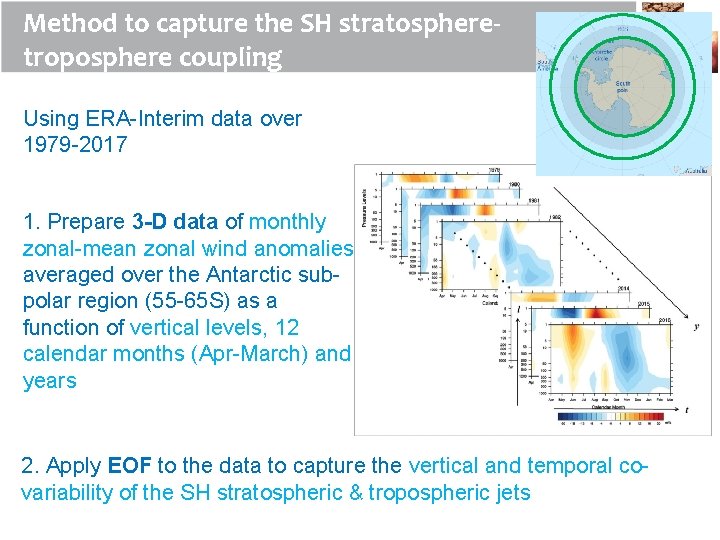
Method to capture the SH stratospheretroposphere coupling Using ERA-Interim data over 1979 -2017 1. Prepare 3 -D data of monthly zonal-mean zonal wind anomalies averaged over the Antarctic subpolar region (55 -65 S) as a function of vertical levels, 12 calendar months (Apr-March) and years 2. Apply EOF to the data to capture the vertical and temporal covariability of the SH stratospheric & tropospheric jets
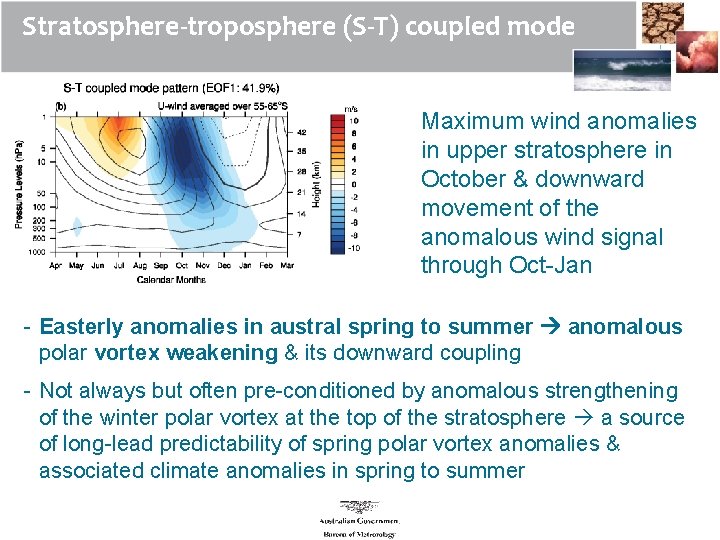
Stratosphere-troposphere (S-T) coupled mode Maximum wind anomalies in upper stratosphere in October & downward movement of the anomalous wind signal through Oct-Jan - Easterly anomalies in austral spring to summer anomalous polar vortex weakening & its downward coupling - Not always but often pre-conditioned by anomalous strengthening of the winter polar vortex at the top of the stratosphere a source of long-lead predictability of spring polar vortex anomalies & associated climate anomalies in spring to summer
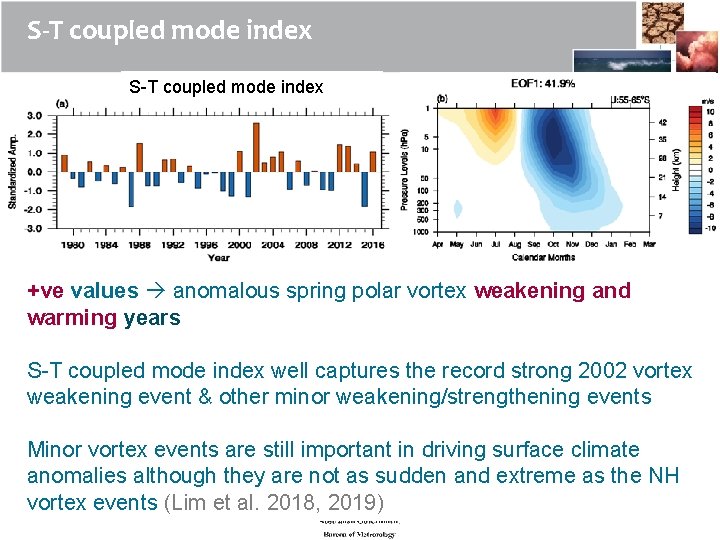
S-T coupled mode index +ve values anomalous spring polar vortex weakening and warming years S-T coupled mode index well captures the record strong 2002 vortex weakening event & other minor weakening/strengthening events Minor vortex events are still important in driving surface climate anomalies although they are not as sudden and extreme as the NH vortex events (Lim et al. 2018, 2019)
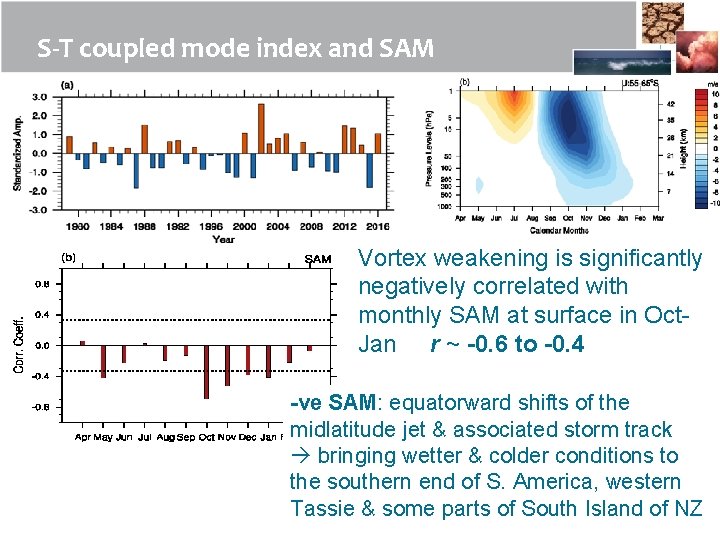
S-T coupled mode index and SAM Vortex weakening is significantly negatively correlated with monthly SAM at surface in Oct. Jan r ~ -0. 6 to -0. 4 -ve SAM: equatorward shifts of the midlatitude jet & associated storm track bringing wetter & colder conditions to the southern end of S. America, western Tassie & some parts of South Island of NZ
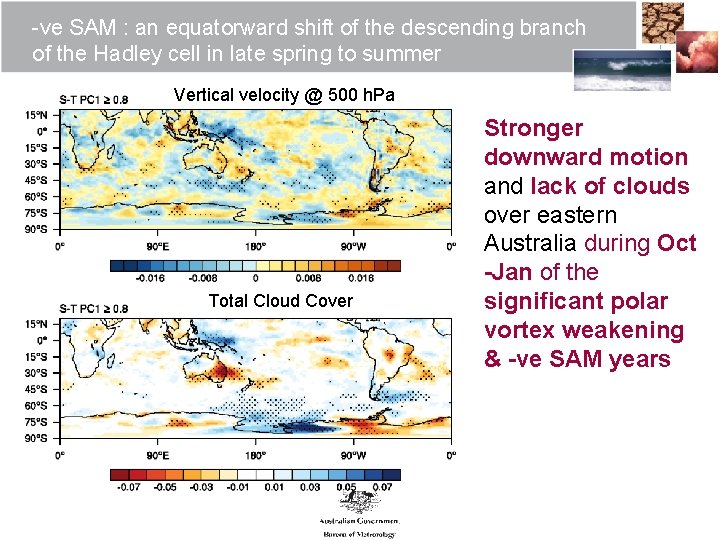
-ve SAM : an equatorward shift of the descending branch of the Hadley cell in late spring to summer Vertical velocity @ 500 h. Pa Total Cloud Cover Stronger downward motion and lack of clouds over eastern Australia during Oct -Jan of the significant polar vortex weakening & -ve SAM years
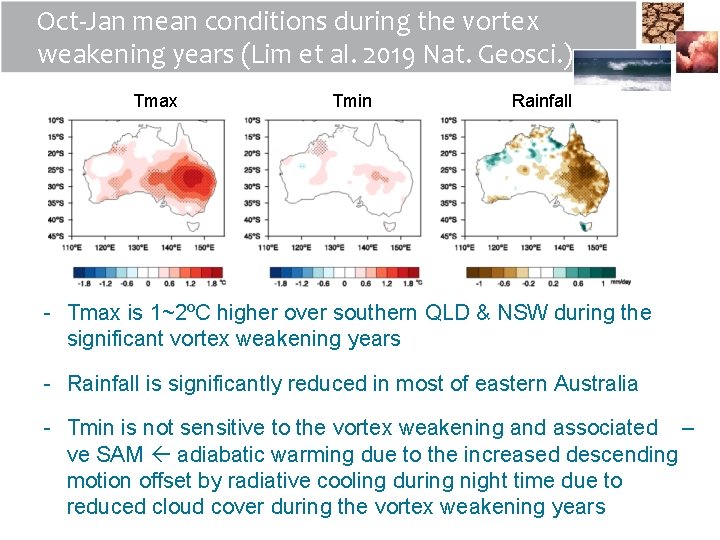
Oct-Jan mean conditions during the vortex weakening years (Lim et al. 2019 Nat. Geosci. ) Tmax Tmin Rainfall - Tmax is 1~2ºC higher over southern QLD & NSW during the significant vortex weakening years - Rainfall is significantly reduced in most of eastern Australia - Tmin is not sensitive to the vortex weakening and associated – ve SAM adiabatic warming due to the increased descending motion offset by radiative cooling during night time due to reduced cloud cover during the vortex weakening years
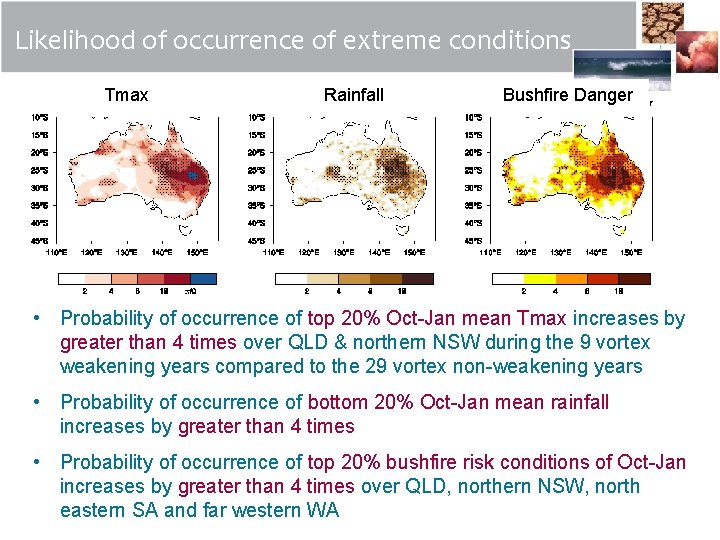
Likelihood of occurrence of extreme conditions Tmax Rainfall Bushfire Danger • Probability of occurrence of top 20% Oct-Jan mean Tmax increases by greater than 4 times over QLD & northern NSW during the 9 vortex weakening years compared to the 29 vortex non-weakening years • Probability of occurrence of bottom 20% Oct-Jan mean rainfall increases by greater than 4 times • Probability of occurrence of top 20% bushfire risk conditions of Oct-Jan increases by greater than 4 times over QLD, northern NSW, north eastern SA and far western WA
ACCESS-S 1 Forecasts Can ACCESS-S 1 predict interannual variations of the Antarctic polar vortex and associated climate extremes over Australia? Predictands: the S-T coupled mode index Top quintile Tmax Bottom quintile rainfall of October to January 11 -member ensemble forecasts initialised on 1 September for the hindcast period of 1990 -2012
Predicting the S-T coupled mode • Project ensemble mean forecasts of Antarctic sub-polar [U]' onto the sub-domain of the S-T coupled mode pattern from the surface to 1 h. Pa from September to January when the polar vortex and its downward coupling variability is maximum • Project ERAI data onto the same sub -domain to get a comparable time series forecast verification Correlation skill 0. 76
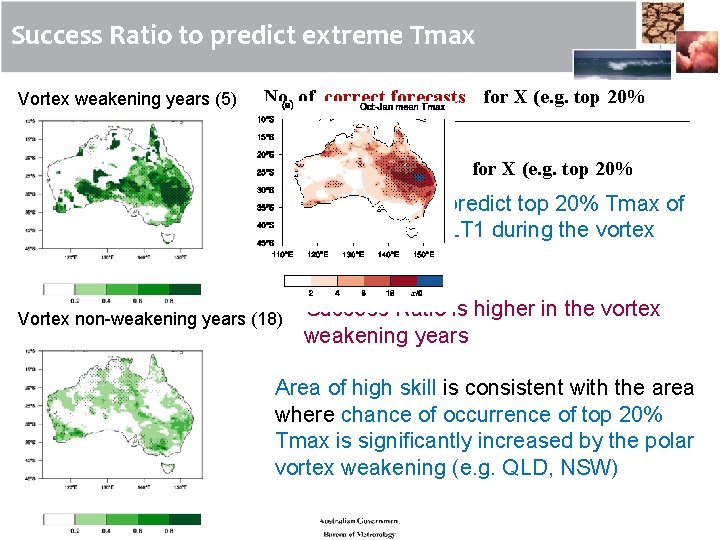
Success Ratio to predict extreme Tmax Vortex weakening years (5) No. of correct forecasts for X (e. g. top 20% Tmax) No. of forecast alarms for X (e. g. top 20% Tmax) Success Ratio to predict top 20% Tmax of Oct-Jan mean @ LT 1 during the vortex weakening years Vortex non-weakening years (18) Success Ratio is higher in the vortex weakening years Area of high skill is consistent with the area where chance of occurrence of top 20% Tmax is significantly increased by the polar vortex weakening (e. g. QLD, NSW)
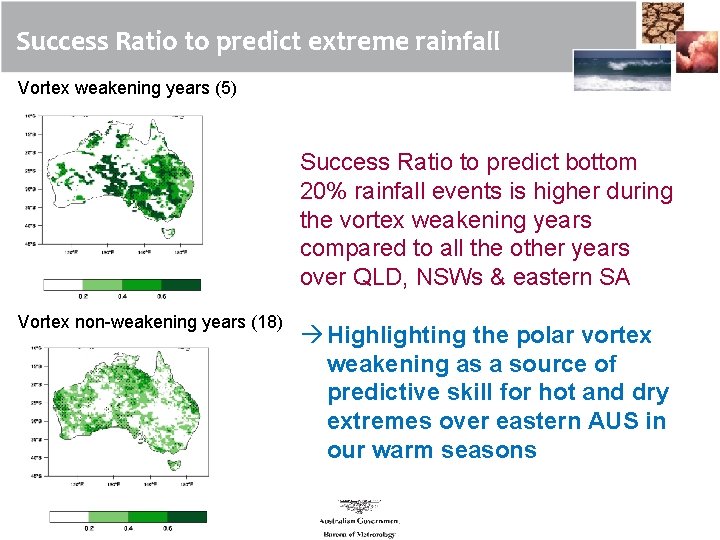
Success Ratio to predict extreme rainfall Vortex weakening years (5) Success Ratio to predict bottom 20% rainfall events is higher during the vortex weakening years compared to all the other years over QLD, NSWs & eastern SA Vortex non-weakening years (18) Highlighting the polar vortex weakening as a source of predictive skill for hot and dry extremes over eastern AUS in our warm seasons
Summary Less dramatic but still significant stratospheric polar vortex weakening events occur over Antarctica persistent –ve SAM during late spring-early summer extreme high Tmax, low rainfall & high fire danger weather conditions over QLD & NSW in late spring – early summer ACCESS-S 1 forecasts are skilful in predicting the S-T coupled mode index and the occurrence of extreme high Tmax and low rainfall during the polar vortex weakening years when forecasts are initialised in early September. We have been experiencing the very extreme climate conditions associated with stratospheric polar vortex weakening this spring ACCESS-S 1 predicted these anomalous conditions since mid-August