
IMPACT OF PECTIN ON THE GASTRIC DIGESTIBILITY OF
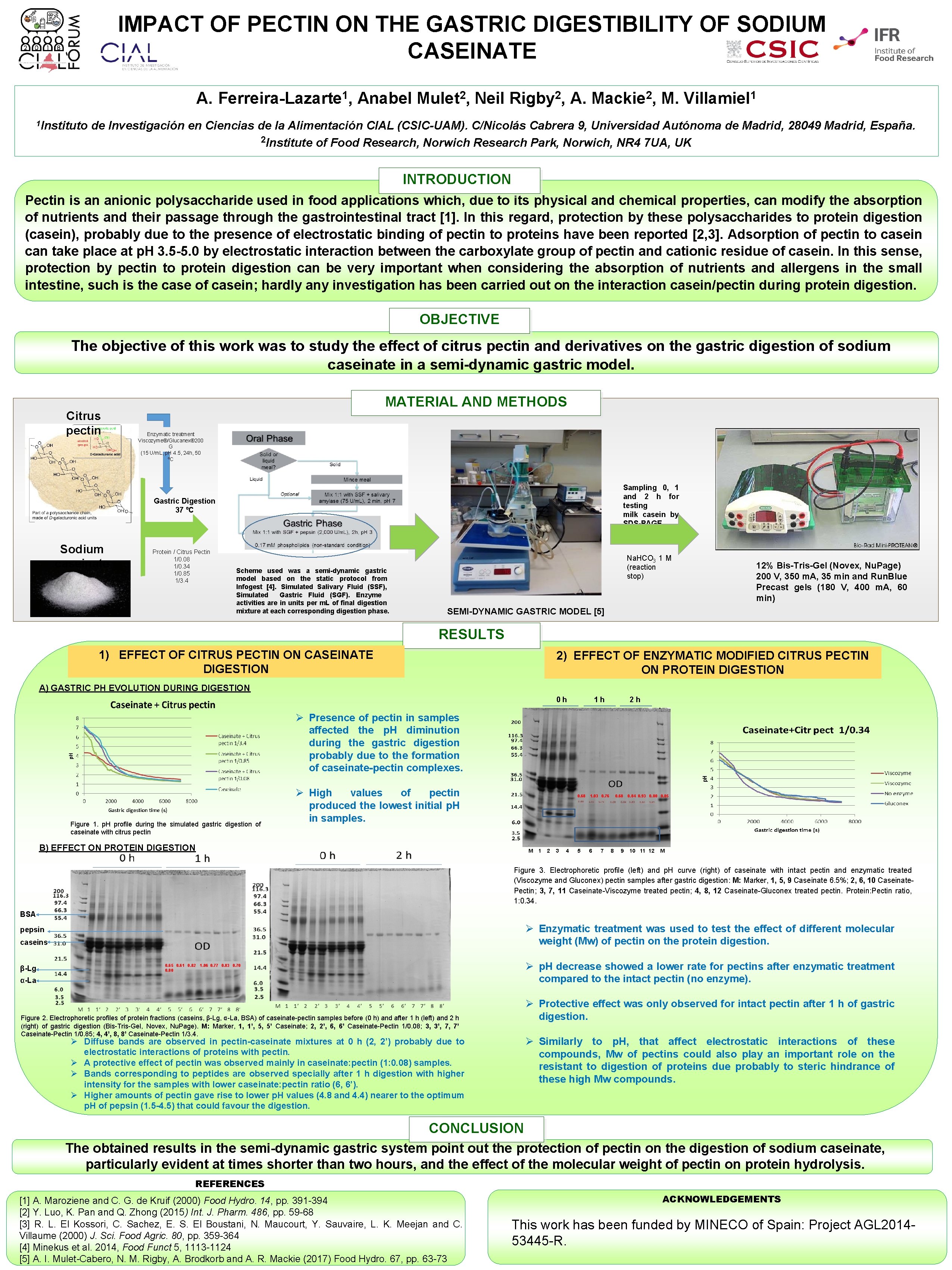
IMPACT OF PECTIN ON THE GASTRIC DIGESTIBILITY OF SODIUM CASEINATE A. Ferreira-Lazarte 1, Anabel Mulet 2, Neil Rigby 2, A. Mackie 2, M. Villamiel 1 1 Instituto de Investigación en Ciencias de la Alimentación CIAL (CSIC-UAM). C/Nicolás Cabrera 9, Universidad Autónoma de Madrid, 28049 Madrid, España. 2 Institute of Food Research, Norwich Research Park, Norwich, NR 4 7 UA, UK INTRODUCTION Pectin is an anionic polysaccharide used in food applications which, due to its physical and chemical properties, can modify the absorption of nutrients and their passage through the gastrointestinal tract [1]. In this regard, protection by these polysaccharides to protein digestion (casein), probably due to the presence of electrostatic binding of pectin to proteins have been reported [2, 3]. Adsorption of pectin to casein can take place at p. H 3. 5 -5. 0 by electrostatic interaction between the carboxylate group of pectin and cationic residue of casein. In this sense, protection by pectin to protein digestion can be very important when considering the absorption of nutrients and allergens in the small intestine, such is the case of casein; hardly any investigation has been carried out on the interaction casein/pectin during protein digestion. OBJECTIVE The objective of this work was to study the effect of citrus pectin and derivatives on the gastric digestion of sodium caseinate in a semi-dynamic gastric model. Citrus pectin MATERIAL AND METHODS Enzymatic treatment Viscozyme®/Glucanex® 200 G (15 U/m. L, p. H 4. 5, 24 h, 50 ºC Sampling 0, 1 and 2 h for testing milk casein by SDS-PAGE Gastric Digestion 37 ºC Sodium caseinate Protein / Citrus Pectin 1/0. 08 1/0. 34 1/0. 85 1/3. 4 Scheme used was a semi-dynamic gastric model based on the static protocol from Infogest [4]. Simulated Salivary Fluid (SSF), Simulated Gastric Fluid (SGF). Enzyme activities are in units per m. L of final digestion mixture at each corresponding digestion phase. Na. HCO 3 1 M (reaction stop) 12% Bis-Tris-Gel (Novex, Nu. Page) 200 V, 350 m. A, 35 min and Run. Blue Precast gels (180 V, 400 m. A, 60 min) SEMI-DYNAMIC GASTRIC MODEL [5] RESULTS 1) EFFECT OF CITRUS PECTIN ON CASEINATE DIGESTION 2) EFFECT OF ENZYMATIC MODIFIED CITRUS PECTIN ON PROTEIN DIGESTION A) GASTRIC PH EVOLUTION DURING DIGESTION 0 h 1 h 2 h Ø Presence of pectin in samples affected the p. H diminution during the gastric digestion probably due to the formation of caseinate-pectin complexes. Figure 1. p. H profile during the simulated gastric digestion of caseinate with citrus pectin Ø High values of pectin produced the lowest initial p. H in samples. B) EFFECT ON PROTEIN DIGESTION M 1 2 3 4 0. 68 1. 03 0. 76 5 6 7 0. 68 8 9 0. 84 0. 93 0. 80 0. 85 10 11 12 M Figure 3. Electrophoretic profile (left) and p. H curve (right) of caseinate with intact pectin and enzymatic treated (Viscozyme and Gluconex) pectin samples after gastric digestion: M: Marker, 1, 5, 9 Caseinate 6. 5%; 2, 6, 10 Caseinate. Pectin; 3, 7, 11 Caseinate-Viscozyme treated pectin; 4, 8, 12 Caseinate-Gluconex treated pectin. Protein: Pectin ratio, 1: 0. 34. BSA Ø Enzymatic treatment was used to test the effect of different molecular weight (Mw) of pectin on the protein digestion. pepsin caseins β-Lg 0. 65 0. 61 0. 82 0. 80 Ø p. H decrease showed a lower rate for pectins after enzymatic treatment compared to the intact pectin (no enzyme). 1. 06 0. 77 0. 83 0. 70 α-La Ø Protective effect was only observed for intact pectin after 1 h of gastric digestion. Figure 2. Electrophoretic profiles of protein fractions (caseins, β-Lg, α-La, BSA) of caseinate-pectin samples before (0 h) and after 1 h (left) and 2 h (right) of gastric digestion (Bis-Tris-Gel, Novex, Nu. Page). M: Marker, 1, 1’, 5, 5’ Caseinate; 2, 2’, 6, 6’ Caseinate-Pectin 1/0. 08; 3, 3’, 7, 7’ Caseinate-Pectin 1/0. 85; 4, 4’, 8, 8’ Caseinate-Pectin 1/3. 4. Ø Similarly to p. H, that affect electrostatic interactions of these compounds, Mw of pectins could also play an important role on the resistant to digestion of proteins due probably to steric hindrance of these high Mw compounds. Ø Diffuse bands are observed in pectin-caseinate mixtures at 0 h (2, 2’) probably due to electrostatic interactions of proteins with pectin. Ø A protective effect of pectin was observed mainly in caseinate: pectin (1: 0. 08) samples. Ø Bands corresponding to peptides are observed specially after 1 h digestion with higher intensity for the samples with lower caseinate: pectin ratio (6, 6’). Ø Higher amounts of pectin gave rise to lower p. H values (4. 8 and 4. 4) nearer to the optimum p. H of pepsin (1. 5 -4. 5) that could favour the digestion. CONCLUSION The obtained results in the semi-dynamic gastric system point out the protection of pectin on the digestion of sodium caseinate, particularly evident at times shorter than two hours, and the effect of the molecular weight of pectin on protein hydrolysis. REFERENCES [1] A. Maroziene and C. G. de Kruif (2000) Food Hydro. 14, pp. 391 -394 [2] Y. Luo, K. Pan and Q. Zhong (2015) Int. J. Pharm. 486, pp. 59 -68 [3] R. L. El Kossori, C. Sachez, E. S. El Boustani, N. Maucourt, Y. Sauvaire, L. K. Meejan and C. Villaume (2000) J. Sci. Food Agric. 80, pp. 359 -364 [4] Minekus et al. 2014, Food Funct 5, 1113 -1124 [5] A. I. Mulet-Cabero, N. M. Rigby, A. Brodkorb and A. R. Mackie (2017) Food Hydro. 67, pp. 63 -73 ACKNOWLEDGEMENTS This work has been funded by MINECO of Spain: Project AGL 201453445 -R.
- Slides: 1