
Impact of Microphysics Schemes in WRF on Passive

- Slides: 15
Impact of Microphysics Schemes in WRF on Passive Microwave Brightness Temperatures Research Group Meeting 19 August 2016 Scott Sieron Advisors: Fuqing Zhang, Eugene Clothiaux Major Collaborator: Lu Yinghui
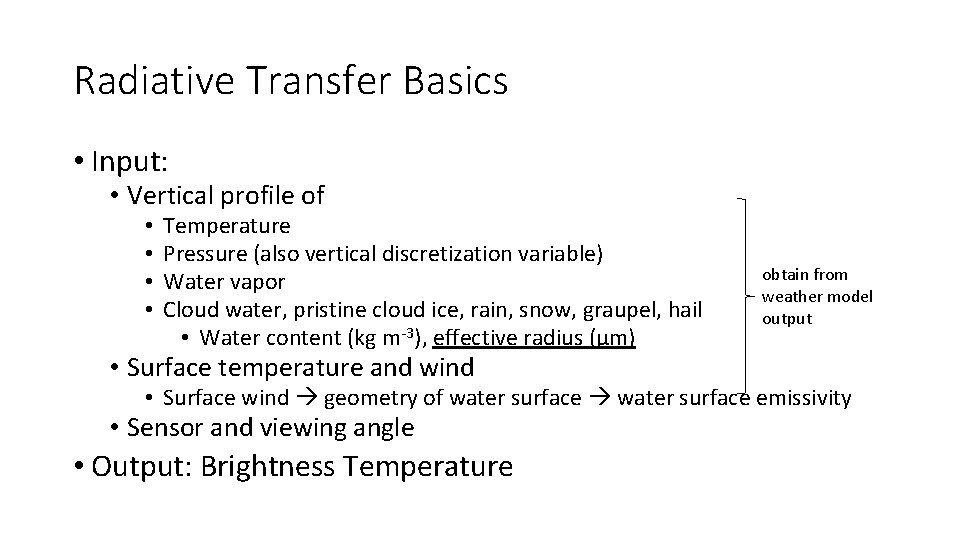
Radiative Transfer Basics • Input: • Vertical profile of • • Temperature Pressure (also vertical discretization variable) Water vapor Cloud water, pristine cloud ice, rain, snow, graupel, hail • Water content (kg m-3), effective radius (μm) • Surface temperature and wind obtain from weather model output • Surface wind geometry of water surface emissivity • Sensor and viewing angle • Output: Brightness Temperature
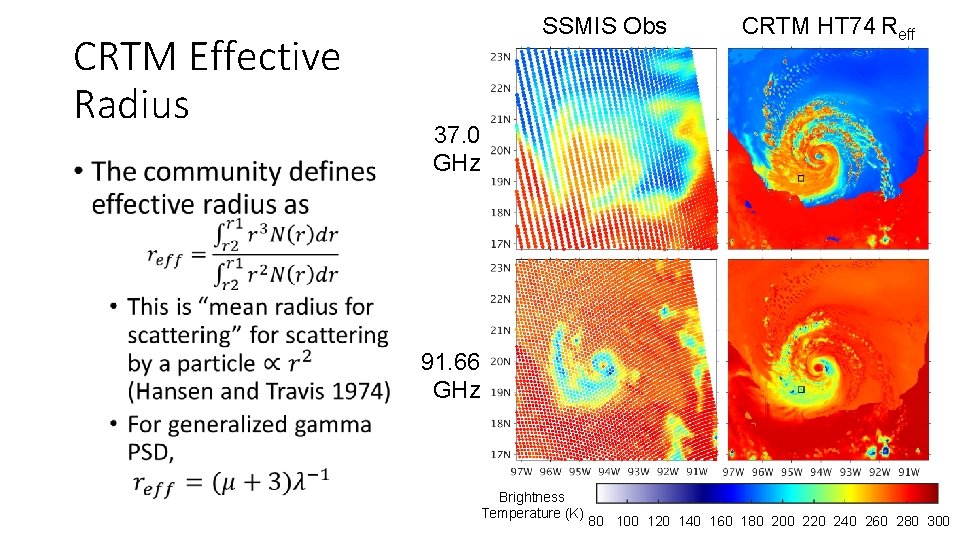
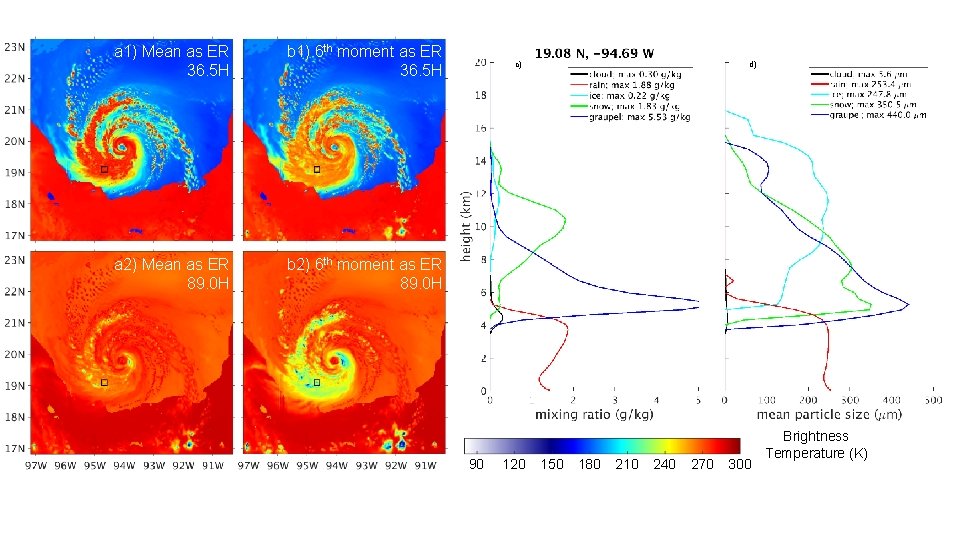
CRTM Effective Radius • SSMIS Obs CRTM HT 74 Reff 37. 0 GHz 91. 66 GHz Brightness Temperature (K) 80 100 120 140 160 180 200 220 240 260 280 300
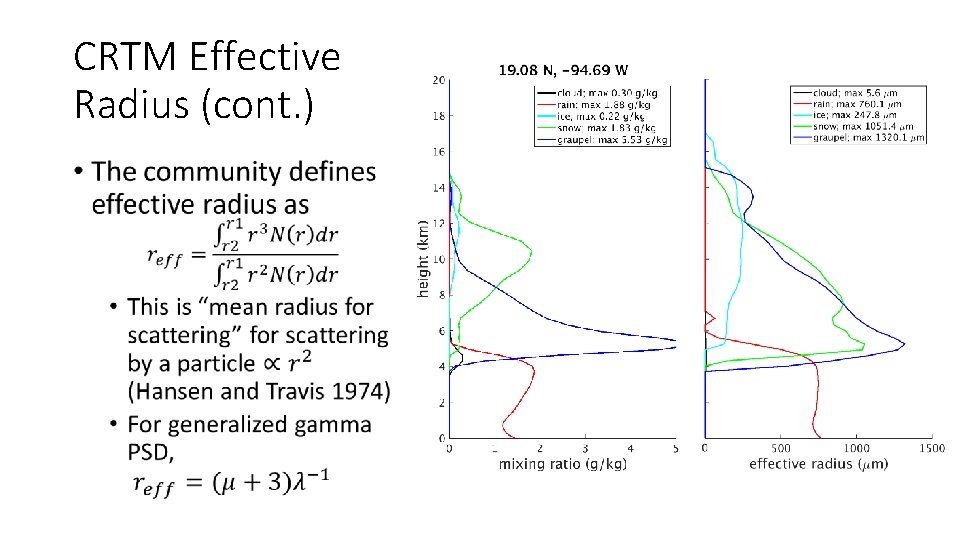
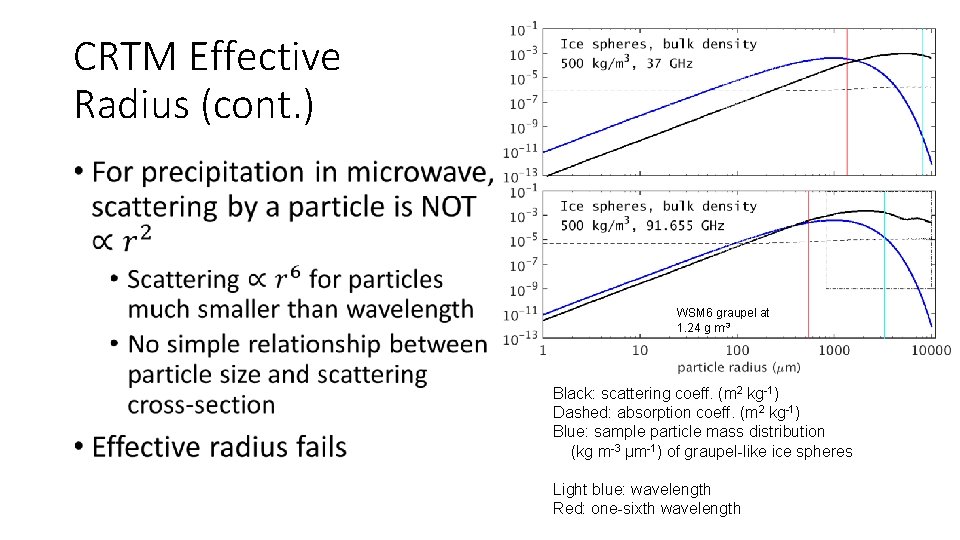
CRTM Effective Radius (cont. )
CRTM Effective Radius (cont. ) • WSM 6 graupel at 1. 24 g m-3 Black: scattering coeff. (m 2 kg-1) Dashed: absorption coeff. (m 2 kg-1) Blue: sample particle mass distribution (kg m-3 µm-1) of graupel-like ice spheres Light blue: wavelength Red: one-sixth wavelength
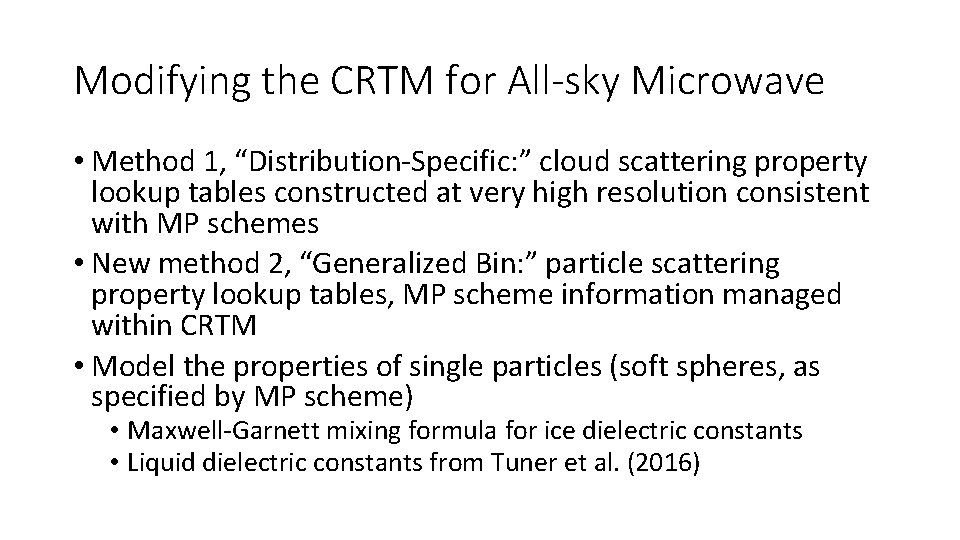
Modifying the CRTM for All-sky Microwave • Method 1, “Distribution-Specific: ” cloud scattering property lookup tables constructed at very high resolution consistent with MP schemes • New method 2, “Generalized Bin: ” particle scattering property lookup tables, MP scheme information managed within CRTM • Model the properties of single particles (soft spheres, as specified by MP scheme) • Maxwell-Garnett mixing formula for ice dielectric constants • Liquid dielectric constants from Tuner et al. (2016)
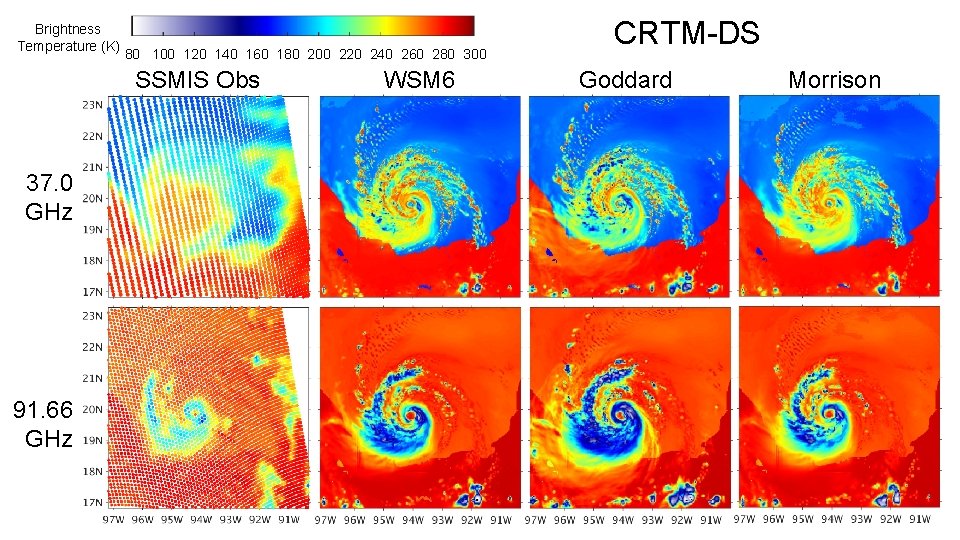
Brightness Temperature (K) 80 100 120 140 160 180 200 220 240 260 280 300 SSMIS Obs 37. 0 GHz 91. 66 GHz WSM 6 CRTM-DS Goddard Morrison
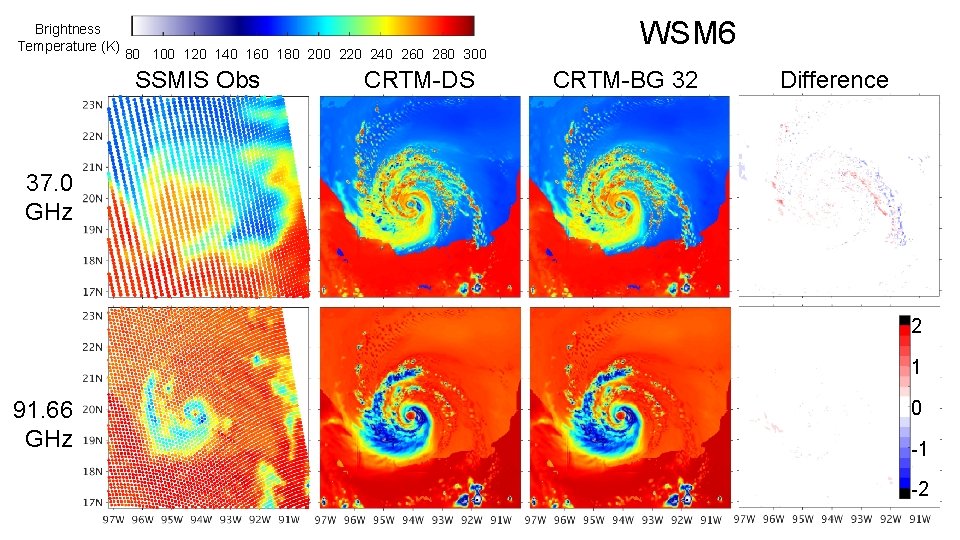
Brightness Temperature (K) 80 100 120 140 160 180 200 220 240 260 280 300 SSMIS Obs CRTM-DS WSM 6 CRTM-BG 32 Difference 37. 0 GHz 2 1 91. 66 GHz 0 -1 -2
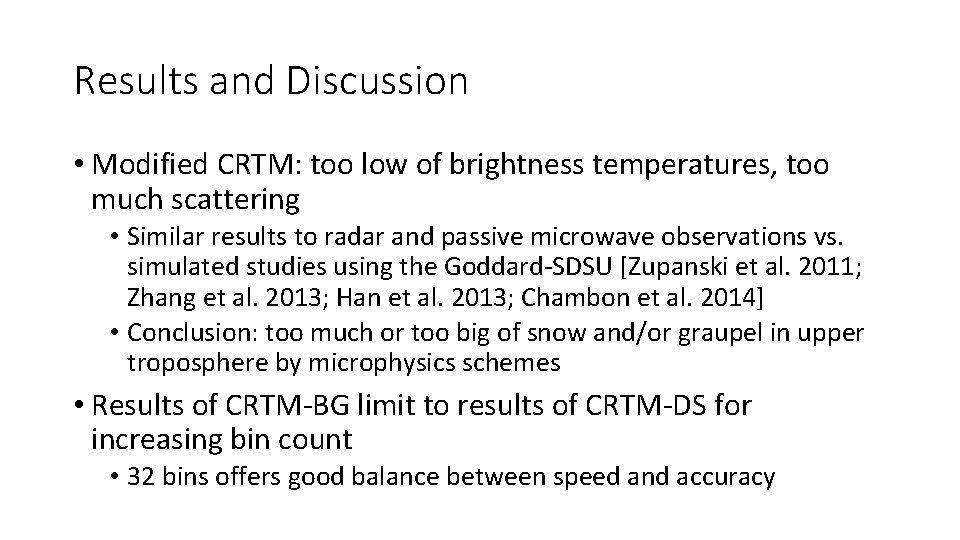
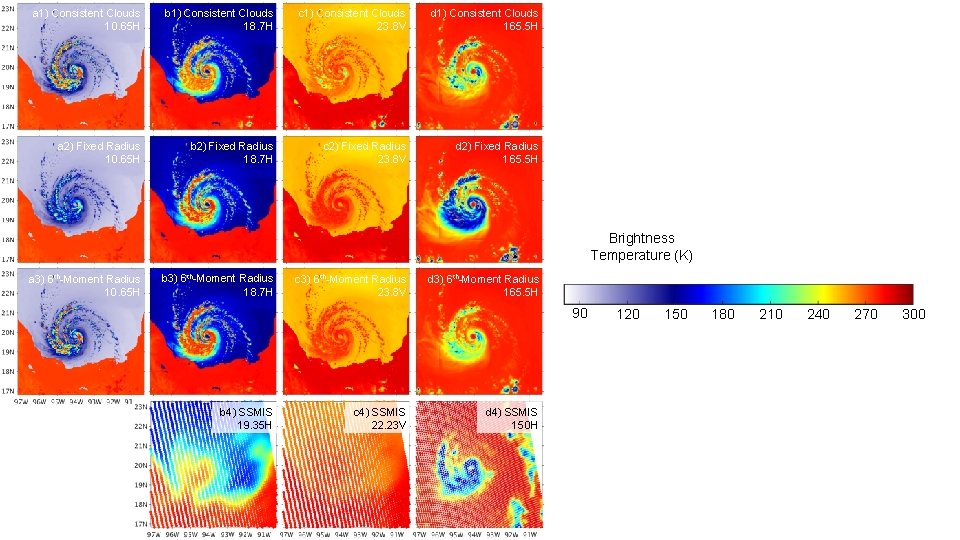
Results and Discussion • Modified CRTM: too low of brightness temperatures, too much scattering • Similar results to radar and passive microwave observations vs. simulated studies using the Goddard-SDSU [Zupanski et al. 2011; Zhang et al. 2013; Han et al. 2013; Chambon et al. 2014] • Conclusion: too much or too big of snow and/or graupel in upper troposphere by microphysics schemes • Results of CRTM-BG limit to results of CRTM-DS for increasing bin count • 32 bins offers good balance between speed and accuracy
Results and Discussion (continued) • Differences in simulated brightness temperatures between microphysics schemes: • Different integrated cloud masses • Significantly different particle size distributions
Future Directions • Refining and adding modifications, working within the CRTM repository Optimize Bin Discretized computations, reduce redundant LUT queries Non-spherical particle optical properties Tangent linear, adjoint, K-matrix Antenna pattern convolution and slant path constructions (features in satellite simulators) • Automatic stream number estimation • • • Uses for this tool: • Ensemble parameter estimation • Observing System Experiments (testing data assimilation) • Simulated or real observations
References Chambon, P. , S. Q. Zhang, A. Y. Hou, M. Zupanski, and S. Cheung, 2014: Assessing the impact of pre-GPM microwave precipitation observations in the Goddard WRF ensemble data assimilation system. Quart. Jour. Roy. Meteor. Soc. , 140, 1219– 1235. Han, M. , S. A. Braun, T. Matsui, and C. R. Williams, 2013: Evaluation of cloud microphysics schemes in simulations of a winter storm using radar and radiometer measurements. J. Geophys. Res. Atmos. , 118, 1401– 1419. Liu, Q. , and F. Weng, 2006: Advanced doubling-adding method for radiative transfer in planetary atmospheres. J. Atmos. Sci. , 63, 3459‒ 3465. Skamarock, W. C. , J. B. Klemp, J. Dudhia, D. O. Gill, D. M. Barker, M. G. Duda, X. -Y. Huang, W. Wang, and J. G. Powers, 2008: A description of the Advanced Research WRF version 3. NCAR Technical Note 475, http: //www. mmm. ucar. edu/wrf/users/docs/arw_v 3. pdf. Weng, Y. , and F. Zhang, 2012: Assimilating Airborne Doppler Radar Observations with an Ensemble Kalman Filter for Convection-permitting Hurricane Initialization and Prediction: Katrina (2005). Mon. Wea. Rev. , 140, 841 -859. Wong, V. , and K. A. Emanuel, 2007: Use of cloud radars and radiometers for tropical cyclone intensity estimation, Geophys. Res. Lett. , 34, L 12811, doi: 10. 1029/2007 GL 029960. Zhang, S. Q. , M. Zupanski, A. Y. Hou, X. Lin, and S. H. Cheung, 2013: Assimilation of Precipitation-Affected Radiances in a Cloud-Resolving WRF Ensemble Data Assimilation System. Mon. Wea. Rev. , 141, 754– 772. Zhang, F. , Y. Weng, J. A. Sippel, Z. Meng, and C. H. Bishop, 2009: Cloud-resolving Hurricane Initialization and Prediction through Assimilation of Doppler Radar Observations with an Ensemble Kalman Filter. Mon. Wea. Rev. , 137, 2105 -2125. Zupanski, D. , S. Q. Zhang, M. Zupanski, A. Y. Hou, and S. H. Cheung, 2011: A Prototype WRF-Based Ensemble Data Assimilation System for Dynamically Downscaling Satellite Precipitation Observations. J. Hydrometeor. , 12, 118– 134.
Extra Slides
a 1) Mean as ER 36. 5 H b 1) 6 th moment as ER 36. 5 H a 2) Mean as ER 89. 0 H b 2) 6 th moment as ER 89. 0 H d) c) c) WSM 6 89. 0 H 90 120 150 180 210 240 270 300 Brightness Temperature (K)
a 1) Consistent Clouds 10. 65 H b 1) Consistent Clouds 18. 7 H c 1) Consistent Clouds 23. 8 V d 1) Consistent Clouds 165. 5 H a 2) Fixed Radius 10. 65 H b 2) Fixed Radius 18. 7 H c 2) Fixed Radius 23. 8 V d 2) Fixed Radius 165. 5 H Brightness Temperature (K) a 3) 6 th-Moment Radius 10. 65 H b 3) 6 th-Moment Radius 18. 7 H c 3) 6 th-Moment Radius 23. 8 V d 3) 6 th-Moment Radius 165. 5 H 90 b 4) SSMIS 19. 35 H c 4) SSMIS 22. 23 V d 4) SSMIS 150 H 120 150 180 210 240 270 300