
IMPACT OF GLOBALIZATION ON DIRECTIVE PRINCIPLES OF STATE
IMPACT OF GLOBALIZATION ON DIRECTIVE PRINCIPLES OF STATE POLICY Apurva Thakur Pre-Ph. D Coursework- 2020
About Directive Principles of State Policy T he Constitution of India, particularly under Directive Principles of State Policy, provides the basic policy framework for the industrial relations policy of the Government. The preamble of the Constitution promises to secure justice “Social, Economic and Political” to all the citizens. The chapter on fundamental rights guarantee its citizens several rights such as right to freedom of association, rights against exploitation, prohibition of beggar and other similar forms of forced labour and prohibits employment of children below 14 years in any factory or mine. A combined reading of relevant fundamental rights and Directive Principles of State Policy makes it clear that the framers of the Constitution made it obligatory for the state to promote industrial development, peace, harmony and also labour welfarism.
• DPSP enshrined in Part-IV ( A 36 to 51 ) of the constitution are borrowed from Ireland constitution. • Our Constitution established a Welfare State and the Directive Principles of State Policy (DPSP) contained a detailed agenda for socio-economic transformation and reconstruction of our society. The DPSP were to be taken as fundamental and as providing guidance in the governance of the country
Reading International Conventions into DPSP by the Supreme Court In Kapila Hingorani v. state of Bihar, Failure of state owned Company to pay salaries to their employees had resulted in deaths of employees due to starvation. While upholding the right to life (21) and Articles 38, 39, 41 of the Constitution of India, the SC quoted Article 11 of the ICESCR (The International Covenant on Economic, Social and Cultural Rights )which puts a duty on the state to provide adequate standard of living including food, clothing and shelter.
Air India Statutory Corporation v. United Labour Union, 1996 • SC observed that DPSP are forerunners to the united nations convention on Right to development. DPSPs are embedded in the constitution and have been elevated to the status of Fundamental Rights.
Kesavanand Bharti v. state of kerala, 1973 Art 51 - “promotion of international peace and security” adheres to the international principle of ‘pacta sunt servanda’ and is included as a basic sructure of the constitution.
Bandhua mukti morcha v. UOI, 1984 • SC stated that Art 21 derives it’s life breath from DPSP. It invoked Art 39(e )(f), art 41 , Art 42 to pass an order granting dignity and freedom from bonded labour and granted compensation for the same.
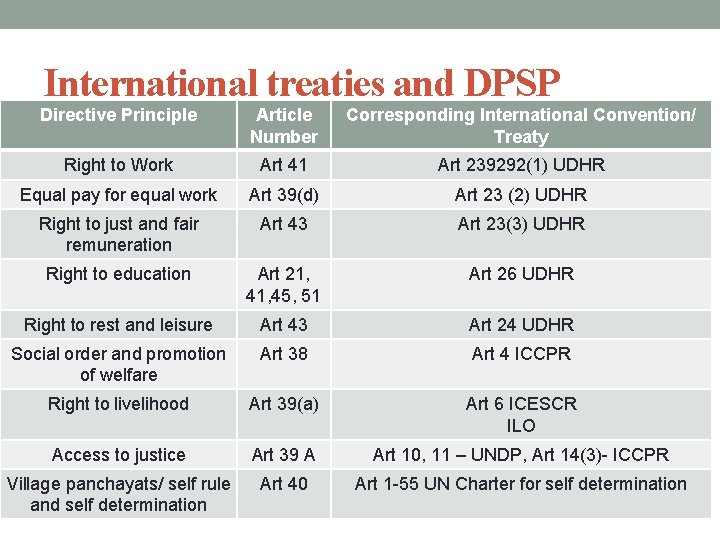
International treaties and DPSP Directive Principle Article Number Corresponding International Convention/ Treaty Right to Work Art 41 Art 239292(1) UDHR Equal pay for equal work Art 39(d) Art 23 (2) UDHR Right to just and fair remuneration Art 43 Art 23(3) UDHR Right to education Art 21, 45, 51 Art 26 UDHR Right to rest and leisure Art 43 Art 24 UDHR Social order and promotion of welfare Art 38 Art 4 ICCPR Right to livelihood Art 39(a) Art 6 ICESCR ILO Access to justice Art 39 A Art 10, 11 – UNDP, Art 14(3)- ICCPR Village panchayats/ self rule and self determination Art 40 Art 1 -55 UN Charter for self determination
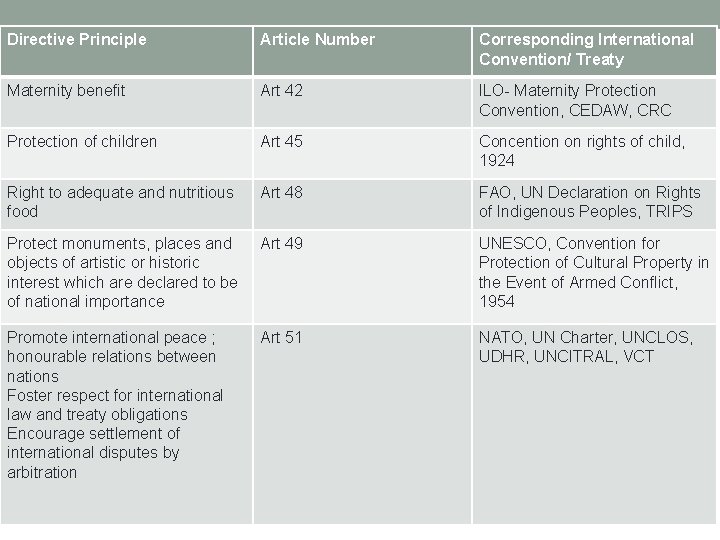
Directive Principle Article Number Corresponding International Convention/ Treaty Maternity benefit Art 42 ILO- Maternity Protection Convention, CEDAW, CRC Protection of children Art 45 Concention on rights of child, 1924 Right to adequate and nutritious food Art 48 FAO, UN Declaration on Rights of Indigenous Peoples, TRIPS Protect monuments, places and objects of artistic or historic interest which are declared to be of national importance Art 49 UNESCO, Convention for Protection of Cultural Property in the Event of Armed Conflict, 1954 Promote international peace ; honourable relations between nations Foster respect for international law and treaty obligations Encourage settlement of international disputes by arbitration Art 51 NATO, UN Charter, UNCLOS, UDHR, UNCITRAL, VCT
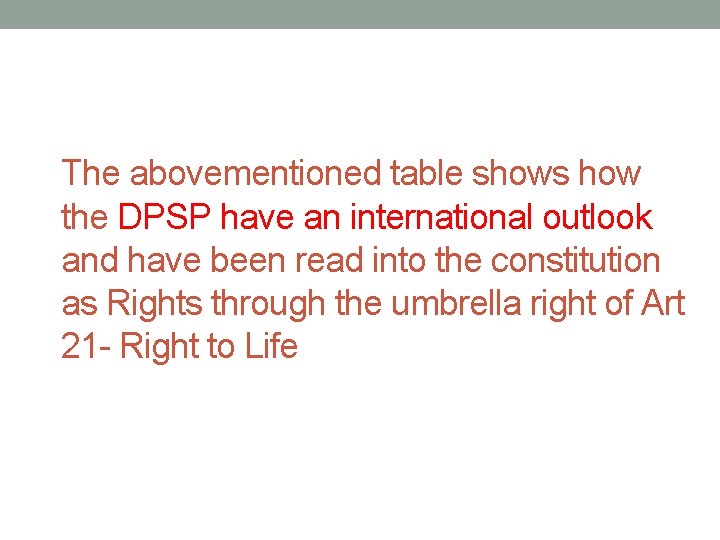
The abovementioned table shows how the DPSP have an international outlook and have been read into the constitution as Rights through the umbrella right of Art 21 - Right to Life
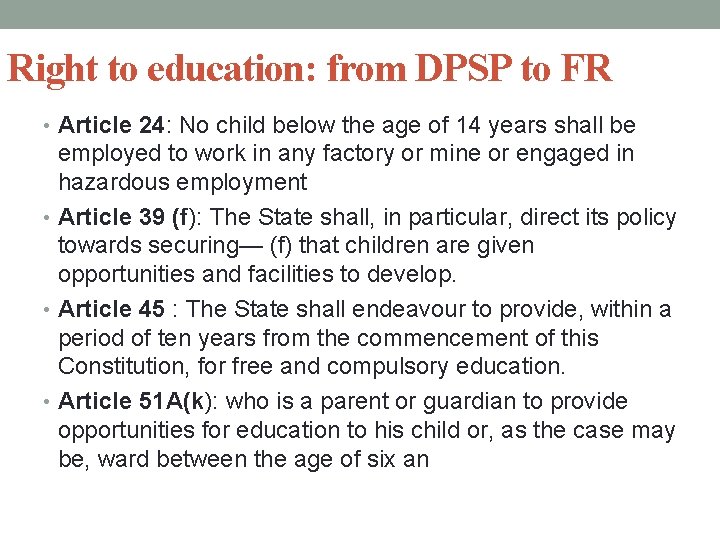
Right to education: from DPSP to FR • Article 24: No child below the age of 14 years shall be employed to work in any factory or mine or engaged in hazardous employment • Article 39 (f): The State shall, in particular, direct its policy towards securing— (f) that children are given opportunities and facilities to develop. • Article 45 : The State shall endeavour to provide, within a period of ten years from the commencement of this Constitution, for free and compulsory education. • Article 51 A(k): who is a parent or guardian to provide opportunities for education to his child or, as the case may be, ward between the age of six an
Unnikrishnan v State of AP, 1993 The case involved a challenge by certain private professional educational facilities to the constitutionality of state laws regulating capitation fees charged by such institutions. . The Court ruled that there is no fundamental right to education for a professional degree that flows from Article 21 Mohini Jain v UOI, 1992 Right to life' is the compendious expression for all those rights which the courts must enforce because they are basic to the dignified enjoyment of life. It extends to the full range of conduct which the individual is free to pursue. The right to education flows directly from right to life. The right to life under Article 21 and the dignity of an individual cannot be assured unless it is accompanied by the right to education. The State Government is under an obligation to make endeavor to provide educational facility at all levels to its citizens
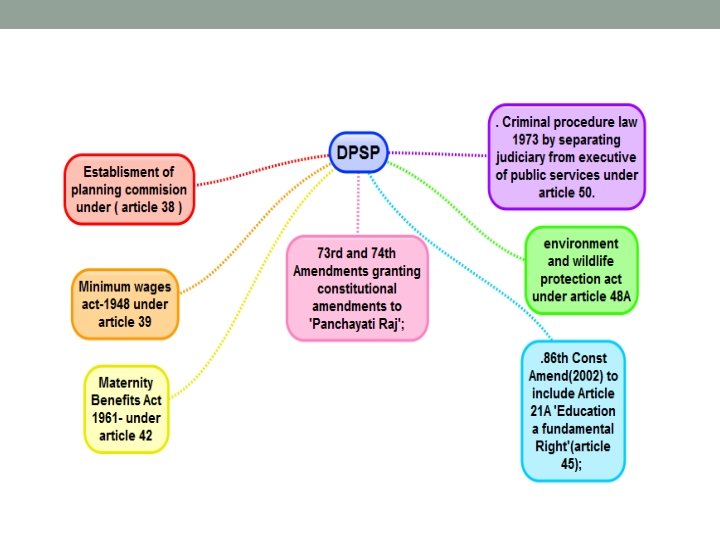
• Art 21 A- The Constitution (Eighty-sixth Amendment) Act, 2002 inserted Article 21 -A in the Constitution of India to provide free and compulsory education of all children in the age group of six to fourteen years as a Fundamental Right in such a manner as the State may, by law, determine • Right of Children to Free and Compulsory Education (RTE) Act, 2009, which represents the consequential legislation envisaged under Article 21 -A, means that every child has a right to full time elementary education of satisfactory and equitable quality in a formal school which satisfies certain essential norms and standards

THANK YOU
- Slides: 15