
Impact of Epicardial Anterior Fat Pad Retention on
- Slides: 10
Impact of Epicardial Anterior Fat Pad Retention on Postcardiothoracic Surgery Atrial Fibrillation Incidence: The AFISTIII Study Impact of Epicardial Anterior Fat Pad Retention on Postcardiothoracic Surgery Atrial Fibrillation Incidence: The AFIST-III Study C. Michael White, Pharm. D; Stephen Sander, Pharm. D; Craig I. Coleman, Pharm. D; Robert Gallagher, MD; Hiroyoshi Takata, MD; Chester Humphrey, MD; Nickole Henyan, Pharm. D; Effie L. Gillespie, Pharm. D; Jeffrey Kluger, MD Published in the Journal of the American College of Cardiology January 23, 2007 Clinical Trial Results. org
The AFIST-III Study: Background • Drugs with antiadrenergic effects reduce postoperative atrial fibrillation (POAF). • Because the epicardial anterior fat pad (AFP) is parasympathetically innervated, its routine excision during coronary artery bypass grafting (CABG) may precipitate autonomic imbalance and induce POAF. Clinical Trial Results. org White et al. , JACC 2007; 49(3): 298 -303
The AFIST-III Study: Background • Given conflicting preliminary data, the Atrial Fibrillation Suppression Trial-III (AFIST-III) was conducted to evaluate the impact of maintaining the AFP on POAF. • Additionally, the present study evaluated the impact of AFP maintenance on heart rate variability, an established marker of parasympathetic tone, in order to explore the underlying mechanism. Clinical Trial Results. org White et al. , JACC 2007; 49(3): 298 -303
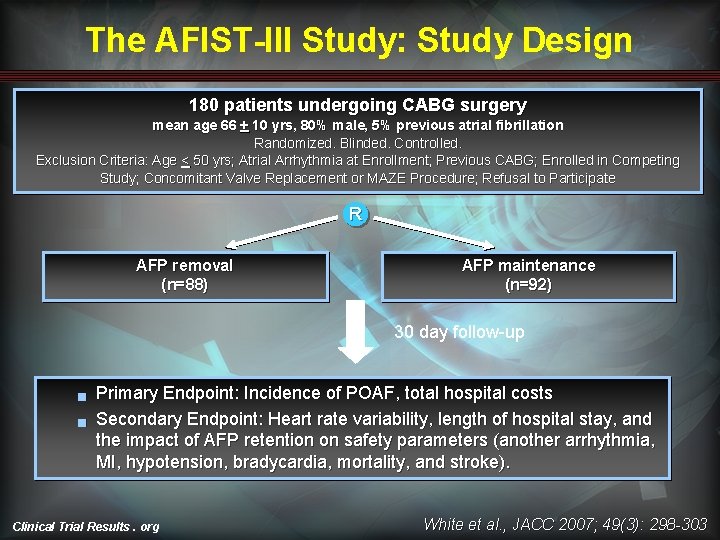
The AFIST-III Study: Study Design 180 patients undergoing CABG surgery mean age 66 + 10 yrs, 80% male, 5% previous atrial fibrillation Randomized. Blinded. Controlled. Exclusion Criteria: Age < 50 yrs; Atrial Arrhythmia at Enrollment; Previous CABG; Enrolled in Competing Study; Concomitant Valve Replacement or MAZE Procedure; Refusal to Participate R AFP removal (n=88) AFP maintenance (n=92) 30 day follow-up g g Primary Endpoint: Incidence of POAF, total hospital costs Secondary Endpoint: Heart rate variability, length of hospital stay, and the impact of AFP retention on safety parameters (another arrhythmia, MI, hypotension, bradycardia, mortality, and stroke). Clinical Trial Results. org White et al. , JACC 2007; 49(3): 298 -303
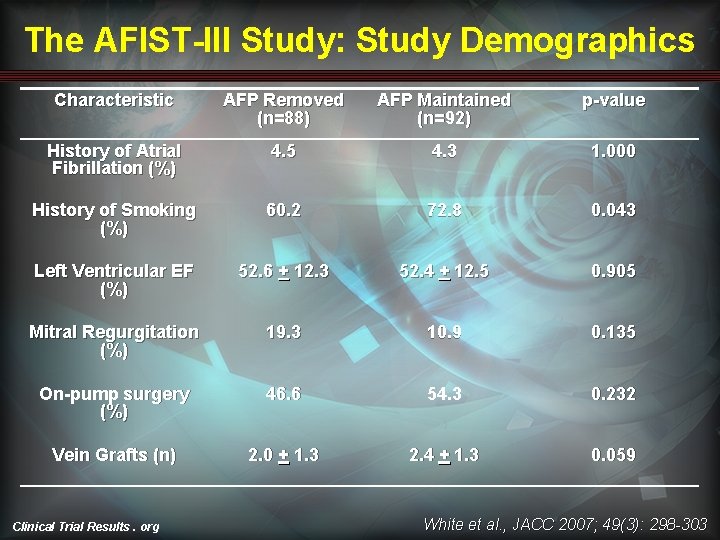
The AFIST-III Study: Study Demographics Characteristic AFP Removed (n=88) AFP Maintained (n=92) p-value History of Atrial Fibrillation (%) 4. 5 4. 3 1. 000 History of Smoking (%) 60. 2 72. 8 0. 043 Left Ventricular EF (%) 52. 6 + 12. 3 52. 4 + 12. 5 0. 905 Mitral Regurgitation (%) 19. 3 10. 9 0. 135 On-pump surgery (%) 46. 6 54. 3 0. 232 Vein Grafts (n) 2. 0 + 1. 3 2. 4 + 1. 3 0. 059 Clinical Trial Results. org White et al. , JACC 2007; 49(3): 298 -303
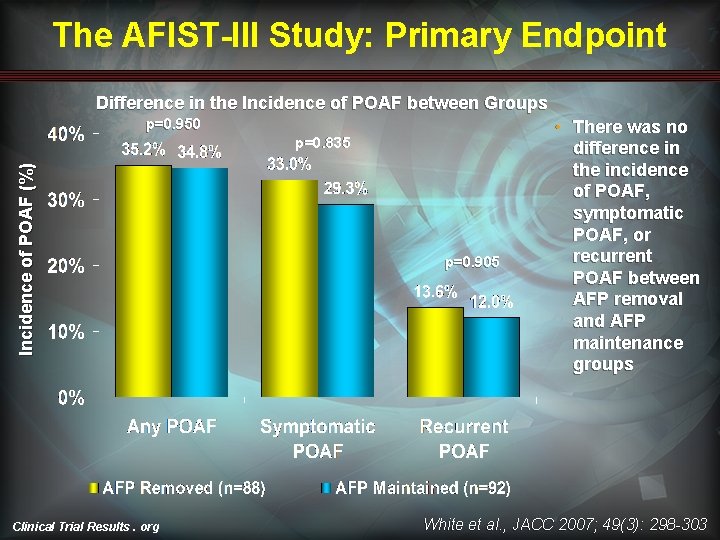
The AFIST-III Study: Primary Endpoint Difference in the Incidence of POAF between Groups p=0. 950 Incidence of POAF (%) p=0. 835 Clinical Trial Results. org p=0. 905 • There was no difference in the incidence of POAF, symptomatic POAF, or recurrent POAF between AFP removal and AFP maintenance groups White et al. , JACC 2007; 49(3): 298 -303
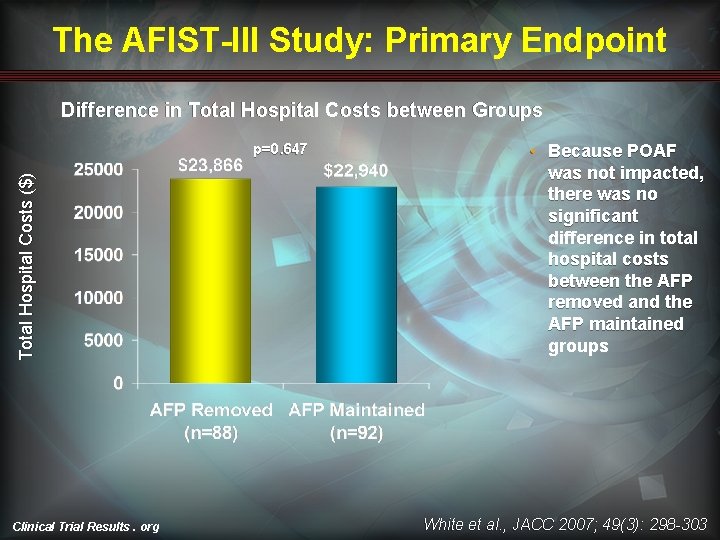
The AFIST-III Study: Primary Endpoint Difference in Total Hospital Costs between Groups Total Hospital Costs ($) p=0. 647 Clinical Trial Results. org • Because POAF was not impacted, there was no significant difference in total hospital costs between the AFP removed and the AFP maintained groups White et al. , JACC 2007; 49(3): 298 -303
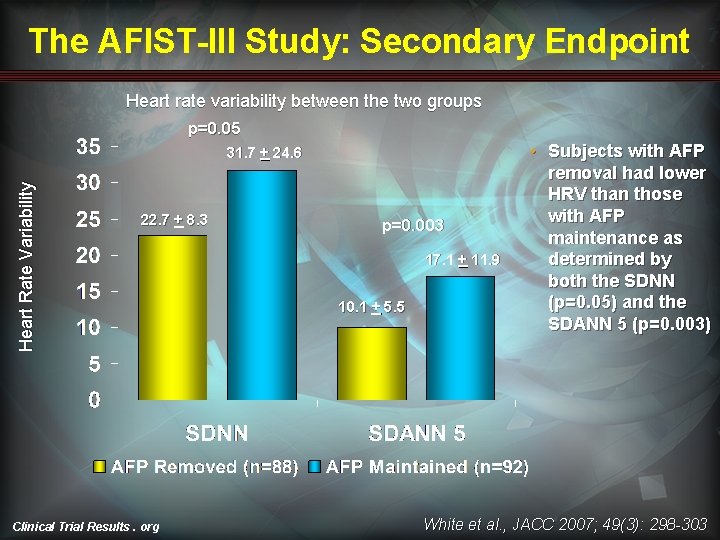
The AFIST-III Study: Secondary Endpoint Heart rate variability between the two groups p=0. 05 Heart Rate Variability 31. 7 + 24. 6 22. 7 + 8. 3 Clinical Trial Results. org p=0. 003 17. 1 + 11. 9 10. 1 + 5. 5 • Subjects with AFP removal had lower HRV than those with AFP maintenance as determined by both the SDNN (p=0. 05) and the SDANN 5 (p=0. 003) White et al. , JACC 2007; 49(3): 298 -303
The AFIST-III Study: Limitations • The cardiothoracic surgeons were not blinded to study group allocation. However, the impact of not blinding the surgeon was minimized by blinding data collectors, clinicians who treated the patients, and the patients themselves. • Use of other drugs to control POAF was not controlled for. Clinical Trial Results. org White et al. , JACC 2007; 49(3): 298 -303
The AFIST-III Study: Summary • AFP maintenance did not positively or negatively impact clinical end points, particularly POAF, in the AFIST-III study. • Maintaining the AFP does not alter the incidence of POAF after CABG or total hospital costs in any appreciable way, even though it preserves parasympathetic tone. Clinical Trial Results. org White et al. , JACC 2007; 49(3): 298 -303