
Impact of Dementia on Capacity to Manage Finances



















































- Slides: 106
Impact of Dementia on Capacity to Manage Finances and Prevention of Financial Exploitation Daniel Marson, J. D. , Ph. D. Professor of Neurology Director, Alzheimer’s Disease Center Department of Neurology University of Alabama at Birmingham dmarson@uab. edu The Aging Population, Alzheimer’s and Other Dementias: Law and Public Policy National Health Law and Policy Resource Center University of Iowa, Iowa City, Iowa March 1, 2012
Disclosure n Financial Capacity Instrument (FCI) n Semi-Structured Clinical Interview for Financial Capacity (SCIFC) u Owned by UAB Research Foundation u Inventor u No n Dr. Marson royalty income No relationships with pharmaceutical companies
Outline 1: Dementia and Financial Capacity n Capacity Assessment in an Aging Society n Dementia and Functional Change n What is Financial Capacity? n Warning Signs of Diminished Financial Capacity n Research on Financial Capacity in MCI and AD n Financial Capacity and the Alzheimer Brain
Outline 2: Prevention of Financial Exploitation n The $18. 1 Trillion Problem n Contractual/Transactional Approaches to Prevention n Familial Approaches to Prevention n Legislative Approaches to Prevention
Capacity Assessment in an Aging Society
Definitions—Oxford Universal Dictionary n Capacity ~1480 u Mental [selected definitions] receiving power; ability to take in impressions, ideas, knowledge. 1485 u Active power of mind, talent. 1485 u The power, ability, or faculty for anything in particular. 1647 u Law. Legal qualification. 1480
Definitions—Oxford Universal Dictionary n Competent ~1483 u Law. n [selected definitions] Legally qualified or sufficient. 1483 Competence ~1594 u Sufficiency [selected definitions] of qualification, capacity. 1700 u Especially law—legal capacity. 1708
“As our society ages, clinical assessment of higher order functional capacities has become increasingly important. In areas like financial capacity, medical decision making capacity, medication compliance, and driving, society has a strong interest in accurately discriminating intact from impaired functioning. ” Marson et al. (2000) Archives of Neurology, 57: 877 -844
Capacity Assessment and Aging n Unprecedented aging society n Older population vulnerable to cognitive disorders affecting decision-making ability n Persons with diminished capacity vulnerable to poor decision-making and exploitation
Capacity Assessment and Aging n Individualistic society n Intergenerational transfer of wealth--$16 B - $18 B n Breakdown of traditional family structure n Family disputes over care of elderly u control u use of health care & financial decisions of estate and inheritance
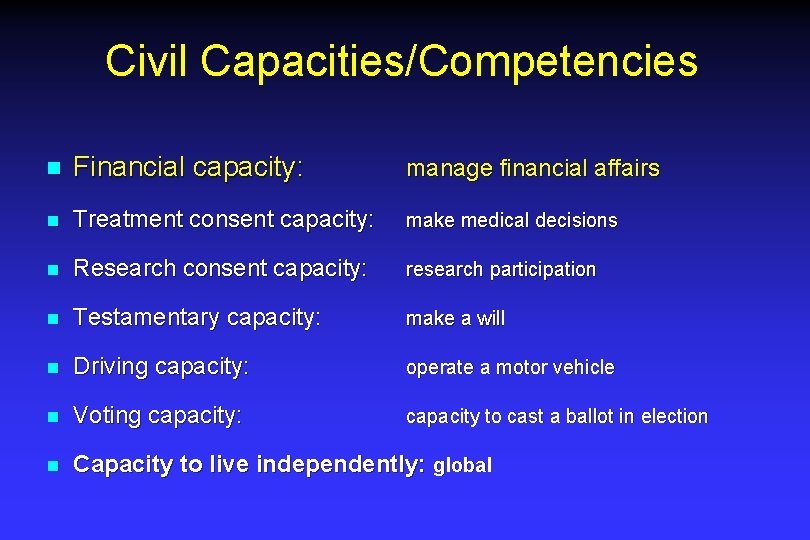
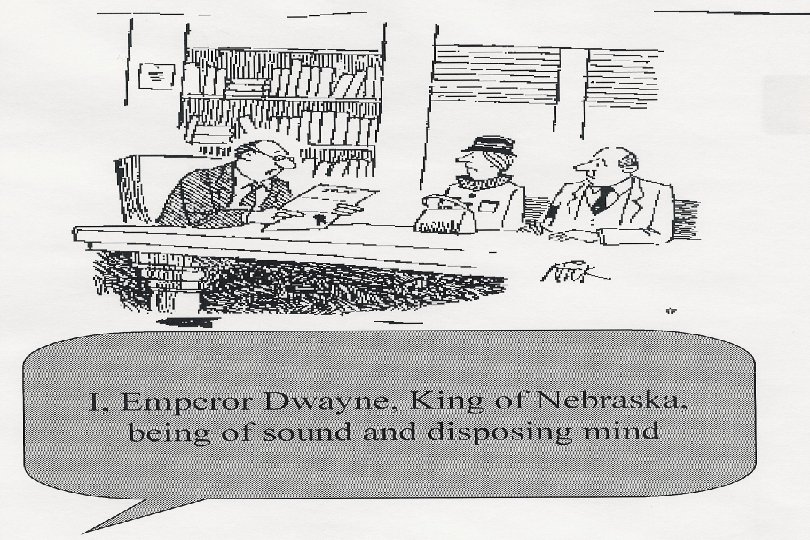
Civil Capacities/Competencies n Financial capacity: manage financial affairs n Treatment consent capacity: make medical decisions n Research consent capacity: research participation n Testamentary capacity: make a will n Driving capacity: operate a motor vehicle n Voting capacity: capacity to cast a ballot in election n Capacity to live independently: global
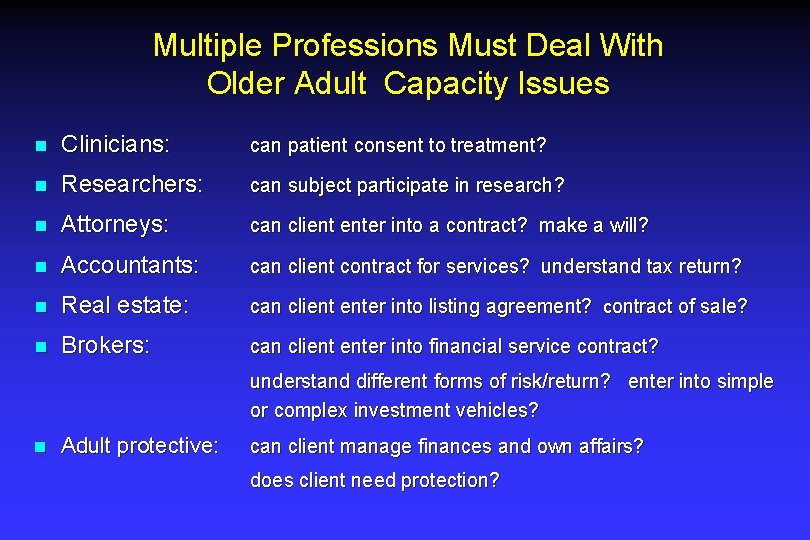
Multiple Professions Must Deal With Older Adult Capacity Issues n Clinicians: can patient consent to treatment? n Researchers: can subject participate in research? n Attorneys: can client enter into a contract? make a will? n Accountants: can client contract for services? understand tax return? n Real estate: can client enter into listing agreement? contract of sale? n Brokers: can client enter into financial service contract? understand different forms of risk/return? enter into simple or complex investment vehicles? n Adult protective: can client manage finances and own affairs? does client need protection?
Dementia and Functional Change
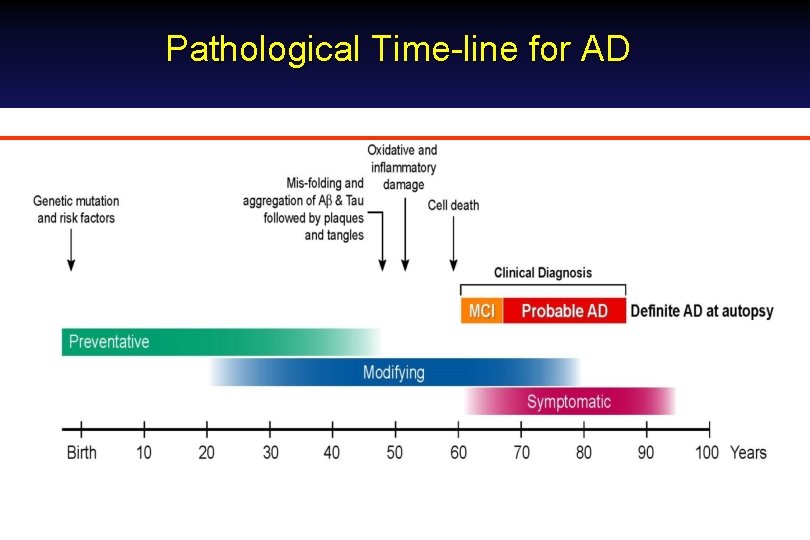
Pathological Time-line for AD
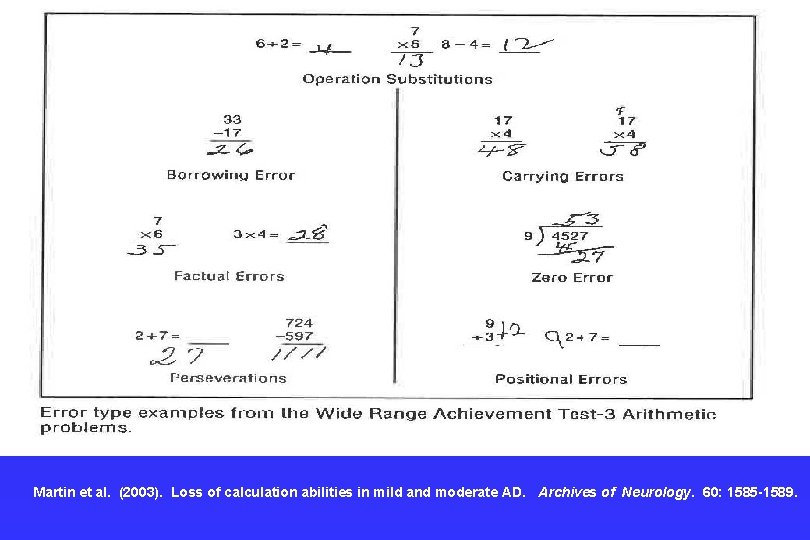
Cognitive Signs of Emerging Dementia n Short term memory loss n Disorientation n Communication problems n Comprehension problems n Lack of mental flexibility, inability to plan n Calculation problems Assessment of Older Adults with Diminished Capacity: A Handbook for Lawyers, p. 14 -15
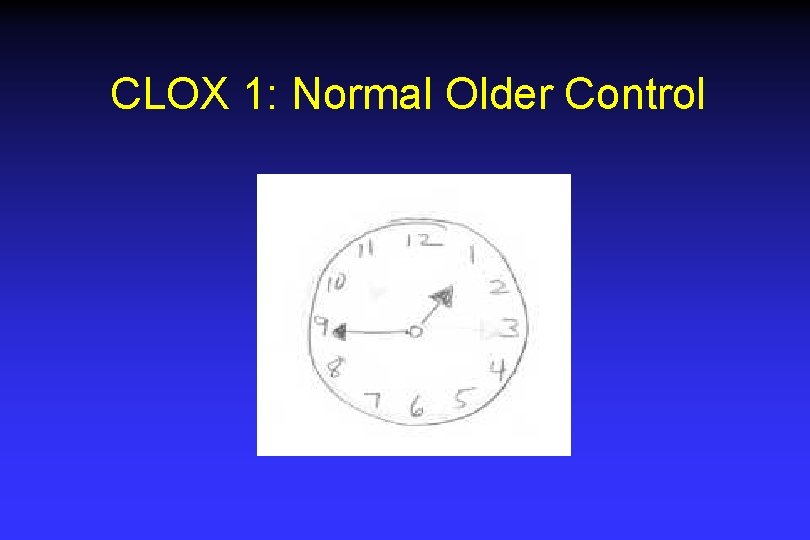
CLOX 1: Normal Older Control
CLOX 1: Mild Cognitive Impairment
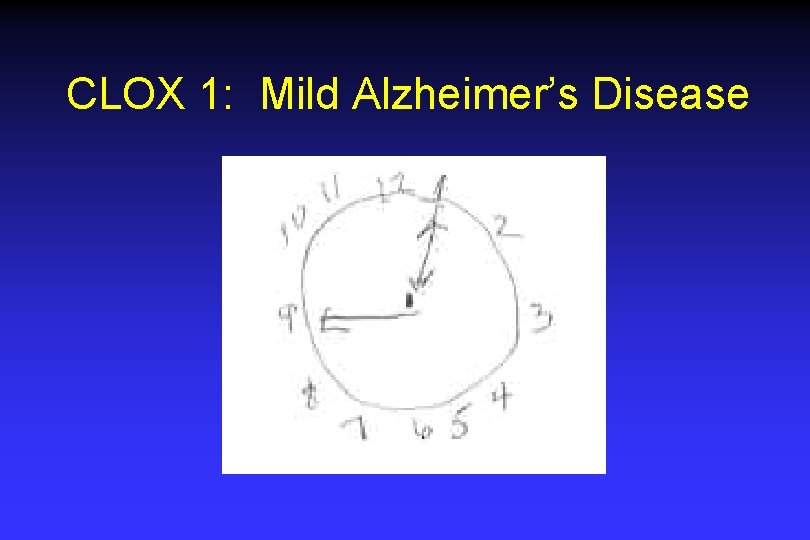
CLOX 1: Mild Alzheimer’s Disease
Emotional/Behavioral Signs of Diminished Capacity n Significant emotional distress n Emotional lability n Social inappropriateness n Delusions n Hallucinations n Poor grooming/hygiene Assessment of Older Adults with Diminished Capacity: A Handbook for Lawyers, pp. 15 -16
Instrumental Activities of Daily Living n Instrumental activities of daily living are more complex activities that are not essential to self-care, but that enable the individual to live independently within a community u Light housework u Preparing meals and cleanup u Shopping for groceries or clothes u Using the telephone u Using transportation (community mobility) u Taking medications u Health management and maintenance u Managing money
Activities of Daily Living n Activities of daily living (ADLs) are "the things we normally do in daily living including any daily activity we perform for self-care (such as feeding ourselves, bathing, dressing, grooming), work, homemaking, and leisure. " ~Medicine. Net. com Medical Dictionary u Bathing u Grooming u Dressing and undressing u Eating u Transferring from bed to chair, and back u Voluntarily control of urinary and fecal discharge u Using the toilet u Walking (not bedridden)
IADLs As Early Functional Markers in Dementia Research n IADLs are cognitively complex activities vulnerable to cognitive aging, MCI, and dementia n IADLs like financial capacity show significant impairment in MCI and the very earliest stages of AD n Are diagnostically important markers for research on progression in MCI and conversion to dementia
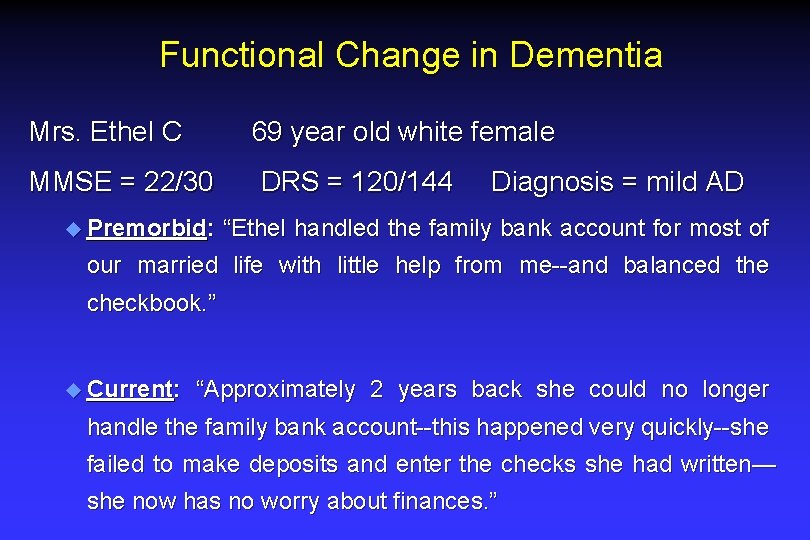
Functional Change in Dementia Mrs. Ethel C 69 year old white female MMSE = 22/30 u Premorbid: DRS = 120/144 Diagnosis = mild AD “Ethel handled the family bank account for most of our married life with little help from me--and balanced the checkbook. ” u Current: “Approximately 2 years back she could no longer handle the family bank account--this happened very quickly--she failed to make deposits and enter the checks she had written— she now has no worry about finances. ”
Financial Capacity
“everyday use of money will be highly correlated with general success in independent living” Melton et al. (1987) Psychological Evaluations for the Courts, p. 249
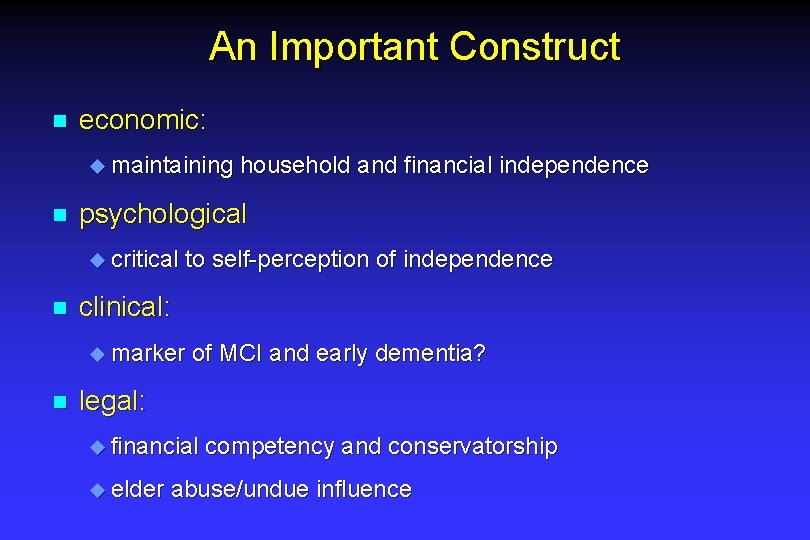
An Important Construct n economic: u maintaining n psychological u critical n to self-perception of independence clinical: u marker n household and financial independence of MCI and early dementia? legal: u financial u elder competency and conservatorship abuse/undue influence
Defining Financial Capacity: Two Key Perspectives n Performance Perspective: u FC as the ability to carry out financial activities u Handle money, understand concepts, pay bills, etc. u Emphasizes n role of performance. Best Interest Perspective: u FC as ability to identify and protect financial self-interest u Emphasizes role of judgment.
“the capacity to manage money and financial assets in ways that meet a person’s needs and which are consistent with his/her values and self-interest” D. Marson October, 2007
Conceptual Model of Financial Capacity
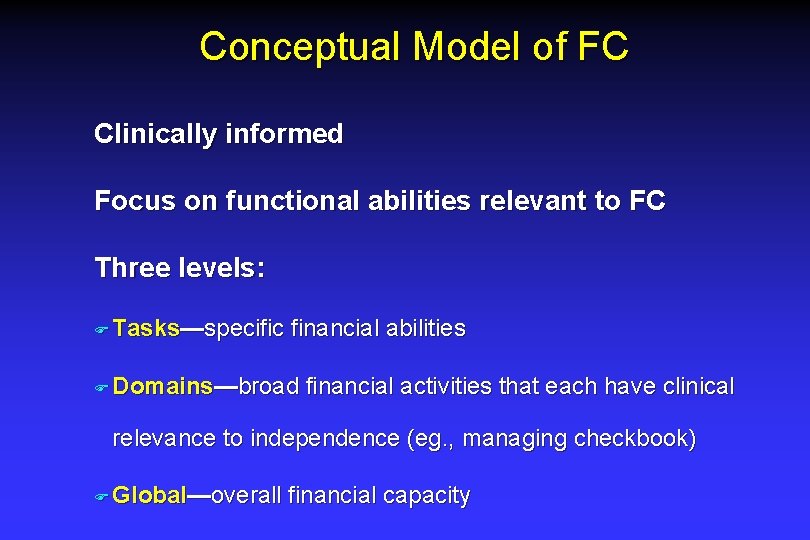
Conceptual Model of FC Clinically informed Focus on functional abilities relevant to FC Three levels: F Tasks—specific financial abilities F Domains—broad financial activities that each have clinical relevance to independence (eg. , managing checkbook) F Global—overall financial capacity
Financial Tasks n n n n Naming coins/currency Coin/currency relationships Count coins/currency Understanding concepts Applying concepts Conduct cash transactions Making change for vending Tipping in a restaurant n n n n n Understanding checkbook Using checkbook/register Understanding bank statement Using a bank statement Awareness of mail fraud Awareness of telephone fraud Prioritizing bills Preparing bills for mailing Making investment decision
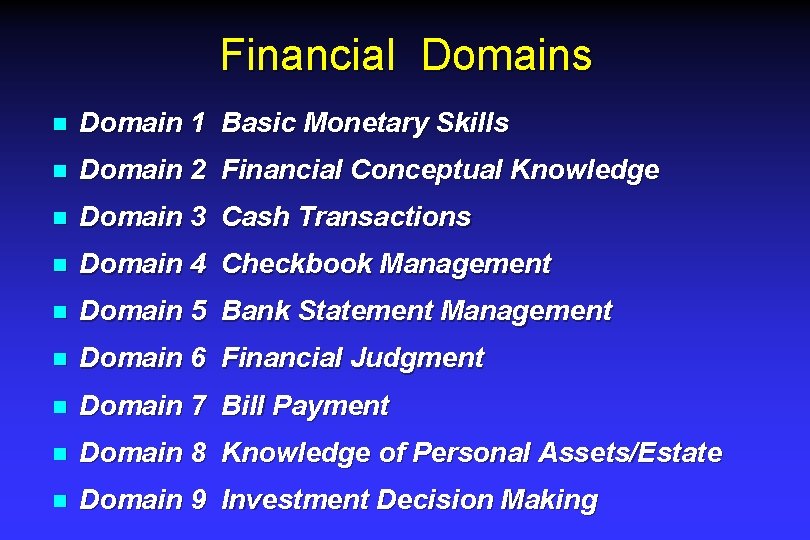
Financial Domains n Domain 1 Basic Monetary Skills n Domain 2 Financial Conceptual Knowledge n Domain 3 Cash Transactions n Domain 4 Checkbook Management n Domain 5 Bank Statement Management n Domain 6 Financial Judgment n Domain 7 Bill Payment n Domain 8 Knowledge of Personal Assets/Estate n Domain 9 Investment Decision Making
Tasks by Domain n n Domain 1 Basic Monetary Skills u Task 1 a Naming coins/currency Simple u Task 1 b Coins/currency relationships Complex u Task 1 c Counting coins/currency Simple Domain 2 Financial Conceptual Knowledge u Task 2 a Define financial concepts Complex u Task 2 b Apply financial concepts Complex
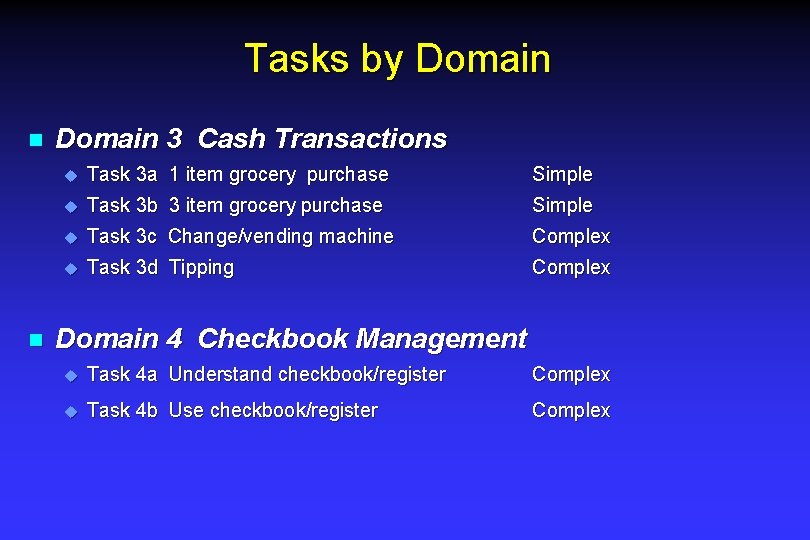
Tasks by Domain n n Domain 3 Cash Transactions u Task 3 a 1 item grocery purchase Simple u Task 3 b 3 item grocery purchase Simple u Task 3 c Change/vending machine Complex u Task 3 d Tipping Complex Domain 4 Checkbook Management u Task 4 a Understand checkbook/register Complex u Task 4 b Use checkbook/register Complex
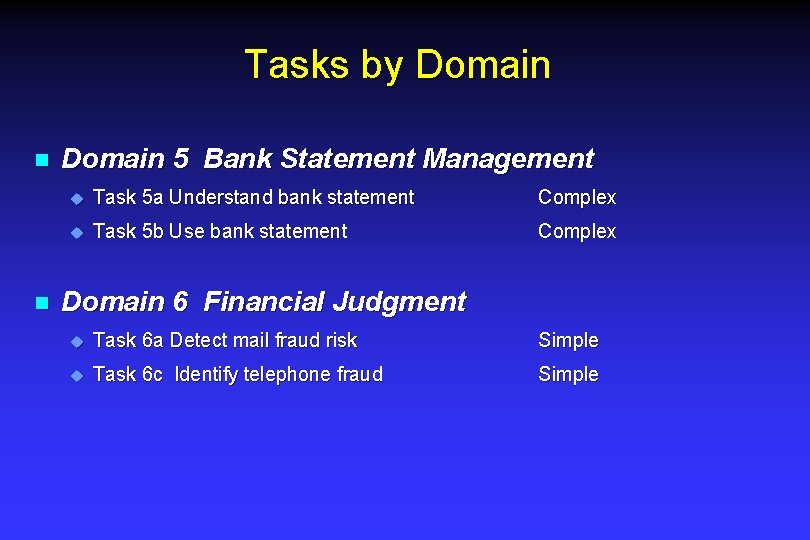
Tasks by Domain n n Domain 5 Bank Statement Management u Task 5 a Understand bank statement Complex u Task 5 b Use bank statement Complex Domain 6 Financial Judgment u Task 6 a Detect mail fraud risk Simple u Task 6 c Identify telephone fraud Simple
Tasks by Domain n Domain 7 Bill Payment u Task 7 a Understand bills Simple u Task 7 b Prioritize bills Simple u Task 7 c Prepare bills for mailing Complex n Domain 8 Knowledge of Personal Assets/Estate n Domain 9 Investment Decision Making
Warning Signs of Diminished Financial Capacity
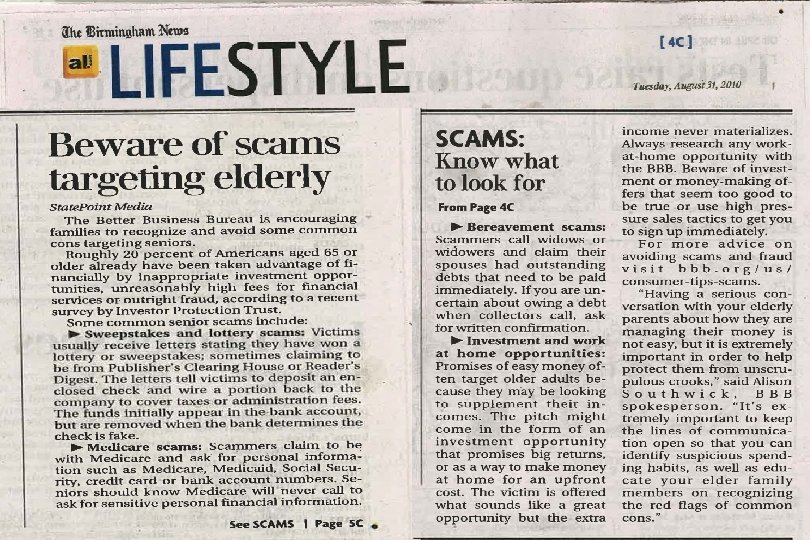
Slide provided by Dr. Marson, JD, Ph. D and UAB
Martin et al. (2003). Loss of calculation abilities in mild and moderate AD. Archives of Neurology. 60: 1585 -1589.
Responding to Warning Signs of Diminished Financial Capacity
Financial Capacity in MCI and AD: Clinical Interview Assessment
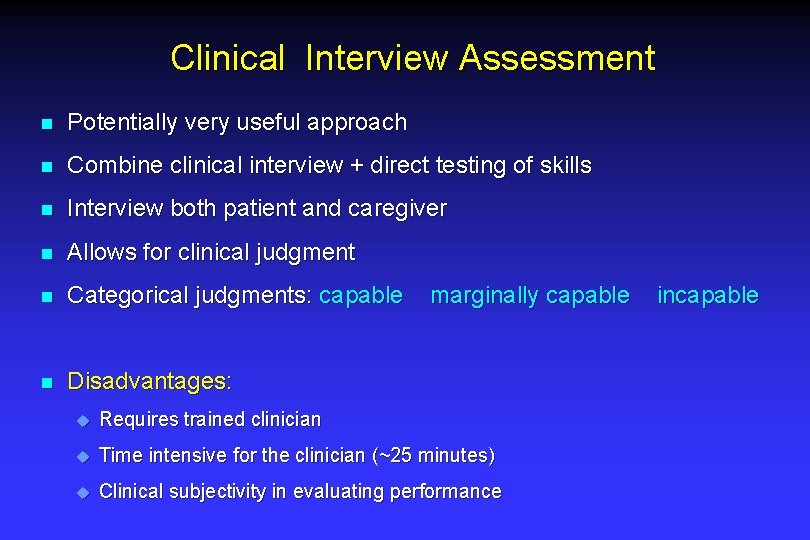
Clinical Interview Assessment n Potentially very useful approach n Combine clinical interview + direct testing of skills n Interview both patient and caregiver n Allows for clinical judgment n Categorical judgments: capable n Disadvantages: marginally capable u Requires trained clinician u Time intensive for the clinician (~25 minutes) u Clinical subjectivity in evaluating performance incapable
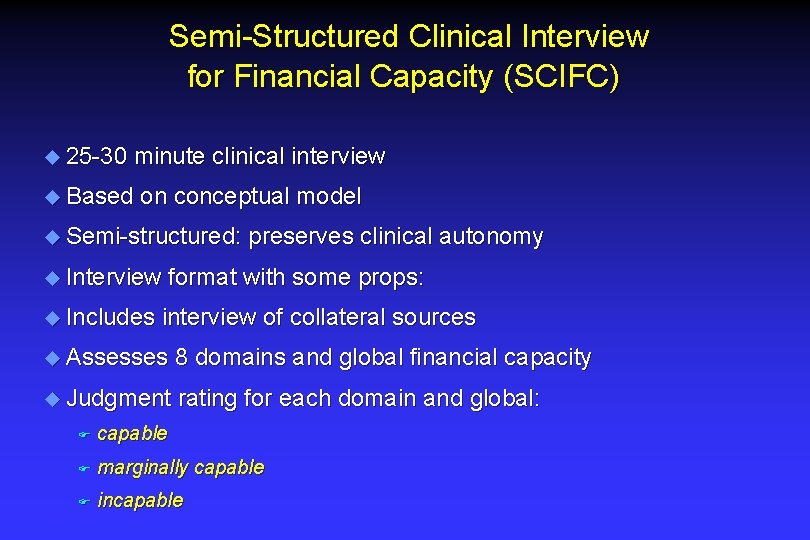
Semi-Structured Clinical Interview for Financial Capacity (SCIFC) u 25 -30 minute clinical interview u Based on conceptual model u Semi-structured: u Interview u Includes preserves clinical autonomy format with some props: interview of collateral sources u Assesses 8 domains and global financial capacity u Judgment rating for each domain and global: F capable F marginally capable F incapable
Order of Financial Domains on SCIFC n Domain 2 Financial Conceptual Knowledge n Domain 1 Basic Monetary Skills n Domain 3 Cash Transactions n Domain 4 Checkbook Management n Domain 5 Bank Statement Management n Domain 6 Financial Judgment n Domain 7 Bill Payment n Domain 8 Knowledge of Personal Assets/Estate
Excerpted Domains on SCIFC n Domain 2 Financial Conceptual Knowledge n Domain 1 Basic Monetary Skills n Domain 3 Cash Transactions n Domain 4 Checkbook Management n Domain 5 Bank Statement Management n Domain 6 Financial Judgment n Domain 7 Bill Payment n Domain 8 Knowledge of Personal Assets/Estate
Who Is Ms. Y? 59 years old African-American Married 14 years of education RN and director of adult day care
Financial Capacity Training Video #1— 040 Ms. Y
Who Is Mr. X? 74 years old Caucasian Married 9 years of education Retired Last occupation: architectural design construction supervisor
Financial Capacity Training Video #2— 298 Mr. X
Who Is Mr. Z? 73 years old Caucasian Married 14 years of education Retired Last occupation: nursing assistant at VA hospital
Financial Capacity Training Video #3— 326 Mr. Z
Research Findings Using SCIFC Clinical Interview
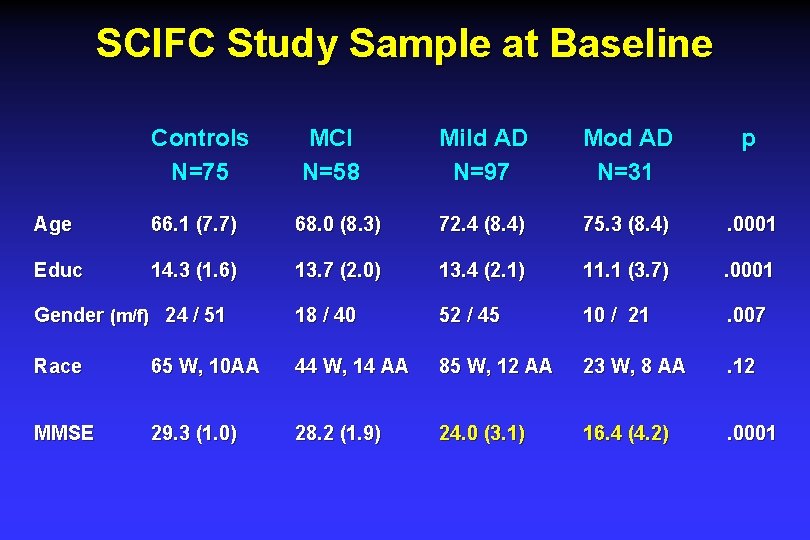
SCIFC Study Sample at Baseline Controls N=75 MCI N=58 Mild AD N=97 Mod AD N=31 p Age 66. 1 (7. 7) 68. 0 (8. 3) 72. 4 (8. 4) 75. 3 (8. 4) . 0001 Educ 14. 3 (1. 6) 13. 7 (2. 0) 13. 4 (2. 1) 11. 1 (3. 7) . 0001 Gender (m/f) 24 / 51 18 / 40 52 / 45 10 / 21 . 007 Race 65 W, 10 AA 44 W, 14 AA 85 W, 12 AA 23 W, 8 AA . 12 MMSE 29. 3 (1. 0) 28. 2 (1. 9) 24. 0 (3. 1) 16. 4 (4. 2) . 0001
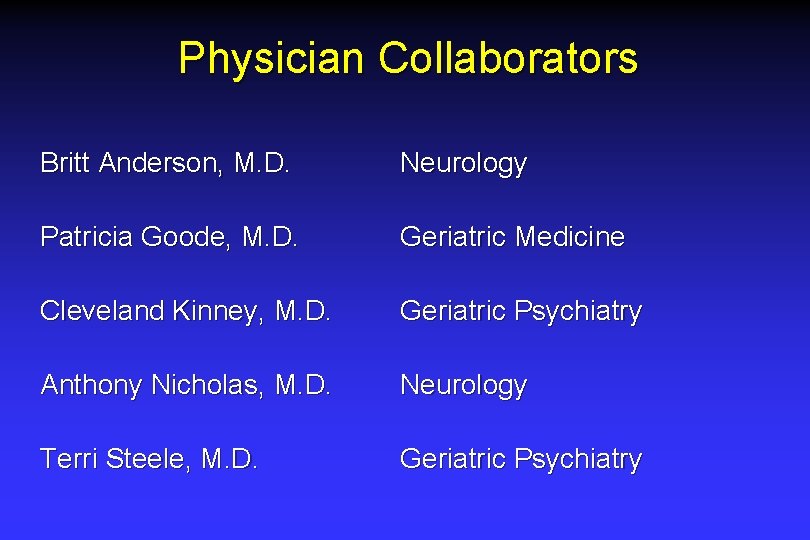
Physician Collaborators Britt Anderson, M. D. Neurology Patricia Goode, M. D. Geriatric Medicine Cleveland Kinney, M. D. Geriatric Psychiatry Anthony Nicholas, M. D. Neurology Terri Steele, M. D. Geriatric Psychiatry
Physician Capacity Judgments • Study recruited 261 participants • Study physicians made 11, 118 financial capacity judgments • Each physician made an average of 2, 224 judgments • 627 ratings missing of 11, 745 possible: 94. 7% completion rate • Attests to effort/commitment of study physicians and staff
Basic Monetary Skills: Judgment Outcomes By Percentage and Group Control, MCI, mild AD differ from mod AD at p <. 01 using GEE Jts = 353 Jts = 282 Jts = 475 Jts = 155
Checkbook Management: Judgment Outcomes By Percentage and Group Control differ from MCI at p =. 06 Control, MCI differ from mild AD and mod AD at p <. 01 Mild AD differ from mod AD at p <. 01 Jts = 356 Jts = 267 Jts = 446 Jts = 144
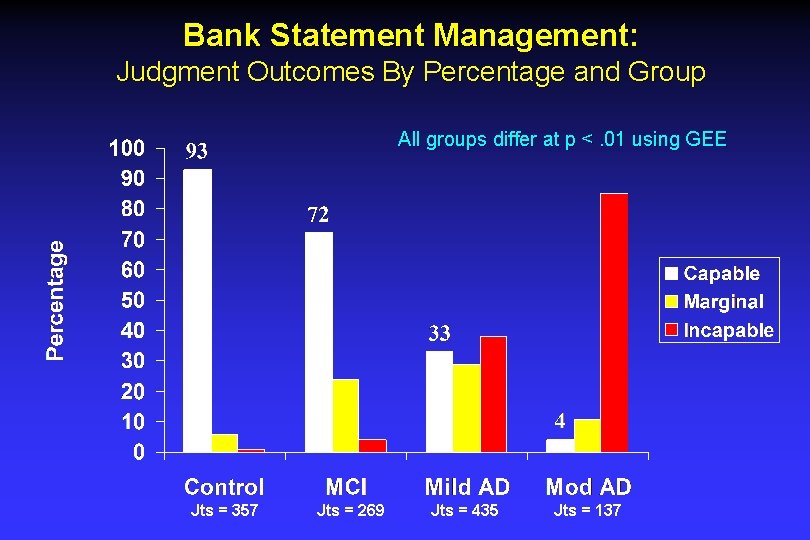
Bank Statement Management: Judgment Outcomes By Percentage and Group All groups differ at p <. 01 using GEE Jts = 357 Jts = 269 Jts = 435 Jts = 137
Global Financial Capacity: Judgment Outcomes By Percentage and Group All groups differ at p <. 01 using GEE Jts = 333 Jts = 282 Jts = 476 Jts = 155
Financial Capacity and the Alzheimer’s Disease Brain
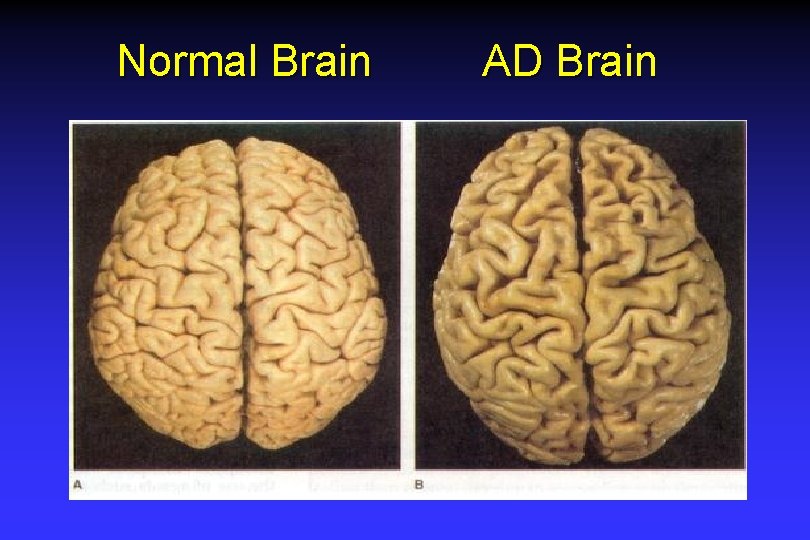
Normal Brain AD Brain
Loss of Brain Tissue in Alzheimer’s Disease Normal Aging Mild Cognitive Impairment Alzheimer’s Disease
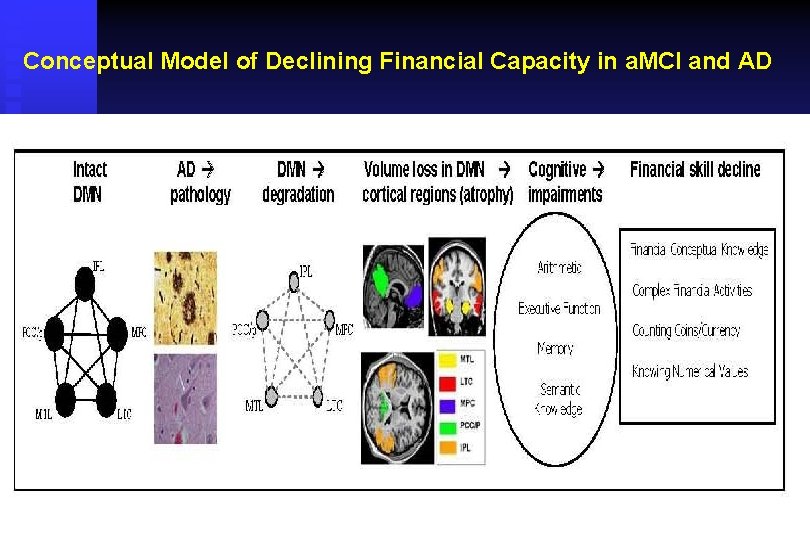
Conceptual Model of Declining Financial Capacity in a. MCI and AD
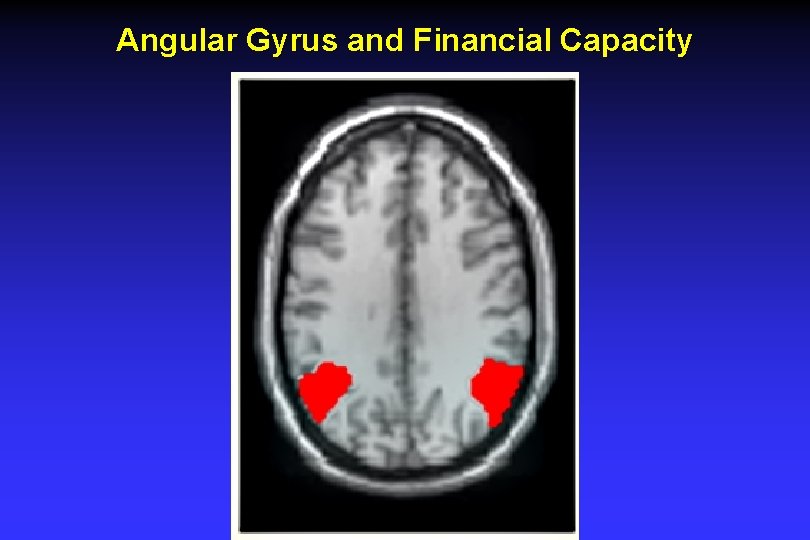
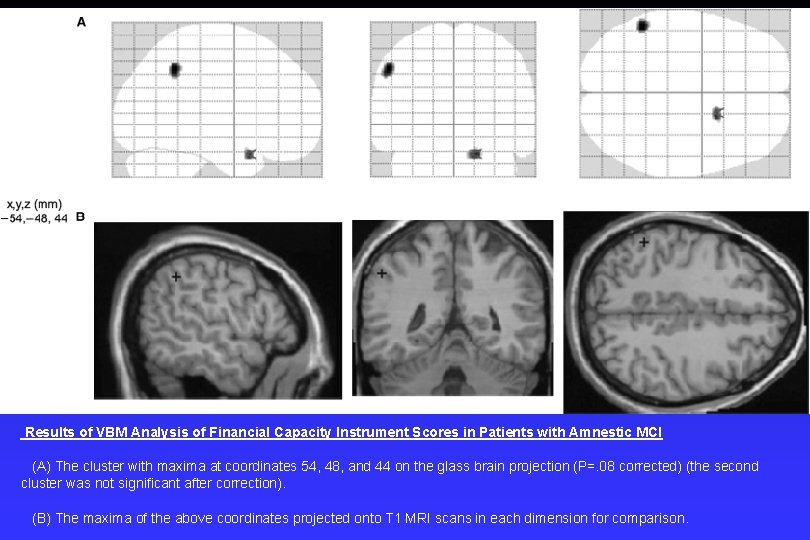
Angular Gyrus and Financial Capacity
Results of VBM Analysis of Financial Capacity Instrument Scores in Patients with Amnestic MCI (A) The cluster with maxima at coordinates 54, 48, and 44 on the glass brain projection (P=. 08 corrected) (the second cluster was not significant after correction). (B) The maxima of the above coordinates projected onto T 1 MRI scans in each dimension for comparison.
Journal of the American Geriatrics Society, 58: 265– 274, 2010
Perhaps some day we will be able to use MRI scans to help identify older persons at risk for loss of financial capacity?
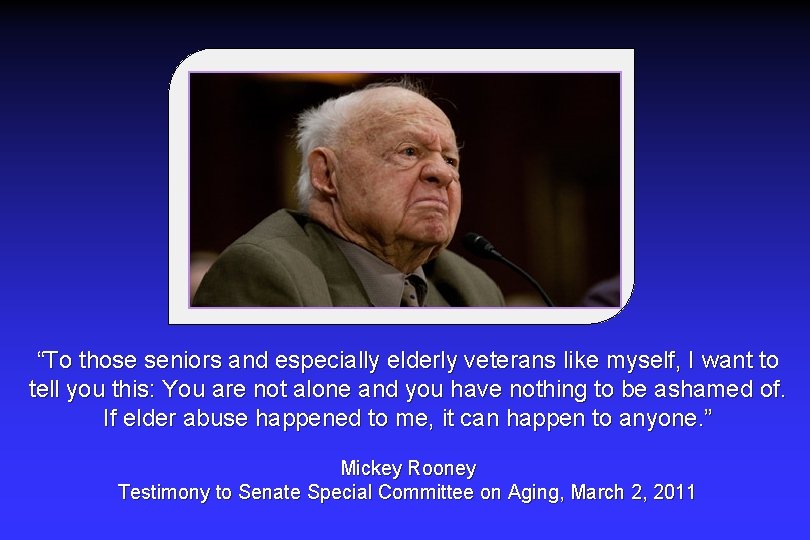
“To those seniors and especially elderly veterans like myself, I want to tell you this: You are not alone and you have nothing to be ashamed of. If elder abuse happened to me, it can happen to anyone. ” Mickey Rooney Testimony to Senate Special Committee on Aging, March 2, 2011
Outline 2: Prevention of Financial Exploitation n The $18. 1 Trillion Problem Facing Us n Contractual/Transactional Approaches to Prevention n Familial Approaches to Prevention n Legislative Approaches to Prevention
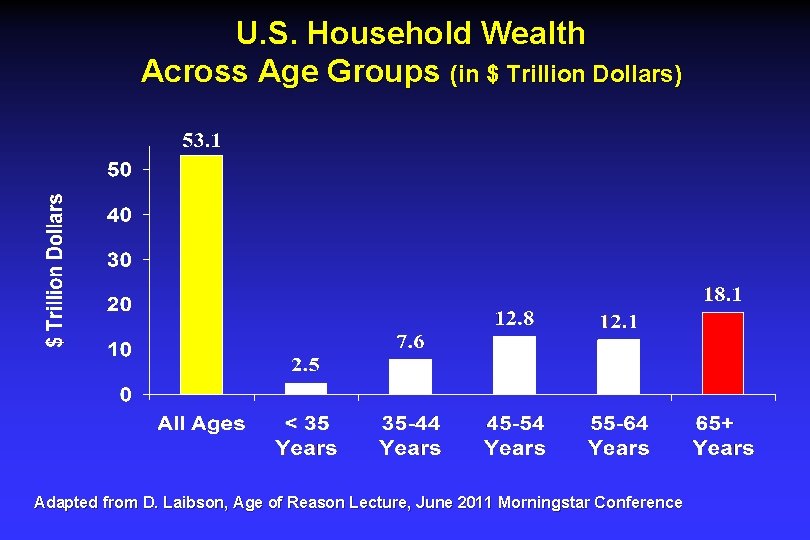
The $18. 1 Trillion Problem
% U. S. Households Across Age Group Adapted from D. Laibson, Age of Reason Lecture, June 2011 Morningstar Conference
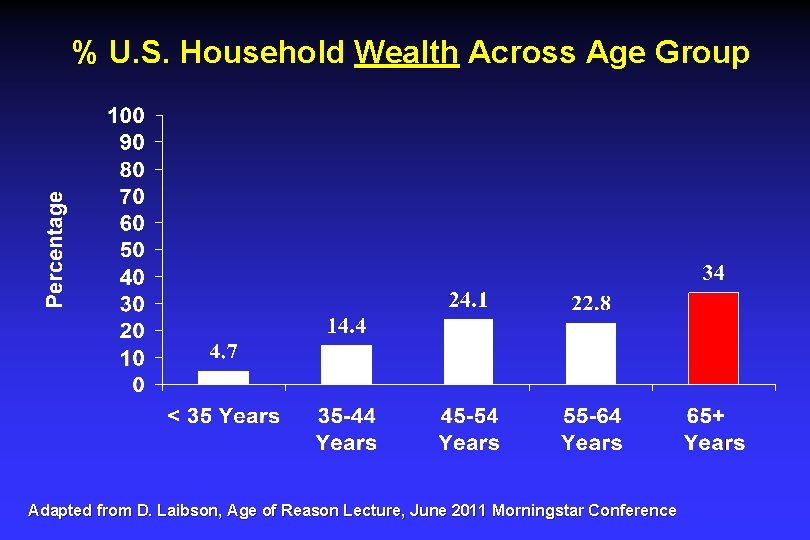
% U. S. Household Wealth Across Age Group Adapted from D. Laibson, Age of Reason Lecture, June 2011 Morningstar Conference
All U. S. Households Balance Sheet [Federal Reserve Flow of Funds— 2009] Total = $53. 1 Trillion From D. Laibson, Age of Reason Lecture, June 2011 Morningstar Conference
U. S. Household Wealth Across Age Groups (in $ Trillion Dollars) Adapted from D. Laibson, Age of Reason Lecture, June 2011 Morningstar Conference
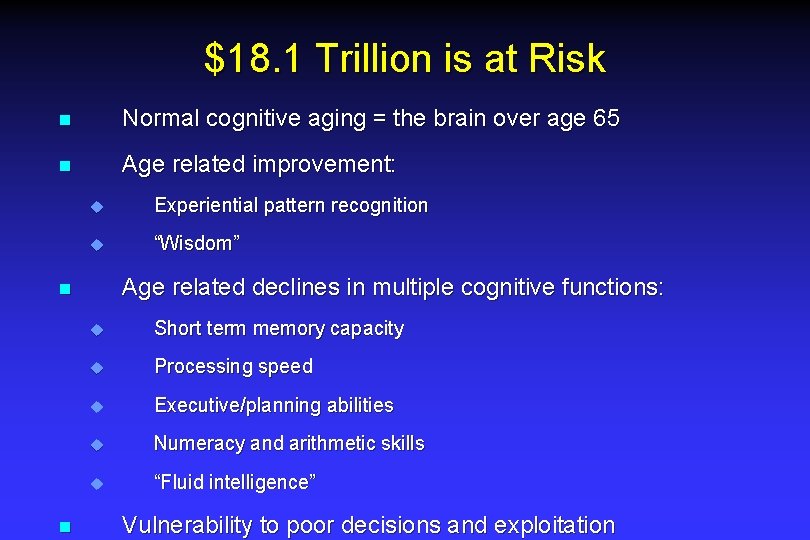
$18. 1 Trillion is at Risk n Normal cognitive aging = the brain over age 65 n Age related improvement: u Experiential pattern recognition u “Wisdom” Age related declines in multiple cognitive functions: n n u Short term memory capacity u Processing speed u Executive/planning abilities u Numeracy and arithmetic skills u “Fluid intelligence” Vulnerability to poor decisions and exploitation
“If the chance of getting a disease is 10 percent, how many people out of 1, 000 would be expected to get the disease? ” Adapted from D. Laibson, Age of Reason Lecture, June 2011 Morningstar Conference
Normal Cognitive Aging and Financial Capacity n We have focused on impact of prodromal (MCI) and clinical dementia (AD) on financial capacity n But in terms of overall impact, normal cognitive aging is the greatest threat to financial capacity in the elderly: n 2009: 39. 6 million elderly in U. S. 5. 2 million with AD over 65 2030: 72. 1 million elderly in U. S. 7. 7 million with AD over 65 --www. aoa. gov/aoaroot/aging_statistics/index. aspx--accessed 29 Feb 2012 --2011 Alzheimer’s Disease Facts and Figures, Alzheimer’s Association, p. 19
Prevention of Financial Catastrophes and Exploitation in Older Adults
Time Magazine September 3, 2001
Approaches to Prevention: Contractual/Transactional Beyond the Durable Power of Attorney for Finances n which authorizes a proxy to act financially for grantor Explicit advance planning for diminished capacity as n part of specific banking, trust, investment transactions “Diminished Capacity” clauses? n u Explicitly recognize possibility of future diminished capacity u Authorize financial institution to contact designated family u Set forth an agreed general plan of action u Provide secure path of communication/action for institutions
Approaches to Prevention: Legislative n Increasing recognition that diminished financial capacity is an inherent aspect of aging–both normal and abnormal cognitive aging n Legislatures may wish to enact special protections for older adults as consumers and contracting parties n Should there be a designated time period in which an older adult and his/her family may unilaterally cancel without penalty incurred contractual obligations? n Could potentially reduce scam transaction activity?
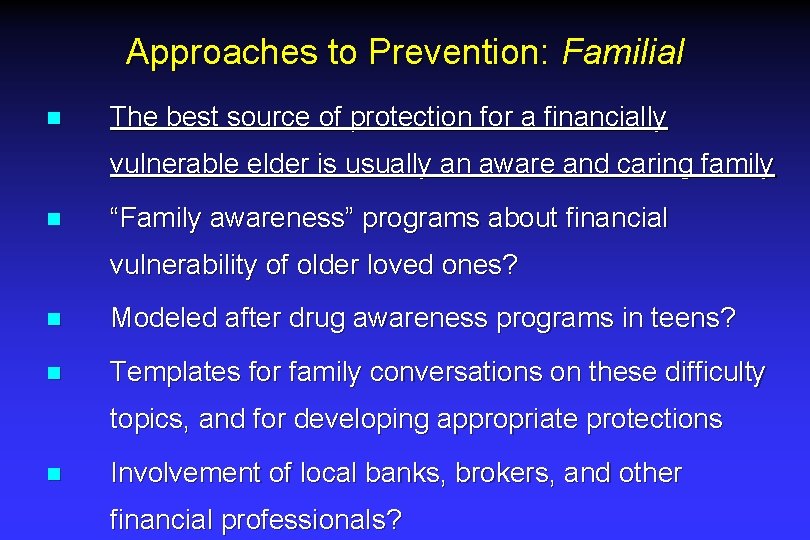
Approaches to Prevention: Familial n The best source of protection for a financially vulnerable elder is usually an aware and caring family n “Family awareness” programs about financial vulnerability of older loved ones? n Modeled after drug awareness programs in teens? n Templates for family conversations on these difficulty topics, and for developing appropriate protections n Involvement of local banks, brokers, and other financial professionals?
Collaborators UAB Department of Neurology Roy Martin, Ph. D. Randall Griffith, Ph. D. Kristin Triebel, Psy. D. Ozioma Okonkwo, Ph. D Lindy Harrell, M. D. , Ph. D. John Brockington, M. D. UAB Department of Biostats Alfred Bartolucci, Ph. D. UAB Dept of Education Scott Snyder, Ph. D. UAB Dept of Psychology Virginia Wadley, Ph. D. David Clark, M. D. Richard Powers, M. D. Katherine Belue, B. S. UCSD Department of Biostatistics Rema Raman, Ph. D Ron Thomas, Ph. D
NIH Support Studies of Financial Capacity in Alzheimer’s Disease (1 R 01 MH 55247) Alzheimer’s Disease Research Center (1 P 50 AG 16582) A Longitudinal Study of Loss of Financial Capacity in Alzheimer’s Disease (ADRC Project 2) Functional Change in Mild Cognitive Impairment (1 R 01 AG 021927)
Questions?
Financial Capacity in MCI and AD: Psychometric Testing
Psychometric Assessment of FC n Direct assessment of performance in a controlled setting n Standardized, objective scoring, norm referenced n Finely grained measurement versus vague informant report n Verify patient and family report of financial abilities n Useful clinical addition to traditional NP test battery n Disadvantages: u May lack ecological validity—difficult to replicate community setting in clinic u Requires trained administrator and are time consuming u Tests of financial capacity not commonly available
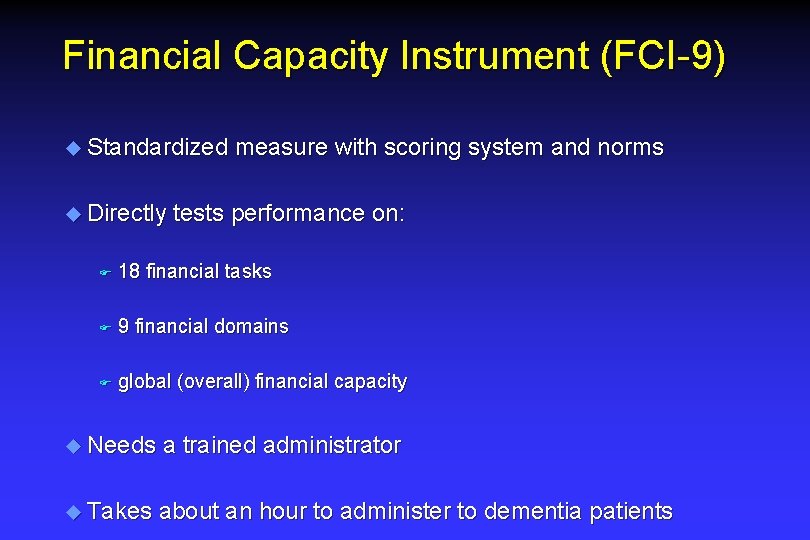
Financial Capacity Instrument (FCI-9) u Standardized u Directly measure with scoring system and norms tests performance on: F 18 financial tasks F 9 financial domains F global (overall) financial capacity u Needs a trained administrator u Takes about an hour to administer to dementia patients
FCI Video: Domain 7—Bill Payment Task 7 a: Understanding Bills Task 7 b: Prioritizing Bills Task 7 c: Preparation of Bills for Payment
Research Findings Using Financial Capacity Instrument
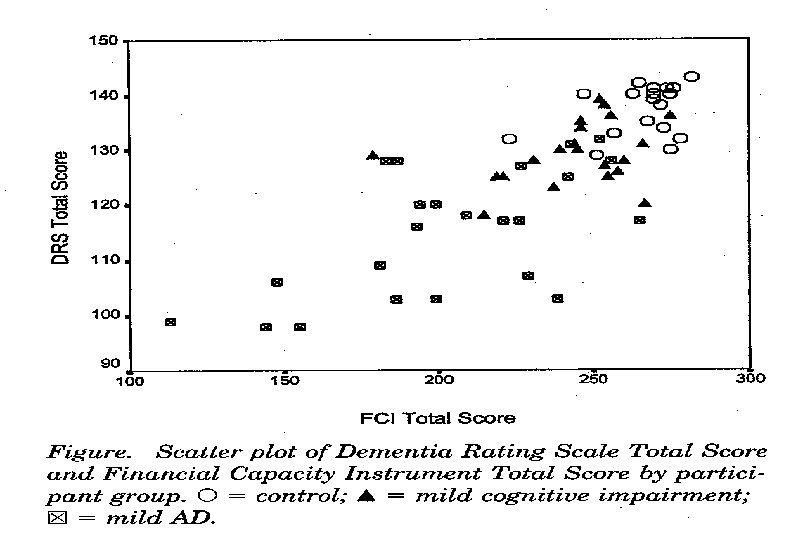
FCI Study Sample Controls MCI Mild AD p N 26 30 34 Age 66. 2 (7. 7) 67. 6 (8. 9) 73. 4 (8. 4) . 05 Educ 14. 5 (2. 4) 14. 6 (2. 3) 14. 6 (2. 7) ns Race 73% W 77% W 94%W ns Gender 69% F 57% F 60% F ns MMSE 29. 2 (1. 1) 28. 5 (1. 2) 24. 0 (2. 9) <. 001 DRS 137. 1 (4. 6) 130. 9 (5. 7) 113. 9 (10. 2) <. 001 1. 0 (0. 8) 5. 1 (1. 3) <. 001 CDR sum box 0. 0 (0. 1)
Group Differences on FCI Total Score C > MCI > AD p =. 0001
Task 7 c: Preparing Bills for Payment C, MCI > AD p =. 0001 Controls=36, MCI=35, Mild AD=53
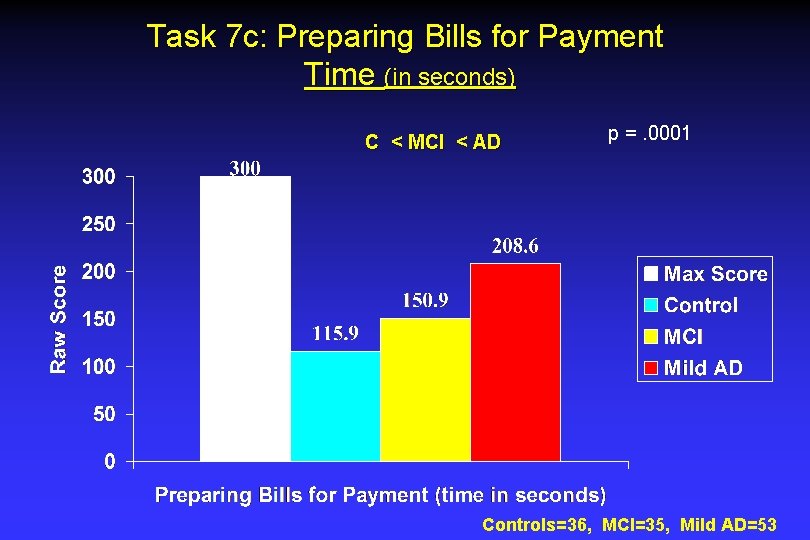
Task 7 c: Preparing Bills for Payment Time (in seconds) C < MCI < AD p =. 0001 Controls=36, MCI=35, Mild AD=53
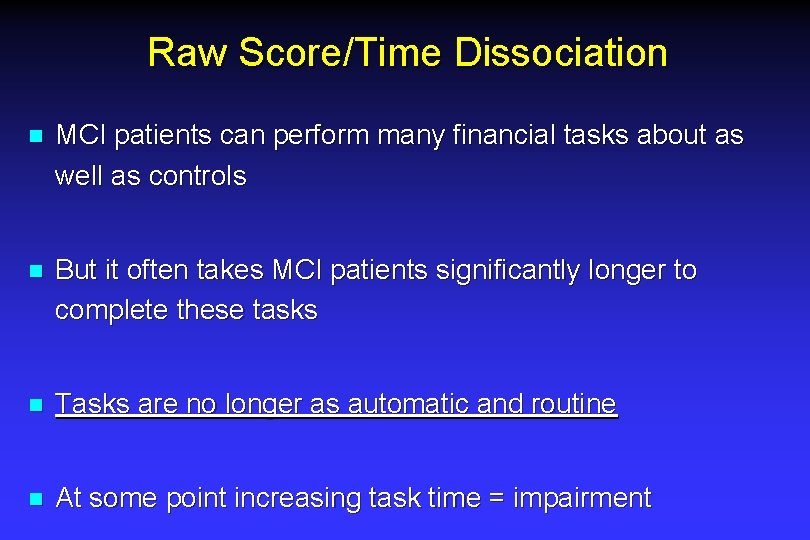
Raw Score/Time Dissociation n MCI patients can perform many financial tasks about as well as controls n But it often takes MCI patients significantly longer to complete these tasks n Tasks are no longer as automatic and routine n At some point increasing task time = impairment