Impact of CYP Polymorphisms on Fentanyl Pharmacokinetics in
- Slides: 1
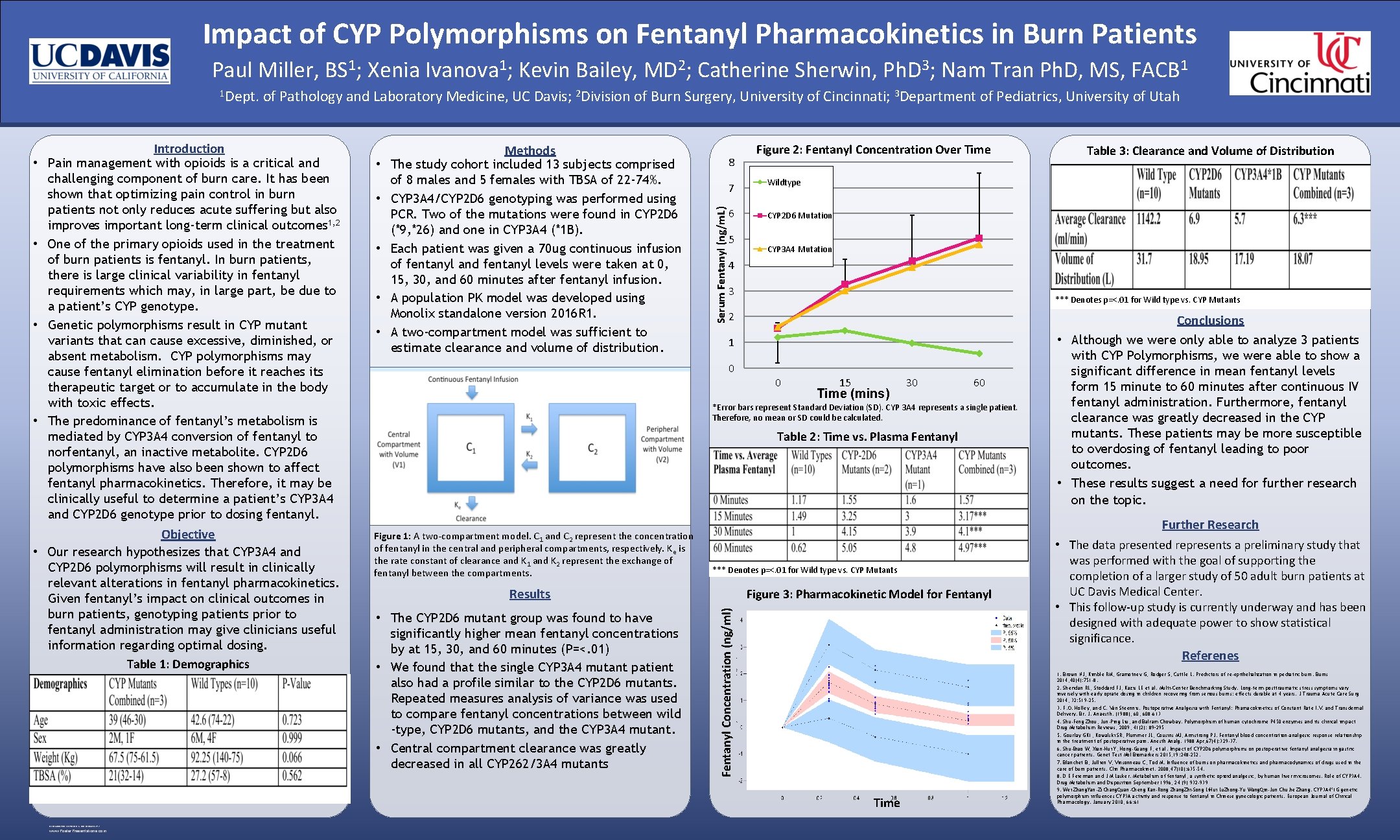
Impact of CYP Polymorphisms on Fentanyl Pharmacokinetics in Burn Patients Paul Miller, BS 1; Xenia Ivanova 1; Kevin Bailey, MD 2; Catherine Sherwin, Ph. D 3; Nam Tran Ph. D, MS, FACB 1 • • Introduction Pain management with opioids is a critical and challenging component of burn care. It has been shown that optimizing pain control in burn patients not only reduces acute suffering but also improves important long-term clinical outcomes 1, 2 One of the primary opioids used in the treatment of burn patients is fentanyl. In burn patients, there is large clinical variability in fentanyl requirements which may, in large part, be due to a patient’s CYP genotype. Genetic polymorphisms result in CYP mutant variants that can cause excessive, diminished, or absent metabolism. CYP polymorphisms may cause fentanyl elimination before it reaches its therapeutic target or to accumulate in the body with toxic effects. The predominance of fentanyl’s metabolism is mediated by CYP 3 A 4 conversion of fentanyl to norfentanyl, an inactive metabolite. CYP 2 D 6 polymorphisms have also been shown to affect fentanyl pharmacokinetics. Therefore, it may be clinically useful to determine a patient’s CYP 3 A 4 and CYP 2 D 6 genotype prior to dosing fentanyl. Objective Our research hypothesizes that CYP 3 A 4 and CYP 2 D 6 polymorphisms will result in clinically relevant alterations in fentanyl pharmacokinetics. Given fentanyl’s impact on clinical outcomes in burn patients, genotyping patients prior to fentanyl administration may give clinicians useful information regarding optimal dosing. Table 1: Demographics • • • Methods The study cohort included 13 subjects comprised of 8 males and 5 females with TBSA of 22 -74%. CYP 3 A 4/CYP 2 D 6 genotyping was performed using PCR. Two of the mutations were found in CYP 2 D 6 (*9, *26) and one in CYP 3 A 4 (*1 B). Each patient was given a 70 ug continuous infusion of fentanyl and fentanyl levels were taken at 0, 15, 30, and 60 minutes after fentanyl infusion. A population PK model was developed using Monolix standalone version 2016 R 1. A two-compartment model was sufficient to estimate clearance and volume of distribution. 8 Serum Fentanyl (ng/m. L) • of Pathology and Laboratory Medicine, UC Davis; 2 Division of Burn Surgery, University of Cincinnati; 3 Department of Pediatrics, University of Utah 7 Wildtype 6 CYP 2 D 6 Mutation 5 CYP 3 A 4 Mutation 3 *** Denotes p=<. 01 for Wild type vs. CYP Mutants 2 1 0 15 Time (mins) www. Poster. Presentations. com 60 Table 2: Time vs. Plasma Fentanyl *** Denotes p=<. 01 for Wild type vs. CYP Mutants Results • The CYP 2 D 6 mutant group was found to have significantly higher mean fentanyl concentrations by at 15, 30, and 60 minutes (P=<. 01) • We found that the single CYP 3 A 4 mutant patient also had a profile similar to the CYP 2 D 6 mutants. Repeated measures analysis of variance was used to compare fentanyl concentrations between wild -type, CYP 2 D 6 mutants, and the CYP 3 A 4 mutant. • Central compartment clearance was greatly decreased in all CYP 262/3 A 4 mutants Figure 3: Pharmacokinetic Model for Fentanyl Time RESEARCH POSTER PRESENTATION DESIGN © 2012 30 *Error bars represent Standard Deviation (SD). CYP 3 A 4 represents a single patient. Therefore, no mean or SD could be calculated. Figure 1: A two-compartment model. C 1 and C 2 represent the concentration of fentanyl in the central and peripheral compartments, respectively. K e is the rate constant of clearance and K 1 and K 2 represent the exchange of fentanyl between the compartments. Table 3: Clearance and Volume of Distribution 4 0 Figure 2: Fentanyl Concentration Over Time Fentanyl Concentration (ng/ml) 1 Dept. Conclusions • Although we were only able to analyze 3 patients with CYP Polymorphisms, we were able to show a significant difference in mean fentanyl levels form 15 minute to 60 minutes after continuous IV fentanyl administration. Furthermore, fentanyl clearance was greatly decreased in the CYP mutants. These patients may be more susceptible to overdosing of fentanyl leading to poor outcomes. • These results suggest a need for further research on the topic. Further Research • The data presented represents a preliminary study that was performed with the goal of supporting the completion of a larger study of 50 adult burn patients at UC Davis Medical Center. • This follow-up study is currently underway and has been designed with adequate power to show statistical significance. Referenes 1. Brown NJ, Kimble RM, Gramotnev G, Rodger S, Cuttle L. Predictors of re-epithelialization in pediatric burn. Burns 2014; 40(4): 751 -8. 2. Sheridan RL, Stoddard FJ, Kazis LE et al. Multi-Center Benchmarking Study. Long-term posttraumatic stress symptoms vary inversely with early opiate dosing in children recovering from serious burns: effects durable at 4 years. J Trauma Acute Care Surg 2014; 32: 519 -25. 3. F. O. Holley, and C. Van Steennis. Postoperative Analgesia with Fentanyl: Phamacokinetics of Constant Rate I. V. and Transdermal Delivery. Br. J. Anaesth. (1988), 608 -613 4. Shu-Feng Zhou, Jun-Ping Liu, and Balram Chowbay. Polymorphism of human cytochrome P 450 enzymes and its clinical impact Drug Metabolism Reviews, 2009; 41(2): 89– 295 5. Gourlay GK 1, Kowalski SR, Plummer JL, Cousins MJ, Armstrong PJ. Fentanyl blood concentration-analgesic response relationship in the treatment of postoperative pain. Anesth Analg. 1988 Apr; 67(4): 329 -37. 6. Shu-Biao W, Xian-Hui Y, Hong-Guang F, et al. Impact of CYP 2 D 6 polymorphisms on postoperative fentanyl analgesia in gastric cancer patients. Genet Test Mol Biomarkers 2015; 19: 248 -252. 7. Blanchet B, Jullien V, Vinsonneau C, Tod M. Influence of burns on pharmacokinetics and pharmacodynamics of drugs used in the care of burn patients. Clin Pharmacokinet. 2008; 47(10): 635 -54. 8. D E Feierman and J M Lasker. Metabolism of fentanyl, a synthetic opioid analgesic, by human liver microsomes. Role of CYP 3 A 4. Drug Metabolism and Disposition September 1996, 24 (9) 932 -939 9. Wei Zhang. Yan-Zi Chang. Quan-Cheng Kan-Rong Zhang. Zhi-Song Li. Hui Lu. Zhong-Yu Wang. Qin-Jun Chu. Jie Zhang. CYP 3 A 4*1 G genetic polymorphism influences CYP 3 A activity and response to fentanyl in Chinese gynecologic patients. European Journal of Clinical Pharmacology. January 2010, 66: 61