
Impact of Censoring Data Below an Arbitrary Quantification
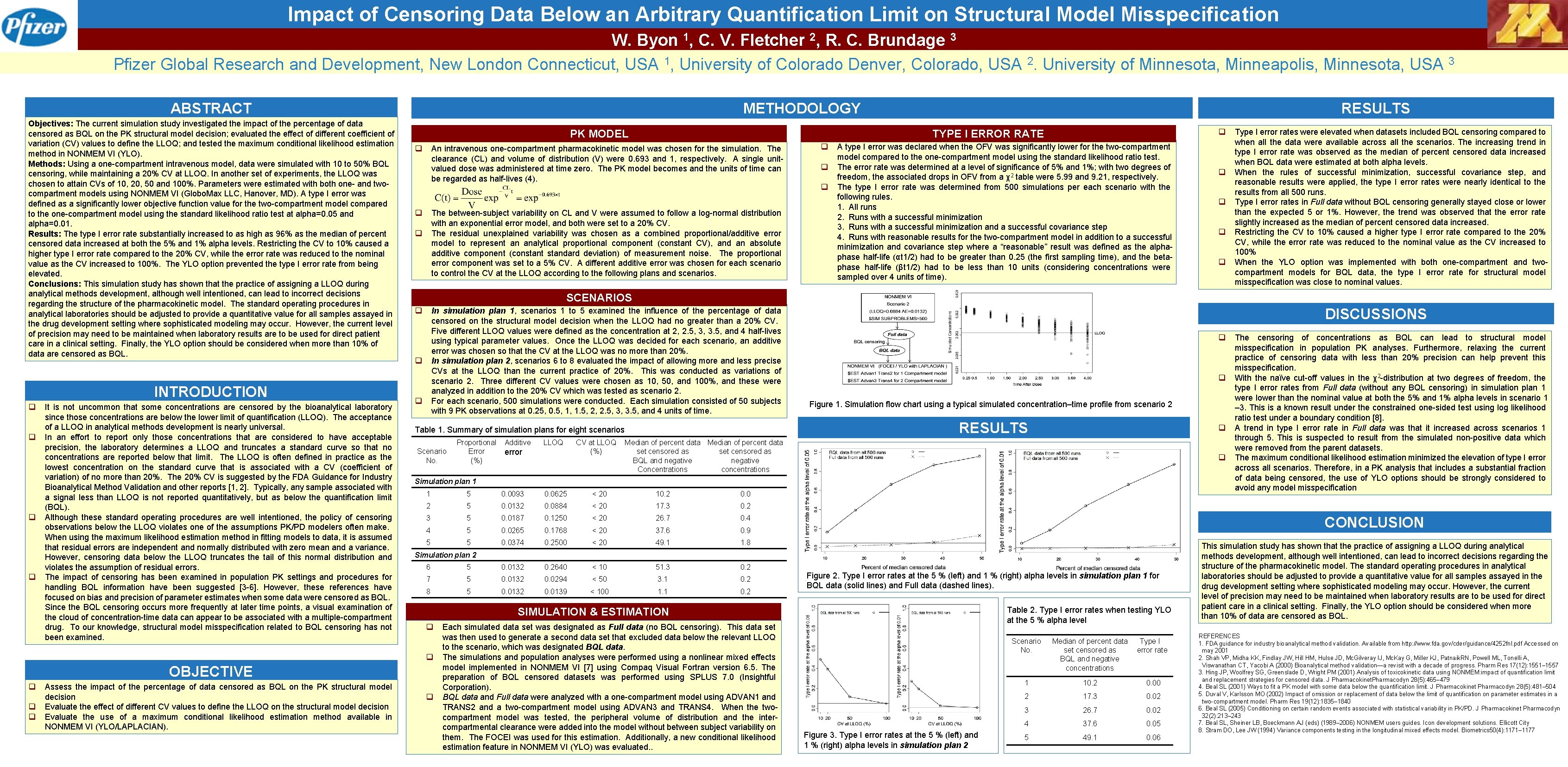
Impact of Censoring Data Below an Arbitrary Quantification Limit on Structural Model Misspecification W. Byon 1, C. V. Fletcher 2, R. C. Brundage 3 Pfizer Global Research and Development, New London Connecticut, USA 1, University of Colorado Denver, Colorado, USA 2. University of Minnesota, Minneapolis, Minnesota, USA 3 ABSTRACT Objectives: The current simulation study investigated the impact of the percentage of data censored as BQL on the PK structural model decision; evaluated the effect of different coefficient of variation (CV) values to define the LLOQ; and tested the maximum conditional likelihood estimation method in NONMEM VI (YLO). Methods: Using a one-compartment intravenous model, data were simulated with 10 to 50% BQL censoring, while maintaining a 20% CV at LLOQ. In another set of experiments, the LLOQ was chosen to attain CVs of 10, 20, 50 and 100%. Parameters were estimated with both one- and twocompartment models using NONMEM VI (Globo. Max LLC, Hanover, MD). A type I error was defined as a significantly lower objective function value for the two-compartment model compared to the one-compartment model using the standard likelihood ratio test at alpha=0. 05 and alpha=0. 01. Results: The type I error rate substantially increased to as high as 96% as the median of percent censored data increased at both the 5% and 1% alpha levels. Restricting the CV to 10% caused a higher type I error rate compared to the 20% CV, while the error rate was reduced to the nominal value as the CV increased to 100%. The YLO option prevented the type I error rate from being elevated. Conclusions: This simulation study has shown that the practice of assigning a LLOQ during analytical methods development, although well intentioned, can lead to incorrect decisions regarding the structure of the pharmacokinetic model. The standard operating procedures in analytical laboratories should be adjusted to provide a quantitative value for all samples assayed in the drug development setting where sophisticated modeling may occur. However, the current level of precision may need to be maintained when laboratory results are to be used for direct patient care in a clinical setting. Finally, the YLO option should be considered when more than 10% of data are censored as BQL. INTRODUCTION q q It is not uncommon that some concentrations are censored by the bioanalytical laboratory since those concentrations are below the lower limit of quantification (LLOQ). The acceptance of a LLOQ in analytical methods development is nearly universal. In an effort to report only those concentrations that are considered to have acceptable precision, the laboratory determines a LLOQ and truncates a standard curve so that no concentrations are reported below that limit. The LLOQ is often defined in practice as the lowest concentration on the standard curve that is associated with a CV (coefficient of variation) of no more than 20%. The 20% CV is suggested by the FDA Guidance for Industry Bioanalytical Method Validation and other reports [1, 2]. Typically, any sample associated with a signal less than LLOQ is not reported quantitatively, but as below the quantification limit (BQL). Although these standard operating procedures are well intentioned, the policy of censoring observations below the LLOQ violates one of the assumptions PK/PD modelers often make. When using the maximum likelihood estimation method in fitting models to data, it is assumed that residual errors are independent and normally distributed with zero mean and a variance. However, censoring data below the LLOQ truncates the tail of this normal distribution and violates the assumption of residual errors. The impact of censoring has been examined in population PK settings and procedures for handling BQL information have been suggested [3 -6]. However, these references have focused on bias and precision of parameter estimates when some data were censored as BQL. Since the BQL censoring occurs more frequently at later time points, a visual examination of the cloud of concentration-time data can appear to be associated with a multiple-compartment drug. To our knowledge, structural model misspecification related to BQL censoring has not been examined. METHODOLOGY PK MODEL q The between-subject variability on CL and V were assumed to follow a log-normal distribution with an exponential error model, and both were set to a 20% CV. The residual unexplained variability was chosen as a combined proportional/additive error model to represent an analytical proportional component (constant CV), and an absolute additive component (constant standard deviation) of measurement noise. The proportional error component was set to a 5% CV. A different additive error was chosen for each scenario to control the CV at the LLOQ according to the following plans and scenarios. q q In simulation plan 1, scenarios 1 to 5 examined the influence of the percentage of data censored on the structural model decision when the LLOQ had no greater than a 20% CV. Five different LLOQ values were defined as the concentration at 2, 2. 5, 3, 3. 5, and 4 half-lives using typical parameter values. Once the LLOQ was decided for each scenario, an additive error was chosen so that the CV at the LLOQ was no more than 20%. In simulation plan 2, scenarios 6 to 8 evaluated the impact of allowing more and less precise CVs at the LLOQ than the current practice of 20%. This was conducted as variations of scenario 2. Three different CV values were chosen as 10, 50, and 100%, and these were analyzed in addition to the 20% CV which was tested as scenario 2. For each scenario, 500 simulations were conducted. Each simulation consisted of 50 subjects with 9 PK observations at 0. 25, 0. 5, 1, 1. 5, 2, 2. 5, 3, 3. 5, and 4 units of time. q q q A type I error was declared when the OFV was significantly lower for the two-compartment model compared to the one-compartment model using the standard likelihood ratio test. The error rate was determined at a level of significance of 5% and 1%; with two degrees of freedom, the associated drops in OFV from a χ2 table were 5. 99 and 9. 21, respectively. The type I error rate was determined from 500 simulations per each scenario with the following rules. 1. All runs 2. Runs with a successful minimization 3. Runs with a successful minimization and a successful covariance step 4. Runs with reasonable results for the two-compartment model in addition to a successful minimization and covariance step where a “reasonable” result was defined as the alphaphase half-life (αt 1/2) had to be greater than 0. 25 (the first sampling time), and the betaphase half-life (βt 1/2) had to be less than 10 units (considering concentrations were sampled over 4 units of time). q q Scenario No. Proportional Error (%) Additive LLOQ error CV at LLOQ (%) DISCUSSIONS q q Figure 1. Simulation flow chart using a typical simulated concentration–time profile from scenario 2 RESULTS Table 1. Summary of simulation plans for eight scenarios q Median of percent data set censored as BQL and negative Concentrations concentrations q Simulation plan 1 1 5 0. 0093 0. 0625 < 20 10. 2 0. 0 2 5 0. 0132 0. 0884 < 20 17. 3 0. 2 3 5 0. 0187 0. 1250 < 20 26. 7 0. 4 4 5 0. 0265 0. 1768 < 20 37. 6 0. 9 5 5 0. 0374 0. 2500 < 20 49. 1 1. 8 6 5 0. 0132 0. 2640 < 10 51. 3 0. 2 7 5 0. 0132 0. 0294 < 50 3. 1 0. 2 8 5 0. 0132 0. 0139 < 100 1. 1 0. 2 Figure 2. Type I error rates at the 5 % (left) and 1 % (right) alpha levels in simulation plan 1 for BQL data (solid lines) and Full data (dashed lines). Table 2. Type I error rates when testing YLO at the 5 % alpha level SIMULATION & ESTIMATION q q Each simulated data set was designated as Full data (no BQL censoring). This data set was then used to generate a second data set that excluded data below the relevant LLOQ to the scenario, which was designated BQL data. The simulations and population analyses were performed using a nonlinear mixed effects model implemented in NONMEM VI [7] using Compaq Visual Fortran version 6. 5. The preparation of BQL censored datasets was performed using SPLUS 7. 0 (Insightful Corporation). BQL data and Full data were analyzed with a one-compartment model using ADVAN 1 and TRANS 2 and a two-compartment model using ADVAN 3 and TRANS 4. When the twocompartment model was tested, the peripheral volume of distribution and the intercompartmental clearance were added into the model without between subject variability on them. The FOCEI was used for this estimation. Additionally, a new conditional likelihood estimation feature in NONMEM VI (YLO) was evaluated. . The censoring of concentrations as BQL can lead to structural model misspecification in population PK analyses. Furthermore, relaxing the current practice of censoring data with less than 20% precision can help prevent this misspecification. With the naïve cut-off values in the χ2 -distribution at two degrees of freedom, the type I error rates from Full data (without any BQL censoring) in simulation plan 1 were lower than the nominal value at both the 5% and 1% alpha levels in scenario 1 – 3. This is a known result under the constrained one-sided test using log likelihood ratio test under a boundary condition [8]. A trend in type I error rate in Full data was that it increased across scenarios 1 through 5. This is suspected to result from the simulated non-positive data which were removed from the parent datasets. The maximum conditional likelihood estimation minimized the elevation of type I error across all scenarios. Therefore, in a PK analysis that includes a substantial fraction of data being censored, the use of YLO options should be strongly considered to avoid any model misspecification CONCLUSION Simulation plan 2 OBJECTIVE Assess the impact of the percentage of data censored as BQL on the PK structural model decision Evaluate the effect of different CV values to define the LLOQ on the structural model decision Evaluate the use of a maximum conditional likelihood estimation method available in NONMEM VI (YLO/LAPLACIAN). q Type I error rates were elevated when datasets included BQL censoring compared to when all the data were available across all the scenarios. The increasing trend in type I error rate was observed as the median of percent censored data increased when BQL data were estimated at both alpha levels. When the rules of successful minimization, successful covariance step, and reasonable results were applied, the type I error rates were nearly identical to the results from all 500 runs. Type I error rates in Full data without BQL censoring generally stayed close or lower than the expected 5 or 1%. However, the trend was observed that the error rate slightly increased as the median of percent censored data increased. Restricting the CV to 10% caused a higher type I error rate compared to the 20% CV, while the error rate was reduced to the nominal value as the CV increased to 100% When the YLO option was implemented with both one-compartment and twocompartment models for BQL data, the type I error rate for structural model misspecification was close to nominal values. SCENARIOS q q q TYPE I ERROR RATE An intravenous one-compartment pharmacokinetic model was chosen for the simulation. The clearance (CL) and volume of distribution (V) were 0. 693 and 1, respectively. A single unitvalued dose was administered at time zero. The PK model becomes and the units of time can be regarded as half-lives (4). q RESULTS Figure 3. Type I error rates at the 5 % (left) and 1 % (right) alpha levels in simulation plan 2 Scenario No. Median of percent data set censored as BQL and negative concentrations Type I error rate 1 10. 2 0. 00 2 17. 3 0. 02 3 26. 7 0. 02 4 37. 6 0. 05 5 49. 1 0. 06 This simulation study has shown that the practice of assigning a LLOQ during analytical methods development, although well intentioned, can lead to incorrect decisions regarding the structure of the pharmacokinetic model. The standard operating procedures in analytical laboratories should be adjusted to provide a quantitative value for all samples assayed in the drug development setting where sophisticated modeling may occur. However, the current level of precision may need to be maintained when laboratory results are to be used for direct patient care in a clinical setting. Finally, the YLO option should be considered when more than 10% of data are censored as BQL. REFERENCES 1. FDA guidance for industry bioanalytical method validation. Available from http: //www. fda. gov/cder/guidance/4252 fnl. pdf Accessed on may 2001 2. Shah VP, Midha KK, Findlay JW, Hill HM, Hulse JD, Mc. Gilveray IJ, Mc. Kay G, Miller KJ, Patnaik. RN, Powell ML, Tonelli A, Viswanathan CT, Yacobi A (2000) Bioanalytical method validation—a revisit with a decade of progress. Pharm Res 17(12): 1551– 1557 3. Hing JP, Woolfrey SG, Greenslade D, Wright PM (2001) Analysis of toxicokinetic data using NONMEM: impact of quantification limit and replacement strategies for censored data. J Pharmacokinet. Pharmacodyn 28(5): 465– 479 4. Beal SL (2001) Ways to fit a PK model with some data below the quantification limit. J Pharmacokinet Pharmacodyn 28(5): 481– 504 5. Duval V, Karlsson MO (2002) Impact of omission or replacement of data below the limit of quantification on parameter estimates in a two-compartment model. Pharm Res 19(12): 1835– 1840 6. Beal SL (2005) Conditioning on certain random events associated with statistical variability in PK/PD. J Pharmacokinet Pharmacodyn 32(2): 213– 243 7. Beal SL, Sheiner LB, Boeckmann AJ (eds) (1989– 2006) NONMEM users guides. Icon development solutions. Ellicott City 8. Stram DO, Lee JW (1994) Variance components testing in the longitudinal mixed effects model. Biometrics 50(4): 1171– 1177
- Slides: 1