
Impact of Acculturation Gap Stress on Latino Adolescents
- Slides: 1
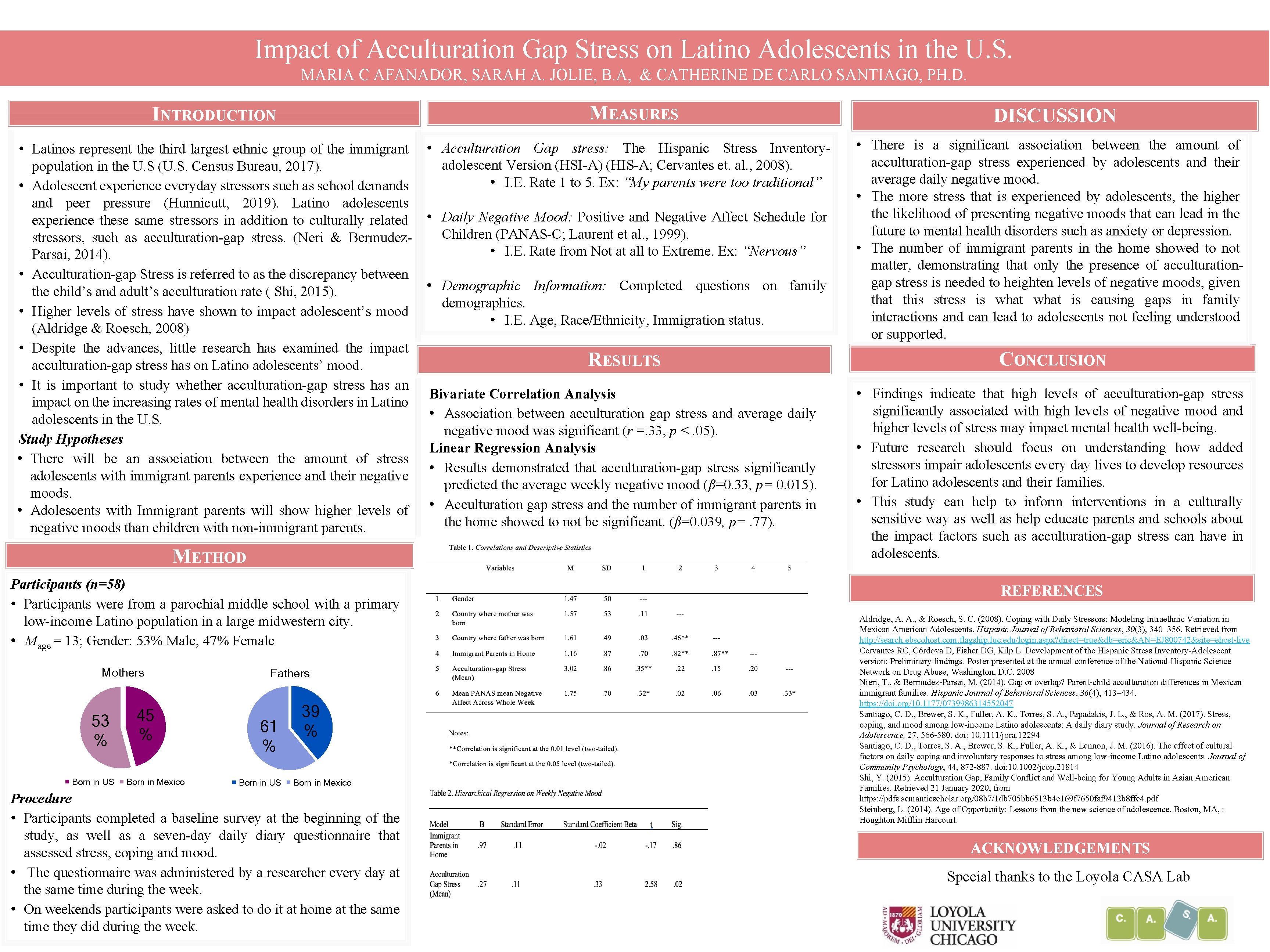
Impact of Acculturation Gap Stress on Latino Adolescents in the U. S. MARIA C AFANADOR, SARAH A. JOLIE, B. A, & CATHERINE DE CARLO SANTIAGO, PH. D. MEASURES INTRODUCTION • Latinos represent the third largest ethnic group of the immigrant population in the U. S (U. S. Census Bureau, 2017). • Adolescent experience everyday stressors such as school demands and peer pressure (Hunnicutt, 2019). Latino adolescents experience these same stressors in addition to culturally related stressors, such as acculturation-gap stress. (Neri & Bermudez. Parsai, 2014). • Acculturation-gap Stress is referred to as the discrepancy between the child’s and adult’s acculturation rate ( Shi, 2015). • Higher levels of stress have shown to impact adolescent’s mood (Aldridge & Roesch, 2008) • Despite the advances, little research has examined the impact acculturation-gap stress has on Latino adolescents’ mood. • It is important to study whether acculturation-gap stress has an impact on the increasing rates of mental health disorders in Latino adolescents in the U. S. Study Hypotheses • There will be an association between the amount of stress adolescents with immigrant parents experience and their negative moods. • Adolescents with Immigrant parents will show higher levels of negative moods than children with non-immigrant parents. METHOD Participants (n=58) • Participants were from a parochial middle school with a primary low-income Latino population in a large midwestern city. • Mage = 13; Gender: 53% Male, 47% Female Mothers 53 % Born in US 45 % Born in Mexico Fathers 61 % Born in US 39 % Born in Mexico Procedure • Participants completed a baseline survey at the beginning of the study, as well as a seven-day daily diary questionnaire that assessed stress, coping and mood. • The questionnaire was administered by a researcher every day at the same time during the week. • On weekends participants were asked to do it at home at the same time they did during the week. • Acculturation Gap stress: The Hispanic Stress Inventoryadolescent Version (HSI-A) (HIS-A; Cervantes et. al. , 2008). • I. E. Rate 1 to 5. Ex: “My parents were too traditional” • Daily Negative Mood: Positive and Negative Affect Schedule for Children (PANAS-C; Laurent et al. , 1999). • I. E. Rate from Not at all to Extreme. Ex: “Nervous” • Demographic Information: Completed questions on family demographics. • I. E. Age, Race/Ethnicity, Immigration status. DISCUSSION • There is a significant association between the amount of acculturation-gap stress experienced by adolescents and their average daily negative mood. • The more stress that is experienced by adolescents, the higher the likelihood of presenting negative moods that can lead in the future to mental health disorders such as anxiety or depression. • The number of immigrant parents in the home showed to not matter, demonstrating that only the presence of acculturationgap stress is needed to heighten levels of negative moods, given that this stress is what is causing gaps in family interactions and can lead to adolescents not feeling understood or supported. RESULTS CONCLUSION Bivariate Correlation Analysis • Association between acculturation gap stress and average daily negative mood was significant (r =. 33, p <. 05). Linear Regression Analysis • Results demonstrated that acculturation-gap stress significantly predicted the average weekly negative mood (β=0. 33, p= 0. 015). • Acculturation gap stress and the number of immigrant parents in the home showed to not be significant. (β=0. 039, p=. 77). • Findings indicate that high levels of acculturation-gap stress significantly associated with high levels of negative mood and higher levels of stress may impact mental health well-being. • Future research should focus on understanding how added stressors impair adolescents every day lives to develop resources for Latino adolescents and their families. • This study can help to inform interventions in a culturally sensitive way as well as help educate parents and schools about the impact factors such as acculturation-gap stress can have in adolescents. REFERENCES Aldridge, A. A. , & Roesch, S. C. (2008). Coping with Daily Stressors: Modeling Intraethnic Variation in Mexican American Adolescents. Hispanic Journal of Behavioral Sciences, 30(3), 340– 356. Retrieved from http: //search. ebscohost. com. flagship. luc. edu/login. aspx? direct=true&db=eric&AN=EJ 800742&site=ehost-live Cervantes RC, Córdova D, Fisher DG, Kilp L. Development of the Hispanic Stress Inventory-Adolescent version: Preliminary findings. Poster presented at the annual conference of the National Hispanic Science Network on Drug Abuse; Washington, D. C. 2008 Nieri, T. , & Bermudez-Parsai, M. (2014). Gap or overlap? Parent-child acculturation differences in Mexican immigrant families. Hispanic Journal of Behavioral Sciences, 36(4), 413– 434. https: //doi. org/10. 1177/0739986314552047 Santiago, C. D. , Brewer, S. K. , Fuller, A. K. , Torres, S. A. , Papadakis, J. L. , & Ros, A. M. (2017). Stress, coping, and mood among low-income Latino adolescents: A daily diary study. Journal of Research on Adolescence, 27, 566 -580. doi: 10. 1111/jora. 12294 Santiago, C. D. , Torres, S. A. , Brewer, S. K. , Fuller, A. K. , & Lennon, J. M. (2016). The effect of cultural factors on daily coping and involuntary responses to stress among low-income Latino adolescents. Journal of Community Psychology, 44, 872 -887. doi: 10. 1002/jcop. 21814 Shi, Y. (2015). Acculturation Gap, Family Conflict and Well-being for Young Adults in Asian American Families. Retrieved 21 January 2020, from https: //pdfs. semanticscholar. org/08 b 7/1 db 705 bb 6513 b 4 c 169 f 7650 faf 9412 b 8 ffe 4. pdf Steinberg, L. (2014). Age of Opportunity: Lessons from the new science of adolescence. Boston, MA, : Houghton Mifflin Harcourt. ACKNOWLEDGEMENTS Special thanks to the Loyola CASA Lab