
Impact of a surgical closing protocol to decrease


- Slides: 15
Impact of a surgical closing protocol to decrease surgical site infections in cesarean deliveries Michelle Wyatt, MD; Claire Jensen, MD; Isabel Yelsa; Stephanie Duong, BA; Matthew Hathcock, MS; Enid Rivera-Chiauzzi, MD Mayo Clinic Rochester, MN wyatt. michelle@mayo. edu SASGOG 2020 Virtual Visit © 2020 MFMER | slide-1
- Review morbidity associated with surgical site infections LEARNING OBJECTIVE - Discuss evidence based approaches to reduce surgical site infections - Review surgical site infection data after implementation of a surgical closing tray © 2020 MFMER | slide-2
1 Surgical Site Infections © 2020 MFMER | slide-3
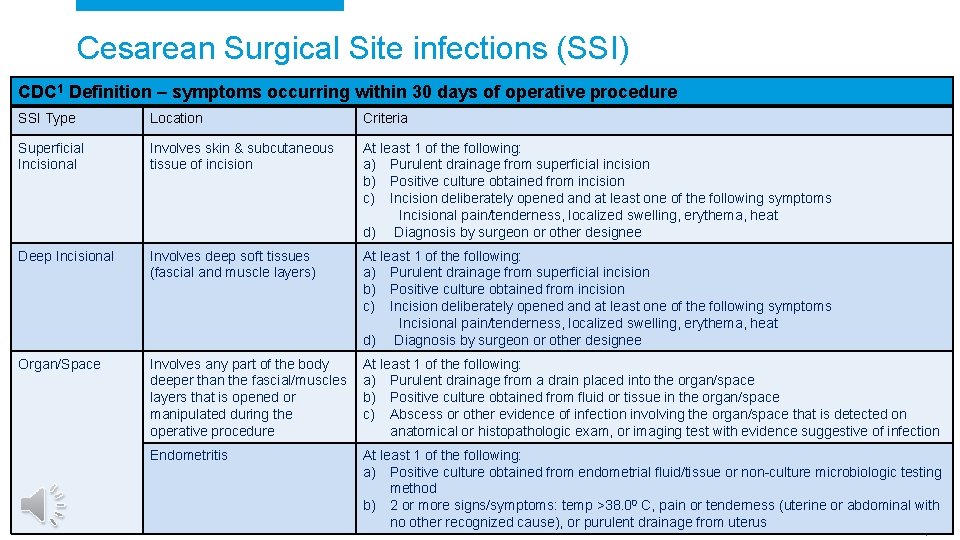
Cesarean Surgical Site infections (SSI) CDC 1 Definition – symptoms occurring within 30 days of operative procedure SSI Type Location Criteria Superficial Incisional Involves skin & subcutaneous tissue of incision At least 1 of the following: a) Purulent drainage from superficial incision b) Positive culture obtained from incision c) Incision deliberately opened and at least one of the following symptoms Incisional pain/tenderness, localized swelling, erythema, heat d) Diagnosis by surgeon or other designee Deep Incisional Involves deep soft tissues (fascial and muscle layers) At least 1 of the following: a) Purulent drainage from superficial incision b) Positive culture obtained from incision c) Incision deliberately opened and at least one of the following symptoms Incisional pain/tenderness, localized swelling, erythema, heat d) Diagnosis by surgeon or other designee Organ/Space Involves any part of the body deeper than the fascial/muscles layers that is opened or manipulated during the operative procedure At least 1 of the following: a) Purulent drainage from a drain placed into the organ/space b) Positive culture obtained from fluid or tissue in the organ/space c) Abscess or other evidence of infection involving the organ/space that is detected on anatomical or histopathologic exam, or imaging test with evidence suggestive of infection Endometritis At least 1 of the following: a) Positive culture obtained from endometrial fluid/tissue or non-culture microbiologic testing method b) 2 or more signs/symptoms: temp >38. 00 C, pain or tenderness (uterine or abdominal with no other recognized cause), or purulent drainage from uterus © 2020 MFMER | slide-4
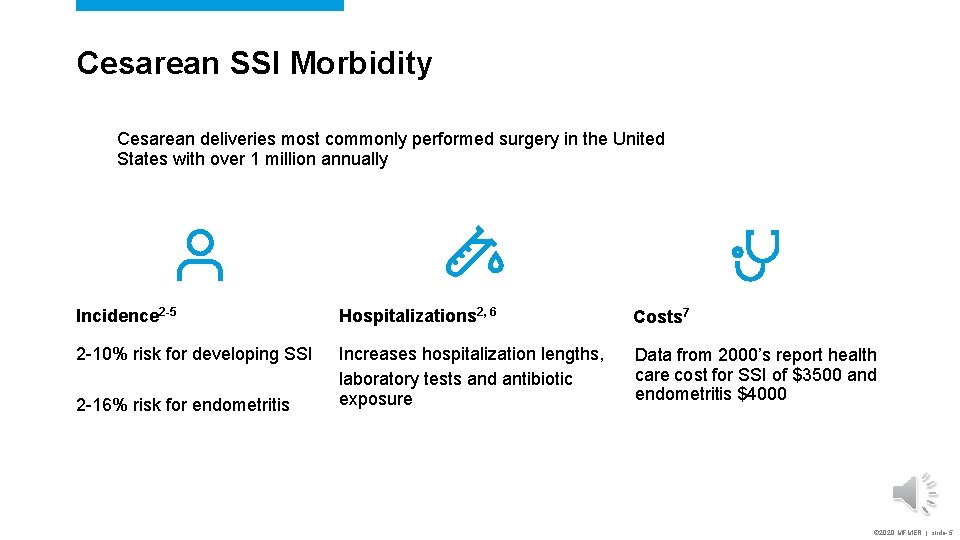
Cesarean SSI Morbidity Cesarean deliveries most commonly performed surgery in the United States with over 1 million annually Incidence 2 -5 Hospitalizations 2, 6 Costs 7 2 -10% risk for developing SSI Increases hospitalization lengths, laboratory tests and antibiotic exposure Data from 2000’s report health care cost for SSI of $3500 and endometritis $4000 2 -16% risk for endometritis © 2020 MFMER | slide-5
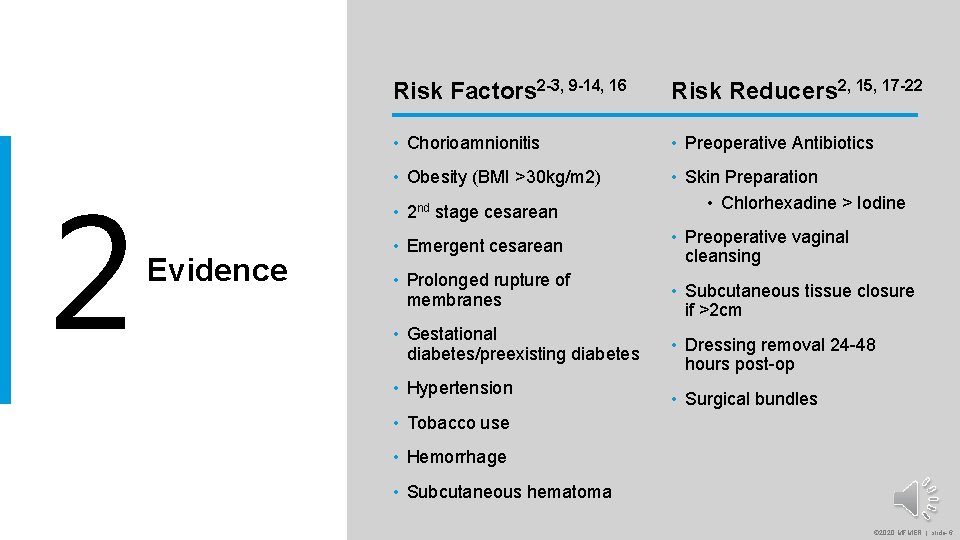
2 Risk Factors 2 -3, 9 -14, 16 Risk Reducers 2, 15, 17 -22 • Chorioamnionitis • Preoperative Antibiotics • Obesity (BMI >30 kg/m 2) • Skin Preparation • Chlorhexadine > Iodine • 2 nd stage cesarean Evidence • Emergent cesarean • Prolonged rupture of membranes • Gestational diabetes/preexisting diabetes • Hypertension • Preoperative vaginal cleansing • Subcutaneous tissue closure if >2 cm • Dressing removal 24 -48 hours post-op • Surgical bundles • Tobacco use • Hemorrhage • Subcutaneous hematoma © 2020 MFMER | slide-6
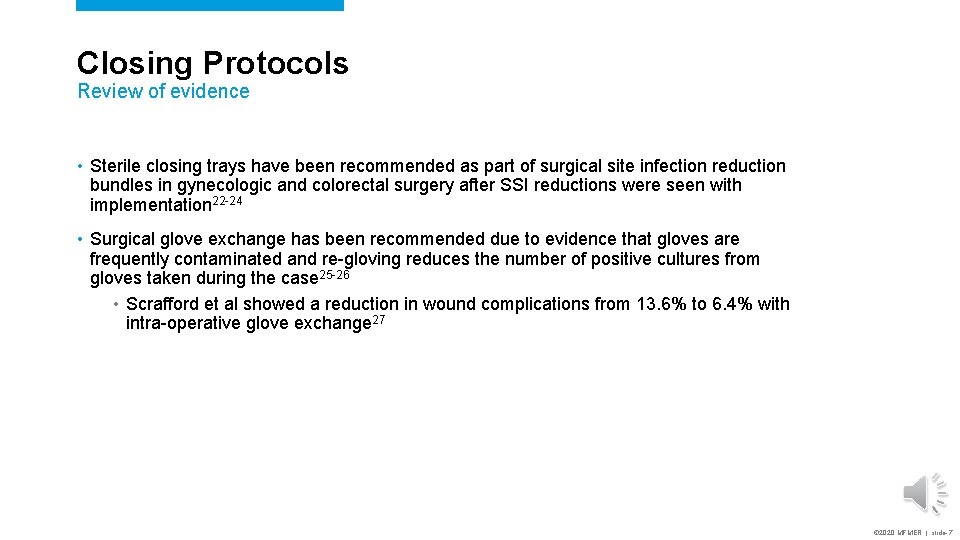
Closing Protocols Review of evidence • Sterile closing trays have been recommended as part of surgical site infection reduction bundles in gynecologic and colorectal surgery after SSI reductions were seen with implementation 22 -24 • Surgical glove exchange has been recommended due to evidence that gloves are frequently contaminated and re-gloving reduces the number of positive cultures from gloves taken during the case 25 -26 • Scrafford et al showed a reduction in wound complications from 13. 6% to 6. 4% with intra-operative glove exchange 27 © 2020 MFMER | slide-7
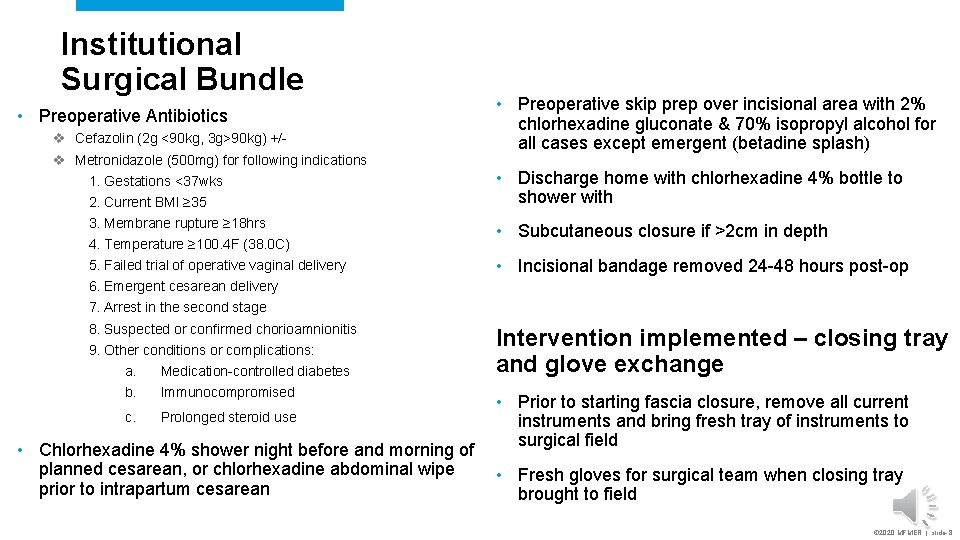
Institutional Surgical Bundle • Preoperative Antibiotics v Cefazolin (2 g <90 kg, 3 g>90 kg) +/v Metronidazole (500 mg) for following indications 1. Gestations <37 wks 2. Current BMI ≥ 35 3. Membrane rupture ≥ 18 hrs 4. Temperature ≥ 100. 4 F (38. 0 C) 5. Failed trial of operative vaginal delivery 6. Emergent cesarean delivery 7. Arrest in the second stage 8. Suspected or confirmed chorioamnionitis 9. Other conditions or complications: a. Medication-controlled diabetes b. Immunocompromised c. Prolonged steroid use • Preoperative skip prep over incisional area with 2% chlorhexadine gluconate & 70% isopropyl alcohol for all cases except emergent (betadine splash) • Discharge home with chlorhexadine 4% bottle to shower with • Subcutaneous closure if >2 cm in depth • Incisional bandage removed 24 -48 hours post-op Intervention implemented – closing tray and glove exchange • Prior to starting fascia closure, remove all current instruments and bring fresh tray of instruments to surgical field • Chlorhexadine 4% shower night before and morning of planned cesarean, or chlorhexadine abdominal wipe • Fresh gloves for surgical team when closing tray prior to intrapartum cesarean brought to field © 2020 MFMER | slide-8
3 Study design and results © 2020 MFMER | slide-9
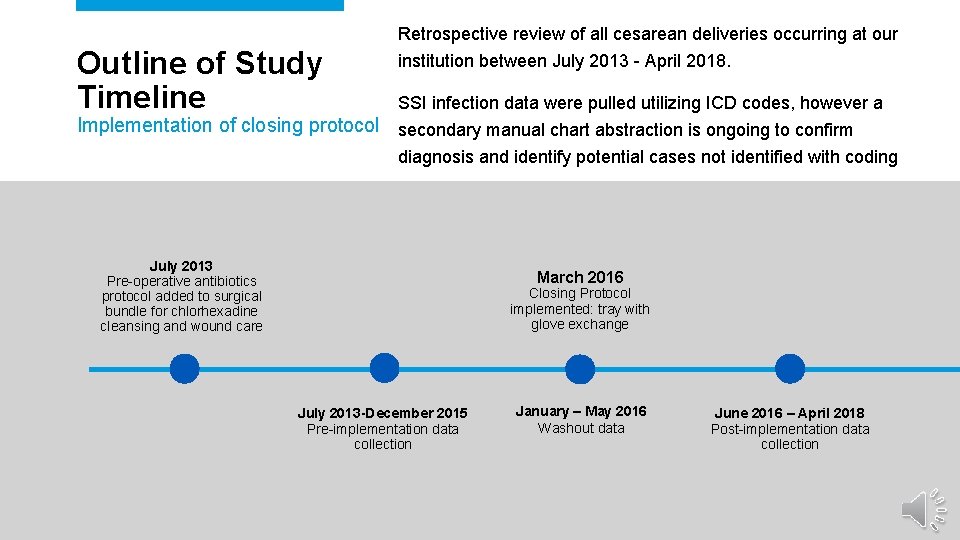
Retrospective review of all cesarean deliveries occurring at our Outline of Study Timeline institution between July 2013 - April 2018. SSI infection data were pulled utilizing ICD codes, however a Implementation of closing protocol secondary manual chart abstraction is ongoing to confirm diagnosis and identify potential cases not identified with coding July 2013 Pre-operative antibiotics protocol added to surgical bundle for chlorhexadine cleansing and wound care March 2016 Closing Protocol implemented: tray with glove exchange July 2013 -December 2015 Pre-implementation data collection January – May 2016 Washout data June 2016 – April 2018 Post-implementation data collection © 2020 MFMER | slide-10
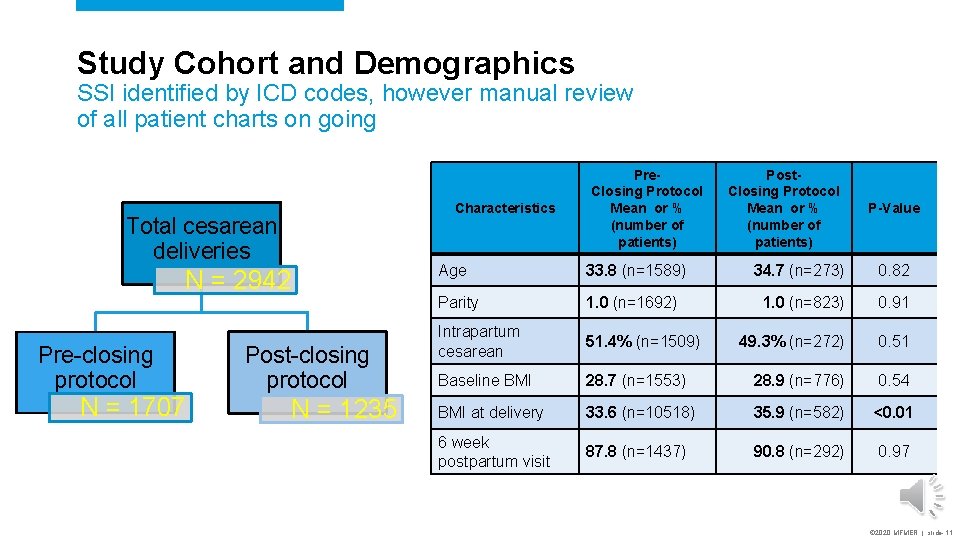
Study Cohort and Demographics SSI identified by ICD codes, however manual review of all patient charts on going Characteristics Total cesarean deliveries N = 2942 Pre-closing protocol N = 1707 Post-closing protocol N = 1235 Pre. Closing Protocol Mean or % (number of patients) Post. Closing Protocol Mean or % (number of patients) P-Value Age 33. 8 (n=1589) 34. 7 (n=273) 0. 82 Parity 1. 0 (n=1692) 1. 0 (n=823) 0. 91 Intrapartum cesarean 51. 4% (n=1509) 49. 3% (n=272) 0. 51 Baseline BMI 28. 7 (n=1553) 28. 9 (n=776) 0. 54 BMI at delivery 33. 6 (n=10518) 35. 9 (n=582) <0. 01 6 week postpartum visit 87. 8 (n=1437) 90. 8 (n=292) 0. 97 © 2020 MFMER | slide-11
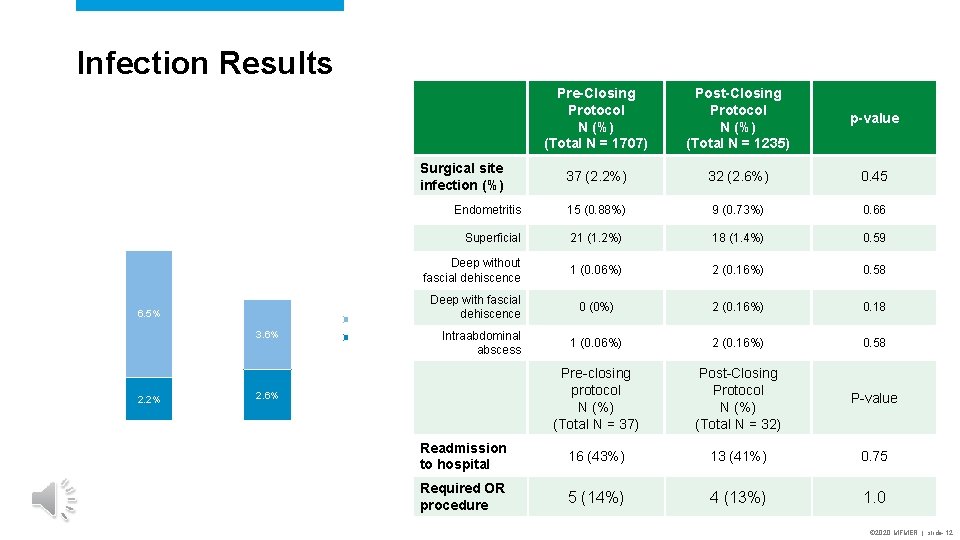
Infection Results Pre-Closing Protocol N (%) (Total N = 1707) Post-Closing Protocol N (%) (Total N = 1235) p-value 37 (2. 2%) 32 (2. 6%) 0. 45 Endometritis 15 (0. 88%) 9 (0. 73%) 0. 66 Superficial 21 (1. 2%) 18 (1. 4%) 0. 59 Deep without fascial dehiscence 1 (0. 06%) 2 (0. 16%) 0. 58 0 (0%) 2 (0. 16%) 0. 18 1 (0. 06%) 2 (0. 16%) 0. 58 Pre-closing protocol N (%) (Total N = 37) Post-Closing Protocol N (%) (Total N = 32) P-value Readmission to hospital 16 (43%) 13 (41%) 0. 75 Required OR procedure 5 (14%) 4 (13%) 1. 0 Surgical site infection (%) 30 day infection diagnosis 10. 0% 9. 0% Percent of patients 8. 0% 7. 0% 6. 0% 5. 0% 6. 5% Non SSI 3. 6% 4. 0% 3. 0% SSI Deep with fascial dehiscence Intraabdominal abscess 2. 0% 1. 0% 2. 2% 2. 6% Pre-protocol Post-protocol 0. 0% © 2020 MFMER | slide-12
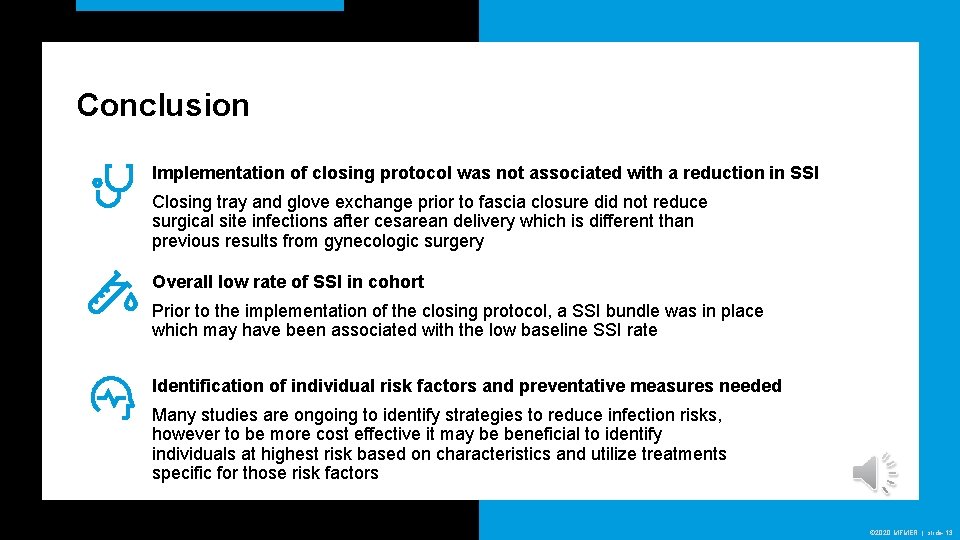
Conclusion Implementation of closing protocol was not associated with a reduction in SSI Closing tray and glove exchange prior to fascia closure did not reduce surgical site infections after cesarean delivery which is different than previous results from gynecologic surgery Overall low rate of SSI in cohort Prior to the implementation of the closing protocol, a SSI bundle was in place which may have been associated with the low baseline SSI rate Identification of individual risk factors and preventative measures needed Many studies are ongoing to identify strategies to reduce infection risks, however to be more cost effective it may be beneficial to identify individuals at highest risk based on characteristics and utilize treatments specific for those risk factors © 2020 MFMER | slide-13
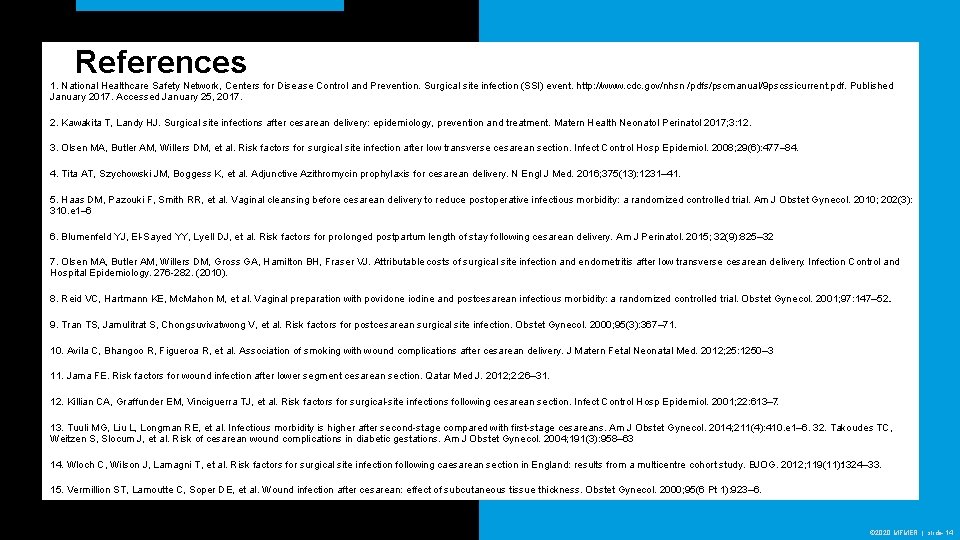
References 1. National Healthcare Safety Network, Centers for Disease Control and Prevention. Surgical site infection (SSI) event. http: //www. cdc. gov/nhsn /pdfs/pscmanual/9 pscssicurrent. pdf. Published January 2017. Accessed January 25, 2017. 2. Kawakita T, Landy HJ. Surgical site infections after cesarean delivery: epidemiology, prevention and treatment. Matern Health Neonatol Perinatol 2017; 3: 12. 3. Olsen MA, Butler AM, Willers DM, et al. Risk factors for surgical site infection after low transverse cesarean section. Infect Control Hosp Epidemiol. 2008; 29(6): 477– 84. 4. Tita AT, Szychowski JM, Boggess K, et al. Adjunctive Azithromycin prophylaxis for cesarean delivery. N Engl J Med. 2016; 375(13): 1231– 41. 5. Haas DM, Pazouki F, Smith RR, et al. Vaginal cleansing before cesarean delivery to reduce postoperative infectious morbidity: a randomized controlled trial. Am J Obstet Gynecol. 2010; 202(3): 310. e 1– 6 6. Blumenfeld YJ, El-Sayed YY, Lyell DJ, et al. Risk factors for prolonged postpartum length of stay following cesarean delivery. Am J Perinatol. 2015; 32(9): 825– 32 7. Olsen MA, Butler AM, Willers DM, Gross GA, Hamilton BH, Fraser VJ. Attributable costs of surgical site infection and endometritis after low transverse cesarean delivery. Infection Control and Hospital Epidemiology. 276 -282. (2010). 8. Reid VC, Hartmann KE, Mc. Mahon M, et al. Vaginal preparation with povidone iodine and postcesarean infectious morbidity: a randomized controlled trial. Obstet Gynecol. 2001; 97: 147– 52. . 9. Tran TS, Jamulitrat S, Chongsuvivatwong V, et al. Risk factors for postcesarean surgical site infection. Obstet Gynecol. 2000; 95(3): 367– 71. 10. Avila C, Bhangoo R, Figueroa R, et al. Association of smoking with wound complications after cesarean delivery. J Matern Fetal Neonatal Med. 2012; 25: 1250– 3. 11. Jama FE. Risk factors for wound infection after lower segment cesarean section. Qatar Med J. 2012; 2: 26– 31. 12. Killian CA, Graffunder EM, Vinciguerra TJ, et al. Risk factors for surgical-site infections following cesarean section. Infect Control Hosp Epidemiol. 2001; 22: 613– 7. 13. Tuuli MG, Liu L, Longman RE, et al. Infectious morbidity is higher after second-stage compared with first-stage cesareans. Am J Obstet Gynecol. 2014; 211(4): 410. e 1– 6. 32. Takoudes TC, Weitzen S, Slocum J, et al. Risk of cesarean wound complications in diabetic gestations. Am J Obstet Gynecol. 2004; 191(3): 958– 63 14. Wloch C, Wilson J, Lamagni T, et al. Risk factors for surgical site infection following caesarean section in England: results from a multicentre cohort study. BJOG. 2012; 119(11): 1324– 33. 15. Vermillion ST, Lamoutte C, Soper DE, et al. Wound infection after cesarean: effect of subcutaneous tissue thickness. Obstet Gynecol. 2000; 95(6 Pt 1): 923– 6. © 2020 MFMER | slide-14
References 16. Opøien HK, Valbø A, Grinde-Andersen A, et al. Post-cesarean surgical site infections according to CDC standards: rates and risk factors. A prospective cohort study. Acta Obstet Gynecol Scand. 2007; 86(9): 1097– 102. 29. Schneid-Kofman N, Sheiner E, Levy A, et al. Risk factors for wound infection following cesarean deliveries. Int J Gynaecol Obstet. 2005; 90: 10– 5. 17. Smaill FM, Grivell RM. Antibiotic prophylaxis versus no prophylaxis for preventing infection after cesarean section. Cochrane Database of Systematic Reviews 2014, Issue 10. Art. No. : CD 007482. 18. American College of Obstetricians and Gynecologists. ACOG practice bulletin no. 199: use of prophylactic antibiotics in labor and delivery. Obstet Gynecol. 2018; 132(3): 103 -119. Tuuli MG, Liu J, Stout MJ, et al. A randomized trial comparing skin antiseptic agents at cesarean delivery. N Engl J Med. 2016; 374(7): 647– 55. 20. Ngai IM, Van Arsdale A, Govindappagari S, et al. Skin preparation for prevention of surgical site infection after cesarean delivery: a randomized controlled trial. Obstet Gynecol. 2015; 126(6): 1251– 7. 21. Tanner J, Norrie P, Melen K. Preoperative hair removal to reduce surgical site infection. Cochrane Database Syst Rev. 2011; (11): CD 004122. Johnson MP, Kim SJ, Langstraat CL, et al. Using Bundled Interventions to Reduce Surgical Site Infection After Major Gynecologic Cancer Surgery. Obstet Gynecol 2016; 127: 1135 -44. 23. Cima R, Dankbar E, Lovely J, Pendlimari R, Aronhalt K, Nehring S, et al. Colorectal surgery surgical site infection reduction program: a national surgical quality improvement program–driven multidisciplinary single-institution experience. J Am Coll Surg 2013; 216: 23– 33. 24. Bull A, Wilson J, Worth LJ, Stuart RL, Gillespie E, Waxman B, et al. A bundle of care to reduce colorectal surgical infections: an Australian experience. J Hosp Infect 2011; 78: 297– 301 25. Ritter MA, French ML, Eitzen H. Evaluation of microbial contamination of surgical gloves during actual use. Clin Orthop Relat Res. 1976: 303– 306. 26. Mc. Cue SF, Berg EW, Saunders EA. Efficacy of double-gloving as a barrier to microbial contamination during total joint arthroplasty. J Bone Joint Surg Am. 1981; 63: 811– 813. 27. Scrafford JD, Reddy B, Rivard C, Vogel RI. Effect of intra-operative glove-changing during cesarean section on post-operative complications: A randomized controlled trial. Arch Gynecol Obstet. 2018 Jun; 297(6): 1449– 1454. © 2020 MFMER | slide-15