
Impact of a Protocol Implementation on Identification and
- Slides: 1
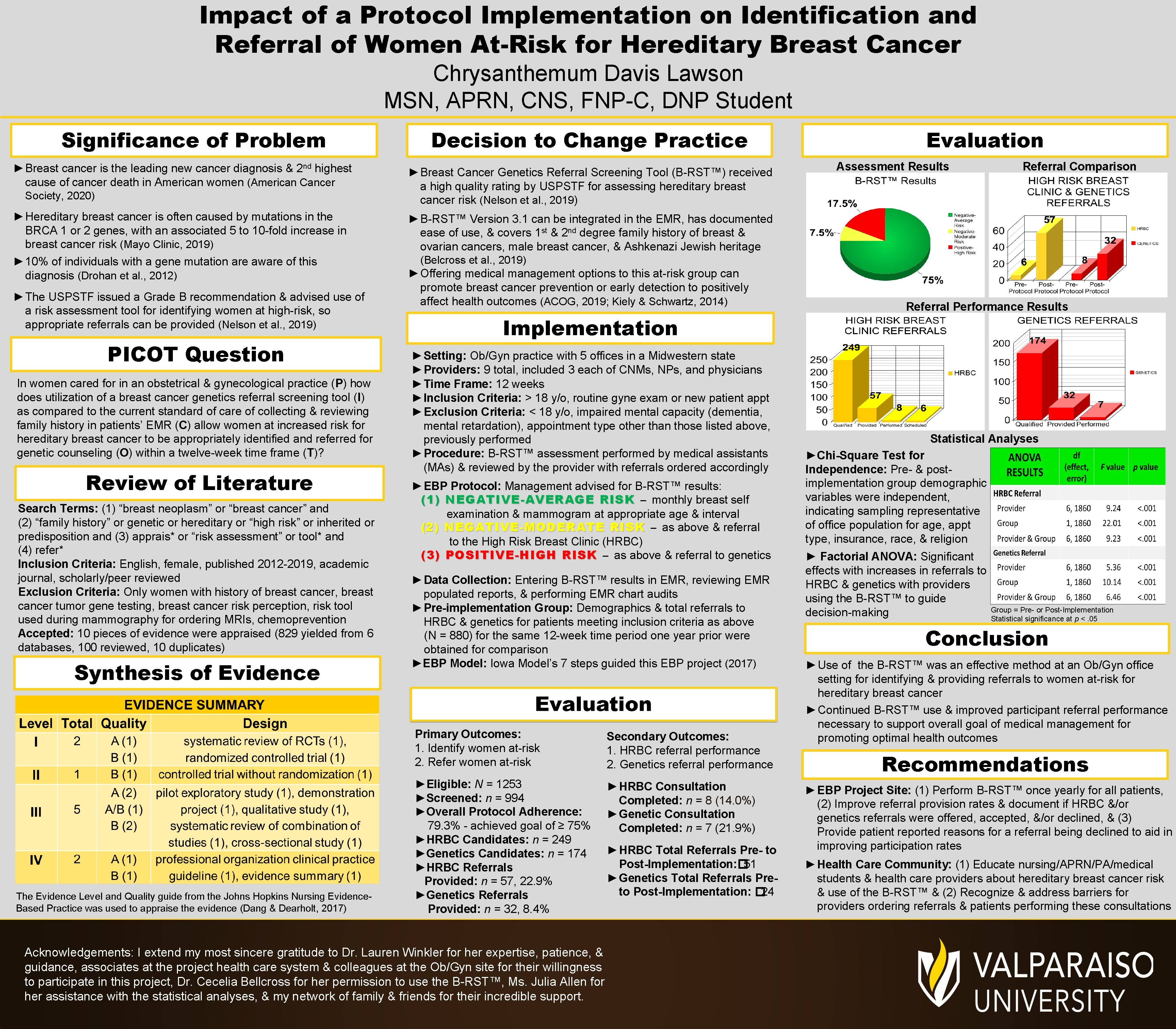
Impact of a Protocol Implementation on Identification and Referral of Women At-Risk for Hereditary Breast Cancer Chrysanthemum Davis Lawson MSN, APRN, CNS, FNP-C, DNP Student Significance of Problem ► Breast cancer is the leading new cancer diagnosis & 2 nd highest cause of cancer death in American women (American Cancer Society, 2020) ► Hereditary breast cancer is often caused by mutations in the BRCA 1 or 2 genes, with an associated 5 to 10 -fold increase in breast cancer risk (Mayo Clinic, 2019) ► 10% of individuals with a gene mutation are aware of this diagnosis (Drohan et al. , 2012) ► The USPSTF issued a Grade B recommendation & advised use of a risk assessment tool for identifying women at high-risk, so appropriate referrals can be provided (Nelson et al. , 2019) PICOT Question In women cared for in an obstetrical & gynecological practice (P) how does utilization of a breast cancer genetics referral screening tool (I) as compared to the current standard of care of collecting & reviewing family history in patients’ EMR (C) allow women at increased risk for hereditary breast cancer to be appropriately identified and referred for genetic counseling (O) within a twelve-week time frame (T)? Review of Literature Search Terms: (1) “breast neoplasm” or “breast cancer” and (2) “family history” or genetic or hereditary or “high risk” or inherited or predisposition and (3) apprais* or “risk assessment” or tool* and (4) refer* Inclusion Criteria: English, female, published 2012 -2019, academic journal, scholarly/peer reviewed Exclusion Criteria: Only women with history of breast cancer, breast cancer tumor gene testing, breast cancer risk perception, risk tool used during mammography for ordering MRIs, chemoprevention Accepted: 10 pieces of evidence were appraised (829 yielded from 6 databases, 100 reviewed, 10 duplicates) Synthesis of Evidence The Evidence Level and Quality guide from the Johns Hopkins Nursing Evidence. Based Practice was used to appraise the evidence (Dang & Dearholt, 2017) Decision to Change Practice ► Breast Cancer Genetics Referral Screening Tool (B-RST™) received a high quality rating by USPSTF for assessing hereditary breast cancer risk (Nelson et al. , 2019) Evaluation Assessment Results Referral Comparison ► B-RST™ Version 3. 1 can be integrated in the EMR, has documented ease of use, & covers 1 st & 2 nd degree family history of breast & ovarian cancers, male breast cancer, & Ashkenazi Jewish heritage (Belcross et al. , 2019) ► Offering medical management options to this at-risk group can promote breast cancer prevention or early detection to positively affect health outcomes (ACOG, 2019; Kiely & Schwartz, 2014) Implementation ► Setting: Ob/Gyn practice with 5 offices in a Midwestern state ► Providers: 9 total, included 3 each of CNMs, NPs, and physicians ► Time Frame: 12 weeks ► Inclusion Criteria: > 18 y/o, routine gyne exam or new patient appt ► Exclusion Criteria: < 18 y/o, impaired mental capacity (dementia, mental retardation), appointment type other than those listed above, previously performed ► Procedure: B-RST™ assessment performed by medical assistants (MAs) & reviewed by the provider with referrals ordered accordingly ► EBP Protocol: Management advised for B-RST™ results: (1) NEGATIVE-AVERAGE RISK – monthly breast self examination & mammogram at appropriate age & interval (2) NEGATIVE-MODERATE RISK – as above & referral to the High Risk Breast Clinic (HRBC) (3) POSITIVE-HIGH RISK – as above & referral to genetics ► Data Collection: Entering B-RST™ results in EMR, reviewing EMR populated reports, & performing EMR chart audits ► Pre-implementation Group: Demographics & total referrals to HRBC & genetics for patients meeting inclusion criteria as above (N = 880) for the same 12 -week time period one year prior were obtained for comparison ►EBP Model: Iowa Model’s 7 steps guided this EBP project (2017) Primary Outcomes: 1. Identify women at-risk 2. Refer women at-risk Secondary Outcomes: 1. HRBC referral performance 2. Genetics referral performance ►Eligible: N = 1253 ►Screened: n = 994 ►Overall Protocol Adherence: 79. 3% - achieved goal of ≥ 75% ►HRBC Candidates: n = 249 ►Genetics Candidates: n = 174 ►HRBC Referrals Provided: n = 57, 22. 9% ►Genetics Referrals Provided: n = 32, 8. 4% ► HRBC Consultation Completed: n = 8 (14. 0%) ► Genetic Consultation Completed: n = 7 (21. 9%) Acknowledgements: I extend my most sincere gratitude to Dr. Lauren Winkler for her expertise, patience, & guidance, associates at the project health care system & colleagues at the Ob/Gyn site for their willingness to participate in this project, Dr. Cecelia Bellcross for her permission to use the B-RST™, Ms. Julia Allen for her assistance with the statistical analyses, & my network of family & friends for their incredible support. ► HRBC Total Referrals Pre- to Post-Implementation: � 51 ► Genetics Total Referrals Preto Post-Implementation: � 24 Referral Performance Results Statistical Analyses ►Chi-Square Test for Independence: Pre- & postimplementation group demographic variables were independent, indicating sampling representative of office population for age, appt type, insurance, race, & religion ► Factorial ANOVA: Significant effects with increases in referrals to HRBC & genetics with providers using the B-RST™ to guide decision-making Group = Pre- or Post-Implementation Statistical significance at p <. 05 Conclusion ► Use of the B-RST™ was an effective method at an Ob/Gyn office setting for identifying & providing referrals to women at-risk for hereditary breast cancer ► Continued B-RST™ use & improved participant referral performance necessary to support overall goal of medical management for promoting optimal health outcomes Recommendations ► EBP Project Site: (1) Perform B-RST™ once yearly for all patients, (2) Improve referral provision rates & document if HRBC &/or genetics referrals were offered, accepted, &/or declined, & (3) Provide patient reported reasons for a referral being declined to aid in improving participation rates ► Health Care Community: (1) Educate nursing/APRN/PA/medical students & health care providers about hereditary breast cancer risk & use of the B-RST™ & (2) Recognize & address barriers for providers ordering referrals & patients performing these consultations