
Impact Jim Briggs 1 REF IMPACT 2 What
Impact Jim Briggs 1
REF IMPACT 2
What is impact? (REF definition) 4. 5. For the purposes of the REF, "impact is defined as an effect on, change or benefit to the economy, society, culture, public policy or services, health, the environment or quality of life, beyond academia (as set out in paragraph 7). Impact includes, but is not limited to, an effect on, change or benefit to: • • • 6. the activity, attitude, awareness, behaviour, capacity, opportunity, performance, policy, practice, process or understanding of an audience, beneficiary, community, constituency, organisation or individuals in any geographic location whether locally, regionally, nationally or internationally. Impact includes the reduction or prevention of harm, risk, cost or other negative effects. 3
"Academic" impact excluded • 7. For the purposes of the impact element of the REF: a) b) c) Impacts on research or the advancement of academic knowledge within the higher education sector (whether in the UK or internationally) are excluded. (The submitted unit’s contribution to academic research and knowledge is assessed within the ‘outputs’ and ‘environment’ elements of REF. ) Impacts on students, teaching or other activities within the submitting HEI are excluded. Other impacts within the higher education sector, including on teaching or students, are included where they extend significantly beyond the submitting HEI. 4
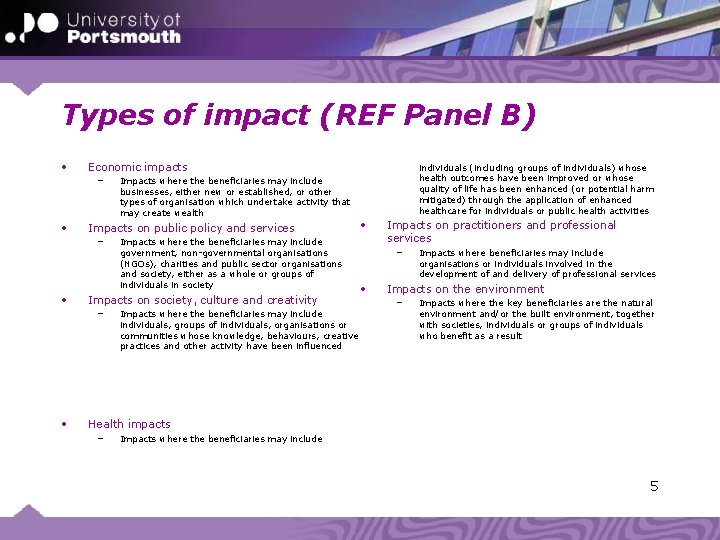
Types of impact (REF Panel B) • Economic impacts – • Impacts on public policy and services – • Impacts where the beneficiaries may include government, non-governmental organisations (NGOs), charities and public sector organisations and society, either as a whole or groups of individuals in society Impacts on society, culture and creativity – • Impacts where the beneficiaries may include businesses, either new or established, or other types of organisation which undertake activity that may create wealth Impacts where the beneficiaries may include individuals, groups of individuals, organisations or communities whose knowledge, behaviours, creative practices and other activity have been influenced individuals (including groups of individuals) whose health outcomes have been improved or whose quality of life has been enhanced (or potential harm mitigated) through the application of enhanced healthcare for individuals or public health activities • Impacts on practitioners and professional services – • Impacts where beneficiaries may include organisations or individuals involved in the development of and delivery of professional services Impacts on the environment – Impacts where the key beneficiaries are the natural environment and/or the built environment, together with societies, individuals or groups of individuals who benefit as a result Health impacts – Impacts where the beneficiaries may include 5
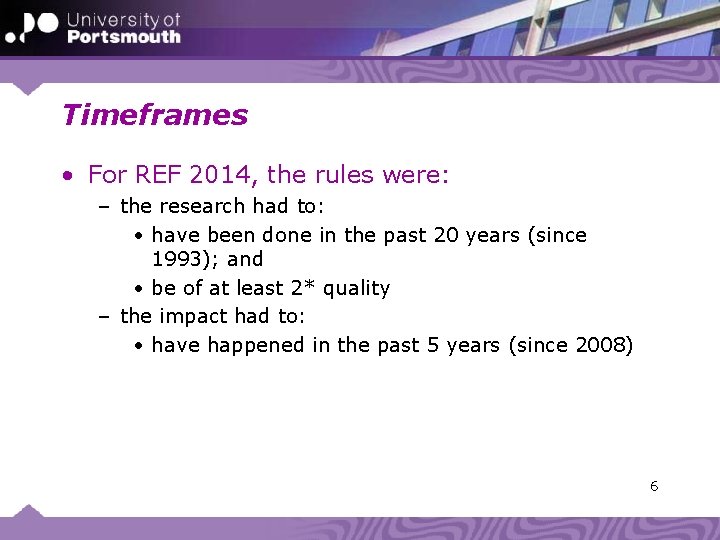
Timeframes • For REF 2014, the rules were: – the research had to: • have been done in the past 20 years (since 1993); and • be of at least 2* quality – the impact had to: • have happened in the past 5 years (since 2008) 6
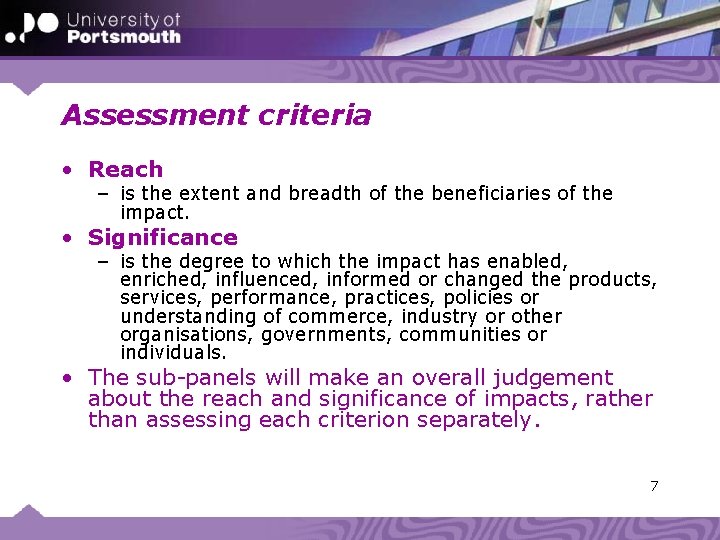
Assessment criteria • Reach – is the extent and breadth of the beneficiaries of the impact. • Significance – is the degree to which the impact has enabled, enriched, influenced, informed or changed the products, services, performance, practices, policies or understanding of commerce, industry or other organisations, governments, communities or individuals. • The sub-panels will make an overall judgement about the reach and significance of impacts, rather than assessing each criterion separately. 7
REF IMPACT CASE STUDY 8
Clinical outcome modelling (REF ICS) • We claimed 3 types of impact: 1. Practitioner/professional service impact. Our work on clinical outcome modelling has influenced the Royal College of Physicians' (RCP) new standard for the assessment of the severity of acute illness (known as the "National Early Warning Score" or NEWS). The specific recommendation is for adoption by NHS bodies, but is already being adopted internationally. 2. Health impact. The chairman of the RCP working party estimated that our work could result in the saving of thousands of lives per year. 3. Economic impact. Our work is incorporated in the Vital. PAC system developed by The Learning Clinic Ltd (TLC), and currently deployed to more than 20 hospitals. 9
Outline of research • Key findings of our research – arranged fairly chronologically • Who was involved – names, job titles, dates • 6 (max) references to key papers • List of funding won – KTP – Oxford 10
Details of impact • Economic impact on The Learning Clinic Ltd – – – describe KTP describe the company's product and how we contributed to it specified the economic impact • – • "The economic benefits to TLC included increased turnover (13 -fold over 3 years), created 15 new jobs, and allowed them to attract over £ 1 m from private investors (source 1). The Vital. PAC product generates 80% of their revenue. " evidenced it with a letter from the CEO of the company Policy impact on Royal College of Physicians – Referred to their policy recommendation report – • Brief history of how they developed NEWS and our role in it Health impact – – – Evidence that Vital. PAC is used in 20 hospitals and NEWS is (or about to be) used in 68% of UK hospitals in a survey conducted by an independent source Emphasised use of NEWS internationally (Wales and Ireland) Some preliminary evidence that Vital. PAC use saves lives Chairman of RCP working party estimated that 6000 lives might be saved annually – evidenced by press reports from the RCP's launch of NEWS Vital. PAC has won 3 national awards 11
EVIDENCING IMPACT 12
Collecting evidence of impact • Important to collect evidence of impact at time it takes place – documents: • reports, correspondence, press clippings, etc. – financial data if you can glean it: • turnover, profit, investment, employees, etc. • Important to be timely because: – contacts at other organisations may move job – relationship with organisations might change 13

RESEARCH COUNCIL BIDS 14
"Pathways to impact" • A mandatory section of the application form (about 2 sides) • Rationale: – "EPSRC helps contribute to the UK’s competitiveness and welfare through the support of an extensive range of research and postgraduate training, with a portfolio of approximately £ 3 billion. Our intention now is to encourage researchers to look at how their work could achieve a positive impact and the pathways to bringing this to fruition. " • ‘Impact’ itself is recognised as follows: – Academically; with regard to presenting an ascertainable contribution in academic progress in understanding methods, theory and application. – Social & Economic; in terms of presenting an ascertainable contribution the research would make to the society and economy whether it be enhancing standard of living, economic performance or the effectiveness of public services. 15
EPSRC tips 1 • When completing your Pathways to Impact section, consider the following: – Who could potentially benefit from this research? What are their needs? And how can they be specifically targeted and reached? – Make the description regarding how potential beneficiaries will be impacted and involved as clear as possible. The use of performance milestones and analysis is advised. – Will it be possible to involve potential recipients of the research? If so, how early can they be involved? – Have there been any previous cases of impact generating activities or knowledge exchange that is relevant to this research? – Ensure commitment towards accomplishing research impacts is shown throughout. 16
EPSRC tips 2 • Try to avoid the following: – Being vague, try to be as detailed and specific as possible. – Not being project specific. Although we encourage being thorough, make sure that the information is relevant to the project itself. – Placing too much onus on track record. Instead, look at what will be accomplished as part of this research project. – Focussing too narrow. Try to consider the broad range of people that could benefit from the project. Try not to keep activities too dissemination orientated or end motivated. Remember the key focus here is impact. 17
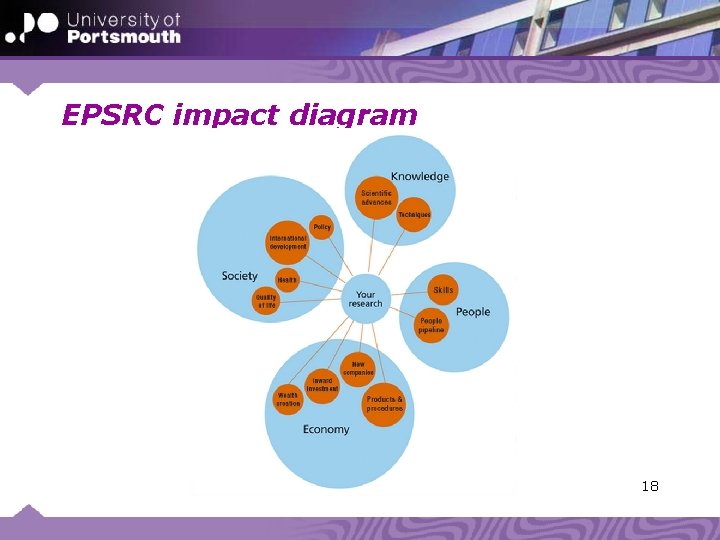
EPSRC impact diagram 18
http: //briggs. myweb. port. ac. uk/research/ IMPACT: THE END 19
- Slides: 19