
Immunoregulation Jennifer Nyland Ph D Office Bldg1 Room
Immunoregulation Jennifer Nyland, Ph. D Office: Bldg#1, Room B 10 Phone: 733 -1586 Email: jnyland@uscmed. sc. edu
Teaching objectives • To discuss regulation of immune responses including regulation by antibody, Tregs, and cytokines • To discuss some genetic factors influencing immunoregulation
Regulation of immune responses • Magnitude of immune response determined by: – Ag-driven activation of lymphocytes – Negative regulatory influences that prevent or dampen response • Regulatory mechanisms act at all phases of immune response – Recognition – Activation – Effector function
Regulation in response to Ag • Recognition: – in absence of co-stimulation → anergy (inability to respond) • Activation: – with CTLA-4 engagement of CD 80/CD 86 → down regulation of Ts (dampens activation) • Effector function: – Too much Ag → tolerance (induced state of unresponsiveness)
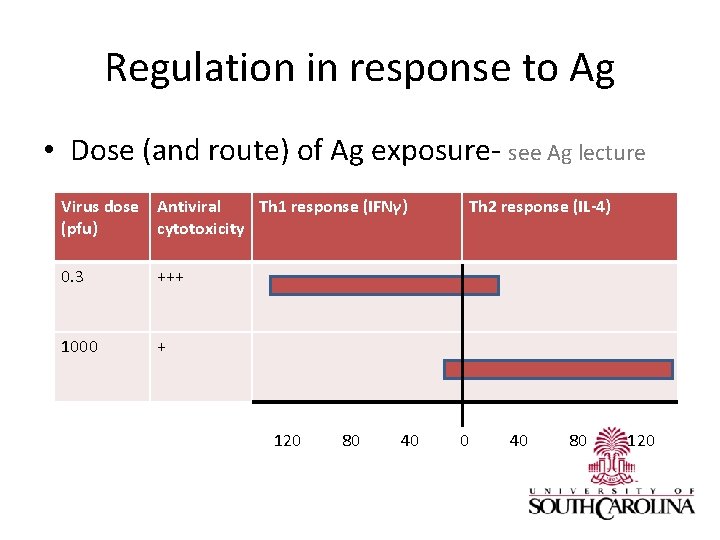
Regulation in response to Ag • Dose (and route) of Ag exposure- see Ag lecture Virus dose (pfu) Antiviral Th 1 response (IFNγ) cytotoxicity 0. 3 +++ 1000 + 120 80 40 Th 2 response (IL-4) 0 40 80 120
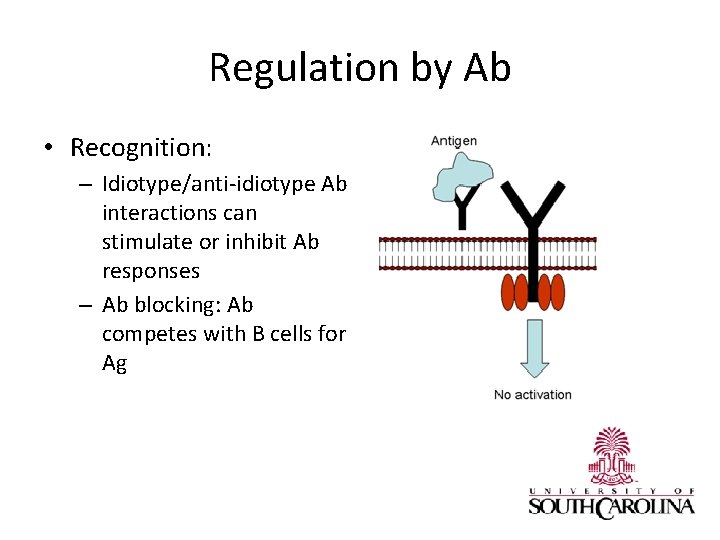
Regulation by Ab • Recognition: – Idiotype/anti-idiotype Ab interactions can stimulate or inhibit Ab responses – Ab blocking: Ab competes with B cells for Ag
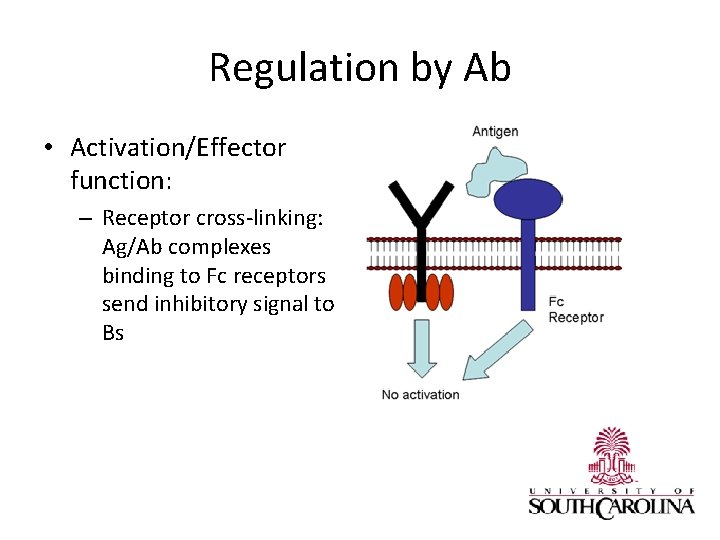
Regulation by Ab • Activation/Effector function: – Receptor cross-linking: Ag/Ab complexes binding to Fc receptors send inhibitory signal to Bs
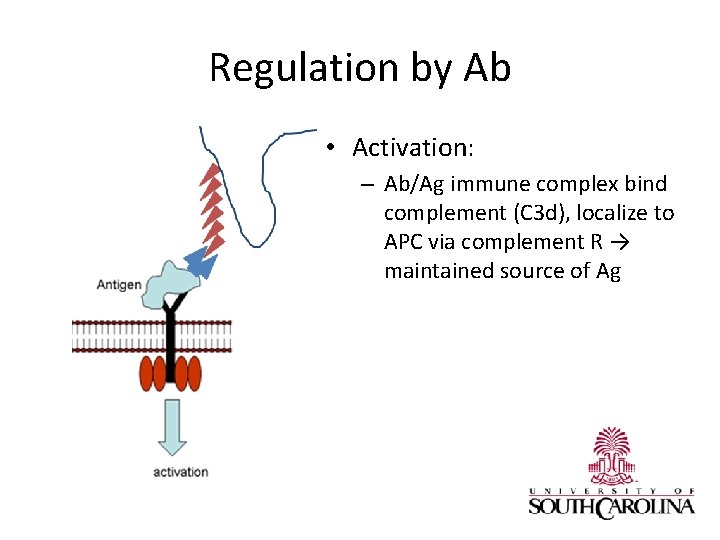
Regulation by Ab • Activation: – Ab/Ag immune complex bind complement (C 3 d), localize to APC via complement R → maintained source of Ag
Regulation by cytokines • Cytokines are positive or negative regulators – Act at many stages of immune response – Dependent on milieu • Other cytokines and receptors – Regulate the type and extent of immune response generated
Regulation by Tregs • Regulatory Ts (Tregs) do not prevent initial T activation – Inhibit sustained response – Prevent chronic and potentially damaging responses • Do not have characteristics of Th 1, Th 2, Th 17 • Suppress Th 1 and Th 2 responses
Regulation by Tregs • Types of Tregs: Naturally arising – Thymus gives rise to CD 4+CD 25+Foxp 3+ = Treg • CD 25 = part of IL-2 R • Foxp 3 = transcription factor, defects → autoimmune and inflammatory disease – Suppress in cell-cell dependent manner • Mechanism unknown
Regulation by Tregs • Types of Tregs: induced Tregs – In the periphery some Ts induced to Treg – Requires Ag, IL-10, or TGF-β • IL-10: CD 4+ CD 25+ Foxp 3 - these are Tr 1 • TGF-β: CD 4+ CD 25+ Foxp 3+ • Ag: CD 4+ CD 25 - Foxp 3 - – Suppress by secretion of: • Tr 1 by IL-10 • Induced Treg by TGF-β • T effector memory cells by IL-2, IFN-γ, etc.
Regulation by Tregs • Types of Tregs: CD 8+ Tregs (CTL 2 cells) – release a spectrum of cytokines similar to Th 2 cells: IFN-γ, IL-6, IL-10 – Differentiation affected by CD 4+ cytokine profile, Ag, and IL-10 • CD 8+ Foxp 3+ – Suppress in a cell-contact dependent manner • downregulation of co-stimulatory molecules on APC → tolerance • Primed by CD 4+ during 1°, suppress during 2°
Genetic factors • MHC-linked genes control response to infection – Certain HLA haplotypes are associated with responders/nonresponders, susceptibility/resistance • Cytokine and chemokine polymorphisms – Primarily in receptor genes • Non-MHC genes – Example, regulation of macrophage activity
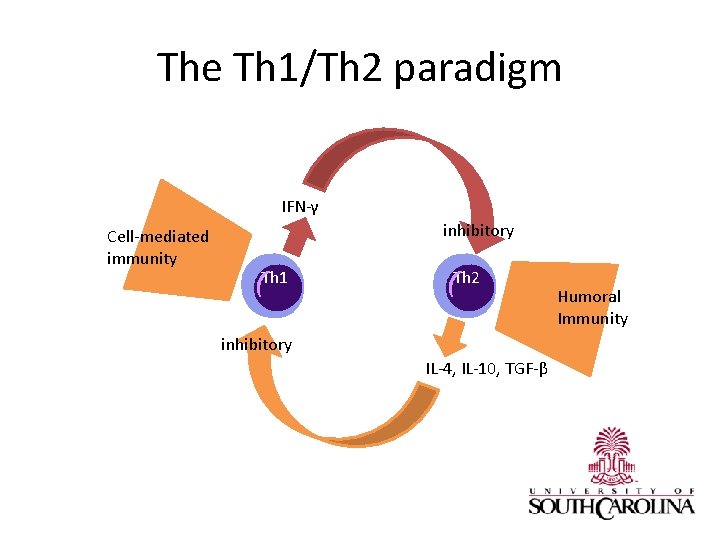
The Th 1/Th 2 paradigm IFN-γ Cell-mediated immunity inhibitory Th 1 Th 2 inhibitory IL-4, IL-10, TGF-β Humoral Immunity
- Slides: 15