
IMMUNOGLOBULINS Structure function and types Dr Vinod K

IMMUNOGLOBULINS Structure, function and types Dr. Vinod K. V.
• Also known as antibodies • They are glycoproteins produced by the body against antigenic stimulus • Synthesised by B lymphocytes
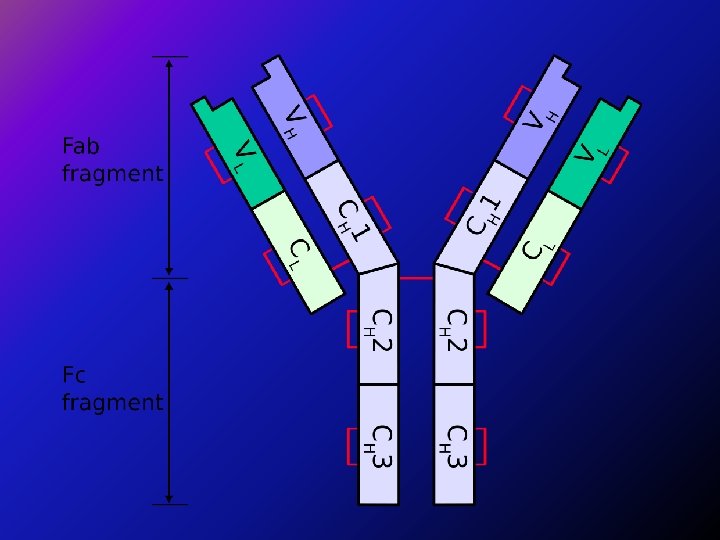
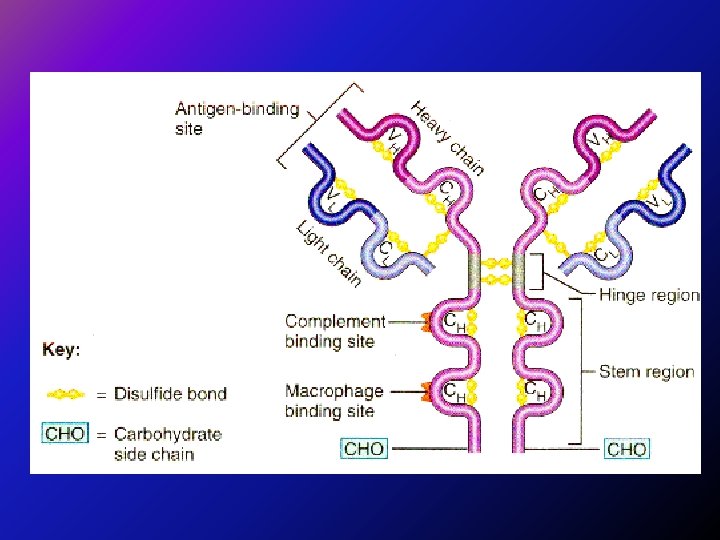
Basic structure Igs are glycoproteins Made up of two pairs of polypeptide chains One pair light chains- L chains (mw 25000 da) One pair heavy chains-H chains (50000 da) L & H chain and H & H chains are joined by disulphide bond • 4 chains are joined to form a flexible Y shaped molecule • • •
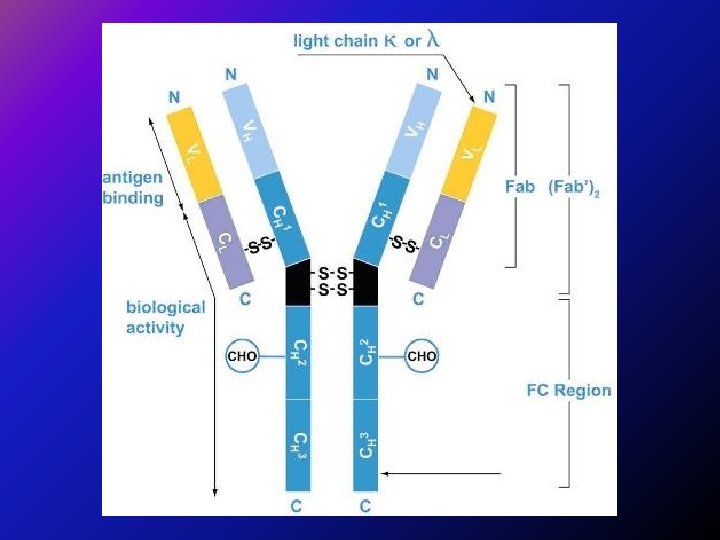
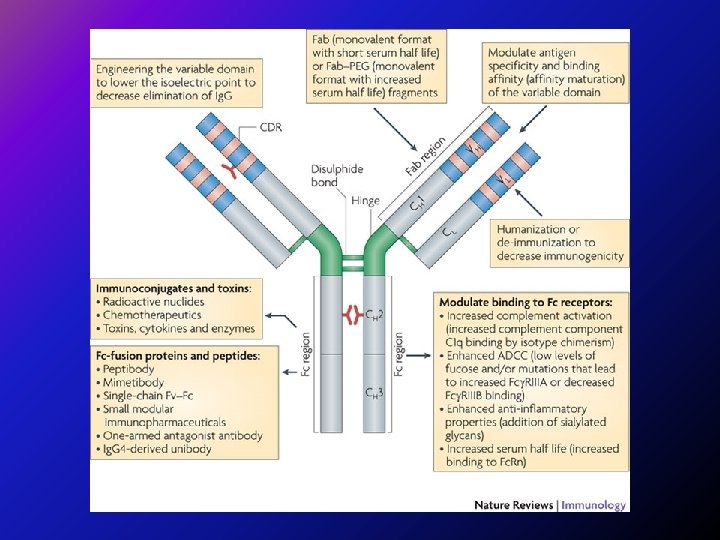
• Two regions- Fab region & Fc region • Fab region- at the tip of each arm of Y • Fc region- limited in variability, responsible for the biological activity, act as receptor binding portion (to phagocytic cells), bind to complement • Ag binding site @ amino terminus • Ag binding site composed of both H & L chains
• Both chains composed of two portions- variable region (N) & constant regions (C) • Constant region – constant sequence- One constant domain in L chain (CL) & 3 -4 domains in H chain (CH 1, CH 2, CH 3) • Variable region – one domain in both H & L chainshighly variable & determines immunological specificity • Hyper variable regions (hot spots)- highly variable region in the variable regions
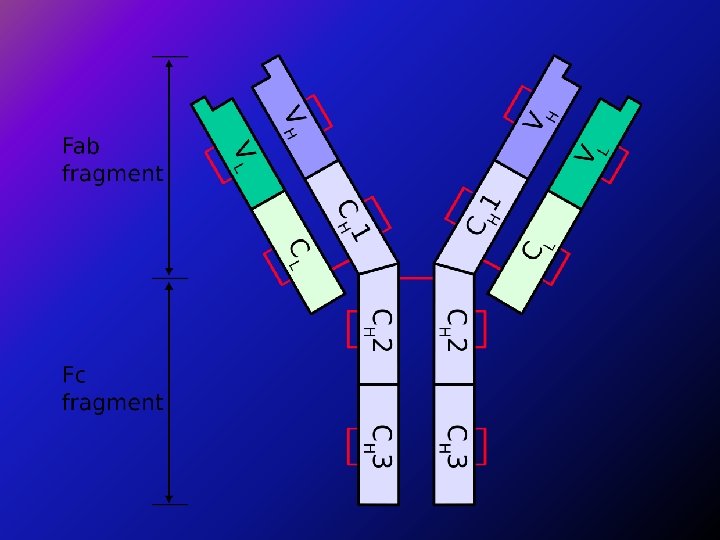
• Intra chain S-S bonds form loops form globular domains • VL & VH are responsible for Ag binding site • Hinge region- between CH 1 & CH 2 , flexible and more exposed to enzymes & chemicals
• L chains are of two types- Kappa & lambda (2: 1 ratio in human sera) • H chain 5 types- A, D, G, E & M
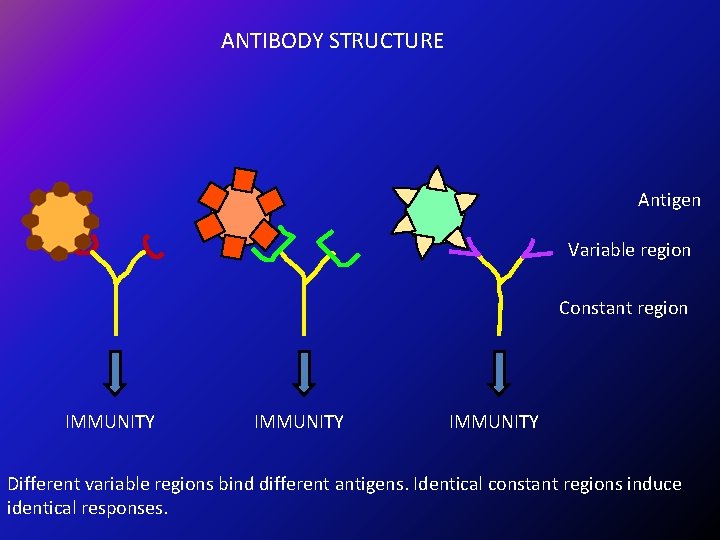
ANTIBODY STRUCTURE Antigen Variable region Constant region IMMUNITY Different variable regions bind different antigens. Identical constant regions induce identical responses.
Classes of immunoglobulins Ig. G • heavy chain is gamma • most common & major serum Ig (75 -80%) • Circulating Ig equally distributed in intra & extra vascular compartments • Contains less CHO than other Igs • mw 1, 50, 000 da, half life 23 days • 8 -16 mg/100 ml serum concentration • Exist as monomer • Only Ab that can cross placenta & provide natural passive immunity • Secondary response Ab- second exposure- production of Ig G is very rapid
• provide long term resistance • 4 sub classes- Ig G 1 -Ig. G 4 Functions • General purpose Ab, protective against agents in blood & tissues • Enhance phagocytosis • Participate in most immunological reactions • neutralise toxins in blood & tissues • Best for opsonisation • Cross placenta
Ig A • • • Second most abundant (10 -13%) mw 4, 000 da half life 6 -8 days Major Ig in colostrum, tear & saliva Low in serum (0. 6 -4. 2 mg/100 ml) Two forms- monomer (in serum) & dimer (in secretions called secretory Ig A) Synthesised by plasma cells near mucosa Has a secretory piece produced by mucosa helps to cross mucos membrane & prevent from denaturation J chain connect monomers Sub classes- Ig A 1 & Ig A 2
Functions • Secretory Ig A provide protection to respiratory & gastrointestinal tracts by inhibiting the attachment of the microbes to mucosa • Causes degranulation of eosinophils & basophils • Enhance phagocytosis by monocytes • Activate alternate pathway • weak in opsonisation

Ig M Third common Ig (5 -8%) occurs as a pentamer (J chain)- largest Ig First Ig to appear in circulation- Primary response First Ab to be formed in fetus Deficiency is associated with septicemia Ig M is short lived, hence its presence indicate recent infection • Four constant domains • 500 -1000 times more effective than Ig G in opsonisation, 100 times in bacterial action, 20 times in bacterial agglutination • Neutralisation is less effective • • •
Function • Detection is useful in the diagnosis of syphilis, HIV, Dengue fever. . • Good at complement fixation • Causes lysis of microbes • Effective in attaching to surface antigenic determinants • Responsible for protection against blood invasion by microbes
Ig D • • • Resembles Ig G in structure Monomer Mostly intravascular (3 mg/100 ml) Half life 3 days Occurs on the surface of unstimulated B cells Cell Bound Ig D are k type, serum Ig D are L type
Functions • Helps in Ag recognition by B cells • Binding of cell bound Ig D with Ag leads to stimulation of B cells, activation or cloning to produce Ab
Ig E Resembles Ig G structurally Monomer Found only in mammals mw 1, 90, 000 da half life 2 days Extravascular Ig Normal serum level in traces but elevated in allergic conditions • Affinity to surface of mast cells-helps to produce histamines • Mainly produced in the lining of respiratory & intestinal tracts • •
Function • Provide protection by being hypersensitive • Causes inflammatory response • Special role in defence against helminth infection • responsible for allergic reactions
- Slides: 23