
Immunization is the process by which an individuals
Immunization. - is the process by which an individual's immune system becomes fortified against an agent (known as the immunogen).
Immunization. • The adaptive immune system: • When this system is exposed to molecules that are foreign to the body , it will orchestrate an immune response, and it will also develop the ability to quickly respond to a subsequent encounter (through immunological memory).
Immunization. • The most important elements of the immune system that are improved by immunization are the B cells (and the antibodies they produce) and T cells. Memory B cell and memory T cells are responsible for a swift response to a second encounter with a foreign molecule.
Vaccines. • Immunization is done through various techniques, most commonly vaccination. Vaccination against microorganisms that cause diseases can prepare the body's immune system, thus helping to fight or prevent an infection.
• The immunization result in: – Anti toxin – Anti invasive – Neutralizing activity – Other types of protective humoral or cellular response in the recipient.
IMMUNITY & IMMUNIZATION II. Immunizations: A. Types: ● Active ● Passive
• Active Immunization: • Administration of all or part of a microorganism or a modified product of that microorganism i. e. a toxoid, a purified antigen, or an antigen produced by genetic engineering→to evoke an immunologic response(produce Antibody) mimicking that of the natural infection but that usually present little or no risk to the recipient. (Ag containing prepration).
what are the advantages of a live attenuated vaccine? • -they act like the natural infection with regard to their effect on the immune response -Immunity develops slowly. • -stimulates longer lasting antibody production -used for long term prophylaxis. -induce antibody production and resistance at the portal of entry for the natural virus
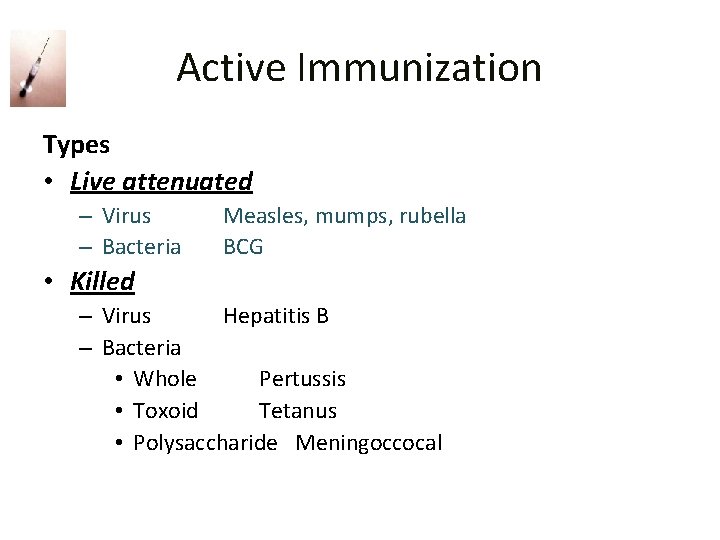
Active Immunization Types • Live attenuated – Virus – Bacteria Measles, mumps, rubella BCG • Killed – Virus Hepatitis B – Bacteria • Whole Pertussis • Toxoid Tetanus • Polysaccharide Meningoccocal
what is the advantage of using an inactivated vaccine? • no chance of it reverting back to virulent form
• Why we need booster doses? • Inactivated and sub-unit(influenza) preparation are incapable of replicating in the host, these vaccines must contain a sufficient antigenic mass to stimulate the desired response maintenance of long-lasting immunity • with inactivated viral or bacterial vaccines often requires periodic administration of booster doses.
what is the advantage of using an carrier protein or adjuvant? • -Enhance APC receptors and cytokine release -carrier protein recruit helper T cells and induce Ig. G antibody responses -conjugate bacterial vaccines
what is a toxoid? • a toxin produced by a bacterial organism that is inactivated by formalin • Eleminated toxicity without eleminating immunogenicity.
Passive immunization • is when antibodies are introduced directly into the body to give passive immunization. • Produce immunity quickly. • Used for short term prophylaxis and therapeutically. • Temporary effect short acting.
Human Immune Serum Globulin • Specific – IM Hepatitis B (HBIG) Rabies (RIG) Tetanus (TIG) Varicella (VZIG) – IV CMV (CMV-IG) RSV (RSV-IG)
Passive Immunization (Cont) • SPECIFIC EQUINE ANTIBODIES (IM) – BOTULISM ANTITOXIN – DIPHTERIA ANTITOXIN – TETANUS ANTITOXIN – SNAKE & SPIDER ANTI-VENOM • MONOCLONAL ANTIBODIES (IV) – ANTI-ENDOTOXIN ANTIBODIES
Bacillus Calmette‑Guerin Vaccine (BCG). • INDICATIONS – All tuberculin negative infants – Intradermal route • PRECAUTIONS & CONTRAINDICATIONS(CI): – Give only to PPD negative children – CI in persons with immunodeficiencies – CI during pregnancy
Diphtheria, Tetanus & Pertussis (DTP) • PREPARATIONS – < 7 years : DTP, DT if we give it alone there is an increased chance of side effect, DTa. P (acellular pertussis vaccine) – > 7 years : Td, Tda. P ( in adults risk of pertussis is very low so we don’t give its vaccination ) – (Td: adult tetanus toxoid full dose and diphtheria toxoid reduced dose) • ADMINISTRATION – IM
Diphtheria, Tetanus & Pertussis (DTP) • CONTRAINDICATIONS (CI) – Encephalopathy within 7 days – Progressive or unstable neurological disorders – Anaphylactic reaction to a previous dose • PRECAUTIONS – severe systemic reactions such as • Temp > 40. 50 C ( 1 st side effect) • Must bring him to the ER if there was redness and pus discharge indicating cellulitis and the child shouldn’t take the other dose. • persistent inconsolable crying > 3 hours • Collapse episodes • Convulsions
Measles, Mumps & Rubella (MMR) • PREPARATIONS: – MEASLES. – MMR. • ADMINISTRATION: – SC. • INDICATIONS: – Primary immunization at 1 & 6 years – New recommendation : 3 doses at 12 m & 18 m & 6 years
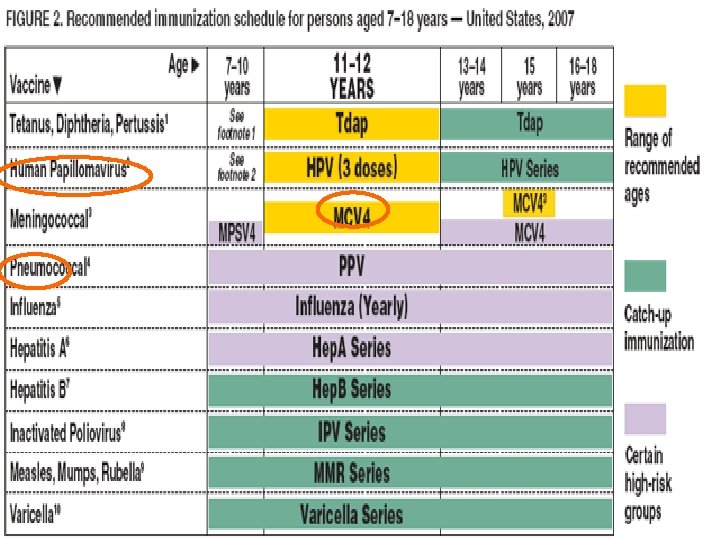
Pneumococcal vaccine • PREPARATIONS: – Purified capsular polysaccharide of 23 serotypes of Streptococcus pneumoniae – 13 valent conjugated vaccine • ADMINISTRATION: – IM / SC – 3 primary dose + 1 booster
Pneumococcal vaccine • INDICATIONS: – Primary vaccination (conjugate vaccine) – children 2 yr. or older with Anatomical or functional asplenia Sickle cell disease Nephrotic syndrome Immunosuppression Note: any child less than 2 years is given the conjugated form with the carrier protein so body will get immunized by T cells. • Child greater than 2 years is given the capsular polysacharride form • • •
Meningococcal vaccine • PREPARATIONS: – monovalent (A or C) – bivalent (A & C ) – quadrivalent (A, C, Y & W‑ 135) – quadrivalent conjugate quadrivalent • ADMINISTRATION: – SC – Given at age of 9&12 months
Meningococcal Prophylaxis • INDICATIONS: – Control of outbreaks – Children with complement deficiencies or asplenia • SIDE EFFECTS: – local erythema and discomfort – transient fever
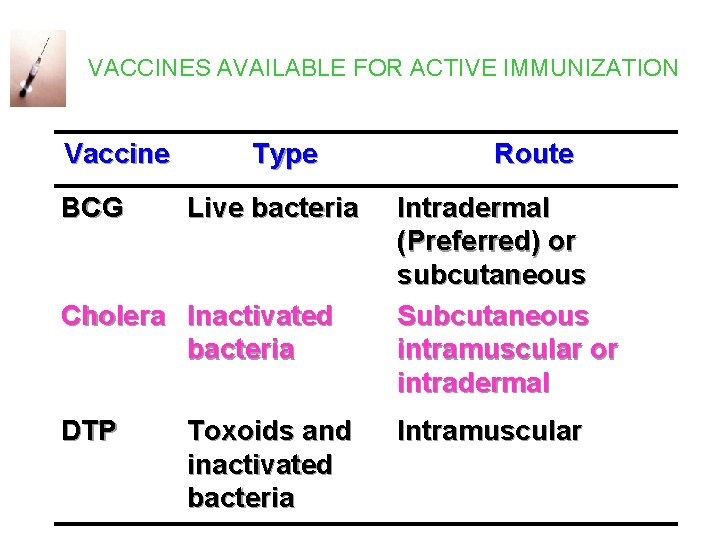
VACCINES AVAILABLE FOR ACTIVE IMMUNIZATION Vaccine BCG Type Live bacteria Cholera Inactivated bacteria DTP Toxoids and inactivated bacteria Route Intradermal (Preferred) or subcutaneous Subcutaneous intramuscular or intradermal Intramuscular
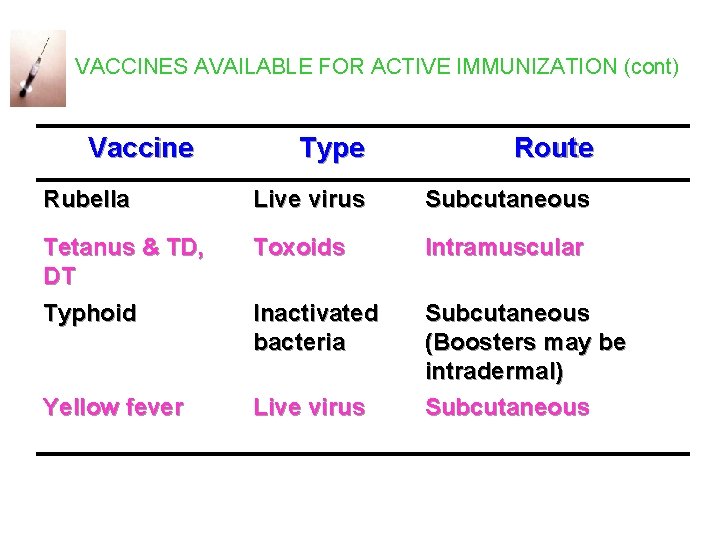
VACCINES AVAILABLE FOR ACTIVE IMMUNIZATION (cont) Vaccine Type Route Rubella Live virus Subcutaneous Tetanus & TD, DT Toxoids Intramuscular Typhoid Inactivated bacteria Yellow fever Live virus Subcutaneous (Boosters may be intradermal) Subcutaneous
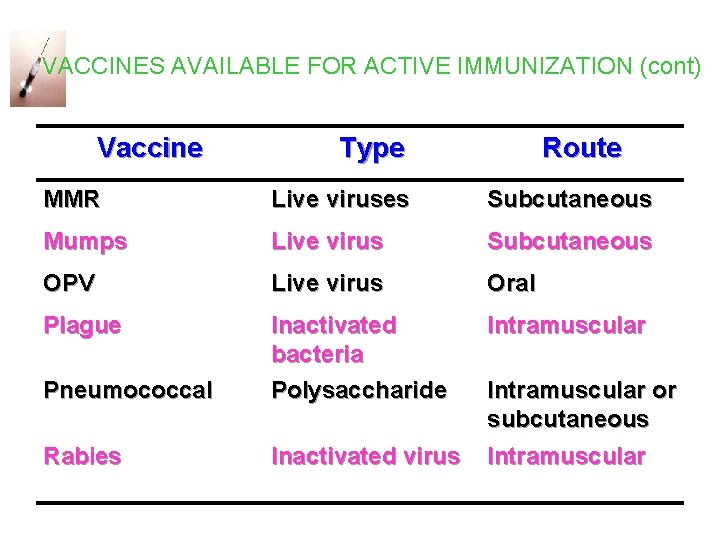
VACCINES AVAILABLE FOR ACTIVE IMMUNIZATION (cont) Vaccine Type Route MMR Live viruses Subcutaneous Mumps Live virus Subcutaneous OPV Live virus Oral Plague Intramuscular Pneumococcal Inactivated bacteria Polysaccharide Rabies Inactivated virus Intramuscular or subcutaneous
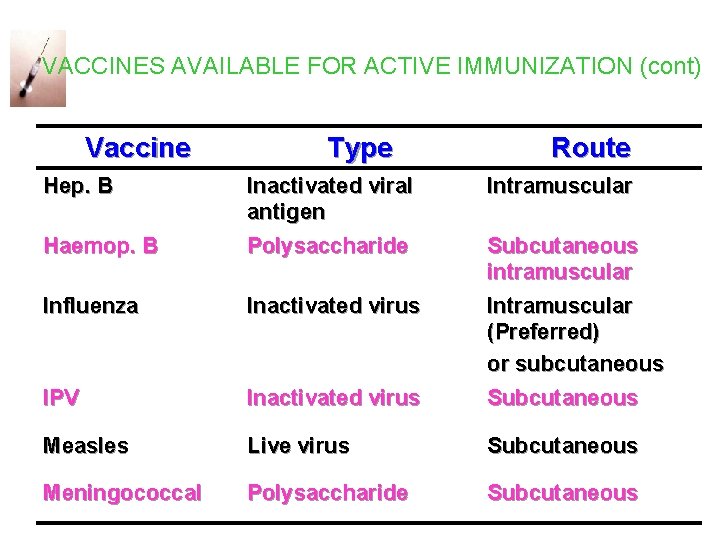
VACCINES AVAILABLE FOR ACTIVE IMMUNIZATION (cont) Vaccine Hep. B Type Route Haemop. B Inactivated viral antigen Polysaccharide Intramuscular Influenza Inactivated virus IPV Inactivated virus Subcutaneous intramuscular Intramuscular (Preferred) or subcutaneous Subcutaneous Measles Live virus Subcutaneous Meningococcal Polysaccharide Subcutaneous
• MMR, OPV and yellow fever are the only live virus vaccines. • BCG is the only live bacterial vaccine.
ROUTINE ACTIVE IMMUNIZATION FOR INFANTS & CHILDREN Age At birth 2 months 4 months 6 months 12 months 18 months 4 – 6 years 14 – 16 years Vaccine BCG, HBV 1 st DPT + Hi. B + OPV 1 st, HBV 2 nd DPT + Hi. B + OPV 3 rd, HBV 3 rd MMR 1 st DPT + Hi. B + OPV 1 st booster DPT + OPV 2 nd booster, MMR 2 nd Td (Repeated every 10 yrs. )
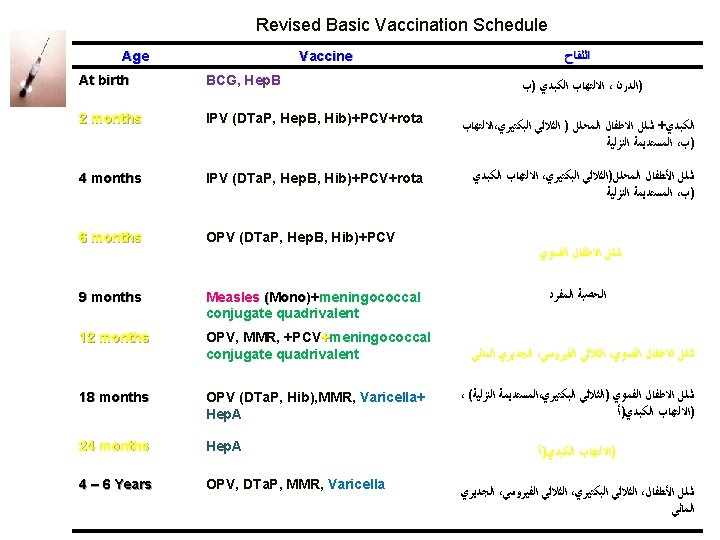
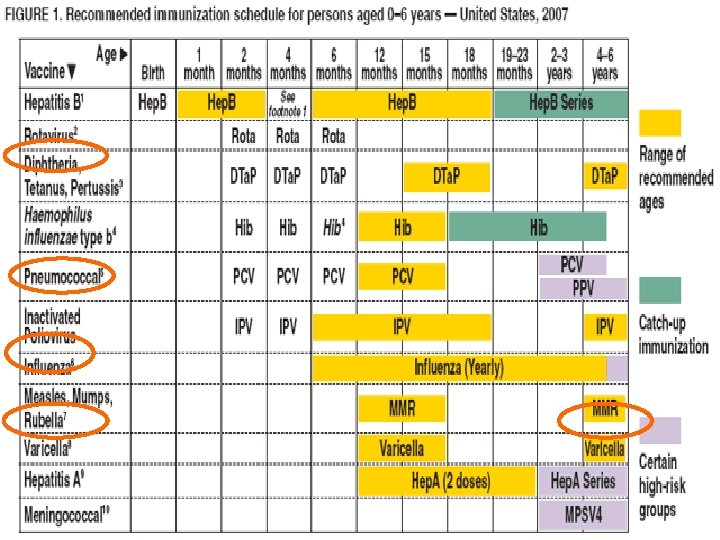
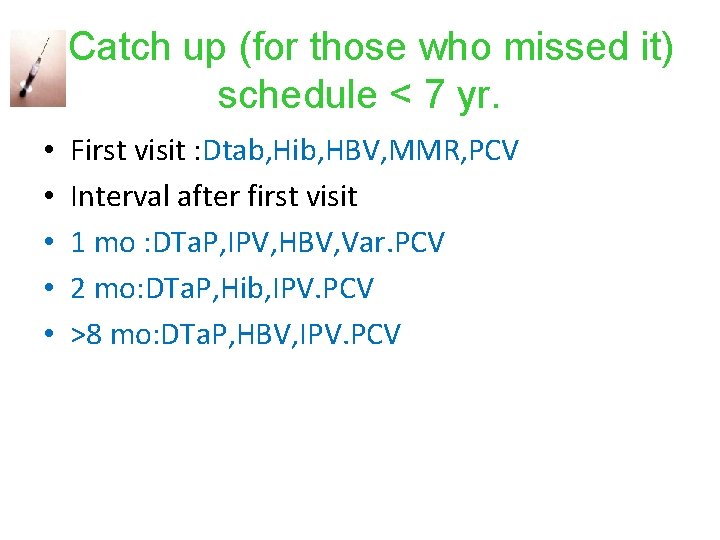
Catch up (for those who missed it) schedule < 7 yr. • • • First visit : Dtab, Hib, HBV, MMR, PCV Interval after first visit 1 mo : DTa. P, IPV, HBV, Var. PCV 2 mo: DTa. P, Hib, IPV. PCV >8 mo: DTa. P, HBV, IPV. PCV
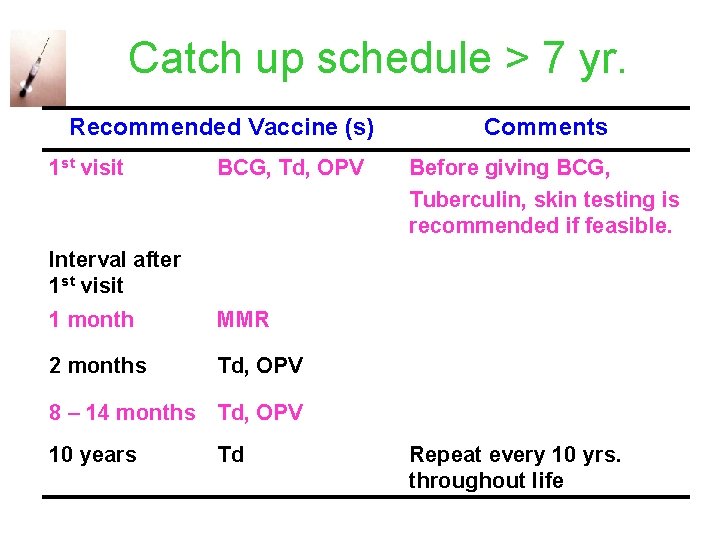
Catch up schedule > 7 yr. Recommended Vaccine (s) 1 st visit BCG, Td, OPV Comments Before giving BCG, Tuberculin, skin testing is recommended if feasible. Interval after 1 st visit 1 month MMR 2 months Td, OPV 8 – 14 months Td, OPV 10 years Td Repeat every 10 yrs. throughout life
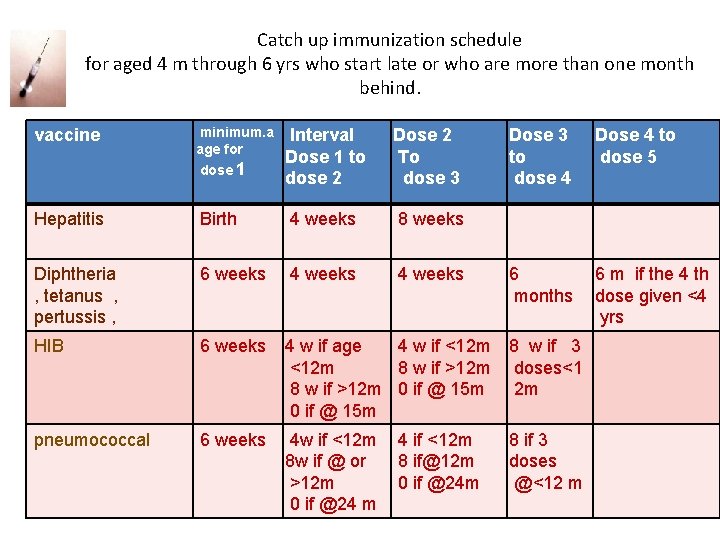
Catch up immunization schedule for aged 4 m through 6 yrs who start late or who are more than one month behind. vaccine minimum. a age for dose 1 Hepatitis Interval Dose 1 to dose 2 Dose 2 To dose 3 Birth 4 weeks 8 weeks Diphtheria , tetanus , pertussis , 6 weeks 4 weeks HIB 6 weeks 4 w if age 4 w if <12 m 8 w if >12 m 0 if @ 15 m 8 w if 3 doses<1 2 m pneumococcal 6 weeks 4 w if <12 m 8 w if @ or >12 m 0 if @24 m 8 if 3 doses @<12 m 4 if <12 m 8 if@12 m 0 if @24 m Dose 3 to dose 4 Dose 4 to dose 5 6 months 6 m if the 4 th dose given <4 yrs
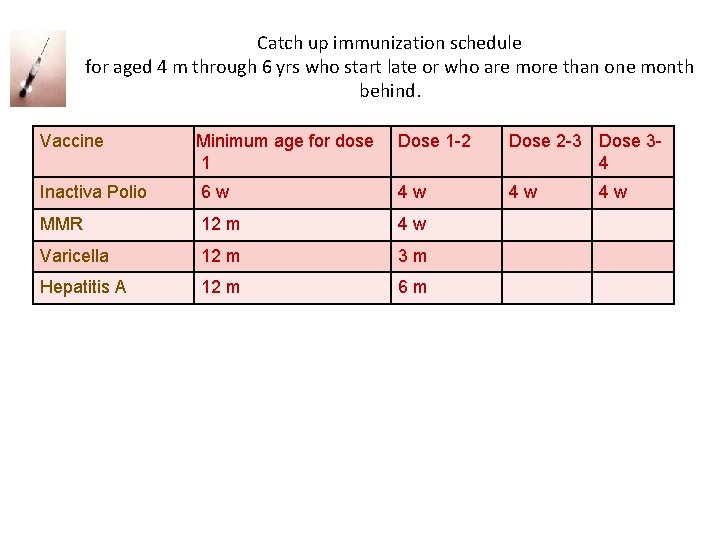
Catch up immunization schedule for aged 4 m through 6 yrs who start late or who are more than one month behind. Vaccine Minimum age for dose 1 Dose 1 -2 Dose 2 -3 Dose 34 Inactiva Polio 6 w 4 w 4 w MMR 12 m 4 w Varicella 12 m 3 m Hepatitis A 12 m 6 m 4 w
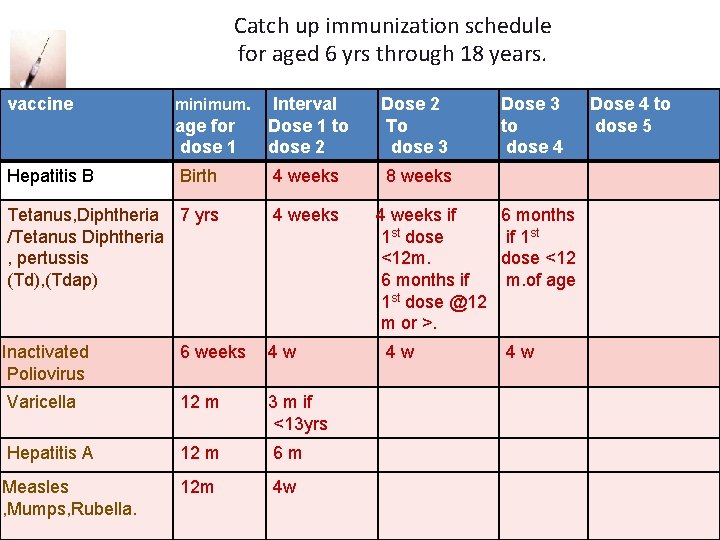
Catch up immunization schedule for aged 6 yrs through 18 years. vaccine age for dose 1 Interval Dose 1 to dose 2 Dose 2 To dose 3 Birth 4 weeks 8 weeks Tetanus, Diphtheria 7 yrs /Tetanus Diphtheria , pertussis (Td), (Tdap) 4 weeks Inactivated Poliovirus 6 weeks 4 w Varicella 12 m 3 m if <13 yrs Hepatitis A 12 m 6 m Measles , Mumps, Rubella. 12 m 4 w Hepatitis B minimum. Dose 3 to dose 4 4 weeks if 6 months 1 st dose if 1 st <12 m. dose <12 6 months if m. of age 1 st dose @12 m or >. 4 w 4 w Dose 4 to dose 5
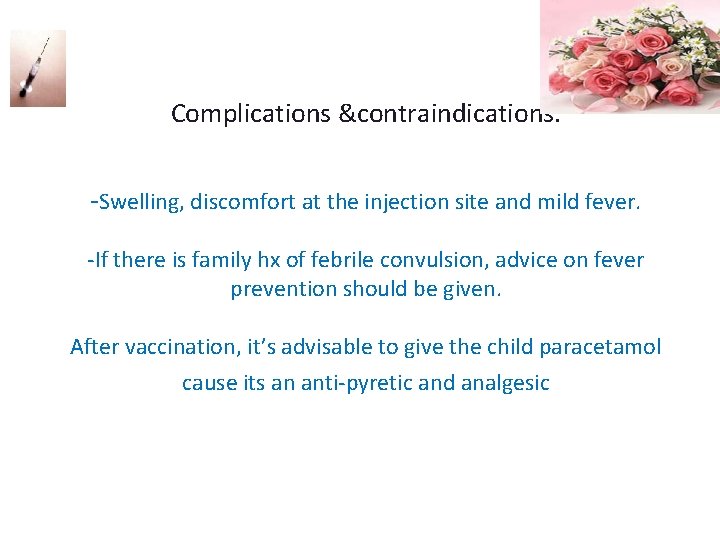
Complications &contraindications. -Swelling, discomfort at the injection site and mild fever. -If there is family hx of febrile convulsion, advice on fever prevention should be given. After vaccination, it’s advisable to give the child paracetamol cause its an anti-pyretic and analgesic
Complications &contraindications • Live vaccine should not be given to children with impaired immune responsiveness (except in children with HIV infection in whom MMR vaccine can be given if HIV was under control ).
Complications &contraindications • Moderate or severe illness with or without fever ( mild infection without fever are not a contraindication ) • Anaphylactic reaction to vaccine or vaccine constituent • Pregnant women • Immunocompromised / Immunosuppressed children shouldn’t take Live attenuated vaccines as BCG • Within 3 -11 months of immunoglobulin administration in treating ITP patients because antibodies will atack the immunoglobulins.
- Complications &contraindications The only contraindication to pertussis vaccination if the child has experienced a sever local or general reaction to a preceding dose. -If there is an evolving neurological problem, immunization should be deferred until the condition is stable.
Immunization Of Special Groups IMMUNOCOMPROMISED HOSTS • Avoid MMR, measles (may be used in HIV) • Avoid OPV; use IPV for these children and their household contacts (gastrointestinal excretions of po vaccine). PRETERM INFANTS • • Treat as term babies Avoid OPV in hospital Influenza vaccine in BPD (bronchopulmonary dysplasia) may delay HBV if <2 kg & mother is HBs. AG negative
What is the benefit of the Live attenuated polio oral vaccine? is it still used today? • -provides local and systemic immunity - It is discontinued in the U. S because of the risk of developing paralytic poliomyelitis in those immunecompromised. It is still used in other parts of the world • While IPV provides only local immunity.
Influenza Virus • Nature of vaccine: – Killed vaccine(injection). – Live attenuated(intranasal) • Preparations: – whole and “split virus” vaccines. – “split virus” vaccines are recommended for children 6 months and older. – composition of the vaccine is changed annually.
Influenza vaccine. • Indications: – – – – Sickle cell anemia. Chronic salicylate therapy. Diabetes mellitus. Chronic renal disease. Chronic metabolic disease. immunosuppressive conditions: cancer, HIV etc. Hospital personnel with significant patient contact.
Immunization & Immunity Misconceptions concerning vaccine contraindications • • Mild acute illness with low-grade fever or mild diarrhea illness in an otherwise well child. Current antimicrobial therapy or the convalescent phase of illness.
- Slides: 47