
Immune System and Search Technology Designing a Fast

- Slides: 37
Immune System and Search Technology Designing a Fast Search Algorithm for P 2 P Network using concepts from Immune Systems Zentrum für Hochleistungsrechnen (ZHR) – A Bios Group Presentation Niloy Ganguly <niloy@zhr. tu-dresden. de>
Overview of the Presentation ● P 2 P Network – Paradigm for Decentralised Computing ● Immune System Features ● Experimental Setup ● Simulation Results Zentrum für Hochleistungsrechnen (ZHR) – A Bios Group Presentation Niloy Ganguly <niloy@zhr. tu-dresden. de>
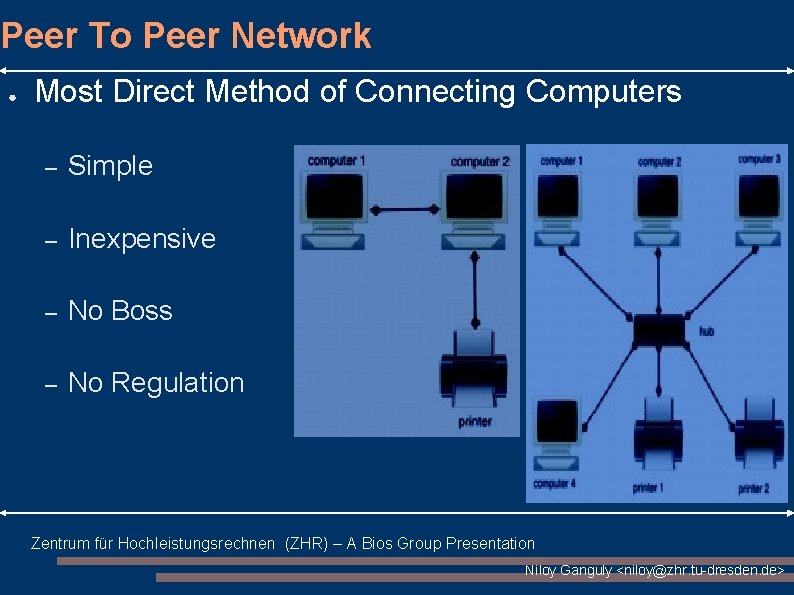
Peer To Peer Network ● Most Direct Method of Connecting Computers – Simple – Inexpensive – No Boss – No Regulation Zentrum für Hochleistungsrechnen (ZHR) – A Bios Group Presentation Niloy Ganguly <niloy@zhr. tu-dresden. de>
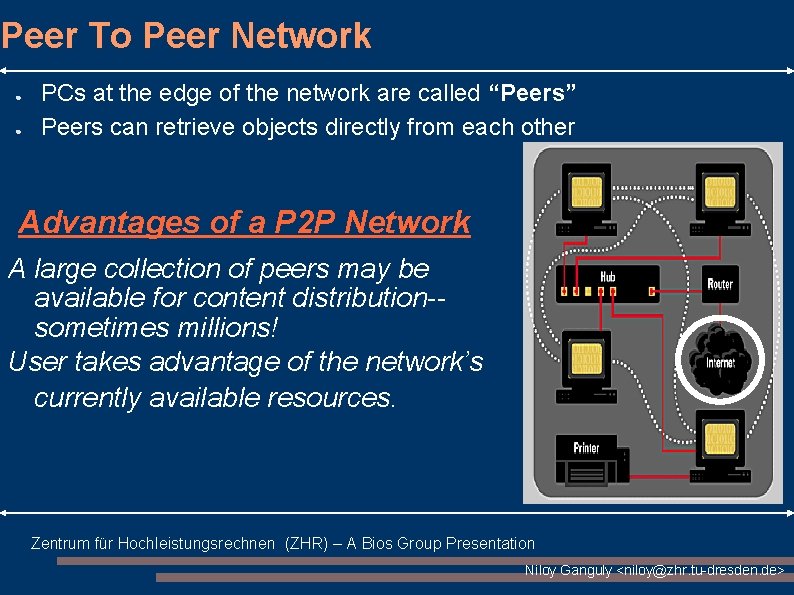
Peer To Peer Network ● ● PCs at the edge of the network are called “Peers” Peers can retrieve objects directly from each other Advantages of a P 2 P Network A large collection of peers may be available for content distribution-sometimes millions! User takes advantage of the network’s currently available resources. Zentrum für Hochleistungsrechnen (ZHR) – A Bios Group Presentation Niloy Ganguly <niloy@zhr. tu-dresden. de>
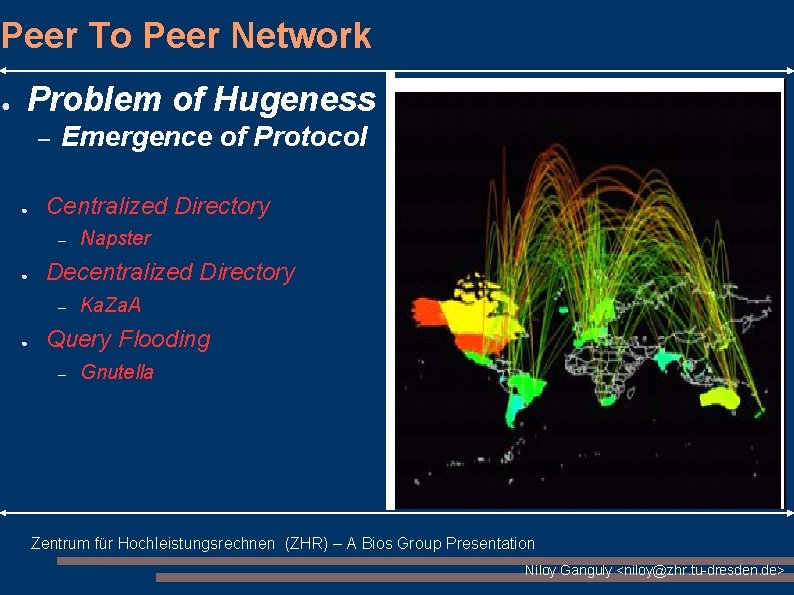
Peer To Peer Network ● Problem of Hugeness – ● Emergence of Protocol Centralized Directory – ● Decentralized Directory – ● Napster Ka. Za. A Query Flooding – Gnutella Zentrum für Hochleistungsrechnen (ZHR) – A Bios Group Presentation Niloy Ganguly <niloy@zhr. tu-dresden. de>
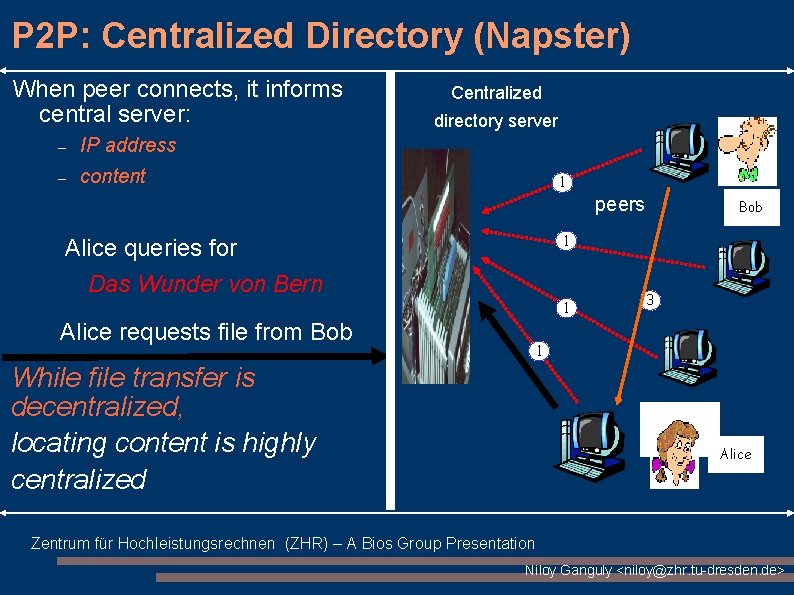
P 2 P: Centralized Directory (Napster) When peer connects, it informs central server: – IP address – content Centralized directory server 1 peers Bob 1 Alice queries for Das Wunder von Bern 1 Alice requests file from Bob 3 1 While file transfer is decentralized, locating content is highly centralized Alice Zentrum für Hochleistungsrechnen (ZHR) – A Bios Group Presentation Niloy Ganguly <niloy@zhr. tu-dresden. de>
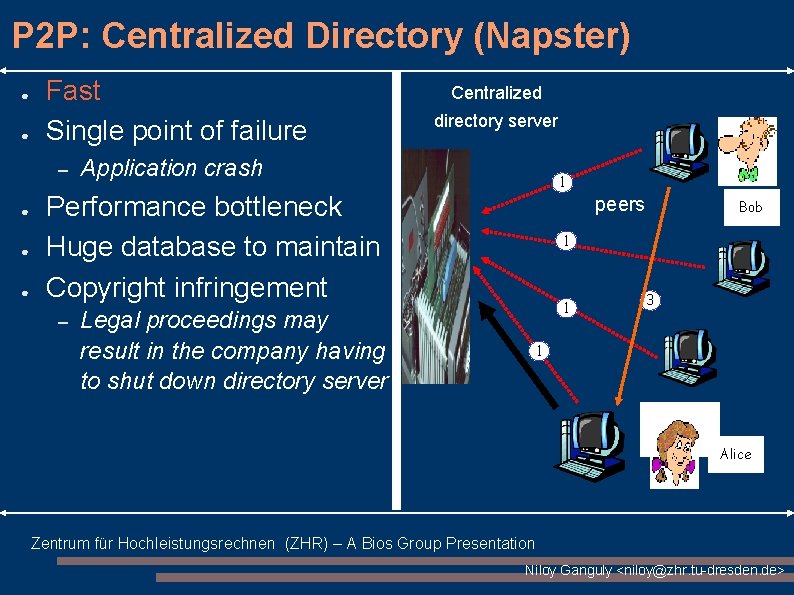
P 2 P: Centralized Directory (Napster) ● ● Fast Single point of failure – ● ● ● Centralized directory server Application crash 1 Performance bottleneck Huge database to maintain Copyright infringement – peers Bob 1 1 Legal proceedings may result in the company having to shut down directory server 3 1 Alice Zentrum für Hochleistungsrechnen (ZHR) – A Bios Group Presentation Niloy Ganguly <niloy@zhr. tu-dresden. de>
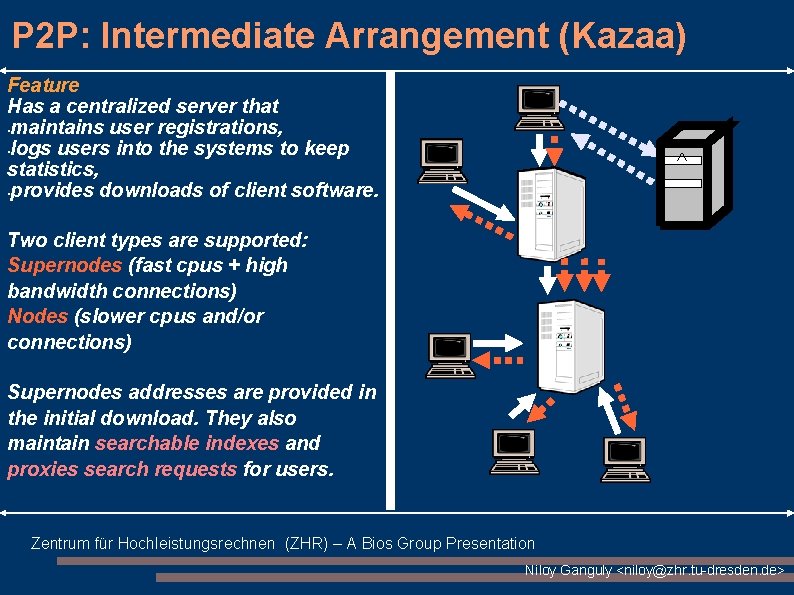
P 2 P: Intermediate Arrangement (Kazaa) Feature Has a centralized server that • maintains user registrations, • logs users into the systems to keep statistics, • provides downloads of client software. ^ Two client types are supported: Supernodes (fast cpus + high bandwidth connections) Nodes (slower cpus and/or connections) Supernodes addresses are provided in the initial download. They also maintain searchable indexes and proxies search requests for users. Zentrum für Hochleistungsrechnen (ZHR) – A Bios Group Presentation Niloy Ganguly <niloy@zhr. tu-dresden. de>
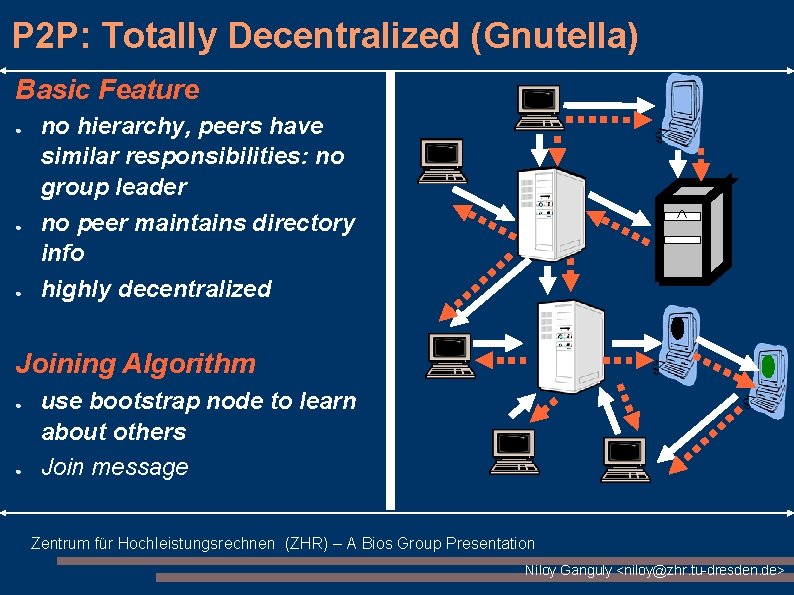
P 2 P: Totally Decentralized (Gnutella) Basic Feature ● ● ● no hierarchy, peers have similar responsibilities: no group leader no peer maintains directory info highly decentralized ^ Joining Algorithm ● ● use bootstrap node to learn about others Join message Zentrum für Hochleistungsrechnen (ZHR) – A Bios Group Presentation Niloy Ganguly <niloy@zhr. tu-dresden. de>
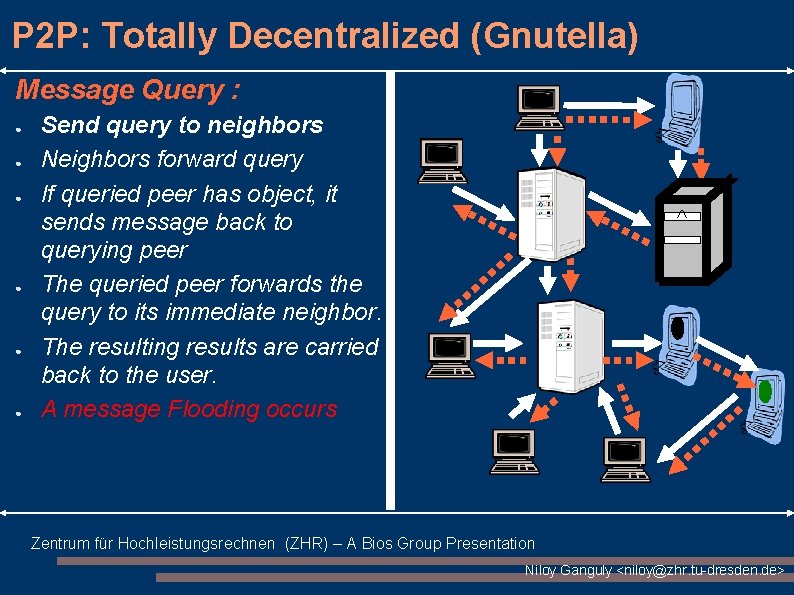
P 2 P: Totally Decentralized (Gnutella) Message Query : ● ● ● Send query to neighbors Neighbors forward query If queried peer has object, it sends message back to querying peer The queried peer forwards the query to its immediate neighbor. The resulting results are carried back to the user. A message Flooding occurs ^ Zentrum für Hochleistungsrechnen (ZHR) – A Bios Group Presentation Niloy Ganguly <niloy@zhr. tu-dresden. de>
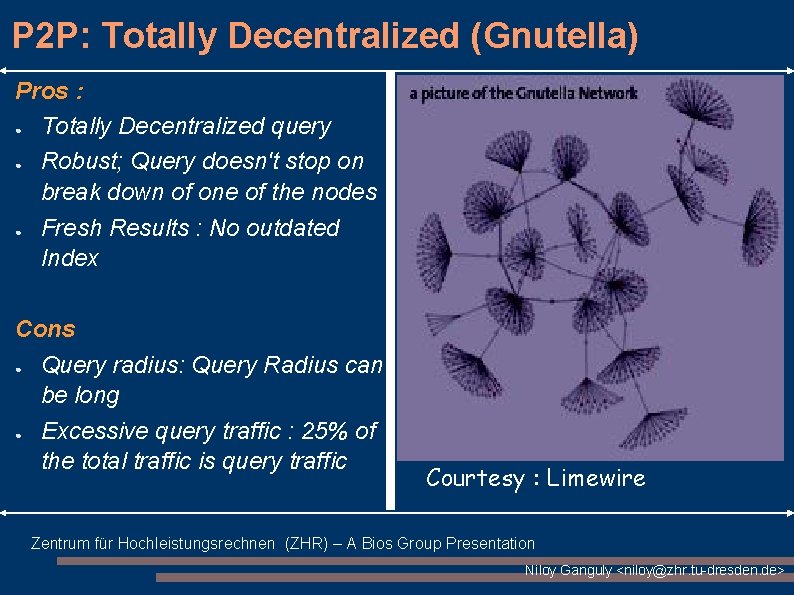
P 2 P: Totally Decentralized (Gnutella) Pros : ● Totally Decentralized query ● Robust; Query doesn't stop on break down of one of the nodes ● Fresh Results : No outdated Index Cons ● Query radius: Query Radius can be long ● Excessive query traffic : 25% of the total traffic is query traffic Courtesy : Limewire Zentrum für Hochleistungsrechnen (ZHR) – A Bios Group Presentation Niloy Ganguly <niloy@zhr. tu-dresden. de>
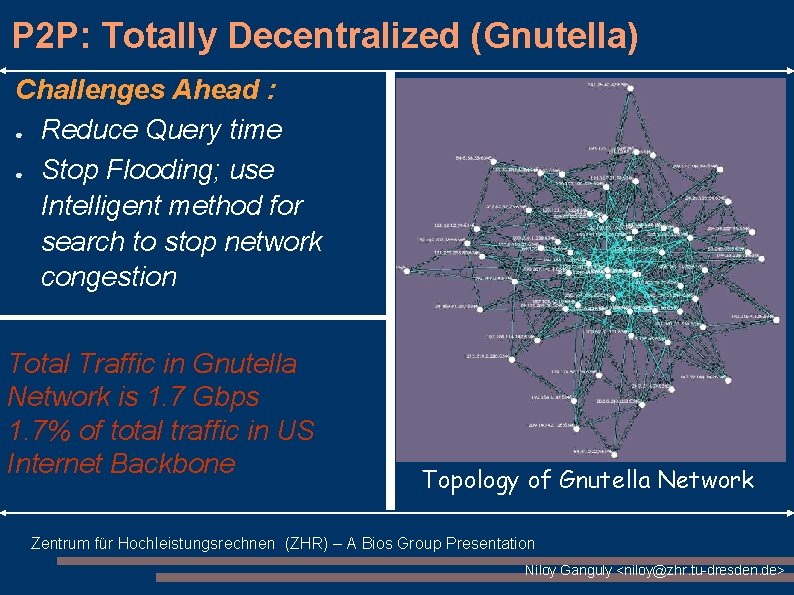
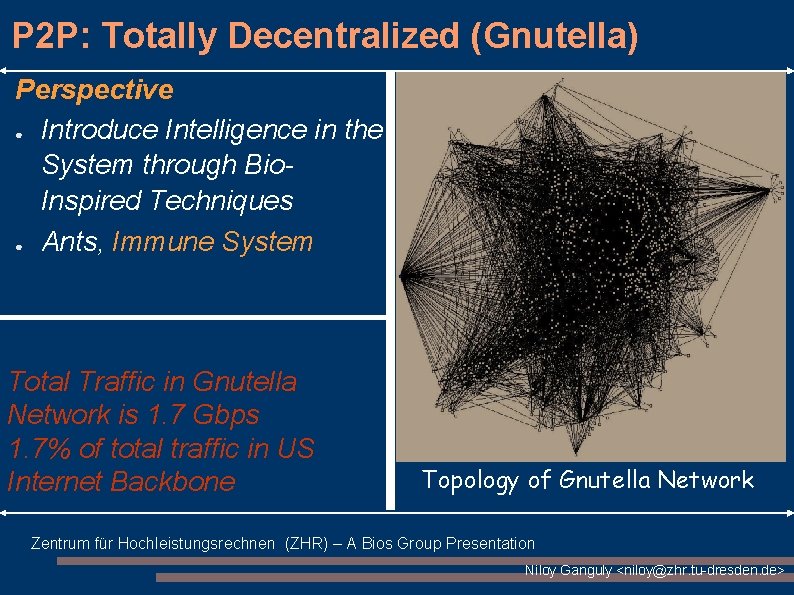
P 2 P: Totally Decentralized (Gnutella) Challenges Ahead : ● Reduce Query time ● Stop Flooding; use Intelligent method for search to stop network congestion Total Traffic in Gnutella Network is 1. 7 Gbps 1. 7% of total traffic in US Internet Backbone Topology of Gnutella Network Zentrum für Hochleistungsrechnen (ZHR) – A Bios Group Presentation Niloy Ganguly <niloy@zhr. tu-dresden. de>
P 2 P: Totally Decentralized (Gnutella) Perspective ● Introduce Intelligence in the System through Bio. Inspired Techniques ● Ants, Immune System Total Traffic in Gnutella Network is 1. 7 Gbps 1. 7% of total traffic in US Internet Backbone Topology of Gnutella Network Zentrum für Hochleistungsrechnen (ZHR) – A Bios Group Presentation Niloy Ganguly <niloy@zhr. tu-dresden. de>
Artificial Immune System ● Relatively new branch of computer science – – ● Using natural immune system as a metaphor for solving computational problems Not modelling the immune system Variety of applications so far … – – – Fault diagnosis (Ishida) Computer security (Forrest, Kim) Novelty detection (Dasgupta) Robot behaviour (Lee) Machine learning (Hunt, Timmis, de Castro) AIS are computational systems, inspired by theoretical immunology and observed immune functions, which are applied to complex problem domains (Timmis, 2001) Zentrum für Hochleistungsrechnen (ZHR) – A Bios Group Presentation Niloy Ganguly <niloy@zhr. tu-dresden. de>
Why the Immune System? ● Recognition – Anomaly detection – Noise tolerance ● Robustness ● Feature extraction ● Diversity ● Reinforcement learning ● Memory ● Distributed ● Adaptive Zentrum für Hochleistungsrechnen (ZHR) – A Bios Group Presentation Niloy Ganguly <niloy@zhr. tu-dresden. de>
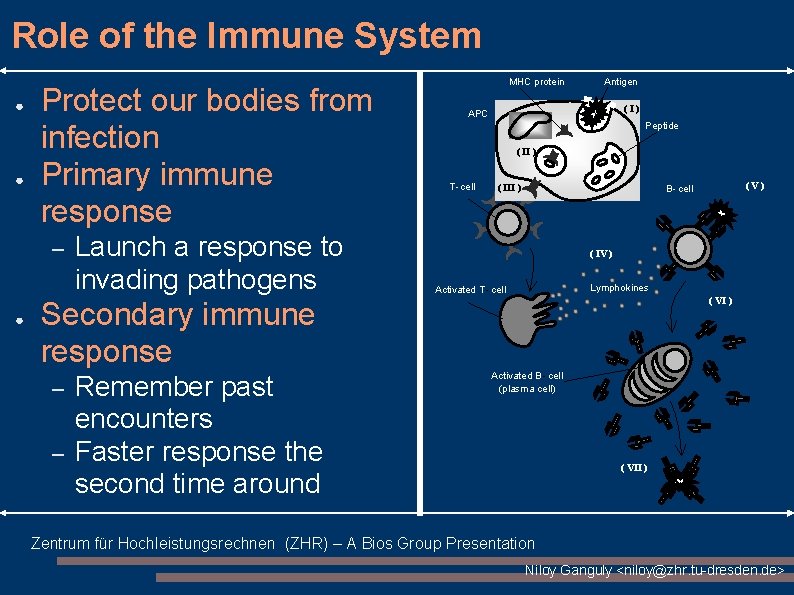
Role of the Immune System ● ● Protect our bodies from infection Primary immune response – ● Launch a response to invading pathogens MHC protein Antigen (I) APC Peptide ( II ) T- cell ( III ) ( IV ) Lymphokines Activated T - cell ( VI ) Secondary immune response – – Remember past encounters Faster response the second time around (V) B- cell Activated B - cell (plasma cell) ( VII ) Zentrum für Hochleistungsrechnen (ZHR) – A Bios Group Presentation Niloy Ganguly <niloy@zhr. tu-dresden. de>
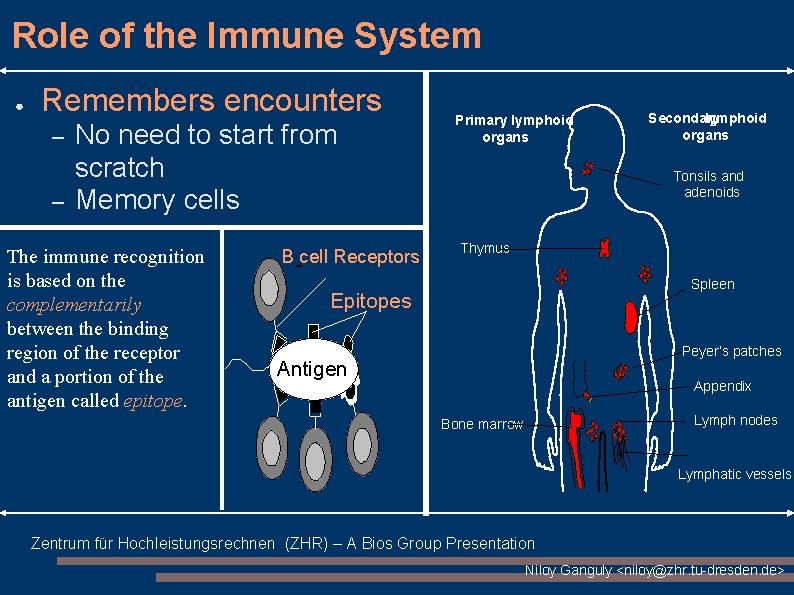
Role of the Immune System ● Remembers encounters – – No need to start from scratch Memory cells The immune recognition is based on the complementarily between the binding region of the receptor and a portion of the antigen called epitope. B -cell Receptors Primary lymphoid organs Secondary lymphoid organs Tonsils and adenoids Thymus Spleen Epitopes Peyer’s patches Antigen Appendix Lymph nodes Bone marrow Lymphatic vessels Zentrum für Hochleistungsrechnen (ZHR) – A Bios Group Presentation Niloy Ganguly <niloy@zhr. tu-dresden. de>
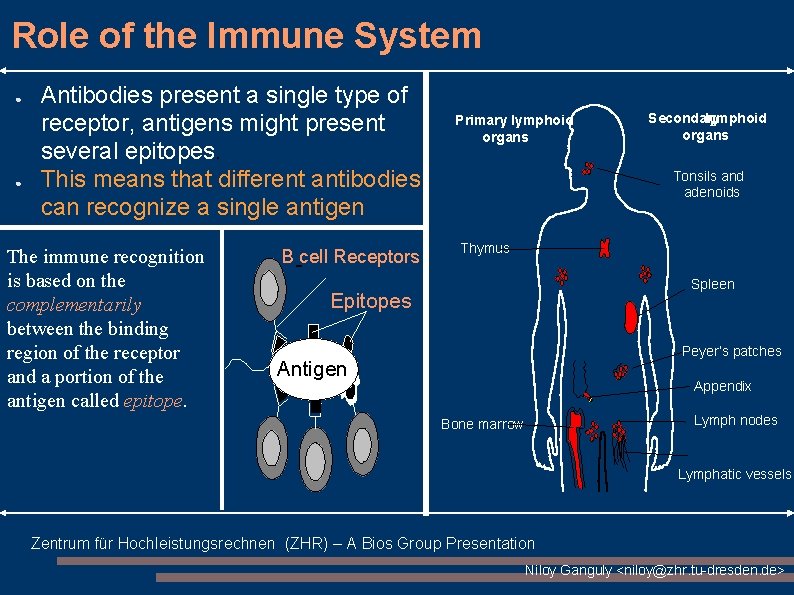
Role of the Immune System ● ● Antibodies present a single type of receptor, antigens might present several epitopes. This means that different antibodies can recognize a single antigen The immune recognition is based on the complementarily between the binding region of the receptor and a portion of the antigen called epitope. B -cell Receptors Primary lymphoid organs Secondary lymphoid organs Tonsils and adenoids Thymus Spleen Epitopes Peyer’s patches Antigen Appendix Lymph nodes Bone marrow Lymphatic vessels Zentrum für Hochleistungsrechnen (ZHR) – A Bios Group Presentation Niloy Ganguly <niloy@zhr. tu-dresden. de>
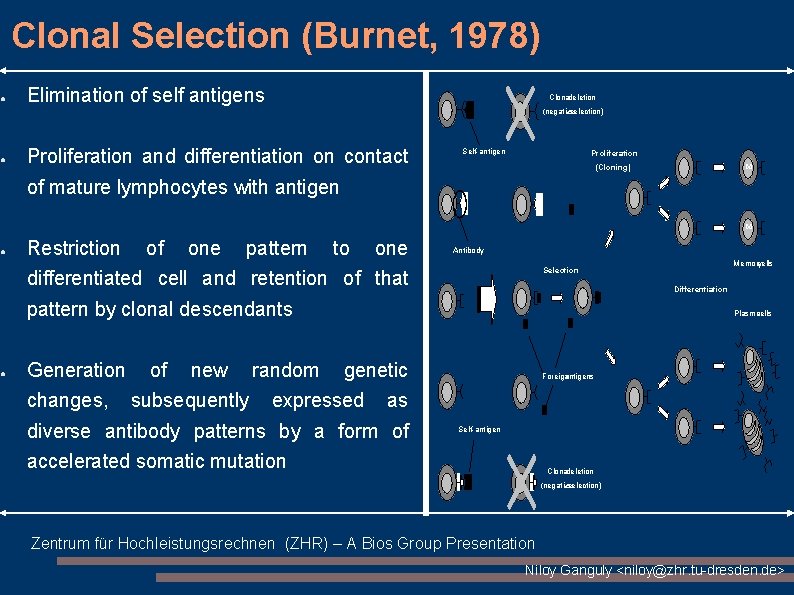
● ● Clonal Selection (Burnet, 1978) Elimination of self antigens Clonaldeletion (negative selection) Proliferation and differentiation on contact Self-antigen Proliferation M (Cloning) of mature lymphocytes with antigen M Restriction of one pattern to one Antibody differentiated cell and retention of that Differentiation pattern by clonal descendants Generation changes, of new subsequently random Memory cells Selection Plasma cells genetic expressed Foreign antigens as diverse antibody patterns by a form of Self-antigen accelerated somatic mutation Clonaldeletion (negative selection) Zentrum für Hochleistungsrechnen (ZHR) – A Bios Group Presentation Niloy Ganguly <niloy@zhr. tu-dresden. de>
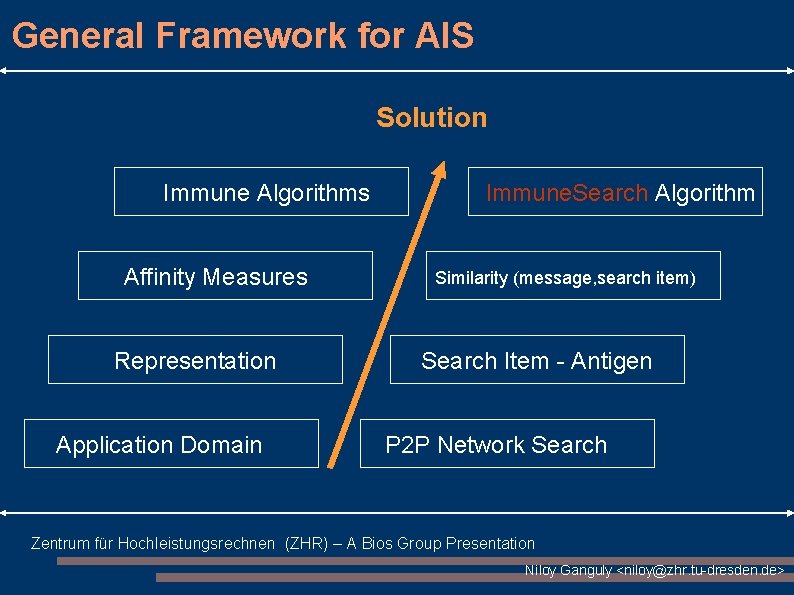
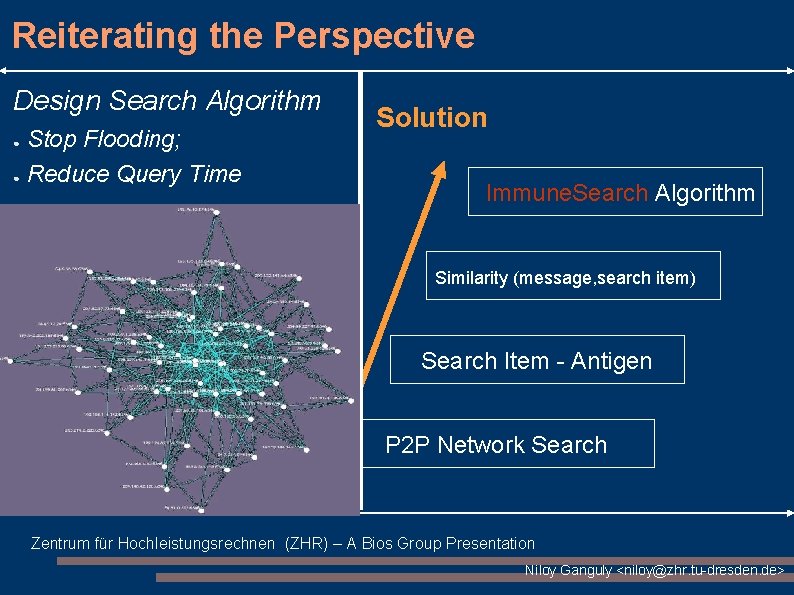
General Framework for AIS Solution Immune Algorithms Affinity Measures Representation Application Domain Immune. Search Algorithm Similarity (message, search item) Search Item - Antigen P 2 P Network Search Zentrum für Hochleistungsrechnen (ZHR) – A Bios Group Presentation Niloy Ganguly <niloy@zhr. tu-dresden. de>
Reiterating the Perspective Design Search Algorithm Stop Flooding; ● Reduce Query Time Solution ● Immune. Search Algorithm Similarity (message, search item) Search Item - Antigen P 2 P Network Search Zentrum für Hochleistungsrechnen (ZHR) – A Bios Group Presentation Niloy Ganguly <niloy@zhr. tu-dresden. de>
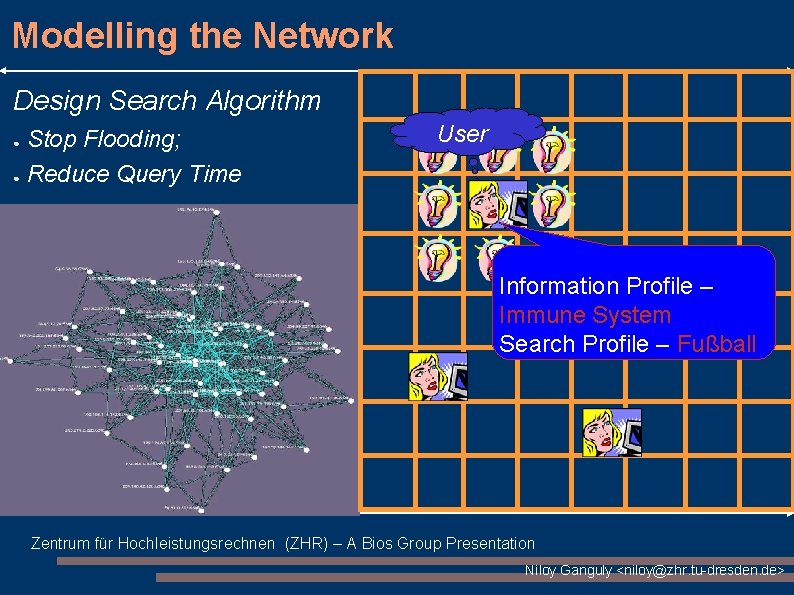
Modelling the Network Design Search Algorithm Stop Flooding; ● Reduce Query Time ● User Information Profile – Immune System Search Profile – Fußball Zentrum für Hochleistungsrechnen (ZHR) – A Bios Group Presentation Niloy Ganguly <niloy@zhr. tu-dresden. de>
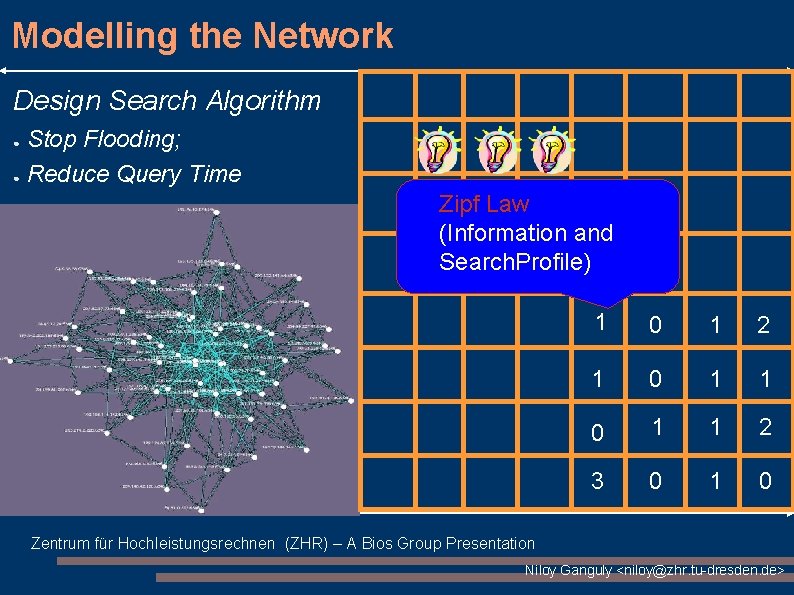
Modelling the Network Design Search Algorithm Stop Flooding; ● Reduce Query Time ● Zipf Law (Information and Search. Profile) 1 0 1 2 1 0 1 1 2 3 0 1 0 Zentrum für Hochleistungsrechnen (ZHR) – A Bios Group Presentation Niloy Ganguly <niloy@zhr. tu-dresden. de>
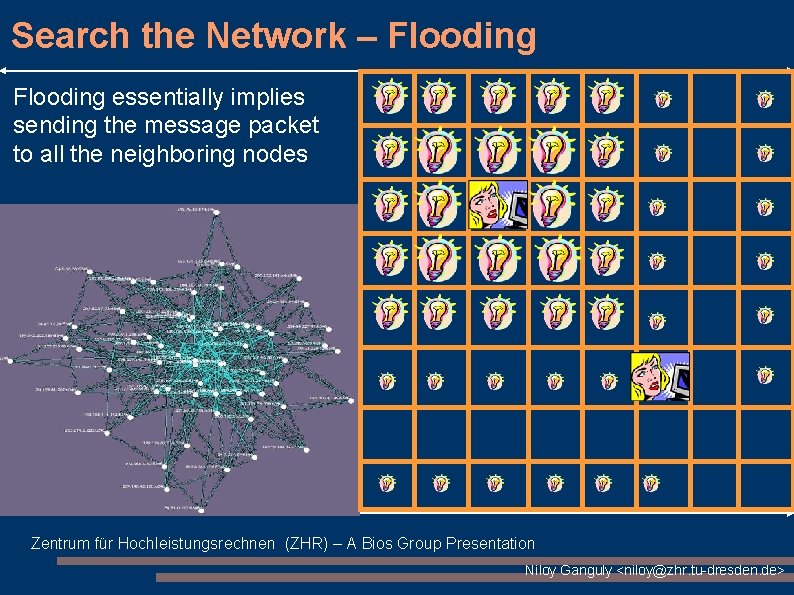
Search the Network – Flooding essentially implies sending the message packet to all the neighboring nodes Zentrum für Hochleistungsrechnen (ZHR) – A Bios Group Presentation Niloy Ganguly <niloy@zhr. tu-dresden. de>
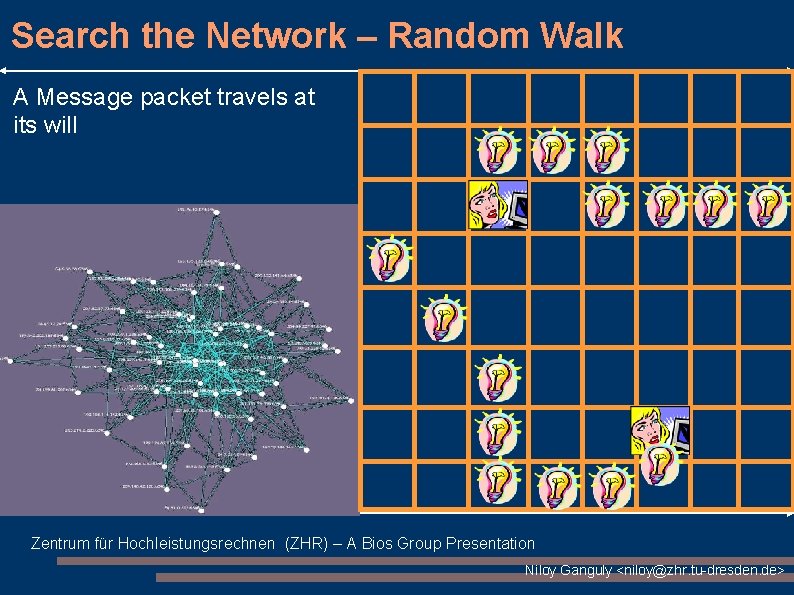
Search the Network – Random Walk A Message packet travels at its will Zentrum für Hochleistungsrechnen (ZHR) – A Bios Group Presentation Niloy Ganguly <niloy@zhr. tu-dresden. de>
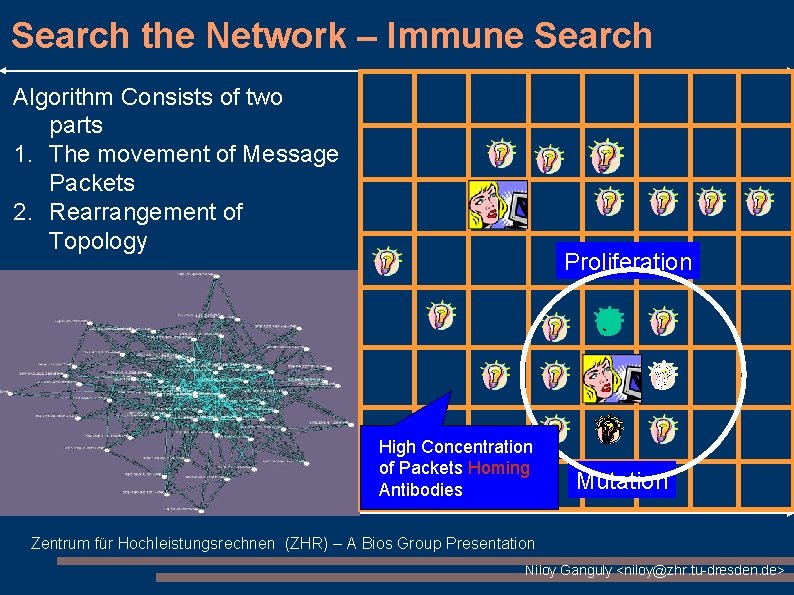
Search the Network – Immune Search Algorithm Consists of two parts 1. The movement of Message Packets 2. Rearrangement of Topology Proliferation High Concentration of Packets Homing Antibodies Mutation Zentrum für Hochleistungsrechnen (ZHR) – A Bios Group Presentation Niloy Ganguly <niloy@zhr. tu-dresden. de>
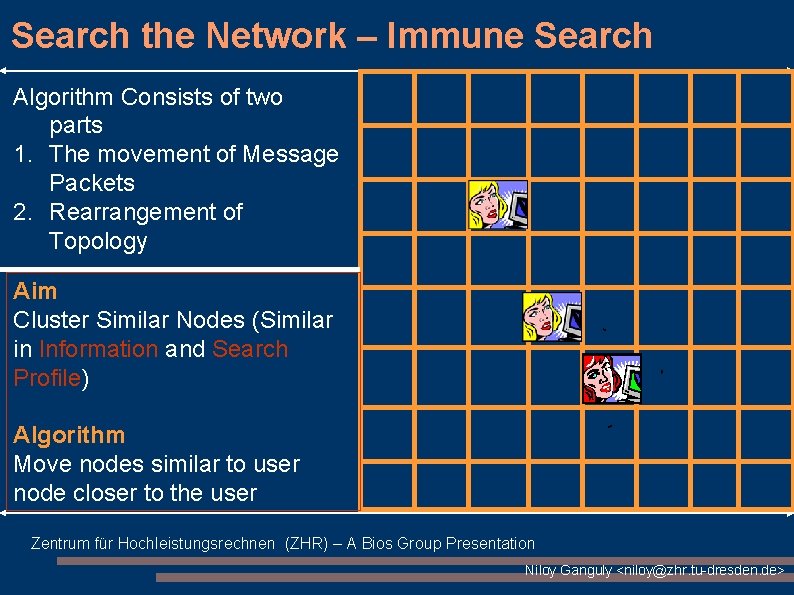
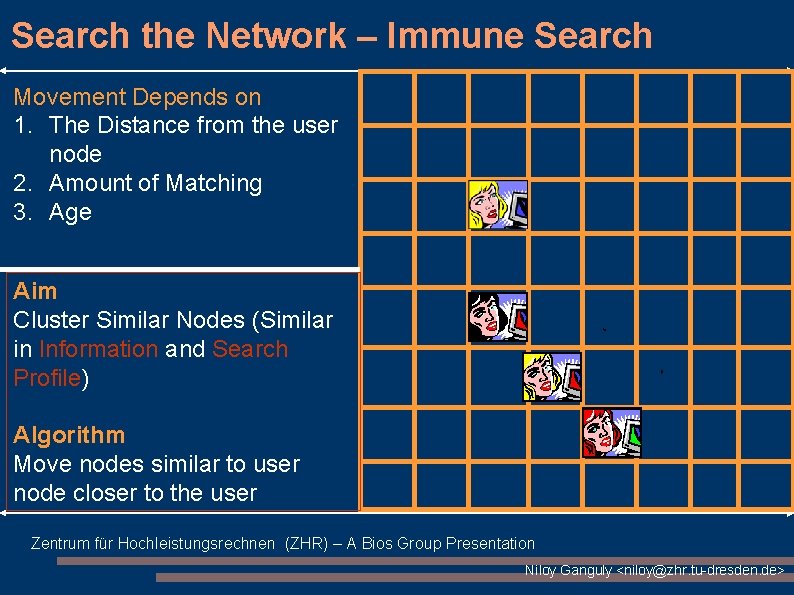
Search the Network – Immune Search Algorithm Consists of two parts 1. The movement of Message Packets 2. Rearrangement of Topology Aim Cluster Similar Nodes (Similar in Information and Search Profile) Algorithm Move nodes similar to user node closer to the user Zentrum für Hochleistungsrechnen (ZHR) – A Bios Group Presentation Niloy Ganguly <niloy@zhr. tu-dresden. de>
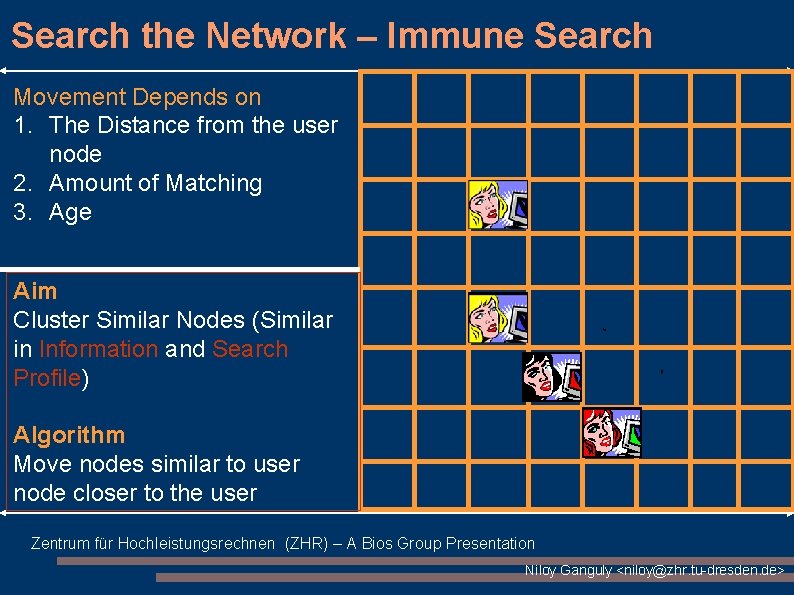
Search the Network – Immune Search Movement Depends on 1. The Distance from the user node 2. Amount of Matching 3. Age Aim Cluster Similar Nodes (Similar in Information and Search Profile) Algorithm Move nodes similar to user node closer to the user Zentrum für Hochleistungsrechnen (ZHR) – A Bios Group Presentation Niloy Ganguly <niloy@zhr. tu-dresden. de>
Search the Network – Immune Search Movement Depends on 1. The Distance from the user node 2. Amount of Matching 3. Age Aim Cluster Similar Nodes (Similar in Information and Search Profile) Algorithm Move nodes similar to user node closer to the user Zentrum für Hochleistungsrechnen (ZHR) – A Bios Group Presentation Niloy Ganguly <niloy@zhr. tu-dresden. de>
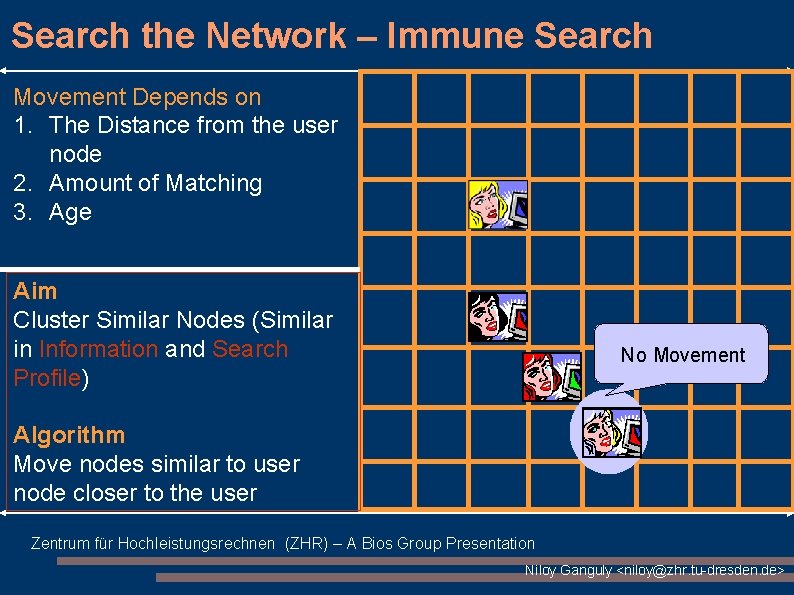
Search the Network – Immune Search Movement Depends on 1. The Distance from the user node 2. Amount of Matching 3. Age Aim Cluster Similar Nodes (Similar in Information and Search Profile) No Movement Algorithm Move nodes similar to user node closer to the user Zentrum für Hochleistungsrechnen (ZHR) – A Bios Group Presentation Niloy Ganguly <niloy@zhr. tu-dresden. de>
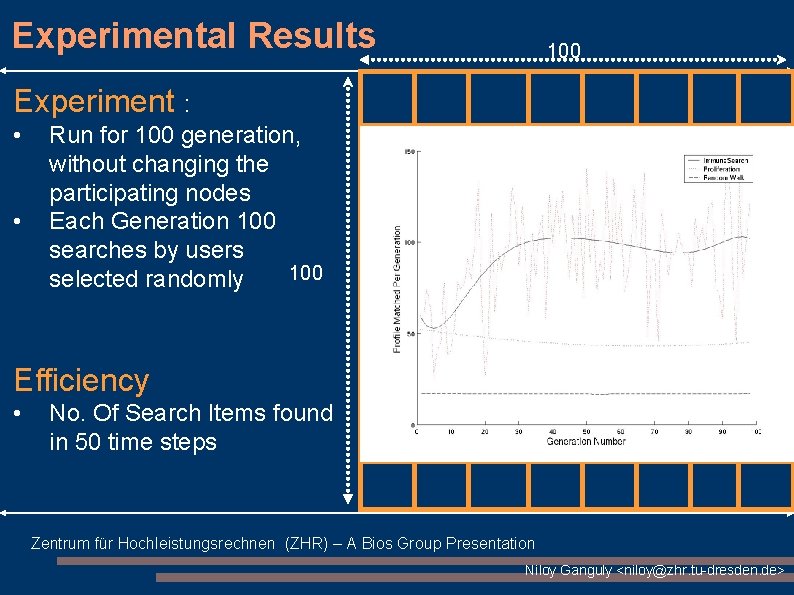
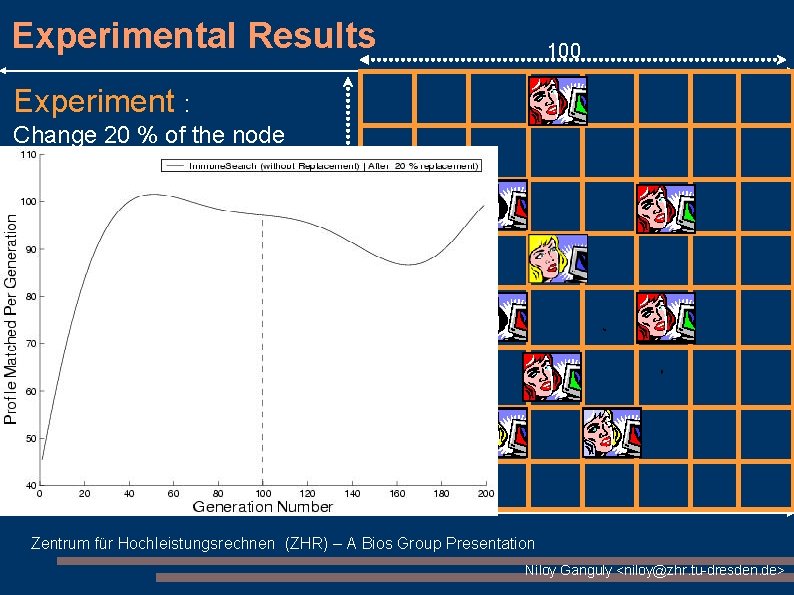
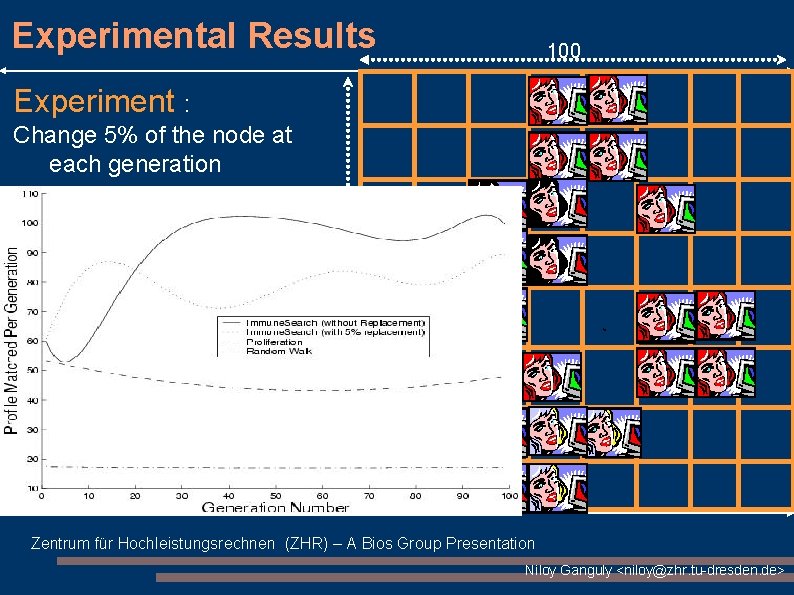
Experimental Results 100 Experiment : • • Run for 100 generation, without changing the participating nodes Each Generation 100 searches by users 100 selected randomly Efficiency • No. Of Search Items found in 50 time steps Zentrum für Hochleistungsrechnen (ZHR) – A Bios Group Presentation Niloy Ganguly <niloy@zhr. tu-dresden. de>
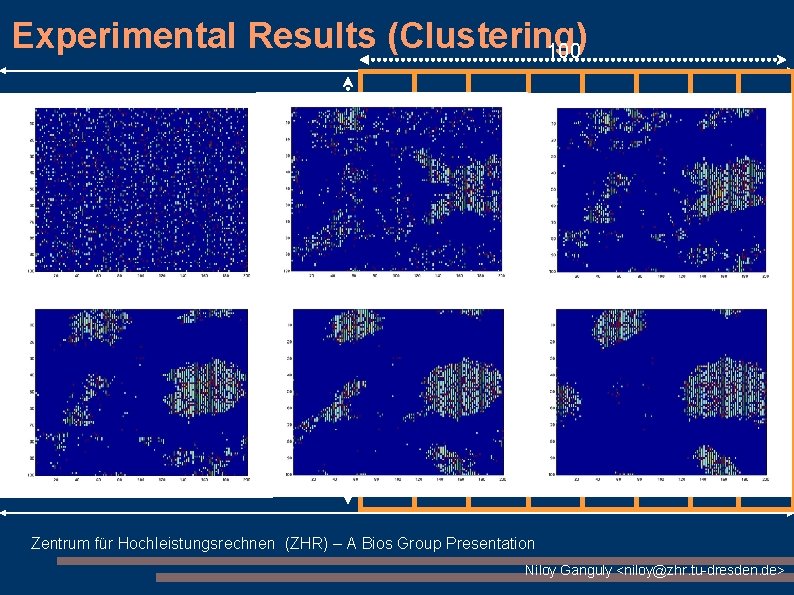
Experimental Results (Clustering) 100 Zentrum für Hochleistungsrechnen (ZHR) – A Bios Group Presentation Niloy Ganguly <niloy@zhr. tu-dresden. de>
Experimental Results 100 Experiment : Change 20 % of the node 100 Zentrum für Hochleistungsrechnen (ZHR) – A Bios Group Presentation Niloy Ganguly <niloy@zhr. tu-dresden. de>
Experimental Results 100 Experiment : Change 5% of the node at each generation 100 Zentrum für Hochleistungsrechnen (ZHR) – A Bios Group Presentation Niloy Ganguly <niloy@zhr. tu-dresden. de>
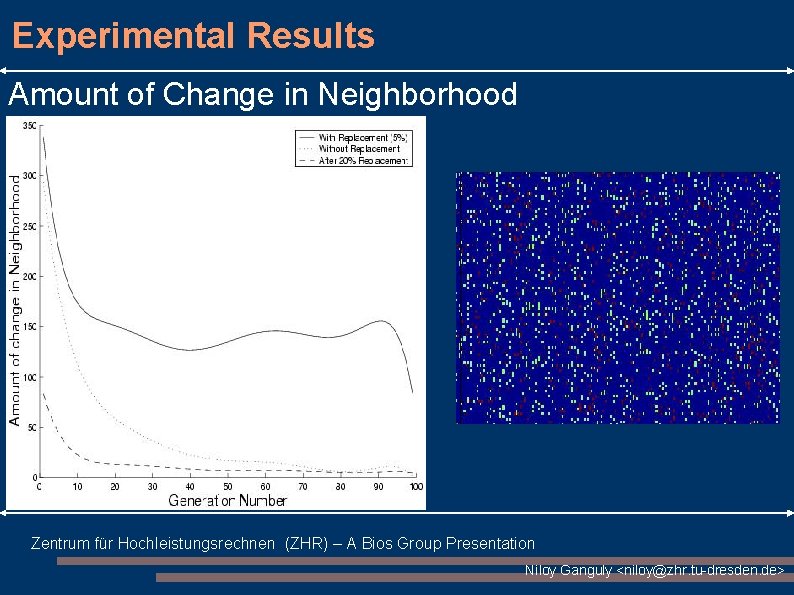
Experimental Results Amount of Change in Neighborhood Zentrum für Hochleistungsrechnen (ZHR) – A Bios Group Presentation Niloy Ganguly <niloy@zhr. tu-dresden. de>
Future Work ● ● Simulate the Results in Real Network Take into account the important concept of Network Traffic Test the algorithm with sophisticated Information Profile and Search Profile Building up mathematical framework through which the simulation results can be analytically justified Zentrum für Hochleistungsrechnen (ZHR) – A Bios Group Presentation Niloy Ganguly <niloy@zhr. tu-dresden. de>
Fragen und Antworten Zentrum für Hochleistungsrechnen (ZHR) – A Bios Group Presentation Niloy Ganguly <niloy@zhr. tu-dresden. de>