
Immune Response to Bacterial Infection Imunopathology of Sepsis
Immune Response to Bacterial Infection, Imunopathology of Sepsis Jiří Litzman
Factors influencing the extent and severity of infection • Pathogen factors • Dose • Virulence of organism • Route of entry • Host factors • • • Integrity of non-specific defences Competence of the immune system Genetic influences Previous exposure to antigen Existence of co-infection
Immune mechanisms against bacterial infections • Non-specific immunity • • • Mechanical barriers Phagocytosis Complement system Lysozyme Defensins
Immune mechanisms against bacterial infections • Specific immunity • Antibodies – • • • Opsonization, Activation of complement system, Neutralization of toxins (e. g. antiphagocytic toxins), Receptor blocade Agglutination of microbes (respiratory tract) • T-lymphocytes • Th 1 lymphocytes- protection againts intracellular pathogens • Th 2 lymphocytes – stimulation of antibody production • Th 17 lymphocytes – pro-inflamatory effect

Bacterial evasions of immune defences • Antiphagocytic machanisms: toxins, capsular polysaccharides • Inhibition of the complement system: Str. pyogenes, E. coli, N. meningitidis • Antigenic variations: Borrelia recurrentis • Proteases lysing Ig. A - Neisseria, Haemophilus • Sequestration in avascular regions- Salmonella typhi in the gall bladder and urinary tract • Intracellular parasitism
Bystander damage caused by the immune response to bacterial infection • Autoimmune diseases • Cross-reactivity of bacterial and corporal antigens rheumatic fever • Type-II hypersensitivity - autoimmune hemolytic anemia caused by Mycoplasma infection • Heat shock proteins • Superantigens (streptococcal, staphylococcal) • Immunocomplex diseases • Type IV hypersensitivity- cavitatoin in pulmonary tuberculosis

Systemic Inflammatory Response Syndrome SIRS • Systemic inflammatory response in a wide range of severe clinical situations. • Characterized by at least 2 conditions: • • Body temperature> 38 ° C or <36 ° C Heart rate> 90 / min Respiratory Frequency> 20 / min or Pa. CO 2 <32 mm. Hg Leukocyte counts> 12 000 / mm 3, <4 000 / mm 3 or> 10% of immature form of granulocytes.


Sepsis: Systemic Inflammatory Response (SIRS) with proven infectious aetiology. Severe sepsis: Sepsis associated with organ dysfunction, hypoperfusion or hypotension. Septic shock: Sepsis induced hypotension despite adequate infusion therapy with abnormalities in organ perfusion.
Sepsis 3 The Third International Consensus Definition for Sepsis and Septic Shock (2016) • Sepsis - A life-threatening organ dysfunction caused by the dysregulation of host responses to infection. • ("Severe sepsis" was omitted)
Pathological immune consequences of sepsis • Severe inflammatory response • Secondary immunosuppression
Organ dysfunction in severe sepsis • Cardiovascular system: hypotension, metabolic acidosis, rise in lactate, oliguria • Respiratory system: decrease in Pa 02, the rise of Pa. CO 2 Hematologic abnormalities: decreased platelet count, DIC, leukocytosis, leukopenia • Nerve system: coma • Renal: increased creatinine • Hepatic: increased bilirubin, ALT

Lipopolysaccharides (LPS) of G-bacteria - Endotoxins, • Are composed of lipid A (responsible for the biological activity), the cortex and the lateral polysaccharide chains. • Through the LPS-binding protein (LBP) binds to CD 14 and TLT-4 on monocytes and macrophages and activates them. • A similar mechanism activates macrophages and peptidoglycan and teichoic acid of G+ of bacteria.
Inflammatory response in sepsis • Formation of pro-inflammatory cytokines as a response to the stimulaci PAMPs (Pathogen-Associated Molecular Pattern) and DAMP (Damage Associated Molecular Pattern – alarmins). • Activation of the complement system formation of C 3 a, C 4 a. • Activation of the coagulation system, platelets. • Activation of endothelial cells leads to endothelial dysfunction with increased permeability. • NET(Neutrophil extracellular traps)osis of granulocytes
Major mediators involved in the pathophysiology of sepsis Proinflammatory: TNF-α, IL-1, IL-6, IL-8, PAF, IL-4, complement activation products Anti-inflammatory: IL-1 RA, IL-10 The main effect outside the immune system: NO (hypotension, myocardial depression)
Tumor necrosis factor-α (TNF-α) in the pathophysiology of sepsis • Produced primarily by cell of the monocyto-macrophage lineages after endotoxin stimulation, GM-CSF, IFN-g • Causes a decrease of blood pressure, leukopenia with subsequent leukocytosis. Induces the formation of IL-1, IL-6, IL-8, subsequently NO (hypotension, pulmonary hypertension), acute phase proteins. • But: Complete blockade of TNF-α production leads to high animal mortality in experimental infection. In people treated with anti-TNF-α MP for rheumatoid arthritis, there was a clinical manifestation of tuberculosis.
Interleukin-1 in the pathophysiology of sepsis Produced by monocyto-macrophage cell lineage. The inductors of production are endotoxin, TNF-α. IL-1 KO mice are resistant to the effect of endotoxin. Induces production of cytokines of an inflammatory response.
IL-6 in the pathophysiology of sepsis Produced by monocytes, macrophages, T-lymphocytes, fibroblasts, endothelial cells. It is a differentiation factor of B lymphocytes and a T lymphocyte activation factor. It acts pyrogenically, induces the formation of acute phase proteins. In some studies, IL-6 levels correlated with patients mortality.
Secondary immunodeficiency in sepsis (formerly Compensatory Anti-Inflammatory Response Syndrome-CARS) • Some patients in sepsis pass from the "hyperinflammatory" phase to a state of low immune response (immunoparalysis). • Anti-inflammatory responses include IL-4, IL-10, IL-11, IL-13. • Changes in antigen-presenting cells of low expression of HLA-DR on monocytes. • Decrease in T-cell count is due to increased apoptosis. • Lymphocytic exhaustion occurs. Th 2 predominance. • High PD 1 (Programmed Cell Death) expression on lymphocytes and its ligands (PD 1 L) on macrophages and granulocytes. • The production of proinflammatory cytokines TNF-α, IL-1, IL-6, IL-8 is reduced.
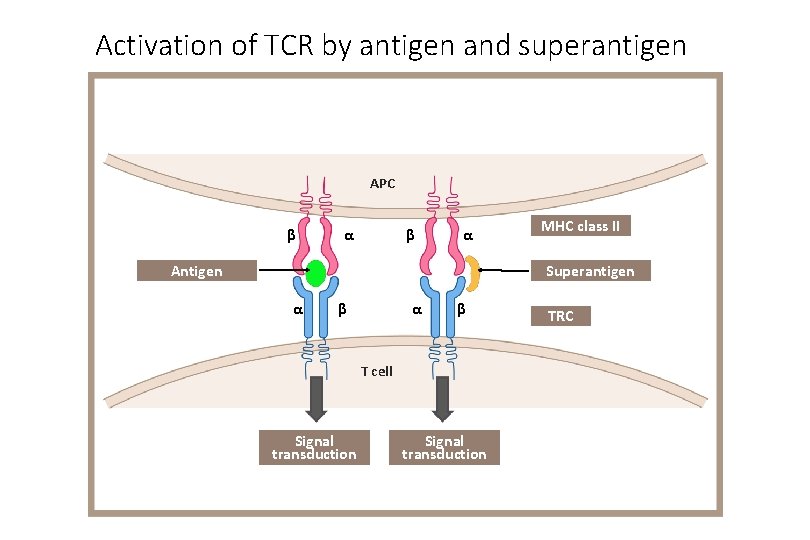
Activation of TCR by antigen and superantigen APC β α Antigen MHC class II Superantigen α β T cell Signal transduction TRC
The most important superantigens • S. aureus: Enterotoxin and toxin toxic shock syndrome • Str. pyogenes: pyrogenic (erythrogenic) toxins, M protein • Clostridium perfringens: enterotoxin • superantigens of mycoplasma, Pseudomonas, Yersinia enterocolitica, Mycobacterium tuberculosis
The toxic shock syndrome • The toxic shock syndrome can most often occur in people infected with staphylococci. • The superantigen toxic shock toxin (TSST-1 - Toxic Shock Syndrome Toxin-1) is crucial in the pathogenesis. • Massive production of cytokines in particular leads to the development of shock and multi-organ failure.
- Slides: 22